Introduction
Most CISOs and risk leaders know their risk landscape well. The harder problem is translating that knowledge into something a board can act on in under 30 minutes.
Directors are fiduciaries, not risk analysts. They need to know which risks threaten the strategy, which are under control, and what they're being asked to approve. A report that buries those answers in technical narrative fails its primary purpose: supporting a decision.
According to EY's Global Board Risk Survey, only 40% of directors were very confident they understand the greatest cyber threats facing their organization — and 60% of boards agreed that emerging risks are insufficiently addressed in current frameworks. Better reporting structure, not more pages, is what closes that gap.
This guide covers the practical mechanics of writing a report that earns board confidence:
- What directors want to see — and why most reports miss it
- What to prepare before writing a single slide
- A step-by-step structure for the report itself
- Key variables that determine whether the report drives decisions or creates confusion
- The most common mistakes that erode board trust
Key Takeaways
- A board risk report is a decision-support document, not a risk register — it connects risk to business impact and asks the board to act.
- Focus on the top five priority risks, what changed since last quarter, and where board input is needed.
- Use plain-English language, KRIs, heat maps, and trend data rather than raw threat inventories.
- Structure covers: executive summary, risk profile, mitigation status, emerging risks, and board-level recommendations.
- Reports that prioritize, contextualize, and recommend earn board trust. Reports that list everything lose it.
What Boards Actually Expect From a Risk Report
Board members are not risk specialists. They are fiduciaries who need three things from every risk report:
- Which risks threaten our strategy?
- Which are under control?
- What are we being asked to decide?
If the report makes them hunt for those answers, it isn't board-ready.
The "So What" Standard
Every risk in the report must connect to a business consequence. Vague statements like "cybersecurity threats are increasing" give the board nothing to act on. The framing Tyson Martin uses in his advisory practice is concrete and immediate: instead of "vendor security gaps," the report should say "a vendor compromise could expose customer data and trust, even if internal controls are strong."
That translation: from threat to consequence, is what makes a report actionable. The test is simple — if a director can't repeat the risk in plain English after reading the section, the communication hasn't landed.
Clarity at the risk level sets up the next structural question: what does the board actually need to do with this information?
Decide vs. Know vs. Manage
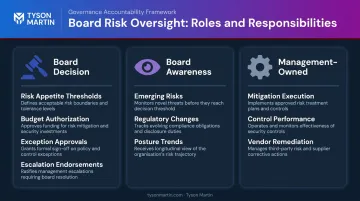
One of the most common structural errors is conflating what the board needs to decide with what management should own. The distinction matters:
- For board decision: Risk appetite thresholds, budget authorization for new controls, exception approvals, escalation policy endorsements
- For board awareness: Emerging risks, regulatory changes, posture trends
- Management-owned: Mitigation task execution, day-to-day control performance, vendor remediation
According to the NYSE Listed Company Manual, management assesses and manages risk while the board's role is to discuss policies with respect to risk assessment and risk management — not to manage individual mitigation actions. Mixing these creates unproductive meetings where directors weigh in on operational details that belong to the CISO's team.
Every item in the report should be tagged against one of those three categories. That single discipline eliminates most unproductive board risk discussions.
What to Prepare Before Writing Your Board Risk Report
Report quality depends entirely on the inputs gathered before writing begins. The core data you need:
- Updated risk register with current likelihood and impact scores
- Status of previously approved mitigation actions — what's complete, what's overdue
- Recent incidents or near-misses since the last reporting cycle
- Regulatory changes relevant to your sector and jurisdiction
Establish Your Risk Appetite Baseline
You cannot write a credible board risk report without a defined risk appetite. Boards need to see not just how risky each threat is, but whether current exposure sits within or outside the organization's stated tolerance. Without that reference point, every risk score is just a number.
Gartner reports that 42% of organizations still lack an established risk appetite statement — meaning nearly half of boards are evaluating risks against no defined baseline.
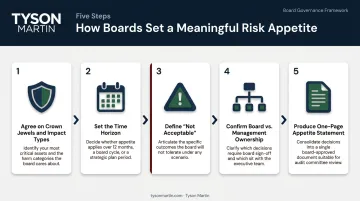
Tyson Martin's approach to establishing appetite doesn't require heavy framework implementation. A single structured workshop can draft both the risk appetite statement and an escalation model. The five-step process:
- Agree on crown jewels and impact types
- Set the time horizon
- Define what "not acceptable" looks like
- Confirm what the board owns versus management
- Produce a one-page appetite statement with an assigned owner
The output is two documents: a one-page appetite statement and a one-page escalation ladder. Both act as guardrails — they keep exposure visible against a defined threshold and give the board a clear line to hold when something escalates.
Confirm the Report's Decision Agenda
Before writing a single section, identify the 2–3 specific decisions you need from the board this cycle. Common examples:
- Approval of a new vendor security standard
- Budget authorization for additional controls
- Endorsement of updated escalation thresholds
- Risk acceptance for a known gap with a named owner and expiry date
Every section of the report should serve those decisions. If a section doesn't connect back to one of those asks, cut it or move it to an appendix.
How to Write a Risk Management Report to the Board: Step by Step
Step 1: Write the Executive Summary First
Draft the executive summary before the rest of the report — not after. This forces clarity on what actually matters.
The summary should answer three questions on one page:
- What is the current risk posture compared to last period? (improving / stable / deteriorating)
- Which risks require board attention or approval this cycle?
- Is the program moving in the right direction?
Open with the overall posture assessment, name the one or two risks driving that assessment, and close with the explicit decisions you're bringing to the board. Summaries that simply list risks fail this test: directors need orientation before they can usefully engage with detail.
NACD's 2026 Cyber Risk Oversight Toolkit recommends a two-page executive memo plus dashboard for standing cyber agenda items. That benchmark is a useful ceiling for the summary section.
Step 2: Build the Risk Profile Section
Present the top five priority risks categorized by type — strategic, financial, operational, cyber/technology, and regulatory/compliance. For each risk, include:
- A plain-English description of the threat and its business consequence
- Likelihood and impact scores
- Current mitigation status
- How exposure has changed since the last report
A heat map or risk dashboard table makes prioritization visual and scannable. NACD recommends mapping risks to business objectives and quantifying financial exposure where possible.
The label problem matters here. NACD has warned that ordinal labels like "high, medium, low" can compress a $50B risk and a $5M risk into the same category — a meaningful error when directors are allocating board attention.
Where relevant, anchor the risk profile in external benchmarks. For cyber risk specifically, IBM's 2024 Cost of a Data Breach report puts the global average breach cost at $4.88M, with the financial sector averaging $6.08M. Those figures give directors a basis for comparison that internal scoring rarely offers on its own.
Step 3: Report on Mitigation Status and Control Performance
For each priority risk, show:
- Mitigation actions underway or completed
- Named owners for each action
- Whether actions are on track, overdue, or blocked
Overdue actions with no explanation are the fastest way to lose board confidence. The board isn't just evaluating the risk landscape; they're assessing whether management is executing its commitments.
Key Risk Indicators (KRIs)
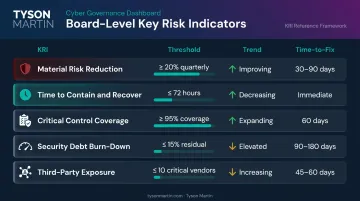
Key Risk Indicators (KRIs) belong here, not raw data. A KRI is a measurable signal showing whether a risk is moving toward or away from tolerance. Tyson Martin's standard board-level KRI set includes five metrics:
- Material risk reduction — top risk scenarios with movement over time and the next decision needed
- Time to contain and recover — time to detect, contain, and restore critical services
- Critical control coverage on highest-value systems — MFA, backup immutability, EDR, and patch SLAs on crown jewels
- Security debt burn-down — size, age, and rate of reduction for known, prioritized gaps
- Third-party exposure — percentage of critical vendors with current reviews, contract controls, and tested incident communication paths
Every KRI should show three elements: the threshold (what's acceptable), the trend (improving or worsening), and time-to-fix (how long risk stays open). A metric that can't trigger a decision is reporting. Oversight requires the threshold.
Step 4: Present Emerging Risks and Forward-Looking Analysis
Most board reports describe what happened. This section is where the report earns its value — surfacing what's building before it becomes critical. Include:
- Risks not yet critical but gaining momentum
- Relevant regulatory changes on the near-term horizon
- Sector-specific threat trends
Use scenario framing for the one or two most consequential emerging risks. For example: "If [X] materializes over the next 12 months, the estimated impact on operations and regulatory standing would be [Y]." Concrete scenarios give the board a basis for discussion without overstating uncertainty.
The data supports giving this section more weight. EY found 60% of boards agree emerging risks are insufficiently addressed in current frameworks, and 61% report lack of alignment among peers on the most material risks over the next 12 months.
Step 5: Close With Recommendations and Clear Board-Level Actions
The final section contains the decisions you need the board to make, stated explicitly. Use a structured format for each item:
- The issue
- The recommended action (with options if applicable)
- The specific decision required from the board
- The proposed timeline
Never bury action items in risk narrative. If the ask is embedded in paragraph five of a risk description, it will be missed.
Also include an update on previously approved board actions. Closing the loop from prior cycles — showing that board direction translated into execution — builds institutional trust over time. That accountability loop is what makes governance inspectable rather than performative.
Key Parameters That Determine Board Report Quality
Two reports covering identical risks can produce completely different board outcomes. These are the variables that matter:
Language and Framing
The board expects plain English. Risk framework terminology — "inherent risk score," "control effectiveness rating," "residual exposure index" — requires translation before it's useful. Frame every risk in business terms.
Tyson Martin's translation approach covers four elements: what could happen, current controls, the biggest gaps, and the plan with timelines. The test: could a director repeat the risk in plain English after reading it once?
| Plain English | Framework Jargon |
|---|---|
| "A cloud identity mistake could create silent access to sensitive systems, leading to fraud or reporting issues" | "IAM control gaps present elevated residual risk" |
Report Length and Focus
NACD recommends a two-page executive memo plus dashboard for standing cyber agenda items, with supporting detail in separate materials. Board attention is finite, and a shorter, decision-focused document consistently outperforms a comprehensive one.
Supporting detail belongs in appendices. Directors who want depth can find it there — without making it a barrier for everyone else.
Frequency and Consistency
Boards develop risk literacy through consistent exposure to the same metrics over time. Changing the format each cycle forces directors to relearn the dashboard rather than track trends — which defeats the purpose of reporting.
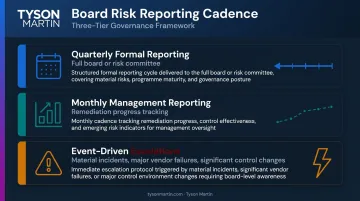
A practical cadence: quarterly formal reporting to the full board or risk committee, with monthly management reporting on remediation progress, and event-driven escalations for material incidents, major vendor failures, or significant control changes.
Common Mistakes That Undermine Board Confidence
These patterns appear frequently in board risk reports and erode director confidence:
Full register dump, no prioritization. A 40+ item register signals the risk function hasn't done its job. The board report is a curated view, not a data export — if everything is on the list, nothing stands out.
Same risks, no change narrative. Listing identical risks quarter after quarter without showing what improved, what worsened, or why signals a static program. Anchor every report in delta: what is different from last time?
Vanity metrics that hide exposure. Blocked attack counts, patch totals, and alert volume look like activity without measuring it. If a metric can't trigger a decision, it's not oversight — it's reporting theater.
Decision requests buried in risk descriptions. If the action you need from the board is in paragraph five, it will be missed. Every decision request belongs in the executive summary and again in the recommendations section.
Under-explaining cyber risk. EY found only 40% of directors were very confident they understand their organization's greatest cyber threats. Plain-language translation is the baseline for effective oversight — not a courtesy.
Frequently Asked Questions
What should a risk management report to the board include?
The core sections are: executive summary (current posture and decisions needed), risk profile with a visual dashboard, mitigation status with KRIs, emerging risks with forward-looking context, and board-level recommendations. Each section should connect risk to business impact and explicitly flag where board action is required.
How often should a risk management report be presented to the board?
Quarterly is standard, timed to scheduled board or risk committee meetings. Regulated environments and periods of elevated risk warrant more frequent updates, and material incidents should trigger an event-driven briefing regardless of the regular cycle.
How long should a board risk management report be?
The main report body should be readable in 20–30 minutes. NACD's benchmark for standing cyber items is a two-page executive memo plus dashboard. Supporting detail — control evidence, vendor assessments, full risk register extracts — belongs in appendices, not the main document.
How do you present cyber risk to a non-technical board?
Translate every technical finding into a business consequence: financial exposure, operational disruption, or regulatory liability. Pair KRIs with external benchmarks — IBM's average breach cost data or Verizon's DBIR ransomware figures — so directors understand what "elevated risk" means in dollar terms.
What is the difference between a risk report and a risk register?
A risk register is the operational database where all identified risks are tracked with owners, scores, and mitigation details. A board risk report is a curated, decision-focused document that draws from the register to surface only the highest-priority items — the ones that require board oversight, not management execution.
What are the 5 examples of risk management?
The five core practices are risk identification, risk assessment, risk mitigation, risk monitoring, and risk review. Together they form a continuous cycle: find threats, score them, respond, track indicators, and update the program based on what you learn.