The frequency and scale of attacks has outpaced most organizations' ability to respond. Attackers move faster, their tools are cheaper, and the consequences of a breach — operational, financial, reputational, and legal — compound quickly. The companies that fare better aren't necessarily the ones with the most security tools. They're the ones with clear governance structures that enable faster decisions under pressure.
This guide covers what boards and executive teams need to understand: how attacks actually disrupt operations, what the full financial cost looks like, the regulatory exposure now facing individual directors, and what resilient organizations are doing differently.
Key Takeaways
- Modern attackers can move laterally through a network in under an hour — organizations without pre-tested escalation protocols often can't contain an incident before significant damage is done
- The average cost of a data breach reached $4.88 million in 2024 — and that figure excludes downstream costs like insurance premium hikes and ongoing compliance spend
- Reputational damage routinely outlasts every other consequence — customer trust is slow to rebuild
- SEC rules now require public companies to disclose material incidents within four business days, creating direct board accountability, not just organizational accountability
- Governance structure determines recovery speed — technology alone does not
Why Cyber Risk Is Now a Board-Level Business Issue
For most of the past decade, cybersecurity lived in the IT budget. Boards received occasional updates, approved spending, and moved on. That model doesn't hold anymore.
The Allianz Risk Barometer has ranked cyber incidents as the top global business risk for multiple consecutive years. The reason is straightforward: attacks now directly affect revenue, market valuation, regulatory standing, and (increasingly) individual executive liability.
When a ransomware attack halts operations for a week, that's not an IT problem. That's a P&L problem, a customer retention problem, and potentially a disclosure obligation.
The AI Acceleration Problem
Generative AI has changed the threat equation in a way that makes past security investments less reliable. Attackers are using AI to automate phishing campaigns at scale, bypass defenses, and sharply compress the time between initial access and significant damage. The assumption that "we've invested in security, we're protected" no longer holds when the threat environment is evolving faster than most security programs can adapt.
The Governance Gap
Most mid-market and enterprise organizations have cybersecurity tools. What they're missing is the board-level oversight structure that determines how fast they can respond when something goes wrong: clear decision rights, defined escalation thresholds, and reporting that shows risk trend over time rather than a snapshot of technical metrics.
This is the gap Tyson Martin identifies most consistently when engaging new clients — boards that receive technical updates full of jargon and green/yellow/red indicators but can't answer basic governance questions:
- What could stop the business?
- What risk are we accepting?
- What decision does management actually need from us?
The sections that follow address each of these questions directly.
How Cyber Attacks Disrupt Business Operations
The Speed Problem
According to CrowdStrike's threat research, attackers can break out — moving laterally from an initial foothold to other systems — in under an hour. For leadership, that number has a specific implication: without pre-defined escalation protocols and clear decision rights, the window to contain an attack closes before the right people are even in the room.
Organizations that haven't pre-tested their incident response discover this the hard way. Who can approve shutting down a critical system? Who calls the insurer? Who speaks externally? These decisions take 20 minutes to negotiate when they haven't been made in advance — and 20 minutes is a long time when attackers are already moving.
Operational Shutdown Scenarios
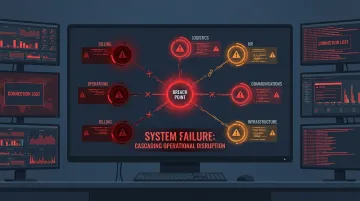
Ransomware doesn't just encrypt files. At scale, it takes down entire enterprise systems simultaneously — order processing, customer service, supply chain coordination, financial operations, all at once.
The 2024 Change Healthcare cyberattack is the clearest recent example. A single attack on a healthcare payment processing company effectively paralyzed billing and payment operations across large portions of the US healthcare system, affecting hospitals, pharmacies, and physician practices for weeks. The CDK Global attack the same year forced thousands of car dealerships to revert to manual, paper-based processes, visibly slowing US auto sales for an entire quarter.
These aren't edge cases. They're the new normal for what a single successful attack looks like at scale.
Third-Party and Credential Risks
Ransomware and direct attacks get the headlines, but two other vectors carry disproportionate board-level risk.
Supply chain exposure is harder to govern because the risk sits outside the organization. One compromised vendor can cascade into disruptions across dozens of dependent companies. Most boards have limited visibility into third-party security practices — meaning they carry risks they don't control and often don't know exist. A common gap Tyson Martin identifies: organizations lack a complete vendor inventory ranked by criticality, so boards can't assess concentration risk or identify which vendors could actually stop core business operations.
Credential theft works differently. Most breaches don't start with sophisticated malware — they start with stolen login credentials. Once an attacker holds valid credentials, they move through systems as a legitimate user. That makes detection harder and extends the window of exposure well beyond what most incident timelines assume.
The Full Financial Cost of a Cyber Incident
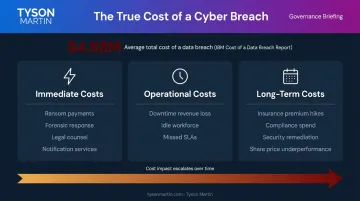
The IBM Cost of a Data Breach Report puts the average breach cost at $4.88 million — but that figure understates total impact for most organizations because it captures only the measurable, near-term costs.
Immediate Costs
These hit within days and are unavoidable once an incident is underway:
- Ransom payments (if paid)
- Emergency IT and forensic response fees
- Outside legal counsel
- Regulatory notification requirements
- Customer credit monitoring and notification services
Operational Costs
System downtime creates revenue losses that accumulate fast. Halted sales, missed SLAs, idle workforce costs, and lost customer transactions compound quickly. MGM Resorts' 2023 cyberattack resulted in a $100M+ impact in a single quarter — and that number reflects only the operational losses MGM publicly disclosed, not the full downstream costs.
Long-Term Financial Effects
The costs that boards underestimate most are the ones that persist for years:
- Cyber insurance premiums increase significantly after an incident — and in some cases, coverage becomes unavailable or excludes specific risk categories
- Compliance costs rise as regulators scrutinize affected organizations more closely
- Security architecture remediation requires sustained capital investment
- Breached companies typically see an immediate share price drop followed by continued underperformance against market benchmarks — Comparitech's analysis of breach impact on share prices documents this pattern across multiple industries and incident types
For public companies, that dynamic matters at the board level: operational losses and investor confidence erosion arrive together, before disclosure strategy is finalized — which is precisely why boards need clear escalation thresholds and pre-planned disclosure protocols, not reactive ones.
Reputational Damage and the Erosion of Stakeholder Trust
Financial losses are recoverable. Reputation is slower to rebuild.
IBM research indicates that loss of customer trust accounts for nearly 40% of breach costs — realized through customer churn, difficulty acquiring new customers, and costly trust-rebuilding campaigns that stretch over years, not months. A company can restore its systems in weeks. Convincing customers to stay after a breach is a different problem entirely.
The B2B dimension is often underestimated. Business partners, institutional clients, and vendors scrutinize the security posture of their counterparties after a publicized breach. Documented outcomes include:
- Contract reviews and stricter audit requirements imposed by partners
- Outright termination of vendor relationships
- Delayed deal cycles as prospects conduct unplanned security evaluations
- Increased insurance and indemnification demands in new agreements
These downstream effects compound losses well beyond the incident itself.
For regulated industries — financial services, healthcare, retail — the reputational exposure is amplified. Customers in these sectors expect a higher standard of data protection, media scrutiny is more intense, and customer attrition tends to be faster.
A breach at a healthcare organization or financial institution doesn't just make news — it triggers regulatory inquiries, accelerates customer defection, and forces the board into public disclosures that are difficult to walk back.
Regulatory and Legal Exposure: What Executives and Directors Must Know
SEC Disclosure Rules
The SEC's cybersecurity disclosure rules, effective for public companies, require disclosure of material cybersecurity incidents within four business days of determining materiality. They also require annual disclosures covering cybersecurity risk governance — meaning the board's oversight practices are now a matter of public record.
Directors who cannot demonstrate active, documented oversight of cyber risk now carry personal exposure that simply didn't exist five years ago. The SEC has made board accountability a public record matter.
Sector-Specific Mandates
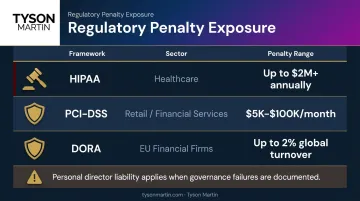
Compliance penalties vary by framework and severity:
| Framework | Who It Applies To | Penalty Range |
|---|---|---|
| HIPAA | Healthcare organizations | Up to $2M+ per violation category annually |
| PCI-DSS | Retail/financial services handling card data | $5,000–$100,000 per month for non-compliance |
| DORA | EU financial services firms | Up to 2% of global annual turnover |
Advisory work across retail and healthcare environments — including through the National Retail Federation's CISO Executive Committee — consistently shows the same pattern: organizations built for continuous readiness fare far better in audits than those chasing point-in-time compliance.
Personal Liability for Executives and Directors
The exposure is no longer limited to the organization. CISOs and senior executives are now facing personal legal accountability through SEC enforcement actions and shareholder derivative suits.
When governance failures upstream contribute to an incident's severity, those failures can become the basis for individual liability claims. The specific failures courts and regulators look for include:
- Undefined decision rights for cyber-related escalations
- Absent or undocumented escalation thresholds
- No evidence of adequate board oversight cadence
Class action lawsuits following customer data breaches have become routine. Organizations that cannot demonstrate a documented, defensible approach to cyber risk governance face materially worse legal outcomes than those with clear evidence of structured oversight and due diligence.
Building Cyber-Resilient Governance: What Boards Can Do
Resilient organizations treat cyber risk as a governance discipline. Technology acquisitions don't produce oversight capability on their own — governance structure does.
What Governance Actually Looks Like
Effective board-level cyber governance requires three structural elements that most organizations are missing:
- Clear decision rights: who approves policy exceptions, who can authorize system shutdowns, who speaks externally, who contacts the insurer
- Defined escalation thresholds: what triggers a board notification versus a management-level response, tied to business impact rather than technical severity
- Stable reporting dashboards: trend indicators that show whether risk is improving or worsening, not a volume of technical metrics directors can't act on
Tyson Martin's board advisory work closes exactly this gap. Rather than technical dashboards, he delivers 8–12 metrics mapped to approved risk appetite thresholds across three layers: exposure, trend, and decision points. The board packet runs one to two pages and answers three questions: Are we safe enough? Are we improving fast enough? Are we ready for a bad day?
That structure also reflects a deliberate independence from the in-house CISO and security vendors, giving boards unfiltered risk perspectives that internal politics and vendor relationships can't shape.
The 90-Day Planning Model
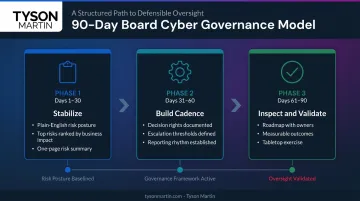
Boards that require clear 90-day plans with named owners, measurable outcomes, and defined accountability structures are far better positioned to assess whether security investments are working. The model follows a phased structure:
- Days 1–30: Stabilize — plain-English risk posture, top risks ranked by business impact, one-page risk summary
- Days 31–60: Build cadence — decision rights documented, escalation thresholds defined, reporting rhythm established
- Days 61–90: Inspect and validate — roadmap with owners, measurable outcomes, tabletop exercise to test incident response under realistic conditions
When escalation rules are pre-approved and decision rights are clear, an organization spends incident time solving the problem rather than negotiating authority. That speed is what governance is actually for.
Risk Reduction Without Strategic Paralysis
Treating every cyber concern as a reason to halt operations creates its own risk: strategic paralysis. Effective cyber governance enables faster, more confident decision-making. The goal is reducing risk to a level the business has consciously accepted, with clear visibility into what's been accepted and why — and the structures in place to act when that threshold is crossed.
Frequently Asked Questions
How would a business be impacted by a cyber attack?
A cyber attack disrupts operations, drives financial losses across immediate and long-term timelines, damages reputation with customers and partners, and triggers regulatory penalties. For organizations without a tested incident response plan, the combined effect can threaten long-term business viability.
What are the most common types of cyber risks facing businesses today?
The primary threat vectors are ransomware, phishing and social engineering, credential theft, supply chain attacks, and cloud misconfigurations. AI is accelerating the scale and sophistication of each — making legacy security assumptions less reliable than they were even two years ago.
How quickly can a cyberattack disrupt business operations?
Modern attackers can move laterally within a network in under an hour. Organizations without pre-tested incident response and escalation protocols often can't contain an attack before significant damage is done — because critical decisions are still being negotiated when the window to act has already closed.
What is the board's responsibility when it comes to cyber risk?
Boards are responsible for oversight, not operational management. That means ensuring management has an adequate program, that material risks are reported clearly and consistently, and that the organization meets its regulatory disclosure obligations under SEC rules and applicable sector mandates.
How does cyber risk affect a company's reputation and stock price?
Breaches typically cause an immediate stock price drop and continued market underperformance against benchmarks. Customer trust erosion and partner relationship strain compound the effect — and data shows these effects persist for years beyond the initial incident.
What should a business do immediately after experiencing a cyber incident?
Activate the incident response plan and initiate containment. Then engage outside counsel and begin regulatory notification within required timeframes. Organizations with pre-established decision rights and escalation thresholds execute these steps faster — and with less compounding damage — than those improvising under pressure.