
Introduction
Most organizations have something in place — a firewall, an endpoint tool, maybe a recent penetration test, perhaps a vendor assessment. What they rarely have is a structured action plan that's been stress-tested, communicated across leadership, and assigned to named owners. That gap between having controls and having a plan is exactly where real risk lives.
This guide is written for boards, executives, CEOs, COOs, and risk leaders who are accountable for cyber outcomes but don't need to become technical experts to fulfill that accountability. This is a governance and execution guide — not a how-to for your security team.
The five steps below move from risk awareness through executable, board-ready action:
- Conduct a risk assessment and map your critical assets
- Prioritize risks by business impact, not technical severity
- Establish decision rights, escalation thresholds, and accountability
- Implement threat detection and incident response protocols
- Build a 90-day execution plan with owners and measurable outcomes
Key Takeaways
- Cyber incidents disrupt revenue, regulatory standing, and M&A value — the board owns this risk, not just IT
- A documented risk register with named owners is the foundation every plan needs
- Prioritization must be driven by business impact, not CVE scores alone
- Decision rights and escalation thresholds must be documented before an incident occurs
- A 90-day execution plan converts strategy into inspectable, measurable progress
Why Cybersecurity Action Planning Is a Board-Level Responsibility
Cyber incidents don't stay in the server room. A ransomware event can halt billing. A vendor breach triggers customer churn. A poorly handled disclosure affects how investors value the company.
According to IBM's 2025 Cost of a Data Breach Report, the global average cost of a data breach is $4.44 million — and that figure doesn't capture operational downtime, regulatory penalties, or the longer-term erosion of customer trust.
Ownership vs. Execution
There's a critical distinction boards often miss: owning cybersecurity risk is different from executing security controls. Execution belongs to the CISO and security team. Ownership belongs to the entire leadership structure — board included.
When boards treat cyber as a delegated IT function, escalation breaks down when it's needed most. Regulators, insurers, and auditors have caught up to this reality.
What Regulators Now Expect
The governance bar has risen sharply — and the requirements are now explicit:
- SEC cybersecurity rules (adopted July 2023) require public companies to disclose material incidents on Form 8-K within four business days of determining materiality, and to describe board oversight of cyber risk in annual Form 10-K filings
- NIST CSF 2.0 (released February 2024) added a new "Govern" function — placing organizational accountability, decision rights, and risk oversight at the center of the framework alongside Identify, Protect, Detect, Respond, and Recover
- EY's 2025 research found that 96% of Fortune 100 companies now disclose at least one board-level committee charged with cybersecurity oversight, up from 81% in 2019 — a signal that the market now treats board-level accountability as standard practice, not competitive differentiation
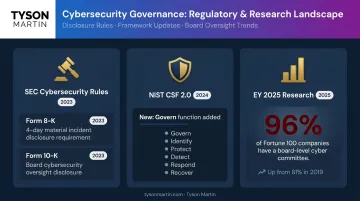
The practical implication: boards that can't describe how they oversee cyber risk — not just that they do — are exposed to regulatory scrutiny, insurer pushback, and investor questions that won't wait for the next quarterly meeting.
Step 1: Conduct a Risk Assessment and Map Your Critical Assets
A cybersecurity action plan has to start with knowing what you're protecting — and most organizations overestimate how well they know this.
Build Your Asset Inventory
The asset inventory process involves categorizing every digital and physical asset by three factors:
- Role in operations — is this system critical to revenue generation or customer delivery?
- Data sensitivity — does it hold regulated, confidential, or high-value information?
- Impact if compromised — what breaks, and how fast, if this system goes down or is exposed?
CIS Control 1 defines this as actively managing, inventorying, tracking, and correcting all enterprise assets — whether connected physically, virtually, remotely, or in the cloud. NIST CSF 2.0's Identify function covers the same ground: hardware, software, data, facilities, services, and people, assessed by relative importance.
Assess Threats and Score Risks
Once assets are mapped, the next step is identifying which threats are actually relevant to your organization. Ransomware, phishing, insider risk, and third-party compromise each carry different weight depending on your industry, size, and how much of your environment is exposed.
Risk scoring evaluates each identified risk across two dimensions:
- Likelihood — how probable is exploitation given your current controls and threat environment?
- Business impact — what are the financial, operational, regulatory, or reputational consequences?
This scoring becomes the foundation for prioritization in Step 2.
Don't Underestimate Third-Party Exposure
Organizations consistently underestimate vendor and partner risk. The Verizon 2024 DBIR found that 15% of breaches involved a third party — a 68% increase from the prior year. Third-party exposure must be included in asset mapping from the start, not treated as an afterthought.
The vendor inventory should capture: vendor name, business owner, access type, data categories touched, integrations, and any known subcontractors.
The Output: A Documented Risk Register
Step 1 ends with a documented risk register — not a presentation, not a shared mental model, but a working accountability document with:
- Risk statement in plain business language
- Likelihood and impact scores
- Key controls currently in place
- Residual risk level
- Named owner (a person, not a team)
- Next action and deadline
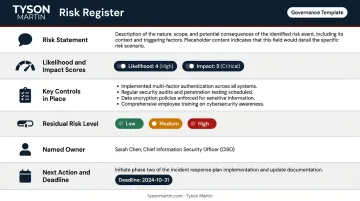
A risk register without a named owner is just a list. Named ownership is what converts it into a live management tool.
Step 2: Prioritize Risks by Business Impact, Not Just Technical Severity
Prioritization in cybersecurity means directing limited resources toward what poses the greatest actual threat to the organization — not just what's loudest or most recently flagged.
Three Levels of Prioritization
Most action plans operate across three distinct layers:
| Level | Focus | Examples |
|---|---|---|
| Strategic | Multi-year investment, policy direction | Major platform decisions, risk appetite |
| Operational | Active systems, live vulnerabilities | Patch cycles, vendor contract terms |
| Tactical | Day-to-day triage, immediate response | Alert handling, access reviews |
Most organizations only address the tactical layer. That leaves strategic and operational decisions unmade — or delegated by default to whoever is closest to the problem, not whoever owns the risk.
Use a Prioritization Matrix
A 2×2 or 3×3 grid mapping impact (low to high) against likelihood (low to high) helps categorize risk quickly:
- High impact + high likelihood → Immediate action required
- High impact + low likelihood → Planned mitigation with owner and deadline
- Low impact + high likelihood → Monitor and address systematically
- Low impact + low likelihood → Accept and document
Business Context Overrides Technical Scores
The matrix tells you where to look — business context tells you what actually matters. Technical CVE severity scores are a starting point, not a decision. A critical vulnerability on an air-gapped, non-production system may rank far below a medium-severity exposure on a customer-facing payment platform.
CISA's Stakeholder-Specific Vulnerability Categorization (SSVC) methodology formalizes this logic: prioritize remediation based on the impact exploitation would have on your organization, not on universal severity rankings.
Beyond technical scores, prioritization decisions should factor in:
- Cost of inaction versus cost of remediation
- Current control effectiveness
- Resource constraints and operational realities
- Actual attack paths, not just theoretical vulnerabilities
Step 3: Establish Decision Rights, Escalation Thresholds, and Accountability
Well-prioritized risks go unaddressed when no one knows who has authority to act. Decision rights answer three questions: who decides, at what threshold, and with what information.
Define Escalation Thresholds
Escalation thresholds are specific, pre-agreed criteria that determine when a security event becomes a board-level issue versus a management-level issue. A practical four-level structure:
- Level 1 (Management): Routine events with no business impact — blocked phishing, normal patching
- Level 2 (Executive): Confirmed intrusions with no data loss, vendor incidents on non-critical services
- Level 3 (Board Chair/Risk Committee): Confirmed data exposure, ransomware affecting operations, regulatory inquiries
- Level 4 (Full Board): Extended revenue system outages, confirmed breach of regulated data, public disclosure requirements
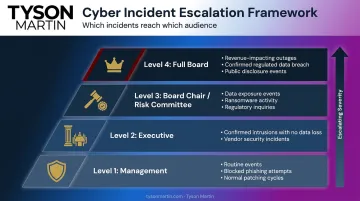
These thresholds must be documented and tested before an incident occurs. Defining "material" during an active crisis is far too late.
Assign Named Owners
Each identified risk and corresponding control needs a named individual as owner — not a team, not a department. Shared ownership in a crisis means no ownership.
NIST CSF 2.0's Govern function is direct on this point: organizational leadership owns cybersecurity risk, and roles, responsibilities, and authorities must be documented, communicated, and enforced — not assumed.
Governance Gaps in Transition
Organizations going through leadership changes, post-M&A integration, or post-incident recovery are particularly exposed to decision-rights gaps. The most common patterns:
- Security "sits in IT" with no authority to enforce policy with other departments
- Hard decisions bounce between leaders without resolution
- Exceptions pile up because rejecting them feels political
- Nobody can confidently approve emergency spend during an active incident
Interim CISO support addresses these gaps directly. In an interim CISO engagement, the first 30 days focus on one deliverable: a documented decision-rights framework covering who accepts risk, who approves exceptions, who has shutdown authority, and what triggers board notification.
That documentation exists before the next incident tests the system — not during it.
Step 4: Implement Threat Detection and Incident Response Protocols
An untested incident response plan will fail the moment pressure hits. Testing isn't a checkbox — it's how you find out whether your governance holds when it actually counts.
Core Components of Incident Response
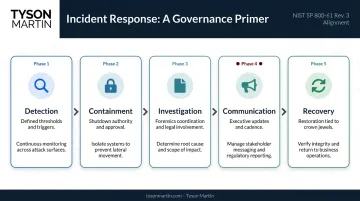
NIST SP 800-61 Rev. 3 (published April 2025) aligns incident response with CSF 2.0's core functions. Each phase needs pre-assigned roles and documented procedures:
- Detection — defined thresholds for what triggers a response, not just tool alerts
- Containment — who has shutdown authority and what does that approval require?
- Investigation — who coordinates forensics, and when does outside counsel get involved?
- Communication — a single source of truth for executive updates, with agreed cadences
- Recovery — restoration priorities tied to crown jewels and business impact
IBM's research shows that organizations with a formal incident response plan reduce breach costs by an average of $473,706 compared to those without one.
What Boards Own vs. What They Delegate
Boards should explicitly own:
- Setting expectations for readiness testing and recovery time goals
- Approving funding that matches the stated risk appetite
- Overseeing disclosure posture and approving exceptional actions (ransom posture, major shutdowns, public risk statements)
Boards should not direct engineers on containment steps or freelance external communications during live response. That's management's domain.
Run Tabletop Exercises
Tabletop exercises are decision drills, not technical exercises. Effective exercises pull in executives and board members — CEO, CISO, CIO, legal, communications, and risk committee — and rotate through scenarios that force real tradeoffs. CISA offers over 100 customizable Tabletop Exercise Packages at no cost.
- Ransomware with partial backups
- Third-party outage stopping revenue
- Data exfiltration with extortion demand
- Insider misuse tied to a sensitive role
The governance gaps these exercises consistently surface: unclear who can declare an incident, confusion over who talks to customers, and no pre-agreed process for outside counsel engagement. Each exercise ends with a short action list — owner, due date, and consequence if it slips.
Review and update plans at least annually — and immediately after any material change to systems, leadership, or the threat landscape. A plan that reflects last year's org chart and last year's vendors isn't ready for this year's incident.
Step 5: Build a 90-Day Execution Plan with Owners and Measurable Outcomes
Execution is what separates a cybersecurity action plan from a filing cabinet document. Strategy that sits in SharePoint doesn't reduce risk — owners, dates, and measurable outcomes do.
The 90-Day Structure
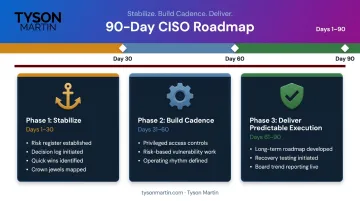
The 90-day execution plan converts risk priorities into a near-term roadmap with three phases:
Days 1–30: Stabilize
- Complete rapid discovery and publish the one-page risk register
- Establish a decision log (what was chosen, deferred, or accepted)
- Address quick wins: privileged access cleanup, MFA coverage, backup integrity
- Assign crown jewels mapping tied to business services
Days 31–60: Build Cadence
- Tighten privileged access and establish vendor risk tiering
- Shift vulnerability work from volume-based to risk-based
- Stand up a security operating rhythm: weekly check-ins, monthly risk reviews
Days 61–90: Deliver Predictable Execution
- Complete a longer-term roadmap with sequencing, cost ranges, and dependencies
- Test recovery for critical systems against stated goals
- Deliver stable trend reporting to leadership and board
What Measurable Outcomes Look Like
Vague goals like "improve security posture" aren't measurable. Specific outcomes are:
- MFA coverage on all privileged accounts — target date and named owner
- Critical patch SLA completion rate on crown jewel systems
- EDR coverage percentage on endpoints that can reach sensitive data
- Mean time to detect and contain, tracked by severity band
- Tabletop exercise completed with leadership before Q3
NIST's measurement guidance is clear: metrics should support technical and high-level decision-making. Every metric needs a target, a trend, and a trigger — so that "red" means something besides panic.
The Board-Facing Dashboard
Those measurable outcomes feed directly into what the board actually sees. Tyson Martin's approach to board reporting is built around trend, not trivia: 8–12 total metrics shown consistently over time, with trend arrows (improving, stable, worsening) and short explanations rather than raw numbers.
The dashboard surfaces only what requires board action — major funding tradeoffs, exceptions past their deadline, material risk threshold crossings. Management handles the operational layer; the board engages on decisions only they can make.
PwC's guidance on cyber reporting to boards reinforces the same principle: standardized metrics tied to business outcomes build board confidence more effectively than technical activity reports.
Given that Gartner found 90% of non-executive directors lack confidence in the value of their organization's cybersecurity investments, board reporting format is where trust is built or lost — and that makes it a first-order concern.
Frequently Asked Questions
What is prioritization in cybersecurity?
Prioritization means ranking identified risks by their potential business impact and likelihood of exploitation so limited security resources go where they matter most — not toward every vulnerability equally. Technical severity scores are a starting point, not the final word.
What should a cybersecurity action plan include?
A complete plan covers five areas: a risk assessment and asset inventory, a risk prioritization framework, a governance and decision rights structure, incident response protocols, and a time-bound execution roadmap with named owners and measurable outcomes.
How often should a cybersecurity action plan be reviewed and updated?
At minimum annually. It should also be updated after material changes — new technology adoption, leadership transitions, M&A activity, regulatory shifts, or a significant security incident. Risk factors evolve; the plan needs to keep pace.
What is the difference between a cybersecurity action plan and an incident response plan?
A cybersecurity action plan is the broader strategic and governance framework for managing cyber risk on an ongoing basis. An incident response plan is a specific subset that defines what to do when a security event occurs.
How do you get board buy-in for a cybersecurity action plan?
Frame cybersecurity in business terms: revenue risk, regulatory exposure, operational continuity. Present a stable view of risk posture with clear decisions the board needs to make versus items delegated to management. Directors engage when they see choices, not just status reports.
What frameworks should guide a cybersecurity action plan?
NIST CSF 2.0 is the most widely adopted starting point, built around six functions: Govern, Identify, Protect, Detect, Respond, and Recover. Regulated industries layer on sector-specific requirements — HIPAA, PCI DSS, or SEC cybersecurity disclosure rules depending on the industry.