Introduction
Most boards approve compliance programs on paper without being able to describe what the framework actually does — or how to tell whether it's working. That gap doesn't stay invisible. It surfaces during regulatory reviews, post-incident investigations, and audits, where the question shifts from "do you have a compliance program?" to "can you show us how it functions?"
The cost of that ambiguity is real. A 2017 Ponemon Institute study found the average cost of non-compliance was $14.82 million — nearly three times the $5.47 million average cost of maintaining a compliance program. The ratio hasn't improved.
Understanding the framework behind your compliance program is how you close that gap. This guide covers what a compliance risk management framework is, its four core components, how the process works step by step, how major frameworks compare, and what meaningful board-level oversight actually looks like.
Key Takeaways
- A compliance risk management framework is a documented system for identifying, assessing, mitigating, and monitoring regulatory and policy risks — continuously, not once a year.
- It turns legal obligations into inspectable, executable priorities with clear ownership at every level.
- Four components must all function: governance and oversight, risk assessment, internal controls, and monitoring and reporting.
- NIST, COSO, and ISO 31000 each emphasize different things; most organizations adapt one to their context.
- Boards should demand a current risk register with named owners, pre-agreed escalation thresholds, and trend-based dashboards rather than raw activity counts.
What Is a Compliance Risk Management Framework?
A compliance risk management framework is the structured, documented system an organization uses to identify regulatory obligations, evaluate the risks of failing to meet them, implement controls, and continuously monitor whether those controls work. It is not a checklist, a policy manual, or a one-time audit exercise.
A checklist tells you what to do. A framework tells you whether you're doing it, whether it's working, and what to do when it stops working.
Compliance Risk vs. Enterprise Risk
Compliance risk management focuses specifically on laws, regulations, and internal policies. Enterprise risk management (ERM) covers the full spectrum — strategic, financial, operational, and compliance risks together. Compliance risk is a subset of ERM, not a replacement for it. Organizations that conflate the two end up with compliance programs that lack strategic context, or ERM programs that treat regulatory exposure as an afterthought.
The Three Lines of Defense
The IIA's Three Lines Model (updated September 2024) defines how accountability flows in practice:
- First line — Business units own and manage their risks day-to-day
- Second line — Compliance and risk management functions monitor independently and provide support
- Third line — Internal audit validates that the whole system functions as designed
- Board — Sits above all three, setting risk appetite and holding the system accountable
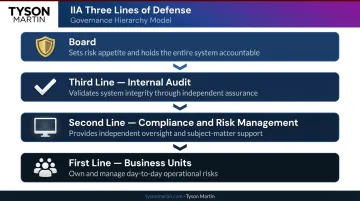
This structure only works when all three lines are active. When compliance becomes the second line's problem alone, the first line stops owning its risks — and the whole model collapses.
A Framework Is a Living System
That accountability structure only holds if the framework underneath it stays current. The DOJ's Evaluation of Corporate Compliance Programs (updated September 2024) is explicit: one hallmark of an effective compliance program is its capacity to improve and evolve. A framework built once and shelved provides false assurance. It must adapt when regulations change, when the business enters new markets, undergoes M&A activity, or experiences a significant incident.
LRN's 2024 Ethics & Compliance Program Effectiveness Report surveyed 1,415 compliance professionals and found 69% faced new or unexpected compliance risks in the prior 12 months. At that pace, a framework that isn't designed to evolve will be out of date before the next annual review.
Key Components of a Compliance Risk Management Framework
Governance and Oversight
Governance is the foundation. Without it, the other components have no authority, no budget, and no accountability.
Effective governance means:
- The board sets risk appetite, receives independent compliance reporting, and holds management accountable
- Senior management operationalizes the program and allocates resources
- The Chief Compliance Officer (or equivalent , including a fractional CISO or board advisor in organizations building this function) manages day-to-day execution with direct access to the board or audit committee, bypassing operational management when necessary
Governance also requires a code of conduct, defined consequences for violations, and a reporting mechanism that works under pressure, not just in calm conditions. The DOJ's 2024 ECCP asks specifically whether compliance personnel have adequate authority, resources, autonomy, and board access. Organizations that cannot answer that question clearly have built a compliance activity, not a compliance framework — and regulators know the difference.
Risk Assessment
The risk assessment is the engine. It maps which regulations apply, evaluates the likelihood and impact of non-compliance in each area, and produces a prioritized risk register that drives resource allocation.
A functional risk register includes:
- The specific obligation or exposure
- Likelihood of a gap occurring
- Potential impact (financial penalty, operational disruption, legal liability, reputational harm)
- Current controls in place
- Residual risk after controls
- Named owner and review date
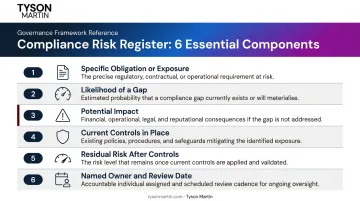
The register is a living document, updated when new regulations are enacted, business changes occur, or monitoring surfaces emerging threats.
Internal Controls and Procedures
Internal controls are the practical measures that reduce identified risks to acceptable levels. Common controls include:
- Access controls and encryption standards for data protection
- Mandatory training programs to close human-error exposure
- Transaction monitoring and documented approval workflows for financial and operational risk
Controls must be matched to risk severity, not applied uniformly. Over-controlling low-risk areas wastes resources. Under-controlling high-risk areas creates the exact exposure the framework is designed to prevent.
Monitoring, Reporting, and Continuous Improvement
Ongoing monitoring and periodic auditing serve different purposes:
| Function | Frequency | Purpose |
|---|---|---|
| Monitoring | Continuous | Detect emerging issues through KRIs, alerts, dashboards |
| Internal audit | Periodic | Validate that the whole system functions as designed |
| External assessment | Periodic | Independent validation of overall compliance posture |
Board reporting should emphasize trends over time — whether risk posture is improving, stable, or deteriorating, and why. A dashboard that shows activity counts (trainings completed, audits conducted) without showing trajectory gives leadership nothing actionable.
The Four-Step Compliance Risk Management Process
Step 1 — Identify
Build a comprehensive inventory of all applicable laws, regulations, industry standards, and internal policies. Map them to specific business units, processes, and systems.
This step is often incomplete on first attempt. In regulated industries — financial services, healthcare, retail — rule sets change frequently, and obligation mapping requires regular revisitation. A framework that starts with an outdated obligation inventory will misprioritize everything downstream.
Step 2 — Assess
Evaluate each identified compliance obligation along two dimensions:
- Likelihood — How probable is a gap?
- Impact — What are the consequences if one occurs?
The output is a risk ranking that lets the organization focus limited resources on the highest-exposure areas first. Low-likelihood, low-impact obligations don't warrant the same investment as high-likelihood, high-impact ones.
Step 3 — Mitigate
Select the appropriate response for each prioritized risk. The four options:
- Eliminate : Change the activity that creates the risk
- Reduce : Implement controls that lower likelihood or impact
- Transfer : Use insurance or contractual protections to shift exposure
- Accept : Document the decision with board awareness and defined review date
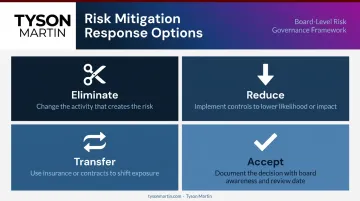
Every mitigation plan needs an owner, a deadline, and a measurable outcome. Without all three, it's an intention — not a plan anyone can be held to.
Step 4 — Monitor and Report
Continuous monitoring keeps the framework honest. Key risk indicators (KRIs), compliance dashboards, whistleblower channels, internal audits, and external assessments all feed into an ongoing picture of whether controls are working.
That picture must reach leadership in plain language that drives decisions, not just documents activity. Executives should be able to answer four questions at any point:
- What are the three highest compliance risks right now?
- What mitigation actions are underway?
- Who owns them?
- What does success look like, and by when?
Organizations in transition (new leadership, post-M&A, post-incident) often need outside expertise to get this structure in place quickly. A fractional CISO or board-level advisor with governance experience can move the timeline from months to weeks.
Tyson Martin's 90-day engagement is designed for exactly this situation: a ranked risk register, named owners, documented decisions, and a board-ready dashboard within 30 days — with full governance cadence established by day 90.
Compliance Frameworks Compared: NIST, COSO, and ISO 31000
No single framework fits every organization. The right choice depends on regulatory environment, industry, size, and governance maturity.
| Framework | Primary Focus | Structure | Best For |
|---|---|---|---|
| NIST CSF 2.0 (released Feb 2024) | Cybersecurity risk outcomes | Govern, Identify, Protect, Detect, Respond, Recover | All sectors managing cyber risk |
| NIST SP 800-53 Rev. 5 | Security & privacy controls catalog | Control families (Access Control, Risk Assessment, etc.) | Federal systems and regulated data environments |
| NIST SP 800-37 Rev. 2 | Information system risk lifecycle | Prepare, Categorize, Select, Implement, Assess, Authorize, Monitor | Technical RMF evidence for regulated systems |
| COSO (2013) | Internal financial controls | Control Environment, Risk Assessment, Control Activities, Information & Communication, Monitoring | Publicly traded companies under SOX |
| ISO 31000:2018 | Risk management principles | Principles, Framework, Process | Any organization, any sector, any size |
NIST is the go-to for technology and cybersecurity compliance controls. The CSF 2.0 added a Govern function, extending its reach into board-level oversight. SP 800-37 provides a lifecycle approach specifically for information systems.
Internal financial controls and fraud deterrence are where COSO dominates. The SEC's SOX ICFR rules recognize COSO as a suitable framework, making it the practical standard for public companies assessing internal controls over financial reporting.
ISO 31000 is the most flexible. It's principle-based, industry-agnostic, and adaptable to any organizational size.
Many organizations build hybrid models that draw from all three:
- COSO for internal financial control rigor
- ISO 31000 for broader strategic governance structure
- NIST where cybersecurity or privacy controls are required
What Boards and Executives Should Demand
Boards are not passive recipients of compliance reports. Governance requires them to demand specific, inspectable outputs.
Three things every board should be able to produce on demand:
- A current risk register with risks ranked by severity and ownership assigned
- Pre-agreed escalation thresholds — defined before pressure hits, not negotiated during an incident
- A trend-based dashboard showing whether risk posture is improving, stable, or deteriorating over time
Organizations that cannot produce all three have a compliance function, not a compliance framework.
What Good Board Reporting Looks Like
Effective compliance dashboards include:
- Top material risk scenarios with movement over time and the specific decision needed
- Control coverage on high-priority assets with exception counts
- Time-to-detect and time-to-contain metrics for significant events
- Third-party risk exposure with vendor review status
- Open decisions — funding approvals, risk acceptances, policy exceptions — with owners and due dates
The DOJ's 2024 ECCP asks explicitly what information boards examined in exercising oversight. A board that receives activity counts without risk trajectory cannot answer that question credibly.
Independent Validation
Dashboard quality only matters if the underlying controls have been independently tested. Internal audits confirm that controls function as designed — but they cannot provide the independent perspective regulators and stakeholders require. Boards should insist on periodic external assessments: structured reviews conducted by advisors without operational skin in the game. LRN's 2024 research found that 83% of high-impact compliance programs reported stronger board oversight and expertise than lower-performing programs.
Common Pitfalls That Undermine Compliance Risk Frameworks
The Static Document Failure
Frameworks built once and shelved are non-functional. Compliance posture changes constantly — new regulations, system changes, business model shifts, and emerging threats all create new exposure. The DOJ asks whether periodic reviews led to updates in policies, procedures, and controls. A framework that hasn't been touched since last year's audit cannot answer that credibly.
The "Compliance as a Department" Problem
When compliance is one team's responsibility, first-line business units stop managing their own risks. Controls get inconsistently applied. The compliance function becomes a bottleneck rather than a monitor.
Effective frameworks distribute compliance ownership across the organization:
- Engineering teams own secure coding practices
- Marketing reviews campaigns for privacy and data accuracy
- Operations manages controls relevant to their workflows
Compliance becomes part of how work gets done — not a review that happens afterward. When business unit leaders don't own their risks, no compliance team is large enough to compensate.
The Reporting Quality Problem
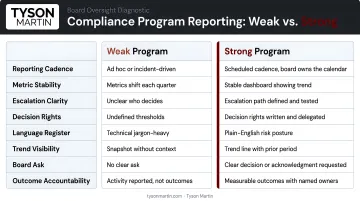
Dashboards that show activity metrics — number of trainings completed, audits conducted, policies reviewed — without showing risk trajectory fail their audience. The DOJ asks whether organizations collect, track, analyze, and use compliance data to detect misconduct and improve the program. Activity counts don't satisfy that standard.
LRN's 2024 research found that high-performing compliance programs were 2.1x more likely to use data from a variety of sources to guide program focus and development. That gap shows up in concrete reporting differences:
- Weak programs track training completions, audit counts, and policy review dates
- Strong programs track risk trajectory, repeat violation rates, and control failure trends
- Regulators look for evidence that data actually changed decisions — not just that data was collected
Frequently Asked Questions
What are the steps of the risk management process?
The four core steps are: identify applicable obligations, assess each by likelihood and impact, mitigate through controls and documented response plans, and monitor continuously. Monitoring feeds back into identification and assessment as conditions change, making this a continuous cycle rather than a one-time sequence.
What are the key components of a compliance risk framework?
The four essential components are governance and oversight structure, a risk assessment process, internal controls and procedures, and ongoing monitoring and reporting. All four must function together. A strong risk assessment process paired with weak monitoring still produces dangerous gaps.
What is a risk-based compliance framework?
A risk-based approach prioritizes compliance resources and controls according to the severity and likelihood of identified risks. It directs effort where exposure is highest rather than treating every requirement equally — the only practical approach at scale.
What is a risk and compliance framework?
The term is often used interchangeably with compliance risk management framework, but can also describe a broader structure that integrates enterprise risk management and regulatory compliance under a single governance model. The distinction is organizational. The components and processes are largely the same.
How does ISO 31000 compare to NIST SP 800-37?
ISO 31000 is principle-based and industry-agnostic — applicable to any organization managing any type of risk. NIST SP 800-37 is prescriptive and specific to managing security and privacy risks across information systems, with a defined lifecycle (Prepare through Monitor). Organizations in regulated industries often use NIST for technical controls and ISO 31000 for the broader governance structure.
Who is responsible for the compliance risk management framework?
Ultimate accountability rests with the board and senior leadership. Operational responsibility sits with the Chief Compliance Officer or equivalent executive. Day-to-day execution is shared across all three lines of defense. When compliance operates as a single department's job, what exists is a compliance function. Not a framework.