Introduction
Most organizations treat compliance monitoring like a calendar event. An annual audit here, a policy review there, and a checkbox at the end. The problem surfaces when a regulator asks how a control failure went undetected for eight months, or when the board asks whether the compliance program actually works — not just whether activities were completed.
That gap between activity and effectiveness is where enforcement actions originate. In 2023, the SEC fined Activision Blizzard $35 million after the company failed to maintain disclosure controls that would have surfaced employee misconduct complaints to decision-makers. The monitoring infrastructure existed. The right data never reached the right people.
This guide walks through a practical framework for designing a risk-based compliance monitoring plan: how to tier risks and prioritize where monitoring effort goes, how to set monitoring cadences that match actual exposure, and how to produce reporting that boards can act on — not just review.
Key Takeaways
- Risk-based compliance monitoring focuses resources on the highest-impact obligations, not every requirement equally.
- A strong plan requires four elements: risk assessment, prioritized controls, clear ownership with escalation thresholds, and continuous reporting.
- Without risk scoring, monitoring generates documentation — rarely the decisions that matter.
- Boards need trend and posture, not data dumps — design the plan backward from that output requirement.
What Is Risk-Based Compliance Monitoring?
Risk-based compliance monitoring is the ongoing process of evaluating whether an organization's operations, controls, and policies meet regulatory and internal requirements — with monitoring intensity calibrated to actual risk level, not applied uniformly across all requirements.
The contrast with traditional compliance is direct: uniform monitoring wastes resources on low-risk areas while under-investing in high-exposure ones.
NERC's shift to a risk-based Compliance Monitoring and Enforcement Program illustrated this clearly. FERC noted when approving NERC's approach in 2015 that a static, one-size-fits-all list of reliability standards had reduced compliance to fine avoidance rather than ensuring reliability. The fix was entity-specific, risk-prioritized monitoring.
The DOJ's Evaluation of Corporate Compliance Programs asks a similar question: is the program well designed, applied in good faith, adequately resourced, and actually working? Activity volume alone doesn't answer it.
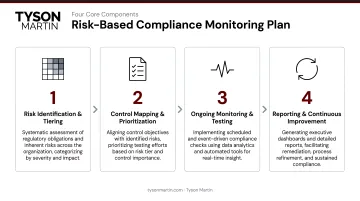
The four core components of any risk-based compliance monitoring plan:
- Risk identification and assessment — map all obligations and pinpoint where exposure is highest
- Risk prioritization and tiering — allocate monitoring resources to obligations by severity, not by default
- Targeted controls and monitoring procedures — match specific tests and safeguards to each risk tier
- Continuous reporting and remediation — track findings, escalate promptly, and close gaps with accountability
Step-by-Step: Building Your Risk-Based Compliance Monitoring Plan
Establish Scope and Regulatory Obligations
Before any risk work begins, document every applicable law, regulation, framework, and internal standard. Scope gaps are blind spots, and blind spots become enforcement actions.
Scope should cover:
- Sector-specific frameworks — HIPAA for covered entities and business associates, PCI DSS for any entity that stores, processes, or transmits cardholder data, SOX Section 404 for Exchange Act reporting companies, GLBA Safeguards for FTC-jurisdiction financial institutions
- Geographic and contractual obligations — every jurisdiction where the organization operates, not just headquarters
- Third-party relationships — vendors and service providers carry real exposure; neither HHS, PCI SSC, nor the FTC allows organizations to outsource the underlying compliance obligation along with the function
Document scope as a matrix: legal trigger, entity type, business process, data or reporting obligation, named owner, and third-party dependency. Anything not in the matrix is not being monitored.
Conduct a Compliance Risk Assessment
Structure the risk assessment around two variables: likelihood of a compliance failure and severity of consequence — including fines, operational disruption, legal liability, and reputational damage.
Map findings to specific regulatory obligations by business unit or process. The OCC's Compliance Management Systems handbook distinguishes inherent risk from residual risk and expects assessment sophistication to match organizational complexity.
HHS OCR's 2025 settlement with Health Fitness Corporation shows what happens when this step is skipped: OCR found the organization had failed to conduct an accurate and thorough HIPAA risk analysis until January 19, 2024 — the day before the settlement was announced. The cost was $227,816 plus mandatory corrective action and monitoring.
The breach affected roughly 4,300 individuals. The risk analysis failure, not the breach itself, drove the enforcement outcome.
The defensible structure: inherent risk → existing controls → residual risk → monitoring depth → board escalation path.
Define and Embed Controls
Translate prioritized risks into specific, testable controls — two types:
- Preventive controls — approvals, access restrictions, policy requirements that stop failures before they occur
- Detective controls — alerts, sampling, audit trails, transaction monitoring that surface failures after they occur
Controls must be embedded in workflows, not bolted on afterward. A control nobody follows is just documentation. Periodic testing verifies controls still function as designed. That testing is what makes monitoring continuous rather than periodic.
Assign Clear Ownership and Escalation Thresholds
Every control and monitoring activity needs a named owner with defined responsibility, authority, and deadlines. Shared accountability is no accountability.
Escalation thresholds define the specific trigger points at which a control failure moves up the chain — from operational team to compliance officer, from compliance officer to executive, from executive to board. A well-designed escalation framework uses a four-level ladder with triggers tied to measurable business impact, not subjective judgment calls.
Key elements to document in advance:
- Who can approve containment actions that may disrupt systems
- When to engage outside counsel or cyber insurers
- What format the board chair receives in the first escalation communication
- What the steady update rhythm looks like once escalation is triggered
These thresholds must be agreed upon and tested before an incident occurs. Organizations that improvise escalation procedures during a live compliance failure spend their crisis time negotiating authority rather than solving the problem.
Build a Continuous Monitoring and Reporting Cadence
A functioning monitoring cadence answers three questions for each control: How frequently is it monitored? What triggers an out-of-cycle review? How are findings documented through to remediation?
Cadence should be risk-weighted:
- High-risk controls — real-time or monthly monitoring
- Moderate-risk controls — quarterly review
- Lower-risk controls — semi-annual or annual cycle
Out-of-cycle reviews are triggered by control failures, regulatory changes, near-misses, significant business changes, and third-party incidents. Building these triggers into the plan itself prevents stale monitoring from accumulating silently.
How to Score and Tier Compliance Risks
Risk tiering creates a defensible, documented rationale for where monitoring resources concentrate. Without a scoring model, prioritization decisions look arbitrary to auditors and boards.
Three-Factor Scoring Approach
NERC's Compliance Oversight Plan framework uses inherent risk assessments, internal control evaluations, and performance considerations — including compliance history and culture — to assign entities to oversight categories. A practical internal scoring model follows similar logic:
| Factor | What It Measures | Questions to Ask |
|---|---|---|
| Inherent Risk | Significance of the obligation and natural exposure based on operations, data handled, and scale | How severe are the consequences of failure? What is the organization's baseline exposure without any controls? |
| Control Risk | Maturity and reliability of existing controls covering this obligation | Are controls documented and tested? Have they failed before? Are they manual or automated? |
| Detection Risk | Likelihood a failure goes undetected before causing harm | Would monitoring catch a failure within days or months? Is there an alert mechanism? |
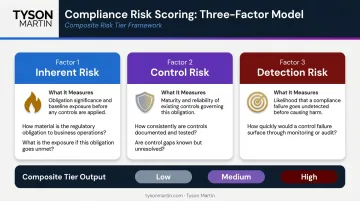
Combine the three factors into a composite tier — High / Medium / Low covers most organizations. That tier then drives monitoring frequency, control investment level, and reporting priority. Label the model as an internal governance design, not a mandated regulatory formula.
Cross-Functional Input Is Non-Negotiable
Compliance risks don't stay in one department. Each function holds a different piece of the picture:
- Legal sees contractual exposure and regulatory interpretation gaps
- IT sees access control failures and system-level vulnerabilities
- Finance sees transaction anomalies and reporting irregularities
- HR sees policy violations and accountability breakdowns
- Operations sees process failures before they surface elsewhere
Risk tiering conversations require structured forums that bring these stakeholders together. The most common reason these discussions fail to produce conclusions isn't disagreement — it's ambiguity over who actually decides. Establishing clear decision rights before the conversation starts is what separates a productive tiering session from a meeting that needs another meeting.
Risk Scores Must Be Refreshed
Risk scores go stale. Re-scoring triggers that belong in the plan itself:
- Regulatory changes that expand or shift obligations
- Incidents or near-misses that reveal control gaps
- M&A activity, new market entry, or significant technology deployments
- Control failures during testing
- Leadership changes that affect accountability
NERC explicitly notes that Compliance Oversight Plans are dynamic and must be updated based on emerging risks or significant changes in organizational responsibilities. The same principle applies to any internal risk-tiering model.
Turning Monitoring Data Into Board-Ready Reporting
Raw monitoring output and what boards actually need are different things. Boards don't need data dumps. They need to understand risk posture, directional trend, and which decisions belong on their agenda. A monitoring plan built backward from that output requirement is one boards will actually use.
What Effective Board Reporting Includes
The OCC expects boards to receive management information reports, risk assessments, and independent audit results to evaluate compliance management system effectiveness. The DOJ asks what information boards examined in exercising oversight over the misconduct area. Neither standard is satisfied by activity counts.
Effective board-level compliance reporting covers:
- Current risk posture by tier — where the organization stands, in plain language
- What changed since the last briefing and why — trend, not snapshot
- Which controls failed or degraded — specific, named findings
- Remediation status — who owns it, by when, and what the residual exposure is until it closes
- Decisions the board needs to make or delegate — one to three explicit items per reporting cycle
Stable Metrics Enable Trend Assessment
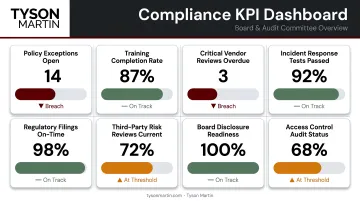
Boards cannot assess trend if the metrics change each cycle. Define KPIs early and hold them stable. A focused set of 8–12 metrics held consistent across quarters gives boards a reliable baseline. Those metrics typically include:
- Open findings by risk tier
- Average days to remediation by tier
- Control failure rate
- Security exceptions past due
- Audit finding aging for high-risk items
- Critical vendor reviews completed
Each metric needs three elements: a threshold defining what's acceptable, a trend line showing whether things are improving or deteriorating, and a time-to-fix indicator showing how long risk stays open. Amber triggers when a metric worsens over two consecutive cycles; red triggers for threshold breaches.
Format: Decision-Ready, Not Data-Rich
Board compliance briefings work best structured in three layers:
- One-page summary — decisions needed and changes since last briefing
- Visual dashboard — heat maps or scorecards showing where attention is required
- Short appendix — control detail for directors who want to go deeper
The dashboard reads like flight instruments, not a novel. Every board pack includes a "Decisions requested" box with options, cost ranges, and a recommended path. Without that box, even a well-built report gets filed and forgotten.
Common Failure Points That Undermine Compliance Monitoring Plans
The Activity Trap
Organizations confuse monitoring activity — audits completed, policies reviewed, training delivered — with monitoring effectiveness. Effectiveness is measured by how quickly risks are detected, escalated, and resolved. The IIA warns explicitly that high activity volume does not demonstrate that an organization is actually safeguarded.
Diagnostic questions that separate activity from effectiveness:
- Did we meet the control, or just complete the task?
- Did this process make us safer?
- Which two systems, if down, would trigger customer contract penalties?
- When did we last prove we can restore our top three systems?
The Ownership Gap
When monitoring tasks are distributed across departments without clear accountability, gaps accumulate silently. The OCC's 2024 enforcement action against City National Bank (a $65 million civil money penalty) cited unsafe practices across operational risk management, internal controls, and compliance risk management. Diffuse ownership creates exactly the kind of accountability vacuum that allows those patterns to persist.
Every control needs a single named owner. Not a team. Not a department. One person who can make trade-offs and answer for the result.
Stale Risk Assessments and Scope Drift
A monitoring plan designed for the organization of two years ago misses the risks of the organization today. M&A activity, new technology deployments, regulatory updates, and leadership changes all create new exposure.
The OCC's 2024 amendment to its enforcement action against Citibank — adding a $75 million penalty — specifically cited lack of processes to monitor data-quality impacts on regulatory reporting. The monitoring architecture simply hadn't kept pace with operational change.
The DOJ asks the same question: did periodic review lead to updates in policies, procedures, and controls? Build re-scoring triggers into the plan — not just annual audit cycles — so the plan reflects the organization you're running today.
Frequently Asked Questions
What is risk-based compliance monitoring?
It's an approach to compliance oversight that concentrates monitoring resources on the highest-risk regulatory obligations rather than applying uniform scrutiny to all requirements. The goal: focus limited compliance resources where failures would hurt most.
What is a compliance monitoring plan?
A documented framework specifying which compliance obligations are monitored, how frequently, by whom, using what methods, and how findings are escalated and remediated. It serves as the operational backbone of an organization's compliance program.
What are the 4 components of the compliance framework?
The four components are:
- Risk identification and assessment
- Risk prioritization and tiering
- Targeted controls and monitoring procedures
- Continuous reporting with structured remediation
OCC, NERC, and IIA guidance each frame these differently, but the underlying logic holds across frameworks.
Who is responsible for compliance monitoring in an organization?
Primary responsibility sits with the compliance function or CISO/CIO depending on the domain. Effective monitoring demands cross-functional ownership across legal, IT, finance, and operations — with the board accountable for risk appetite and escalation decisions.
How often should a compliance monitoring plan be reviewed and updated?
At minimum annually. Also revisit the plan when:
- Regulations change or new obligations apply
- An incident or near-miss occurs
- The business undergoes significant change (mergers, new markets)
- Control failures suggest the plan no longer reflects current risk
How is risk-based compliance monitoring different from a traditional compliance audit?
Audits provide periodic point-in-time snapshots. Risk-based monitoring delivers ongoing visibility, enabling faster detection and remediation of compliance gaps before they become enforcement actions. The distinction is continuous coverage versus periodic sampling.