
Introduction
AI is no longer something organizations are preparing for. It's already running inside them — screening resumes, flagging transactions, summarizing legal documents, and shaping customer experiences. Boards and executive teams face two real pressures: the competitive cost of moving too slowly and the governance cost of moving without guardrails.
Most AI conversations don't help. The enthusiasm camp promises transformation without conditions. The alarm camp warns of existential catastrophe without practical guidance. Neither serves directors or executives who need to make actual decisions.
This post covers where AI creates genuine, measurable business value and where the risks demand board-level attention — including the question most governance discussions skip: what happens when people over-trust AI outputs.
If your board hasn't asked who approved your AI tools, what data they access, or what accountability exists when an AI-influenced decision goes wrong, those questions belong on the agenda now.
Key Takeaways
- AI delivers real productivity gains when applied to the right tasks, with human oversight in place
- The most serious risks are governance failures, not just technical ones: accountability gaps, data exposure, and regulatory liability
- AI outputs that sound authoritative can still be wrong — even experts tend to defer without questioning them
- Board oversight doesn't require technical expertise; it requires the right questions and inspectable answers
- Organizations that delay building AI governance structures are accumulating risk they can't yet see
The Business Case for AI: Where the Rewards Are Real
Productivity Gains Are Documented — With Important Caveats
The productivity case for AI is backed by credible research, not just vendor claims. An NBER field study of over 5,000 customer-support agents found AI assistance increased issues resolved per hour by 14% on average — with lower-skilled workers seeing gains up to 34%. In a separate study of 78 workers at IG Group, AI compressed conceptualization time from 63 minutes to 23 and writing time from 87 minutes to 22.
That's not marginal. For document-heavy workflows — risk summaries, regulatory reports, client-facing analysis — this kind of compression has direct revenue implications.
The same research, however, identifies a hard boundary. HBS and BCG found that for tasks inside AI's capability range, consultants completed 12.2% more tasks and finished 25.1% faster. For tasks outside that range, AI users were 19 percentage points less likely to produce correct solutions. The implication is clear: knowing where your AI tools work — and where they don't — isn't optional.
Market Pressure Is Real
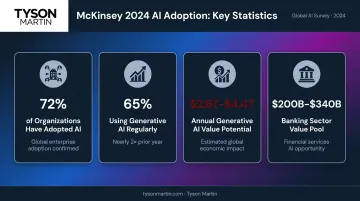
According to McKinsey's 2024 State of AI survey, the numbers on AI adoption and economic potential are no longer speculative:
- 72% of organizations have adopted AI; 67% expect to increase investment over the next three years
- Generative AI reached regular use in 65% of surveyed organizations — nearly double the prior year's figure
- Potential generative AI value across enterprise use cases: $2.6 trillion to $4.4 trillion annually
- In banking alone, the estimated value pool is $200 billion to $340 billion per year
In fast-moving sectors — financial services, retail, healthcare — delayed adoption is not a neutral position. Competitors are already training models on real data and refining workflows. The gap compounds.
The Right Framing: Augmentation, Not Replacement
The most defensible AI deployments share a common characteristic: they make skilled professionals faster and more accurate, rather than replacing their judgment. AI handles the data processing; humans handle the decisions.
This framing matters for governance. When AI is positioned as a decision-support tool with human sign-off, accountability is clearer. When AI is positioned as the decision-maker, accountability evaporates — and that is precisely where regulators, auditors, and plaintiffs start asking hard questions.
The Risks Boards Must Understand
Operational and Security Risks
AI systems expand your organization's attack surface in ways traditional cybersecurity frameworks weren't designed to handle. Every new AI integration — APIs, third-party model providers, data pipelines — creates exposure that needs to be assessed and governed.
NIST's Generative AI Risk Profile identifies specific AI risk categories boards should know:
- Prompt injection — users manipulating AI behavior through crafted inputs
- Data poisoning — corrupted training data producing flawed outputs
- Confabulation — AI generating plausible but factually incorrect information
- Data privacy leakage — inadvertent exposure of sensitive information through AI prompts or model outputs
The data privacy risk deserves particular attention. When employees use AI tools — even approved, commercial tools — they may be entering customer data, employee records, or confidential business information into prompts.
The FTC has warned that model-as-a-service providers may be able to infer business data from how companies use their models. Boards need to know: what data are your AI tools accessing, where is it going, and do your vendor agreements actually address this?
Governance and Liability Risks
Security exposure is only part of the picture. When an AI system produces a flawed recommendation — a bad credit decision, a biased hiring outcome, a missed fraud signal — the question of who is responsible is rarely answered cleanly. The accountability gap may be the most underestimated AI risk boards face. Those that haven't defined AI decision rights before deployment will be answering that question under pressure, after the fact.
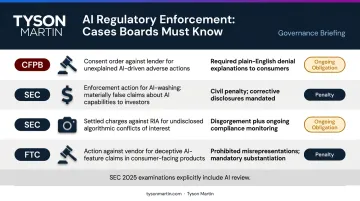
Regulatory exposure is accelerating across sectors:
- The CFPB requires creditors using complex algorithms to provide specific adverse-action reasons — model complexity doesn't remove Equal Credit Opportunity Act obligations
- The SEC charged two investment advisers with misleading AI-use statements in 2024, resulting in $400,000 in civil penalties
- The FTC banned Rite Aid from using AI facial recognition for five years after finding the technology was deployed without reasonable safeguards
- The SEC's 2025 examination priorities explicitly include review of registrants' AI use, representations, and compliance policies
Third-party AI vendor risk compounds all of this. Most organizations aren't building AI models — they're deploying vendor tools.
Standard vendor risk frameworks weren't designed for AI-specific concerns: model drift, hallucination rates, and changes to underlying model behavior that may not trigger contractual notification requirements. That gap needs to be closed before procurement, not after an incident.
The Hidden Danger: Trusting AI Too Much
Automation Bias Is Well-Documented
There's a name for what happens when people defer to algorithmic outputs even when those outputs are wrong: automation bias. And the research on it is unsettling for anyone relying on human review as a safeguard.
An HBS field experiment studying 228 evaluators screening real innovation proposals found that reviewers failed proposals 9% more often with AI assistance than without. More troubling: expert reviewers were just as likely to be persuaded by AI narratives as novices. Expertise did not protect against over-deference.
The study found that when AI provided narrative explanations alongside recommendations, deference to AI outputs increased — but decision quality did not improve. Reviewers engaged less critically, not more.
Why This Hits Hardest on Consequential Decisions
AI outputs are typically well-structured, confidently worded, and internally consistent. They sound right. That makes them cognitively difficult to challenge, particularly in environments where time pressure is real and the AI recommendation aligns with what the reviewer expected to see.
This dynamic plays out in:
- Risk assessments where AI-generated summaries become the basis for sign-off
- Compliance reviews where AI flags (or fails to flag) issues without human re-verification
- Investment or credit decisions where AI scoring shapes outcomes without adequate challenge
The HBS/BCG jagged-frontier research provides a useful map: AI performs well on objective, quantifiable criteria — and significantly less reliably on qualitative, contextual, or novel judgments. Executive teams need to know which category applies to each AI use case in their organization.
The Countermeasure: Designed-In Validation
"Humans in the loop" cannot be a checkbox. It requires specifying exactly what humans are expected to verify, at what threshold, and what authority they have to override the system. Without that specificity, oversight exists on paper but not in practice.
Validation checkpoints should be:
- Tied to specific decision types and risk thresholds
- Assigned to named individuals, not roles in general
- Built with override authority that is defined, documented, and tested before deployment
Building AI Governance That Holds
Effective board-level AI oversight doesn't require technical expertise. NACD's guidance frames AI oversight as a board responsibility covering AI strategy and responsible AI principles — not a delegation to management or IT.
What directors actually need to know:
- Which AI systems are currently deployed in the organization
- What decisions those systems influence
- What data they access and where it goes
- How outputs are reviewed, challenged, and overridden
The Internal Governance Components That Matter
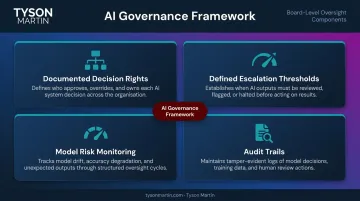
A governance framework that holds under scrutiny includes:
- Documented decision rights — who approves AI deployment, who can escalate, who can shut a system down
- Defined escalation thresholds — what triggers human review versus AI-autonomous action
- Model risk monitoring — tracking for drift, performance degradation, and unexpected behavior changes
- Audit trails — records that regulators, auditors, and legal counsel can inspect
The critical test of any governance framework is whether it gets exercised before an incident — not pulled out in response to one.
When to Bring in External Expertise
Organizations navigating leadership transitions, accelerating AI adoption, or operating in regulated sectors frequently lack the internal bandwidth to build these structures at the pace AI deployment demands. The internal CISO, when present, is typically focused on operations — not the independent governance layer that boards need.
This is where Tyson Martin's board advisory work is most relevant. He works with boards and executive teams to assess AI risk exposure, close governance gaps, and build the decision-rights structures and oversight frameworks that keep accountability intact as AI adoption accelerates.
His approach is deliberately independent of internal security teams and technology vendors — which means boards get an unfiltered view of their actual exposure, not a picture shaped by operational or vendor interests.
Questions Every Board Should Be Asking About AI Right Now
These are not hypothetical governance exercises. They are the questions that regulators, plaintiffs, and auditors will ask when something goes wrong.
Inventory and Oversight
- What AI tools are currently deployed across our organization?
- Who approved each one, and through what process?
- What data do they access, and where is that data sent?
Accountability and Liability
- If an AI-influenced decision causes harm, who is accountable under our current framework?
- Does our D&O coverage address AI-specific decisions?
- Have we reviewed vendor agreements for indemnification and data handling?
Forward-Looking and Regulatory
- How are we monitoring changes in the regulatory environment around AI?
- What is our process for evaluating new AI use cases before deployment?
- Are the humans working alongside AI systems actually empowered to override them — or just nominally in the loop?
Many boards discover, when they first ask the inventory question, that the honest answer is "we don't fully know." That gap is where regulatory exposure, liability, and board accountability actually live — not in the technology itself.
Frequently Asked Questions
What are the biggest AI risks for businesses today?
Four risks demand board-level attention right now:
- Data privacy exposure through AI prompts and third-party integrations
- Automation bias — over-reliance on outputs that haven't been challenged
- Accountability gaps when AI-influenced decisions cause harm
- Regulatory liability in financial services, healthcare, and retail, where enforcement is accelerating
How should a board oversee AI without becoming technical experts?
Boards don't need technical depth — they need clear reporting on what AI systems are in use, what decisions they influence, and what governance structures exist to challenge outputs and assign accountability. The goal is asking the right questions and demanding answers that can be inspected.
Is AI risk different from traditional cybersecurity risk?
Yes. AI introduces risks traditional frameworks weren't designed to address: model hallucinations, training data leakage, third-party model behavior changes, and algorithmic accountability gaps. These require a distinct governance layer beyond standard cybersecurity controls.
How do I know if my organization is ready to adopt AI responsibly?
Look for four indicators:
- Defined data governance policies that cover AI inputs and outputs
- Clear decision rights for AI deployment and escalation
- Vendor risk processes with AI-specific criteria
- A structured human validation process for AI-influenced decisions — not just nominal sign-off
Can AI make reliable decisions without human oversight?
AI performs reliably on objective, quantitative criteria. On qualitative, contextual, or novel judgments, reliability drops significantly. Regardless, accountability for consequential decisions must remain with humans — regulators are now enforcing that expectation directly.
What regulated industries face the most AI governance risk right now?
Financial services, healthcare, and retail face the most active scrutiny. Key exposure areas:
- AI explainability requirements in lending decisions
- Fair-lending algorithm compliance
- Clinical AI transparency under ONC's HTI-1 rule
- AI-driven surveillance pricing in retail
Each carries direct legal and regulatory consequences for governance failures.