Introduction
Boards face a harder oversight job than they did five years ago. Regulatory expectations have risen sharply — the SEC now requires public companies to disclose material cyber incidents within four business days of a materiality determination. AI-driven threats have multiplied. And the window between an emerging risk and a board-level incident has compressed to the point where quarterly briefings are structurally inadequate.
Most boards genuinely want to govern technology risk well. The problem is the infrastructure. Three structural gaps consistently get in the way:
- Lagging reports that can't distinguish a temporary anomaly from a deteriorating control environment
- Shifting metrics that make trend analysis impossible from one cycle to the next
- Untested escalation thresholds that exist on paper but have never been pressure-checked against a real incident
This article explains how AI for board governance converts that fragmented picture into the clarity, speed, and documentation consistency that director oversight actually requires — and what happens to boards that try to govern without it.
Key Takeaways
- AI for board governance surfaces risk trajectories over time — not just point-in-time snapshots — so directors can act on trends, not surprises
- Material issues reach the board earlier, with clearer lines between what directors decide and what management owns
- Audit-ready documentation becomes a byproduct of normal oversight — aligned with SEC, NIST, and sector-specific regulatory expectations
- Boards without AI-augmented oversight typically govern reactively, responding to incidents rather than tracking risk trajectories
- Value compounds when AI insights connect to defined review cadences and escalation thresholds that hold under real conditions
What Is AI for Board Governance?
AI for board governance means giving directors consistent, reliable access to risk and performance information — the kind that manual processes and spreadsheets routinely fail to deliver on schedule or at scale.
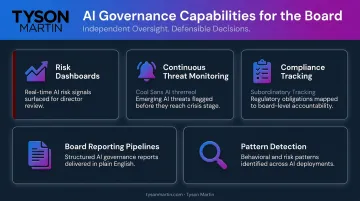
In practice, it shows up in several places:
- Risk dashboards that track trend direction, not just point-in-time scores
- Continuous threat monitoring that escalates material changes across the enterprise as they happen
- Compliance tracking that flags gaps against frameworks like NIST CSF 2.0 or SEC disclosure requirements
- Board reporting pipelines that standardize format, language, and evidence linkage across cycles
- Pattern detection across internal control data that surfaces deterioration before it becomes an incident
AI doesn't replace director judgment. It gives directors clearer signals and stronger evidence so that judgment is better informed. The board still decides — AI shapes what information reaches them, and how reliably.
Key Advantages of AI for Director Oversight
The advantages below map directly to what boards are accountable for: fewer surprises, faster escalation, cleaner communication, and decisions that hold up under scrutiny.
Real-Time Risk Visibility Across the Enterprise
AI continuously monitors technology and cyber risk signals across the organization and surfaces them in a consolidated, board-level view. Instead of waiting for quarterly briefings compiled by management, directors can see current risk indicators, recent changes, and trend trajectories through dashboards calibrated for oversight rather than technical depth.
This matters because the cost of not knowing is high. According to IBM's 2024 Cost of a Data Breach Report, the global average breach cost reached $4.88 million, up 10% from 2023. IBM also found that extensive use of AI and automation in security functions reduced mean time to identify and contain breaches — a direct operational benefit that reduces board-level surprises.
The shift from periodic reporting to continuous visibility changes what boards can actually see. A board reviewing quarterly snapshots cannot distinguish a temporary anomaly from a trend that has been deteriorating for six weeks. A board with AI-generated trend dashboards can.
KPIs this advantage influences:
- Mean time to board awareness of material risks
- Number of board-level surprises per cycle
- Accuracy of risk posture assessment across meetings
- Consistency of reporting definitions and baselines
When it matters most: Regulated industries (financial services, healthcare, retail), post-incident recovery periods, leadership transitions, and any organization where cyber or technology risk is material to business continuity. EY found that 81% of Fortune 100 companies now assign cybersecurity oversight to the audit committee, up from 61% in 2018 — a structural shift that increases demand for consistent, high-quality information flows.
Faster Escalation and Clearer Decision Rights
AI for board governance doesn't just surface risk — it helps boards and management distinguish which risks require board-level decisions versus which should stay with management. That distinction, made in advance and enforced consistently, removes the friction and ambiguity that slows escalation during fast-moving incidents.
By establishing consistent escalation thresholds and monitoring against them in real time, AI tools can automatically flag when a risk crosses from management-level response to board-level visibility. That removes reliance on individual judgment calls, which fail unpredictably under pressure.
The SEC's 2023 final rule cited research showing companies in 2021 took an average of 80 days after breach discovery to disclose — median 56 days. The rule now requires disclosure within four business days of a materiality determination. Meeting that compression requires escalation processes that are defined, tested, and monitored in real time.
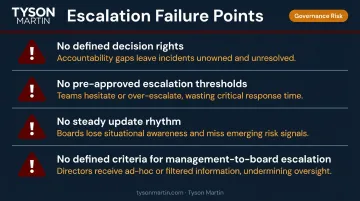
In Tyson Martin's board advisory engagements, the most common escalation failure points include:
- No defined decision rights, so teams spend critical incident time negotiating authority instead of solving the problem
- No pre-approved escalation thresholds, so teams guess under stress
- No steady update rhythm during incidents, creating information vacuums where stakeholders assume the worst
- No defined criteria for when an issue escalates from management to board
KPIs this advantage influences:
- Escalation cycle time from incident detection to board notification
- Percentage of incidents reviewed within required regulatory windows
- Clarity and testability of documented decision rights
Most relevant for: Active incidents, M&A due diligence, major technology transformations, and regulatory examinations — the moments when ambiguous escalation creates the greatest exposure.
Audit-Ready Reporting and Defensible Decisions
AI-driven governance tools generate standardized board reports with consistent formats, evidence linkage, and risk trend data that auditors and regulators can examine. This replaces ad hoc briefings with a documented record of what the board was shown, when, and what decisions followed.
The regulatory basis for this is concrete. SEC Regulation S-K Item 106(c) requires public companies to describe the board's oversight of cybersecurity risks — not just assert that oversight exists, but describe the processes by which the board is informed. NIST CSF 2.0, released in February 2024, added the GOVERN function specifically to establish, communicate, and monitor cybersecurity risk management strategy, with organizational leadership explicitly named as accountable.
The SEC's charges against SolarWinds and its CISO in 2023 made the stakes clear: overstating practices and understating known risks carries real legal consequences.
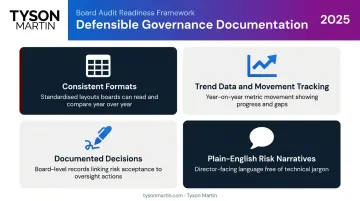
What defensible governance documentation looks like: Tyson Martin's board reporting approach emphasizes several elements that directly support audit readiness:
- Consistent formats using the same metrics, definitions, and impact model across cycles
- Trend data and movement tracking — reporting what changed since the last meeting, not just current state
- Documented decisions — recording risk accepted, exceptions granted, and budget approved so governance doesn't reset every time someone changes roles
- Plain-English risk narratives that connect technical findings to business outcomes directors can repeat and defend
KPIs this advantage influences:
- Audit findings related to board-level oversight gaps
- Time required to respond to regulatory requests for governance evidence
- Consistency of risk documentation across board cycles
Where this applies: Public companies with SEC disclosure obligations, organizations in regulated sectors, and any organization recovering from a significant cyber or technology incident.
What Happens When AI Is Missing from Board Oversight
Without AI-augmented oversight, boards govern on the basis of manually prepared, backward-looking reports. The symptoms are consistent:
- Inconsistent metrics — each board cycle may use different baselines, formats, or definitions, making trend detection nearly impossible and leaving directors unable to distinguish deterioration from noise
- Reporting that shows activity, not exposure — dashboards built to count completed tasks rather than show what could actually stop the business
- Reactive governance — boards that focus on what has already gone wrong rather than where risk is heading, creating a cycle of incident response rather than prevention
- Escalation failures — without pre-defined thresholds, escalation depends entirely on individual judgment, which fails during fast-moving, high-stakes events
These symptoms are recognizable on the ground. When Tyson Martin steps in to stabilize board governance after a breakdown, the pattern is consistent: everything appears green but nothing is prioritized, directors can't answer basic questions about critical service exposure, and escalation arrives late or in panic mode. Security work looks like a pile of projects rather than a ranked roadmap tied to business risk.
Boards in this position often need to bring in external support quickly: a board advisor, interim CISO, or structured governance engagement to rebuild the oversight infrastructure that AI tools could have maintained continuously. The real objective is putting in place the review cadences, decision rights, and escalation frameworks that make the next cycle more defensible than the last.
How to Get the Most Value from AI in Board Governance
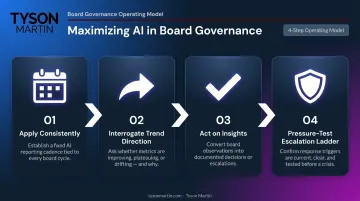
AI for board governance works best when it's embedded in a governance operating model — not deployed as a standalone tool. The value comes from connecting AI-generated insights to consistent review cadences, clear decision rights, and escalation thresholds that have been tested before a real incident forces the question.
Practical steps for boards:
Apply it consistently — establish a standard reporting cadence where AI-generated dashboards anchor every board and audit committee cycle, not just crisis-prompted special briefings. Tyson Martin recommends monthly committee-level review and quarterly full-board review, with real-time alert protocols for material threshold breaches between meetings.
Interrogate trend direction, not just current state — directors should probe risk velocity and trajectory, not just today's reading. The question that drives better oversight: "What changed since the last briefing, and why?"
Act on insights — governance value is only realized when AI-flagged risks produce documented decisions, delegations, or escalations. Insight without a board action or a management directive contributes nothing to oversight quality.
Pressure-test the escalation ladder — draft the risk appetite statement and escalation path, then run a tabletop exercise against both. An escalation framework that exists only on paper hasn't been validated.
Deloitte's 2024 Future of Cyber Survey found that 41% of boards now address cyber-related issues at least monthly — which means the infrastructure to support that cadence has to produce consistent, actionable information every cycle, not just when something goes wrong.
Boards navigating this transition — particularly those in regulated industries or managing technology transformation — often benefit from working with an advisor who can calibrate AI-generated reporting to board-level language and validate that thresholds are meaningful. That external perspective is also what makes escalation frameworks hold when a real incident tests them.
Conclusion
AI for board governance gives directors the signal clarity, escalation speed, and documentation consistency that effective oversight requires. It doesn't replace director judgment — it removes the noise and latency that prevent that judgment from being exercised at the right time, on the right information.
The advantages compound over time. With each governance cycle, boards gain:
- Sharper trend visibility as historical data accumulates
- More predictable escalation when thresholds are consistently tested
- A stronger record of defensible decisions as documented choices stack up
A year of consistent AI-augmented oversight builds something no single briefing can: a board that knows what changed, why it matters, and what was decided — every time.
Frequently Asked Questions
What is the difference between AI for board governance and general AI governance software?
AI for board governance uses AI to improve how directors receive and act on risk information — better dashboards, faster escalation, more consistent reporting. AI governance software manages the AI systems an organization deploys, addressing model risk, bias, and accountability. They solve different problems for different audiences.
Can AI replace the judgment of an experienced board director?
No. AI converts complex data into clear signal, but it cannot substitute for the fiduciary reasoning, strategic context, and accountability that directors bring to governance decisions. The board still decides — AI determines what information reaches the board, how accurately, and how fast.
How should a board evaluate whether AI-generated risk reports are reliable?
Start with three questions:
- Are reports drawn from defined, stable data sources?
- Have metrics been validated against known incidents or approved thresholds?
- Is the reporting cadence consistent enough to detect meaningful trend changes?
Independent validation through internal audit or tabletop exercises adds credibility.
What is the biggest governance risk of using AI in board oversight without proper controls?
False confidence. Boards may believe they have oversight because they receive AI-generated dashboards, without verifying that the underlying data is accurate, the thresholds are meaningful, or the escalation paths have been tested. A green dashboard built on bad data creates the illusion of oversight while leaving the board exposed.
How often should AI-generated board dashboards be reviewed?
Align reviews with the board's regular meeting cadence — monthly at committee level and quarterly at full board. Real-time alert protocols should handle material threshold breaches between scheduled meetings.
Which industries benefit most from AI-enhanced director oversight?
Regulated sectors — financial services, healthcare, and retail — face the highest regulatory expectations for demonstrable board oversight under frameworks like SEC disclosure rules, DORA, NIS2, and HIPAA. Any organization where board oversight must be documented, defensible, and audit-ready benefits directly — not just at examination time, but in how directors engage with risk between meetings.