Introduction
When a breach occurs, the first hours are not a technical problem — they're a governance problem. Who has authority to take systems offline? Who calls outside counsel? Who notifies regulators? If those answers aren't documented before the incident, they get improvised during it.
According to IBM's 2024 Cost of a Data Breach Report, the average global breach cost reached $4.88M — and organizations that identified breaches using their own security teams incurred nearly $1M less than those that learned about it from attackers. Speed and readiness have a direct dollar value.
This guide translates DFIR — Digital Forensics and Incident Response — into plain English for boards, audit committees, and executive teams. It covers:
- What DFIR actually is and why it matters at the governance level
- How the six-phase incident response lifecycle works
- What governance readiness looks like in practice
- What directors must have in place before an attack arrives
Key Takeaways
- DFIR unifies forensic investigation with structured incident response; treating them as separate functions leaves critical coverage gaps that attackers exploit
- Six phases run from preparation through lessons learned — each builds on the last, and skipping one compounds the next crisis
- Mandiant's M-Trends 2026 report puts global median attacker dwell time at 14 days — detection speed is a governance problem, not just a technical one
- Boards need pre-established decision rights, escalation thresholds, and regulatory timelines documented before an incident
- Organizations without a permanent CISO can engage interim CISO leadership to close readiness gaps within 90 days
What Is DFIR? Two Disciplines That Work Better Together
Digital forensics is detective work applied to digital environments — collecting, preserving, and analyzing evidence from hard drives, memory, network traffic, and logs to answer three questions: how did the breach occur, who was responsible, and what was accessed?
Incident response is the organizational process for managing that breach: preparing, detecting, containing, eradicating, recovering, and learning. Where forensics asks "what happened," incident response asks "what do we do right now." NIST SP 800-86 sets the standard for both — requiring preserved information integrity and strict chain of custody throughout.
Why Separating Them Is Dangerous
The two disciplines feed each other. Forensics gives incident responders the evidence they need to make fast, accurate containment decisions. Disciplined incident response preserves the evidence forensic investigators need later — for root cause analysis, regulatory compliance, and potential litigation.
Organizations that treat them as separate functions routinely face two costly outcomes:
- Extended dwell time — response teams act on incomplete information, missing attacker persistence mechanisms
- Evidence destruction — pressure to restore systems quickly overwrites forensic artifacts before they're collected, breaking chain of custody and potentially destroying legal admissibility
When governance structures treat DFIR as a single integrated function — not two siloed teams — organizations contain threats faster and preserve the evidence boards and regulators will later demand.
The Four Pillars of Digital Forensics
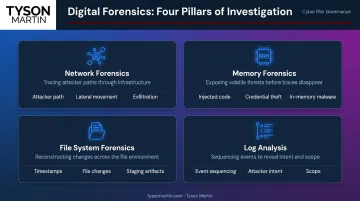
Effective forensic investigation requires evidence from multiple layers of the environment simultaneously. Each pillar answers a different piece of the question.
Network Forensics
Network forensics reviews packet-level activity to identify anomalies, command-and-control communications, lateral movement, and data exfiltration. It shows the attacker's path through the environment — what entered, what moved, and what left.
This pillar answers three questions no other layer can:
- What connected where — external destinations, internal pivot points, C2 beacons
- What moved — data volumes, protocol anomalies, staging transfers before exfiltration
- What left — confirmed exfiltration, even when endpoint logs are wiped
Without this layer, responders can contain the visible compromise while missing exfiltration that already occurred.
Memory Forensics
RAM holds evidence that never touches a disk. Memory forensics reveals injected malicious code, credential theft tools, and in-memory malware that file-based detection products miss entirely. CrowdStrike's 2025 Global Threat Report found that 79% of detections involved malware-free intrusions — hands-on-keyboard activity rather than traditional file-based malware. When attackers operate entirely in memory, this is the only layer that captures them.
File System Forensics
File system forensics examines file structures, modification timestamps, unauthorized changes, and malicious artifacts across endpoints. It answers what files were accessed, altered, deleted, or created during the attack window — and when. This pillar is particularly critical for establishing precise timelines and identifying staging areas attackers use before exfiltration.
Log Analysis
Logs connect events across systems into a single timeline. They reveal attacker intent, scope, and sequence — but only if they exist. Log integrity and centralized retention must be established well before an incident.
Attackers often target log infrastructure specifically to obscure their activity. If centralized logging isn't operational before the incident, this pillar collapses — and the timeline with it.
The Six-Phase DFIR Lifecycle
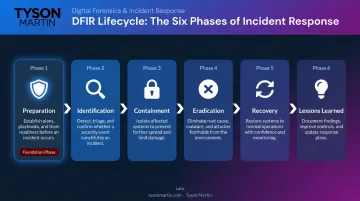
Most mature DFIR programs follow six structured phases. NIST SP 800-61 Rev. 3, finalized in April 2025, maps these phases to the NIST Cybersecurity Framework 2.0 functions. Skipping any phase creates gaps that either extend attacker access or expose the organization to legal and regulatory risk.
Phase 1: Preparation
Preparation is the only phase that happens before damage occurs — which makes it the most important one.
A complete preparation program includes:
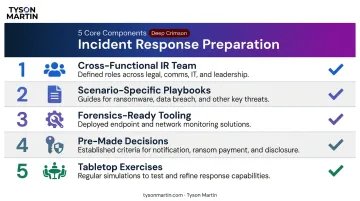
- Cross-functional IR team with named roles across IT, legal, communications, HR, and executive leadership
- Scenario-specific playbooks for ransomware, insider threats, and data breach situations
- Forensics-ready tooling including endpoint agents, centralized logging, and memory capture capabilities
- Pre-made decisions on who can authorize network isolation, who contacts regulators, and when the board gets notified
- Tabletop exercises that pressure-test decision-making under realistic conditions
IBM's 2024 Cost of a Data Breach report found that organizations using security AI and automation reduced identify-and-contain time by nearly 100 days on average. Preparation investments pay measurable dividends when an incident occurs.
Phase 2: Identification
Identification distinguishes real threats from false positives using SIEM alerts, threat intelligence, anomaly detection, and user reports. The goal is confirming that an incident has actually occurred — and characterizing its scope accurately enough to take the right containment actions.
One often-missed requirement: volatile evidence must be preserved immediately upon identification, before any containment actions begin. Memory state and active network connections are destroyed by system restarts and isolation procedures. Capturing them first is non-negotiable.
Phase 3: Containment
Containment stops the spread without tipping off the attacker or destroying evidence. Two stages apply:
- Short-term containment — network isolation, segmentation, or disabling specific accounts to limit immediate damage
- Long-term containment — system rebuilds, credential resets, and hardening while investigation continues
Forensic collection must happen before systems are cleaned. This is where business pressure and investigative requirements collide most directly — and where clear pre-established authority matters most.
Phase 4: Eradication
Eradication removes every malicious presence from the environment. That includes:
- Malware and ransomware payloads
- Backdoors and command-and-control footholds
- Persistence mechanisms (scheduled tasks, registry keys, startup scripts)
- Unauthorized accounts and elevated privileges
Incomplete forensics here is dangerous. Missing a single backdoor means the attacker returns through the same path — often more carefully, with a longer dwell time the second time.
Phase 5: Recovery
Recovery restores systems from validated clean backups, with enhanced monitoring to detect reinfection. Business pressure pushes for fast restoration — but going back online before the environment is genuinely clean resets the incident clock.
The answer isn't slower recovery — it's pre-tested backup integrity and clear criteria for what "clean" means before the incident begins.
Phase 6: Lessons Learned
Post-incident review is the phase most organizations skip. That's a costly decision.
A proper review covers root cause, full timeline reconstruction, what went right and wrong, playbook and policy updates, and findings communicated to leadership and the board. NIST Rev. 3 explicitly ties lessons learned to improving cybersecurity risk management — it's not optional documentation. Organizations that skip it face the same incident again, with the same gaps — and an attacker who now knows exactly how far they can go.
DFIR Readiness: A Governance Imperative
Boards and executive teams that treat DFIR as a purely technical function discover during a real incident that they have no decision framework, no escalation thresholds, and no communication protocols. The technical team may execute well while leadership improvises — and that improvisation compounds damage at the worst possible time.
What Governance Readiness Actually Requires
Effective DFIR governance starts with questions that must be answered before an incident:
Which assets are crown jewels — what would hurt most to lose, and where does that data live?
What regulatory obligations apply — SEC material incident disclosure is due on Form 8-K within 4 business days of a materiality determination; HIPAA breach notification requires notice to affected individuals within 60 days of discovery
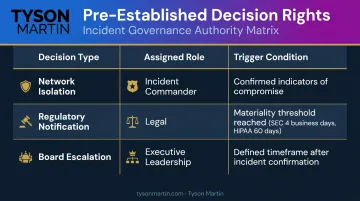
Who has decision authority assigns clear authority to specific roles before conditions require it. For example:
Network isolation: Pre-authorized to the incident commander when indicators of compromise are confirmed — the board accepts the short-term operational impact in advance
Regulatory notification: Assigned to legal, with timing tied to materiality thresholds established before the incident
Board escalation: Triggered within a defined timeframe of incident confirmation (for example, four hours after confirmed ransomware), with a structured first briefing format
Shared responsibility without clear ownership is one of the most common failure modes in breach response. When two roles both "own" a decision, neither makes it fast enough.
Tabletop Exercises Reveal What Documentation Misses
Executive-level tabletop exercises surface governance gaps that technical drills miss entirely. Common findings include:
- No one knows who can take a revenue-generating system offline
- Communications roles for customers, press, and regulators are undefined
- Legal and forensics engagement triggers aren't written down
- Backup recovery times are estimated, not measured
Running one executive tabletop per quarter produces better decisions under pressure than any policy document. Rotate through scenarios: ransomware with partial backups, cloud identity compromise, third-party outage. Each session should end with a short action list with an owner, a due date, and a note on what breaks if it slips.
When to Bring in External Expertise
Tyson Martin's interim CISO engagements are built for organizations in transition: new leadership, active M&A, or no permanent CISO in seat. By day 30, organizations have an updated incident response plan with named roles, escalation rules, and current contact lists, plus a tabletop exercise summary and an access cleanup report covering admin accounts, stale credentials, and MFA gaps.
The 30-to-90-day roadmap sequences fixes with named owners and measurable milestones the internal team can execute. In active breach scenarios, the engagement provides hands-on leadership through the first 72 hours: incident command, rapid containment, and executive communications, with every decision documented for later review by customers, regulators, and the board.
Key DFIR Challenges Organizations Must Overcome
The Detection Gap
Mandiant's M-Trends 2025 report puts global median attacker dwell time at 14 days. That means attackers spend nearly two weeks inside environments before detection — expanding access, exfiltrating data, and establishing persistence. Slow detection is both a technical and a governance failure. Organizations without continuous monitoring, behavioral baselines, or proactive threat hunting give attackers time they should not have.
Evidence Integrity and Chain of Custody
Digital evidence that is improperly collected, handled, or stored loses its legal admissibility. A broken chain of custody doesn't just complicate litigation — it can render forensic findings unusable when regulators or insurers come asking. The most common cause of evidence destruction isn't attacker sophistication — it's business pressure to restore systems before forensic collection is complete. This requires trained personnel and established protocols in place before any incident.
The Skills and Capacity Gap
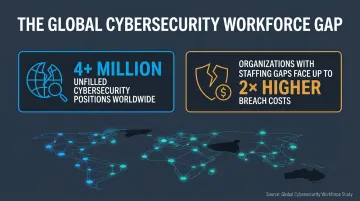
The ISC2 2024 Cybersecurity Workforce Study reported a global cyber workforce gap of 4.8 million — nearly half of total global cyber workforce demand unaddressed. IBM's 2024 data adds a direct cost consequence: organizations with severe security staffing shortages faced breach costs $1.76M higher on average, and 53% of breached organizations had high-level staffing shortages.
Most organizations cannot maintain deep in-house DFIR expertise. The practical response involves three pre-incident decisions:
- Secure a retainer with an external DFIR provider before an incident occurs — not after
- Define response-time SLAs so escalation paths are clear when crisis mode sets in
- Assign internal ownership for the relationship, evidence handling, and executive communication
Future Trends Shaping DFIR
Three trends deserve attention from executive audiences:
- AI-driven forensic analysis accelerates evidence correlation and reduces investigation time. A 2024 peer-reviewed systematic review confirms AI assists forensic experts with data processing — while flagging overfitting, bias, and explainability limitations. AI accelerates the work; it doesn't replace the judgment.
- Cloud-native forensics is an emerging gap. The Cloud Security Alliance reports that 65% of organizations spend 3-5 days longer investigating cloud incidents than on-premises ones — and default log retention can be as short as 30 days, insufficient when attacker dwell times span weeks.
- Proactive threat hunting blends continuous monitoring with pre-incident forensic readiness, shifting from pure reaction to persistent detection. CISA explicitly describes this as a move toward persistent hunting that supports remediation through forensics and partnerships.
Each of these trends produces better data — faster correlation, richer cloud logs, earlier threat signals. What determines whether that data leads to decisive action is governance: clear decision rights, defined escalation thresholds, and institutional knowledge that holds under pressure when a breach is confirmed.
Frequently Asked Questions
What is the role of digital forensics in incident response?
Digital forensics provides the evidence — collected from memory, file systems, networks, and logs — that incident responders need to make accurate containment and remediation decisions. It also preserves artifacts for legal proceedings, regulatory reporting, and post-incident root cause analysis.
What is digital forensics readiness?
Digital forensics readiness means having tools, trained personnel, documented protocols, and governance frameworks in place before an incident occurs. When readiness exists, evidence gets collected properly, decision rights are unambiguous, and response teams execute from a plan rather than improvising under pressure.
What are the four pillars of digital forensics?
The four pillars are network forensics, memory forensics, file system forensics, and log analysis. Each examines a different layer of the digital environment, and together they reconstruct a full account of how an attack unfolded across an organization's infrastructure.
What is the difference between DFIR and a SOC?
A Security Operations Center (SOC) focuses on continuous monitoring and real-time alerting. DFIR activates when a confirmed incident requires deeper investigation — reconstructing timelines, analyzing evidence, and driving eradication and recovery. The SOC surfaces the signal; DFIR determines what it means and what to do about it.
How should a board oversee an organization's DFIR program?
Boards should confirm that documented decision rights and escalation thresholds exist before any incident occurs. From there, they should receive regular briefings on readiness metrics and tabletop exercise outcomes, and verify that the organization has either in-house DFIR capability or a retained external provider with defined response-time SLAs.
What are the most common DFIR challenges organizations face?
The three most cited challenges are slow threat detection (extended attacker dwell times), evidence integrity failures caused by business pressure to restore systems before forensic collection is complete, and insufficient in-house DFIR expertise. Each of these failures has a documented governance remedy — and each is significantly harder to fix after an incident has already started.