Introduction
Most organizations have an incident response plan. Far fewer have one that actually functions when an attack is underway — when systems are going down, phones are ringing, and no one can agree on who has authority to pull the plug on a critical server.
The financial stakes make this gap hard to ignore. According to IBM's 2025 Cost of a Data Breach Report, the global average breach cost reached $4.44 million, with U.S. organizations averaging $10.22 million per incident. Those numbers reflect what happens when organizations respond slowly, inconsistently, or without a tested plan in place.
This guide is for boards, executive teams, CISOs, and risk leaders who need to build — or pressure-test — a plan that holds under real conditions, not just satisfies an auditor. It covers:
- What a cyber attack incident response plan actually is
- How to build one across six proven phases
- What elements most plans get wrong
- How to keep the plan current as your organization evolves
Key Takeaways
- An IRP is a pre-approved playbook defining who does what, in what order, when a cyber attack hits
- Six core phases structure every IRP: from Preparation through Detection, Containment, Eradication, Recovery, and Post-Incident Review
- An untested plan is a document, not a capability — testing is what makes it real
- The most common failure points are unclear decision rights, missing escalation thresholds, and communications plans that collapse under pressure
- Boards must understand their oversight role in the IRP before an incident occurs
What Is a Cyber Attack Incident Response Plan?
An incident response plan (IRP) is a board-approved framework that specifies who does what, in what order, when a cyber attack occurs. It covers people, processes, tools, and communications — across every stage from initial detection through full recovery.
The IRP is designed to accomplish four things:
- Minimize business disruption by enabling fast, coordinated action
- Limit data loss through rapid containment and eradication
- Meet regulatory notification requirements within mandated timeframes
- Create a defensible record of the organization's response for legal, regulatory, and insurance purposes
Three terms get confused regularly — here's how they differ:
| Term | What It Covers |
|---|---|
| IRP | The overarching organizational plan — people, process, communications |
| Playbook | Incident-specific procedures nested within the IRP (e.g., ransomware playbook) |
| Disaster Recovery Plan (DRP) | Focused on restoring systems and infrastructure after disruption |
Each document serves a distinct function. Playbooks give the IRP operational teeth — without them, responders improvise under pressure. Without an IRP, a DRP has no governance structure to determine when recovery starts or who authorizes it.
Why Every Organization Needs a Formal Incident Response Plan
Regulators Set Hard Deadlines — Not Guidelines
Across financial services, healthcare, and retail, regulators don't treat an absent IRP as a minor oversight — they treat it as a compliance failure.
Notification windows are tighter than most executives expect:
- HIPAA: Breach notification to affected individuals and HHS due within 60 days of discovery
- SEC Rule (Form 8-K Item 1.05): Material cybersecurity incident disclosure due within 4 business days of determining materiality
- NYDFS Cybersecurity Regulation: Incident notification to DFS due within 72 hours; ransom payment notice within 24 hours
- Washington State: Notification to affected residents within 30 days
- PCI DSS v4.0.1: Response to suspected or confirmed incidents affecting the cardholder data environment required immediately
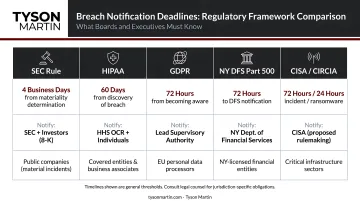
Miss these windows and the breach becomes a compliance violation on top of a security incident.
An IRP Is a Measurable Financial Control
IBM's 2021 Cost of a Data Breach report is direct: organizations with an incident response team that also tested their IRP averaged $3.25 million per breach, versus $5.71 million for organizations without either — a $2.46 million difference. That $2.46 million gap is the measurable return on having a formal plan and a practiced team.
Boards Are Now Accountable for Cybersecurity Oversight
The SEC's 2023 cybersecurity disclosure rules require public companies to describe the board's oversight of cybersecurity risks and management's role in assessing material threats. The SEC has already demonstrated it will act: Blackbaud paid $3 million to settle charges over misleading breach disclosures, and SolarWinds faced charges related to known cybersecurity risk failures.
Regulators and courts examine whether boards exercised reasonable oversight before an incident. An IRP — approved at the board level, tested annually — is a core element of demonstrating that governance was in place.
How to Build Your Cyber Attack Incident Response Plan: The Six Core Phases
NIST SP 800-61 Rev. 3, published in April 2025, organizes incident response as a lifecycle aligned to the six NIST CSF 2.0 functions: Govern, Identify, Protect, Detect, Respond, and Recover. The Govern and Identify functions set the strategic context — defining what you're protecting and who is accountable — before an incident ever occurs.
Most practitioners organize the operational response into six phases:
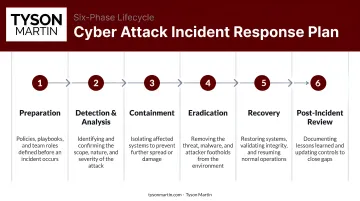
Preparation
Preparation is the foundation of everything else. Done poorly, every subsequent phase will be slower and more costly.
This phase includes:
- Conducting a threat and risk assessment to identify critical assets and likely attack vectors
- Defining what constitutes a security incident (and what doesn't)
- Assigning team roles, backup contacts, and escalation chains
- Building the communications plan — including out-of-band channels for use when primary systems are compromised
- Acquiring and configuring the tools needed to detect and respond
Tyson Martin's advisory engagements treat preparation as an ongoing discipline, not a one-time build. The 90-day framework he uses with new clients targets a working IRP with named roles, a tested call tree, and defined escalation rules within the first 30 days — before anything else.
Detection and Analysis
Detection means continuously monitoring networks and endpoints for anomalous activity, triaging alerts to separate real incidents from false positives, and formally declaring an incident when confirmed.
How fast you find it determines how much it costs. IBM's 2024 data found that internal detection shortened the breach lifecycle by 61 days and saved nearly $1 million compared with attacker-disclosed breaches. Organizations that find out from the attacker — or from a regulator or journalist — pay significantly more.
SIEM and EDR tools are central to this phase. According to the SANS 2024 SOC Survey, EDR/XDR was the highest-reported initial trigger for incident response, with endpoint security alerts driving the most detections among surveyed security operations teams.
Containment
Containment has two objectives: short-term isolation of affected systems to stop the spread, and longer-term hardening of unaffected systems while investigation continues.
This is where pre-approved decision rights matter most. Someone needs the authority to take systems offline without cycling through approvals that cost critical hours. Organizations without pre-defined shutdown authority routinely lose that window while waiting for sign-off from executives who were never briefed in advance.
Eradication
Eradication involves:
- Identifying the root cause of the incident
- Removing all traces of the threat — malware, unauthorized access, compromised credentials
- Scanning for residual risk across connected systems
- Patching or hardening affected systems before returning them to service
Organizations that compress this phase to accelerate recovery frequently face a second incident within weeks — against the same threat actor using the same entry point.
Recovery
Recovery means restoring systems from clean, verified backups, validating that operations are fully functional, and monitoring carefully for signs of reinfection. This is also when the organization communicates progress to internal leadership, affected customers, and regulators as required.
A critical readiness question: when did you last test your backups? Many organizations discover mid-incident that restores were never validated — turning what should be a hours-long recovery into a multi-day outage.
Post-Incident Review
After the incident is resolved, the team conducts a structured lessons-learned review: what happened, what the response got right, where it fell short, and what changes must be made to the IRP, controls, or team structure.
The review produces two things that matter beyond the incident itself:
- A documented record that supports legal proceedings, regulatory inquiries, and insurance claims
- Specific changes to the IRP, escalation thresholds, or team structure — with owners and timelines attached
Critical Elements That Make an IRP Executable
The six phases are the skeleton. These components determine whether the plan actually functions under pressure.
Incident Response Team and Decision Rights
An effective CSIRT includes:
- Incident response lead with clear authority to coordinate
- Security operations for technical investigation and containment
- Legal counsel for privilege protection and regulatory obligations
- Communications/PR for external messaging
- Senior executive representation for decisions that carry business consequences
The composition matters less than the pre-approved decision rights. The plan must specify — in writing, before any incident occurs — who can authorize isolating a system, who can engage law enforcement, who can approve a public disclosure, and who can authorize emergency spend.
That framework answers five questions without debate: who accepts risk at what threshold, who approves security exceptions, who decides budget tradeoffs, who declares incident severity, and who owns vendor go/no-go decisions for critical suppliers.
When those answers are written down and reviewed by executive leadership, organizations stop negotiating authority during the crisis and start solving the problem.
Risk Classification Matrix
The IRP must include a tiered severity framework — P1 through P4 — that defines which incidents trigger which level of response:
| Tier | Description | Response Requirement |
|---|---|---|
| P1 | Critical — active breach, major data loss, critical system down | Immediate response; executive and board notification |
| P2 | High — significant threat, regulatory exposure | Rapid response; executive notification within hours |
| P3 | Moderate — contained threat, limited business impact | Standard response; management notification |
| P4 | Low — minor event, no business impact | Routine handling; documented for trend tracking |
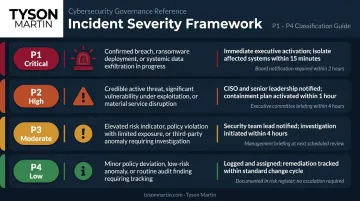
Without a pre-agreed matrix, teams waste the first critical hours debating severity instead of containing damage.
Communications Plan
The communications plan is a separate, detailed component that specifies:
- Who notifies whom internally, with backup contacts
- How regulators, customers, and law enforcement are informed — and in what sequence
- Pre-drafted notification templates for common scenarios
- Who has authority to speak externally (and who explicitly does not)
- Out-of-band communication channels if primary systems are compromised
The last point is often missing entirely. If your email server is down or your Slack workspace is compromised, how does the team coordinate? That answer must exist before the attack.
Performance Metrics
Measuring response effectiveness is what separates a functioning IRP from a document that looks good on paper. Three metrics matter most:
- MTTD (Mean Time to Detect): Time elapsed between attacker entry and first detection
- MTTC (Mean Time to Contain): Time from detection to stopping lateral spread
- MTTR (Mean Time to Recovery): Time from containment to full operational restoration
These metrics give boards a concrete way to track progress over time — faster containment, faster restores, and tested confidence in recovery results. Reporting only "we had no incidents" tells the board nothing useful.
Common Mistakes That Turn an IRP Into a Paper Exercise
The plan exists but has never been tested. Teams have never walked through their roles. Decision authority is unclear. The communications plan has outdated contact information. A plan that has not been exercised is not a plan — it is a binder that creates false confidence.
The governance gap. Most IRPs are built entirely by the security team and never reviewed or approved at the board level. Board members don't know their oversight obligations during an incident. Executives are unfamiliar with escalation thresholds.
Without board-level review and pre-approved decision rights, the plan lacks the authority to hold in a real crisis.
Most IRPs are also built around the wrong threats. Plans written only for ransomware and phishing fail when the incident involves a third-party vendor compromise, an insider threat, or simultaneous multi-system failures. A risk-based plan addresses your organization's actual exposure — not a generic template built for someone else's threat environment.
The update failure. Organizations treat the IRP as a one-time deliverable. Technology changes. People turn over. Regulations shift. A stale plan can be worse than no plan because it sends teams toward outdated contacts, deprecated systems, and procedures that no longer exist.
How to Test and Maintain Your Incident Response Plan
Testing Standards
The minimum: an annual tabletop exercise that walks the full CSIRT — including executive and board representation — through a realistic attack scenario. PCI DSS v4.0.1 requires IRP review and testing at least every 12 months. FFIEC guidance requires periodic scenario planning and tabletop exercises for financial institutions.
More mature organizations run full simulations and red team exercises on a shorter cycle. Any significant incident or material change to your environment should trigger an immediate review — don't wait for the annual schedule.
What an Effective Tabletop Tests
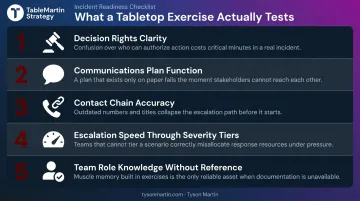
A well-designed tabletop exercise isn't theater — it's a decision drill. Effective exercises test:
- Clarity of decision rights under pressure
- Whether the communications plan actually functions
- Accuracy of contact chains (including after-hours numbers)
- Speed of escalation through severity tiers
- Whether team members know their roles without referencing the document
Tyson Martin structures executive tabletops with timed injects every 10 to 15 minutes — new facts, rumors, or regulator notices that force decisions with limited information. Participants draft external statements during the exercise. Every session ends with a short action list: owner, due date, risk if it slips. Follow-up continues until actions close.
An exercise that exposes a broken contact chain or unclear decision authority is a success — that same gap discovered mid-breach is not recoverable.
Triggers for Immediate Plan Review
Don't wait for the annual cycle when any of these occur:
- New technology adoption that changes your attack surface
- Significant staff changes within the CSIRT
- Regulatory changes affecting notification requirements
- A real incident of any scale
- Findings from a tabletop exercise
- A merger, acquisition, or major organizational restructuring
Document and formally approve each annual review at the senior leadership level. When regulators or insurers ask whether your plan was current at the time of an incident, that paper trail is your answer.
Frequently Asked Questions
What is a cyber incident response plan?
A cyber incident response plan is a pre-approved organizational playbook that specifies how to detect, respond to, and recover from a cyber attack. Its dual purpose: limiting damage and satisfying regulatory notification requirements that carry specific timeframes and documentation obligations.
What are the steps in the cyber incident response process?
The six core phases are Preparation, Detection and Analysis, Containment, Eradication, Recovery, and Post-Incident Review. This structure follows NIST SP 800-61 guidance, now aligned to the NIST CSF 2.0 framework published in final form in April 2025.
What are P1, P2, P3, and P4 incidents?
These are severity tiers in a risk classification matrix. P1 is critical and triggers immediate response with executive and board notification; P2 is high, P3 moderate, and P4 low. Each tier's definitions, escalation timelines, and notification thresholds should be pre-approved in your IRP before an incident occurs.
How do you test an incident response plan?
Three primary methods exist: tabletop exercises (scenario walkthroughs with the full response team), functional drills (testing specific components like the communications plan), and full-scale simulations. Tabletops offer the most accessible entry point and deliver strong value for executive and board readiness.
How often must the cybersecurity incident response plan be tested?
Annual testing is the baseline requirement — explicitly mandated by PCI DSS and expected under FFIEC and HIPAA guidance. High-risk environments and organizations subject to SEC disclosure rules should test more often, and the plan should be reviewed immediately after any real incident or material organizational change.
What is the difference between CSIRT and SOC?
A SOC (Security Operations Center) continuously monitors for threats on a day-to-day basis. A CSIRT (Computer Security Incident Response Team) is a cross-functional group — including legal, communications, and executive leadership — activated specifically to manage and coordinate the response when an incident is formally declared. Many organizations have both; they serve distinct functions.