Introduction
A ransomware attack hits at 2 a.m. Systems start going dark. Your IT team knows exactly what to do technically — but does your CEO know whether to authorize shutting down production systems? Does your General Counsel know when to call your cyber insurer? Does your communications lead have a pre-approved holding statement, or are they waiting for approval that nobody has authority to give?
That's the problem cybersecurity tabletop exercises are designed to solve — before the attack, not during it.
The average cost of a data breach reached $4.88 million in 2024, up from $4.45 million the year prior. For financial services organizations, that figure jumps to $6.08 million. Most of that cost doesn't come from the breach itself. It comes from the confusion, delayed decisions, and communication failures that follow.
This guide covers what you need to make that preparation count:
- What a tabletop exercise is and how it differs from technical drills
- Why it matters for governance, compliance, and board oversight
- Who belongs in the room — and what each role is expected to decide
- How to run one effectively and turn findings into action
Key Takeaways
- A cybersecurity tabletop exercise is a discussion-based simulation that tests people, processes, and decisions — not live systems
- The most common failures are governance failures: unclear decision rights, missing escalation authority, and untested cross-functional coordination
- Executive and board participation is not optional — the highest-stakes decisions belong to the C-suite
- Annual exercises satisfy PCI DSS, DORA, and HIPAA requirements — run additional exercises after major organizational changes
- After-action reports must be written for two audiences: the technical team and the board
What Is a Cybersecurity Tabletop Exercise?
NIST SP 800-84 defines a tabletop exercise as "a discussion-based exercise where personnel with roles and responsibilities in a particular IT plan meet in a classroom setting to validate the content of the plan by discussing their roles during an emergency."
In practice, that means gathering the people who would actually respond to a cyber incident — IT, legal, communications, finance, and executive leadership — and walking them through a realistic scenario to see how they'd respond. No live systems are touched. No operations are disrupted.
The only thing being tested is whether your people and processes actually work together under pressure.
What a Tabletop Exercise Is Not
This distinction matters because organizations frequently confuse tabletops with other security activities:
- Penetration test: no technical exploitation of real systems
- Full-scale operational drill: no simulated system shutdowns or live recovery procedures
- Policy walkthrough: passive document review doesn't test decision-making under pressure
A tabletop exercise is active, scenario-driven, and puts real decisions in front of the people who own them — before an incident forces the issue.
Framework Alignment
Tabletop exercises align with the NIST Incident Response Lifecycle (SP 800-61), which organizes incident handling into four phases:
| Phase | Governance Use in a Tabletop |
|---|---|
| Preparation | Validate authority, escalation paths, and continuity assumptions |
| Detection and Analysis | Rehearse what leaders need to know before declaring an incident |
| Containment, Eradication, and Recovery | Test decision rights for shutdowns, ransom posture, and recovery priorities |
| Post-Incident Activity | Confirm lessons-learned ownership and board reporting |
NIST CSF 2.0 captures the improvement outcome in ID.IM-02: "Improvements are identified from security tests and exercises." Regulatory frameworks including HIPAA, PCI DSS, DORA, and NIS2 require incident response testing — and tabletop exercises satisfy that expectation.
Why Tabletop Exercises Matter: The Business and Governance Case
Gap Discovery Before an Adversary Gets There First
The primary value of a tabletop exercise is finding what doesn't work before a real incident forces that discovery.
Organizations consistently discover three categories of gaps during their first exercise:
- Decision rights confusion — nobody knows who can authorize shutting down production systems, approving emergency spending, or speaking to the press
- Escalation failures — no defined incident commander, no clear call tree, no pre-approved triggers for when the board gets notified
- Cross-functional coordination breakdowns — IT, legal, communications, and finance have never actually coordinated on a cyber scenario together
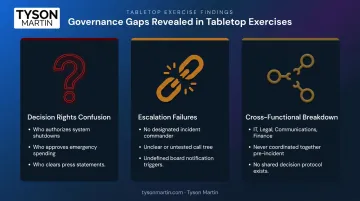
These aren't technical gaps. They're governance gaps. And they're invisible until you run the exercise.
The Compliance Case
Multiple regulatory frameworks now treat incident response testing as a documented requirement, not a best practice:
| Framework | Requirement | Frequency |
|---|---|---|
| PCI DSS v4.0 | Incident response plan must be tested (Req. 12.10.2) | At least every 12 months |
| DORA | Tests on ICT systems supporting critical functions (Art. 24) | At least yearly |
| HIPAA | Periodic testing and revision of contingency plans (45 CFR 164.308) | Periodic |
| SEC Rules | Board oversight and incident disclosure processes (Item 106, Form 8-K) | Annual disclosure + 4-day incident reporting |
The SEC's cybersecurity disclosure rules deserve specific attention. Form 8-K Item 1.05 generally requires material cyber incident disclosure within four business days of a materiality determination. If your executives have never rehearsed what "material" means or who makes that call, those four days will be chaotic.
The Board Governance Angle
That four-day clock is a board-level problem, not an IT problem. A well-designed tabletop surfaces the authority questions that belong at the board level:
- Who has authority to take critical systems offline?
- Who approves ransom payment discussions (even if the policy is "we don't pay")?
- What single spokesperson is authorized to communicate with regulators and media?
- When does the board chair receive notification, and what does that first update include?
When these questions surface mid-exercise without clear answers, that's a governance finding — and one worth fixing on paper rather than under pressure.
Who Should Be in the Room: Roles and Participants
The Four Core Roles
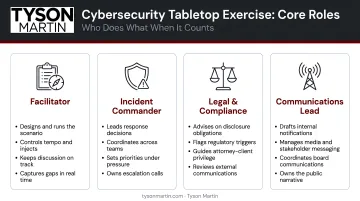
Every effective tabletop exercise needs four defined roles:
- Facilitator — guides the scenario and discussion without doing the thinking for participants; keeps the exercise moving and prevents one voice from dominating
- Participants — the active responders representing each functional area: IT, Legal, Communications, Finance, Operations, and executive leadership
- Evaluator — observes without participating; documents what works and what breaks down for the after-action report
- Observer — a subject matter expert (often a senior security leader or outside advisor) who can answer questions and flag blind spots as they emerge
Why Executive Participation Is Non-Negotiable
The most important decisions during a real cyber incident don't belong to the IT team. They belong to the C-suite. Whether to notify law enforcement, how to communicate with regulators, how to protect shareholder value, what the ransom posture is — these are executive decisions.
If those stakeholders have never rehearsed their role before a breach, they won't perform it well during one. In real incident response, confusion in the first hour drives cost and reputational damage. Unclear authority means delayed containment — and delayed containment compounds both the technical and regulatory exposure.
The recommended participant list for a comprehensive exercise includes: CEO, General Counsel, CISO (or equivalent), CFO, COO, Communications lead, and the executive who owns the most critical business process being tested.
The Case for an Outside Facilitator
Organizations without a standing CISO — and many that have one — benefit from engaging an experienced outside advisor to design, facilitate, and debrief the exercise.
An external facilitator brings independence that internal teams can't replicate. They challenge assumptions without organizational politics getting in the way, surface governance gaps that insiders may be too close to see, and translate technical findings into the risk language boards and audit committees need for defensible oversight.
For Tyson Martin's board advisory clients, this combination of scenario design, live facilitation, and board-level after-action reporting produces governance controls with clear owners — not just a list of follow-up items that stalls at the next leadership transition.
How to Run a Cybersecurity Tabletop Exercise Step by Step
Step 1 — Define Objectives and Select a Scenario
Before building any scenario, identify what the exercise is designed to test. Communication flow between IT and the executive team? Decision-making authority during ransomware? Regulatory notification timelines for a data breach?
A clear objective shapes every other design decision. The scenario should reflect realistic threats for your industry and size — according to the 2024 Verizon Data Breach Investigations Report, ransomware and extortion appeared in 32% of breaches, while third-party involvement grew 68% year over year to account for 15% of incidents. Those numbers belong in your scenario selection conversation.
Step 2 — Assemble the Right Team and Assign Roles
Identify who must be in the room based on the scenario. A ransomware exercise needs IT, Legal, Finance, and the CEO at minimum. A data breach scenario adds Communications and Compliance. Send pre-read materials in advance. Participants should arrive with context, not confusion.
Assign the facilitator and evaluator roles explicitly before the session begins.
Step 3 — Design the Scenario and Inject Questions
Build the scenario as a realistic narrative that unfolds in stages. Prepare a series of "inject" questions — prompts that force specific decisions at each stage. Effective injects include deliberate complications:
- The IT lead is unreachable
- The email system is compromised
- A journalist has already called with specific questions
- Backup restoration is taking twice as long as expected
- A second system appears to be affected

More than stress-testing decisions under compounding pressure, these curveballs expose which assumptions in your incident response plan were never actually tested against reality.
Step 4 — Run the Session
The facilitator presents the scenario, poses inject questions, and guides discussion without answering for the group. The goal is honest conversation, not performance. Remind participants upfront: there are no wrong answers. The exercise exists to discover what the organization doesn't yet know about itself.
Sessions typically run between one and four hours depending on complexity. A focused 60-minute board-level tabletop covers the critical executive decision points without requiring a full-day commitment.
Step 5 — Conduct an Immediate Debrief (Hot Wash)
Within minutes of the exercise ending, while observations are fresh, the facilitator leads a brief debrief around three questions:
- What worked well?
- Where did communication or decision-making break down?
- What needs to change before the next real incident?
Capture all responses immediately. The debrief output feeds directly into the after-action report — and that report is where the exercise's real value gets documented and acted on.
Common Cybersecurity Tabletop Exercise Scenarios
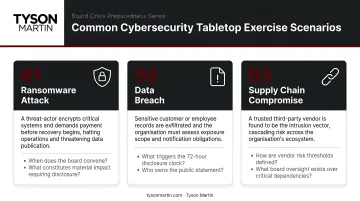
These three scenarios consistently surface the most consequential gaps in enterprise response: authority confusion, regulatory timing, and third-party blind spots. Each one is designed to stress-test decisions — not just procedures.
Ransomware Attack
Employees arrive at work to find systems locked and a ransom demand on their screens, with no clear path to immediate recovery. Backups exist — but no one has tested whether restoration actually works within business hours.
Key inject questions:
- Who has authority to authorize ransom payment discussions, and what's the pre-set policy framework?
- How does the organization communicate internally when email is compromised?
- What is the business continuity threshold — how many hours offline triggers critical operational impact?
- When do you contact your cyber insurer, and who makes that call?
Data Breach Involving Customer or Patient Records
An IT security team detects that a foreign device has been silently scraping customer records for two weeks. The exposed data likely includes PII and payment records.
Questions to pressure-test:
- What are the regulatory notification timelines, and who owns that process — legal, compliance, or both?
- How does the organization communicate to affected customers without triggering panic or legal liability?
- Has materiality been determined? If so, how does the four-day SEC disclosure clock apply?
Supply Chain or Third-Party Vendor Compromise
Vendor-side breaches introduce a different challenge: the organization has no direct control over the incident timeline or disclosure. A widely used SaaS platform announces they've been breached, and the organization's data may have been exposed through that vendor's systems.
Discussion prompts:
- Who owns the vendor relationship response — procurement, IT, or legal?
- How quickly can the organization assess its actual exposure through that vendor?
- What contractual and regulatory obligations are triggered, and who is responsible for activating them?
What to Do After the Exercise: Turning Insights into Governance Action
Write an After-Action Report for Two Audiences
Most after-action reports are written only for the IT team. That's a governance failure.
The report needs two distinct sections:
- For the technical team: Specific, prioritized remediation actions with named owners and deadlines
- For the board or audit committee: A plain-language summary of what the exercise revealed about risk posture, decision rights, and governance gaps — written so directors can act on it, not just file it
Board reporting should use business impact language. Instead of "the IR plan needs to be updated," the board version reads: "We identified three decision points where authority was unclear. We are resolving this by [specific date] through [specific action], with [named executive] accountable."
Close the Gaps with Accountability
An exercise that generates a findings list with no accountability or timeline is not preparedness — it produces the appearance of readiness without the substance.
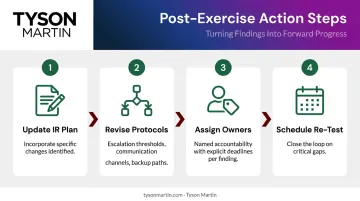
After each exercise:
- Update the incident response plan with specific changes
- Revise escalation thresholds and communication protocols, including backup channels for when email is unavailable
- Assign named owners to each remediation item with explicit deadlines
- Schedule a re-test for critical gaps
Establish a Sustainable Cadence
Annual executive tabletop exercises are the most defensible baseline for most organizations. They satisfy PCI DSS's 12-month testing requirement, DORA's yearly testing mandate, HIPAA's periodic testing standard, and support SEC and NIS2 governance oversight expectations.
Beyond annual exercises, additional drills are warranted after:
- A merger or acquisition (run a tabletop within the first 45 days)
- A new CISO, CIO, or significant leadership change
- A major technology migration or vendor change
- A real incident (as part of post-incident review)
Shorter micro-exercises — 15 to 30 minutes focused on a single decision scenario — maintain team readiness between full exercises without the scheduling burden of a multi-hour session.
Frequently Asked Questions
What is an incident response tabletop exercise?
An incident response tabletop exercise is a specific type of cybersecurity tabletop focused on testing the organization's formal incident response plan. Participants walk through how they would detect, contain, eradicate, and recover from a specific cyber incident, surfacing gaps in the plan before a real crisis forces the discovery.
What are the phases of incident response?
The NIST incident response lifecycle includes four phases: Preparation, Detection and Analysis, Containment/Eradication/Recovery, and Post-Incident Activity. Tabletop exercises are valuable in both the Preparation phase and as part of post-incident lessons-learned review.
How often should organizations run a cybersecurity tabletop exercise?
Most regulated organizations should run at least one executive tabletop annually: PCI DSS and DORA both anchor to annual or 12-month testing requirements. Additional exercises should follow major organizational changes such as M&A, new leadership, significant technology shifts, or following a real incident.
Who should facilitate a cybersecurity tabletop exercise?
The facilitator needs both cybersecurity knowledge and the ability to guide executive-level conversation — either a senior internal security leader (CISO) or an experienced outside advisor. Organizations without a dedicated security executive typically benefit most from an external facilitator, who can surface governance gaps without internal politics shaping the outcome.
How long does a cybersecurity tabletop exercise typically take?
Full exercises run between one and four hours depending on scenario complexity and participant count. Shorter micro-exercises (15–30 minutes on a single scenario) work well for maintaining readiness between annual sessions.
What is the difference between a tabletop exercise and a penetration test?
A penetration test involves technical experts actively attempting to exploit real systems to identify vulnerabilities. A tabletop exercise is a discussion-based simulation testing how leaders communicate, decide, and escalate under pressure. No live systems are involved. Both serve distinct roles in a comprehensive security program — one tests your technology, the other tests your team.