s & Preparation Activities](https://file-host.link/website/tysonmartin-zzqimp/assets/blog-images/45b8d77e-c2b2-4209-8d06-0a667b0ed96f/1780325020104499_1ffb6e0ec6fc4b429c00b5ce0697442e/360.webp)
Introduction
Most organizations have an incident response plan. Far fewer have ever tested it.
That gap matters more than most boards realize. When a ransomware attack hits at 2 a.m., the question isn't whether your team knows what NIST says — it's whether they know who can authorize taking a production system offline, who approves the customer notification, and who calls the regulator. Those decisions don't get made by a document. They get made by people under pressure.
A NIST incident response tabletop exercise is a structured, discussion-based simulation that walks executive and security teams through a realistic cyber incident scenario to test those decisions before a real attack forces a live test. Most organizations treat them as an IT drill. They're not.
The gaps tabletops surface are leadership gaps: unclear decision rights, untested communication chains, and boards that have approved a plan they've never actually rehearsed.
This guide covers what these exercises are, why they belong on the board's agenda, how they work, and what preparation makes them worth the time.
Key Takeaways
- A NIST IR tabletop exercise is a facilitated, discussion-based simulation where cross-functional teams walk through a cyber incident to test decision-making, communication, and response procedures.
- NIST SP 800-61 Rev. 2 defines the four-phase IR lifecycle; SP 800-84 provides the exercise methodology.
- Effective exercises require an updated IR plan, defined decision rights, realistic scenarios, and participants beyond IT — legal, communications, and executives included.
- PCI DSS, HIPAA, FFIEC, and ISO 27001 all require incident response testing — the exercise is the evidence.
- Post-exercise deliverables — documented gaps, updated playbooks, and an after-action report — are what hold up under audit and board review.
What Is a NIST Incident Response Tabletop Exercise?
A tabletop exercise is a facilitated, discussion-based activity where key personnel walk through a simulated cyber incident — ransomware, data breach, insider exfiltration — to evaluate whether their plans, roles, and communication channels actually work. No systems are touched. No equipment is deployed. The exercise tests the human and governance layer.
The NIST Framework Behind It
Two publications define the methodology:
- NIST SP 800-61 Rev. 2 defines the four-phase IR lifecycle: Preparation; Detection and Analysis; Containment, Eradication, and Recovery; and Post-Incident Activity. This is the operational framework every IR plan should follow. Note: Rev. 3 (finalized April 2025) reframes incident response around the NIST Cybersecurity Framework 2.0 functions — Govern, Identify, Protect, Detect, Respond, and Recover.
- NIST SP 800-84 defines tabletop exercises as discussion-based events where personnel with IR roles meet, receive a scenario from a facilitator, and work through responsibilities, coordination, and decision-making. This is the methodology standard for designing and running the exercise.
How Tabletops Differ from Other Testing Methods
| Method | What It Tests | What It Doesn't Touch |
|---|---|---|
| Penetration test | Technical defenses, exploitable vulnerabilities | Governance, decision rights, communications |
| Full-scale operational drill | Actual response actions, system procedures | Speed and practicality for routine use |
| Tabletop exercise | Decision-making, coordination, communication | Live systems or operational disruption |
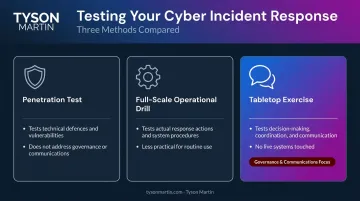
Tabletops don't replace technical testing. They test the decision-making and governance layer — the part that determines whether a well-documented plan actually holds when leadership has to make a call in the first hour.
Why NIST-Aligned Tabletop Exercises Matter for Boards and Executives
The Regulatory Expectation Is Already There
Incident response testing is no longer a best practice — it's an explicit expectation across major frameworks:
- PCI DSS v4.0.1 Requirement 12.10.2 requires that the incident response plan be reviewed, updated, and tested at least annually, covering all elements in Requirement 12.10.1. A documented tabletop can support this evidence if it covers those required elements.
- HIPAA (45 CFR 164.308(a)(6)) requires policies and procedures to address security incidents, including response, documentation, and reporting. A proposed HHS rule published in January 2025 would add more explicit annual testing requirements — treat it as proposed until finalized.
- FFIEC guidance for financial institutions references exercise resources including the Cyber Attack Against Payment Systems (CAPS) tabletop exercise for incident response teams.
- ISO/IEC 27001:2022 includes controls 5.24 (incident management planning and preparation) and 5.26 (response to information security incidents) that expect tested, documented response procedures.
The SEC Governance Dimension
The SEC's cybersecurity disclosure rule (effective for fiscal years ending December 15, 2023 and after) requires annual disclosure of board oversight of cybersecurity risk under Regulation S-K Item 106, and mandates disclosure of material cybersecurity incidents on Form 8-K Item 1.05 within 4 business days after determining materiality — not 4 days after discovery.
That distinction matters. "Materiality" is a judgment call made under pressure by leadership. A board that has never rehearsed that decision is making it for the first time during a live incident — with regulators, counsel, and the clock all waiting. Tabletop exercises are the mechanism for practicing that judgment before it counts.
The Decision Rights Problem
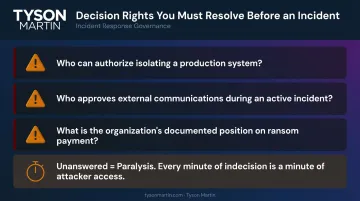
One of the most consistent findings from incident response exercises is that decision authority isn't actually clear. Three questions tend to expose the gap immediately:
- Who can authorize isolating a production system?
- Who approves external communications during an active incident?
- What's the organization's documented position on ransom payment?
Without pre-tested escalation thresholds, real incidents produce paralysis. Every minute spent negotiating authority is a minute the attacker still has access.
How NIST Incident Response Tabletop Exercises Work
The exercise moves through a structured sequence: define objectives, assemble participants, present a scenario with evolving new information at intervals, facilitate discussion, debrief, and produce an after-action report. It functions as a diagnostic tool — the goal is identifying gaps, not grading performance.
Step 1: Define Objectives and Success Criteria
Objectives must be specific before the room convenes — vague objectives produce conversation, not insight. Examples of measurable objectives:
- Confirm that escalation from IT to legal to executive leadership follows a defined path
- Validate that the communications team knows when and how to engage during an active incident
- Determine whether containment decisions can be made within a defined timeframe
- Test whether the board notification threshold is clearly understood by everyone in the room
Step 2: Assemble Cross-Functional Participants
An IT-only tabletop will find IT-only gaps. Effective exercises require:
- Legal and compliance — regulatory notification obligations, outside counsel engagement
- HR — insider threat handling, employee communication
- Communications/PR — customer messaging, media response, draft statement approval
- Executive leadership to authorize resources and drive business continuity decisions
- A board representative or audit committee member for governance oversight and fiduciary accountability
Assign clear roles: a facilitator guides the session, participants engage with the scenario, a scribe/evaluator documents decisions and gaps, and an observer (often a senior advisor or CISO) surfaces blind spots the team may miss.
Step 3: Present the Scenario with Evolving Information
Scenarios should reflect the organization's actual threat landscape. Generic hypotheticals produce abstract conversations. Strong scenarios draw from:
- Threat intelligence relevant to the organization's industry and systems
- Prior incidents or near-misses
- CISA's free Tabletop Exercise Packages (CTEPs), which include customizable scenarios, discussion questions, and after-action report templates
Present the scenario in phases: initial alert, escalation trigger, then new complications introduced at intervals. A regulator calls. A backup restoration fails. A media inquiry arrives.
This structure mirrors how real incidents unfold, forcing participants to make decisions with incomplete information rather than a fully-understood problem.
Step 4: Debrief and Produce an After-Action Report
The session isn't over when the scenario ends. The structured debrief is where governance value is captured.
The after-action report should document:
- What decisions were made, by whom, and on what authority
- Where communication broke down or was ambiguous
- Which procedures were unclear, absent, or contradicted each other
- Specific remediation action items with owners and target dates
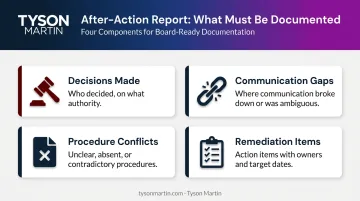
This report is the evidence artifact regulators and auditors expect to see. Without it, the exercise has no documented record of what was tested, what failed, or what the organization committed to fix.
Essential Preparation Activities Before Running a Tabletop Exercise
The most common reason tabletop exercises produce little value: organizations run them against an outdated or incomplete incident response plan.
Update the IR Plan First
Before scheduling the exercise, confirm the IR plan reflects:
- Current systems and infrastructure
- Current personnel and escalation contacts (not last year's org chart)
- Relevant regulatory notification timelines — GDPR requires notification within 72 hours of becoming aware of a qualifying breach; NYDFS-regulated entities have a 72-hour notification window to DFS; the SEC's 4-business-day clock starts after a materiality determination
If the plan references systems that no longer exist or contacts who left the company, the exercise will surface those gaps the hard way.
Define Decision Rights Before the Exercise
Decision rights should be pre-decided, not discovered during a simulated crisis. Before the exercise, establish documented answers to:
- Who can approve taking a system offline if it disrupts business operations?
- Who authorizes external communications or public statements?
- Who interfaces with law enforcement or regulators?
- What is the organization's documented position on ransom payment?
- At what threshold does a security event become a board-level matter?
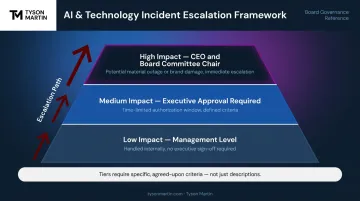
A tiered escalation model solves this directly: low impact stays with management, medium impact requires executive approval with time limits, high impact (potential material outage or brand damage) escalates immediately to the CEO and board committee chair. The tiers need specific, agreed-upon criteria — not just descriptions.
Design Scenarios That Create Pressure
Scenarios should be grounded in the organization's actual threat profile. Industry-specific examples that apply pressure:
- Healthcare: Ransomware affecting clinical systems with patient data exposure
- Retail: Payment card compromise with a media inquiry arriving mid-incident
- Financial services: A regulator calls before the internal investigation is complete
Every scenario should include at least one inject that tests board-level communication — a regulator inquiry, a media report, or a customer notification requirement that forces the group to draft an actual statement, not just discuss one.
Consider Independent Facilitation
Organizations without a dedicated CISO — or those where the CISO is also being evaluated by the exercise — often get more from an independent external advisor designing and facilitating the tabletop. Internally facilitated exercises tend to avoid the organization's actual blind spots — by design or accident.
An independent facilitator structures the exercise against external standards rather than internal assumptions, and produces an after-action report that holds up under board review or regulatory audit. Tabletop exercises are a core component of Tyson Martin's interim CISO engagements — typically embedded in the first 30-60 days when building incident readiness from scratch.
Common Mistakes That Undermine Tabletop Exercise Value
Running It as an IT-Only Event
When only IT and security attend, the exercise finds only IT and security gaps. The governance, legal, communication, and executive decision-making failures — the ones that actually determine whether an organization handles an incident well or poorly — never surface. Boards and executives who aren't in the room cannot learn whether they're capable of making defensible decisions quickly enough.
No Follow-Through After the Exercise
Many organizations conduct a tabletop, surface real gaps, and then file the after-action report without updating the IR plan, assigning remediation owners, or scheduling a follow-up. An exercise without documented follow-through is a compliance artifact. Auditors and regulators increasingly distinguish between organizations that test their plans and organizations that produce evidence of having tested their plans.
Scenarios That Don't Create Real Pressure
Scenarios that are too generic, too catastrophic, or too technically removed from the organization's real environment generate theoretical discussion instead of actionable decisions. The scenario needs to be uncomfortable enough to create pressure but grounded enough that participants recognize it as something that could actually happen to their organization.
A scenario involving a fictional industry or an implausible attack chain lets people stay comfortable — and comfort is exactly what a well-designed exercise should disrupt. The facilitator's job is to watch for the moment participants stop debating the scenario and start debating their own decision-making gaps. That's when the exercise is working.
The three failure patterns above share a common root: treating the exercise as a process to complete rather than a capability to test. Each one produces a document. None of them produce a better-prepared organization.
- IT-only attendance limits what gaps the exercise can expose — governance and executive failures stay invisible
- No follow-through converts real findings into shelf documents with no remediation path
- Low-pressure scenarios let participants stay theoretical, avoiding the friction that reveals actual decision-making weaknesses
Frequently Asked Questions
What is the difference between NIST SP 800-61 and NIST SP 800-84 in the context of incident response exercises?
SP 800-61 defines the incident response lifecycle — how organizations handle incidents through preparation, detection, containment, and post-incident review. SP 800-84 provides the methodology for testing that process through exercises, drills, and simulations. They're complementary: 800-61 is what you're testing, 800-84 is how you design the test.
How often should organizations run NIST-aligned incident response tabletop exercises?
NIST and most compliance frameworks recommend at least annual tabletop exercises. High-risk organizations and those in regulated industries should consider quarterly executive scenario drills. Exercises should also follow any significant change in systems, leadership, or threat environment — not just calendar dates.
Who should participate in a NIST incident response tabletop exercise?
Effective participation requires IT/security, legal, HR, communications/PR, and executive leadership. Board-governed organizations should include a board representative or audit committee member. The exercise should not be limited to the technical team — the gaps it needs to find are governance and decision-making gaps, not technical ones.
Do tabletop exercises satisfy regulatory compliance requirements on their own?
A documented tabletop can satisfy testing requirements in frameworks like PCI DSS 12.10.2, HIPAA, FFIEC, and ISO 27001 — provided it's documented with an after-action report and covers the required elements. It should also sit within a broader program that includes technical testing such as penetration tests and backup restoration validation.
What is a scenario "inject" in the context of a NIST tabletop exercise?
An inject is a new piece of information introduced during the exercise at a set point — a regulator calls, media publishes a story, a backup restoration fails. Injects simulate the evolving, incomplete-information nature of real incidents and force participants to adapt their response rather than execute a pre-planned script.
What should an after-action report from a tabletop exercise include?
A complete after-action report covers:
- Scenario summary and exercise timeline
- Decisions made, and by whom
- Identified gaps in plans or communication
- Remediation action items with assigned owners and target dates
- Mapping to the compliance controls the exercise addressed
This is the document auditors and regulators will ask for.