That's the problem both cyber range exercises and tabletop exercises are designed to solve. But they solve very different versions of it. Choosing the wrong format for your organization's maturity level, audience, or objective can leave critical gaps that only become visible during an actual incident.
This article breaks down what each exercise type does, where each one fits, and how to decide which belongs in your readiness calendar — or whether you need both.
Key Takeaways
- Cyber range exercises simulate real attacks in a live replica environment, testing SOC teams on real-time detection and response.
- Tabletop exercises are structured, discussion-based scenarios designed to test decision-making, escalation, and cross-functional coordination — no systems touched.
- Cyber ranges require significant infrastructure investment; tabletops are lower-cost and accessible at any organization size.
- Organizations earlier in their security maturity typically start with tabletops; those with validated IR plans gain more from cyber ranges.
- Run in sequence, tabletop findings should directly inform what the cyber range stress-tests.
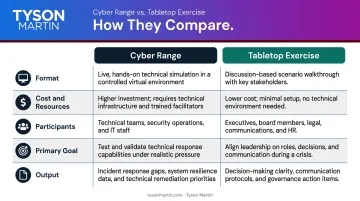
Cyber Range vs Tabletop Exercises: Quick Comparison
The two formats differ across five key dimensions — here's how they compare at a glance.
| Dimension | Cyber Range | Tabletop Exercise |
|---|---|---|
| Format | Live, hands-on-keyboard simulation | Facilitated discussion, no live systems |
| Cost & Resources | High — requires infrastructure, tooling, specialized staff | Low — facilitated internally or with an advisor |
| Participants | Security and technical operations personnel | Executives, legal, communications, HR, IR team |
| Primary Goal | Test technical detection, containment, response speed | Validate decision-making, escalation paths, plan alignment |
| Output | Performance metrics on tools and response timing | Documented gaps, IR plan updates, role clarity |
What Is a Cyber Range Exercise?
A cyber range is a controlled, simulated IT environment that mirrors an organization's real network. Security teams respond to live attack scenarios — ransomware spreading across systems, data being siphoned from cloud environments, a DDoS overwhelming critical infrastructure — without any risk to production systems.
The goal is muscle memory under pressure: can your team detect the attack, contain it, and respond accurately within realistic timeframes?
The Three Phases
Cyber range exercises follow a three-part structure:
- Planning and scenario design — Define objectives, threat types, and scope. What attack are you simulating? What does success look like for defenders?
- Live execution — Defenders respond to active attack simulations, typically in a red team vs. blue team format. NIST defines the red team as the simulated adversary attempting to compromise systems, while the blue team defends.
- Debrief and scoring — Performance data is reviewed to identify tool gaps, detection delays, and response weaknesses — then mitigations are applied and the attack is rerun. FS-ISAC describes this rerun-after-fix loop as a defining feature of hands-on-keyboard simulation.
That structure makes the format well-suited to specific situations — not all of them.
Where Cyber Ranges Fit Best
Cyber ranges are built for technical validation. Common scenarios include:
- Ransomware simulation — Tests detection speed, backup integrity, and lateral movement containment
- DDoS response — Validates capacity thresholds and failover procedures
- Advanced persistent threat (APT) emulation — Stress-tests long-dwell detection capabilities
- Unauthorized device or insider threat scenarios — Evaluates access controls and anomaly detection
Regulated sectors are driving increasing demand. NERC CIP-008-6 requires electric-sector entities to test each cyber security incident response plan at least once every 15 calendar months, with operational exercises as one accepted method. The EU's Digital Operational Resilience Act (DORA) similarly requires financial entities to conduct appropriate ICT resilience testing at least yearly for systems supporting critical functions.
What Is a Tabletop Exercise?
A tabletop exercise is a structured, discussion-based activity where key stakeholders walk through a hypothetical cyber incident — no systems are activated, no technical tools are touched. The facilitator presents an unfolding scenario, and participants talk through how they'd actually respond.
What makes tabletops uniquely valuable isn't the scenario itself. It's who's in the room.
Who Belongs at the Table
A well-structured tabletop should include:
- A facilitator/moderator (internal or external)
- Incident response team lead
- Executive decision-makers (CEO, COO, CFO)
- Legal and compliance counsel
- Communications and public relations lead
- HR representative (especially relevant for insider threat scenarios)
- Board liaison or audit committee representative
The real value often comes from bringing non-technical leaders into the conversation for the first time. When legal and communications aren't accustomed to making decisions alongside the security team, the exercise exposes that coordination gap before an incident does.
How a Tabletop Exercise Works
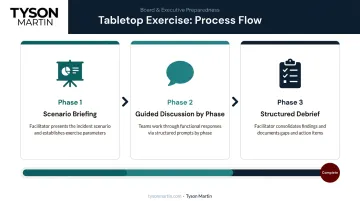
A typical tabletop follows three phases:
- Scenario briefing — Participants receive an opening situation: a ransomware attack discovered at 6am, a data leak published online, a third-party vendor breach affecting production systems.
- Guided discussion by phase — The facilitator walks the group through detection, containment, escalation, external notification, and recovery — pausing to ask who decides, who communicates, and what thresholds trigger board involvement.
- Structured debrief — The session closes with documented action items, identified plan gaps, and specific IR plan updates.
Framework Alignment and Governance Value
Several major frameworks and regulators weigh in on tabletop requirements:
- NIST SP 800-84 defines tabletop exercises as discussion-based sessions used to validate IT contingency and incident response plans — and calls them cost-effective tools for doing so.
- NIST CSF 2.0 subcategory ID.IM-02 supports improvement identification through security tests and exercises.
- CISA recommends organizations drill realistic cyber scenarios at least annually.
The SEC's 2023 cybersecurity disclosure rule doesn't directly mandate tabletop exercises, but it requires public companies to disclose their processes for assessing and managing cybersecurity risk, plus board oversight arrangements.
Running documented tabletop exercises — and using the outputs as governance inputs — is one of the clearest ways boards can demonstrate that oversight is substantive, not just described in a proxy statement.
Tyson Martin's tabletop engagements are structured specifically for this governance layer. Exercises include customized scenarios and a board disclosure rehearsal aligned to SEC Item 1.05 four-day timing.
Each engagement concludes with a structured after-action report: assigned owners, due dates, a re-test plan, a board-level disclosure playbook, and a director crisis decision guide — documentation boards can act on, not archive.
Cyber Range vs Tabletop Exercises: Which Is Right for Your Organization?
Neither format is universally better. The right choice depends on four factors: your organization's maturity, your primary audience, your available budget, and what outcome you actually need.
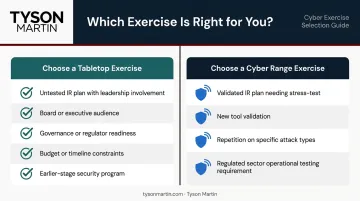
Decision Framework
Choose a tabletop exercise if:
- Your organization hasn't formally tested its IR plan with leadership in the room
- Your primary audience is the board, executive team, legal, or communications
- You need to demonstrate governance readiness to a regulator, insurer, or audit committee
- Budget or timeline constraints make a full technical simulation impractical
- You're earlier in your security program and aren't sure your plan holds together yet
Choose a cyber range exercise if:
- Your SOC team has a validated IR plan and needs to stress-test execution speed
- You're deploying new security tools and want to validate their performance under realistic load
- Your team needs repetition on specific attack scenarios like ransomware or supply chain compromise
- Regulators in your sector (financial services, energy, critical infrastructure) expect evidence of operational testing
The Case for Running Both
The strongest readiness programs use both formats — in sequence.
A tabletop surfaces the plan gaps. The cyber range tests whether the fixes hold under pressure. Organizations that skip the tabletop and go straight to a cyber range often discover mid-simulation that roles aren't clear, escalation thresholds were never defined, or legal and communications have no idea how to operate during the exercise.
The sequence that works: tabletop first, cyber range second. Validate the plan and the people before stress-testing the technology.
The Readiness Gap Most Organizations Don't Talk About
The data on exercise frequency is stark. According to the 2024 UK Cyber Security Breaches Survey, only 22% of businesses have a formal incident response plan. The SANS 2023 Incident Response Survey found 19.1% of organizations don't assess their IR processes at all, and only 17.9% assess outcomes from routine IR exercises.
The average cost of a data breach reached $4.88 million globally in 2024, up 10% from the prior year. Organizations that haven't run an exercise aren't just unprepared — they're betting that their untested plan will hold under conditions designed to break it.
Translating Outputs into Governance
After either exercise, leadership should walk away with more than a completion checkbox. The outputs should feed directly into board reporting. Documented findings with owners and deadlines, updated escalation thresholds, and a clear answer to the question boards and regulators will eventually ask: are we ready, and how do you know?
Organizations working with an independent advisor — separate from the in-house CISO, vendors, and MSSPs — translate exercise findings into defensible governance inputs more reliably. Tyson Martin structures these engagements to close with a decision log, a funded remediation plan, and a re-test commitment: outputs that hold up in front of a board or regulator, not just a summary slide filed away after the session.
Conclusion
Cyber range and tabletop exercises aren't competing options — they work at different layers of readiness. Tabletops validate your plan and your people. Cyber ranges validate your technology and your execution speed. Organizations with limited resources or newer programs typically start with tabletops; those with mature SOC teams and a tested IR plan get the most from cyber range exercises.
The goal of either exercise is to answer three questions before a real incident forces them: who decides, who communicates, and how fast does the organization respond. Exercises that never produce those answers — or that produce answers no one has rehearsed — leave the board exposed when it matters most.
If your board or executive team hasn't run a formal readiness exercise (or if you've completed one but the findings never became funded action items), that's the gap worth closing. Tyson Martin structures readiness programs specifically for board-level expectations and regulatory scrutiny — contact him to discuss where your program stands.
Frequently Asked Questions
What is a cyber range exercise?
A cyber range exercise is a hands-on simulation run in a controlled environment that replicates an organization's real network. Security teams respond to live attack scenarios — such as ransomware or cloud compromise — and practice detection, containment, and response without any risk to production systems.
What is a cyber tabletop exercise?
A tabletop exercise is a discussion-based activity where cross-functional stakeholders walk through a hypothetical cyber incident to test their incident response plan, decision-making, and communication — without activating any real systems or tools. The value lies in surfacing gaps in coordination and escalation before an actual incident exposes them.
What is the difference between a tabletop exercise and a simulation?
Simulations — including cyber range exercises — involve active, hands-on response to live-fire scenarios using real tools and environments. Tabletop exercises are purely discussion-based. The key distinction is technical engagement and realism versus strategic planning and coordination.
Can organizations use both cyber range and tabletop exercises?
Yes. Most mature security programs use both — tabletops first to validate the IR plan and leadership coordination, then cyber range exercises to stress-test technical response under pressure. The tabletop surfaces plan gaps; the range tests whether fixes hold.
How often should organizations run cyber readiness exercises?
CISA recommends drilling realistic scenarios at least annually. Tabletops benefit from higher frequency — especially after leadership changes, acquisitions, or material shifts in the threat environment. Sector-specific rules like NERC CIP require testing at least every 15 months.
Which exercise type is more useful for board-level reporting and governance?
Tabletop exercises are better suited for board-level governance. They involve executive decision-makers directly, produce documented gaps and action plans, and create evidence of due diligence that regulators, insurers, and audit committees can review. Cyber ranges generate technical metrics most relevant to security operations teams.