Introduction
Most enterprises have an incident response plan. Few have tested whether that plan holds under real decision-making pressure — and the space between those two things is where breaches escalate from contained incidents into compounding crises.
The gap isn't technical. It's organizational. When ransomware hits at 2 a.m., the plan sitting in a SharePoint folder doesn't tell you who can authorize taking production systems offline, when legal needs to be in the room, or whether your communications lead has the CEO's direct line. Those decisions either get made clearly and quickly, or they don't — and the cost difference shows up in breach scope, regulatory exposure, and board credibility.
This guide covers what tabletop exercises are, why they've become a board-level governance obligation, and how to coordinate one that actually changes behavior — not just produces a debrief report nobody reads. It's written for boards, executive teams, CISOs, general counsel, and risk leaders.
Key Takeaways
- Enterprise tabletops are structured simulations that test how leadership actually responds to a cyber crisis — not how the plan says they will
- The highest-value output is exposing decision-authority gaps before a real incident forces them open
- Effective exercises require sector-specific scenarios, cross-functional participants, time-pressured injects, and an independent facilitator
- Post-exercise outputs must be governance-grade: named owners, deadlines, and board-ready findings
- Run executive-level exercises at least quarterly, plus trigger-based drills after incidents, leadership changes, or major system changes
What Is an Enterprise Tabletop Exercise?
An enterprise tabletop exercise is a scenario-based, discussion-driven simulation in which senior leaders and cross-functional teams rehearse their response to a cyber crisis in real time — without disrupting live systems or operations.
It tests specific functions:
- Decision-making under pressure
- Cross-team coordination and escalation clarity
- Regulatory notification readiness
- Whether communication protocols hold when multiple things break simultaneously
It does not test technical vulnerabilities — that's penetration testing. A pen test tells you how an attacker gets in. A tabletop tests what happens after they're already inside: how people and processes hold up under time pressure.
Three Exercise Formats
Enterprises typically use three distinct formats, and conflating them produces weaker results from each:
- Technical tabletops — focused on SOC and IT teams; test detection, containment, and technical escalation procedures
- Executive tabletops — focused on C-suite and board-level decisions; test authority clarity, communication protocols, and regulatory notification timing
- Unified command exercises — integrate both levels; test whether technical and executive teams can coordinate effectively under shared crisis conditions
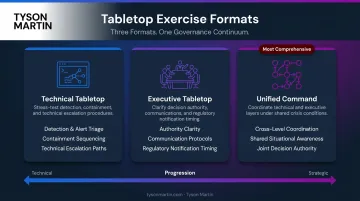
Each format serves a distinct purpose. Running all three functions in the same session typically produces the worst of both — technical participants hold back, executives defer to the technical team, and neither level gets genuinely stress-tested.
Why Enterprise Tabletop Exercises Are a Board-Level Priority
Regulatory Frameworks Now Expect Demonstrated Preparedness
Several governance frameworks place incident preparedness obligations directly at the board and executive level:
- NIST CSF 2.0 — GV.RR-01 and GV.RR-02 require that cybersecurity roles, responsibilities, and authorities are established, communicated, and enforced. ID.IM-02 requires that improvements be identified from security tests and exercises.
- SEC cyber disclosure rules — Regulation S-K Item 106 requires annual disclosure of cybersecurity risk management, strategy, and governance, including board oversight. Form 8-K Item 1.05 requires material incident disclosure within four business days of determining materiality — a timeline that demands pre-rehearsed escalation, not improvisation.
- DORA (EU financial entities) — Articles 11 and 24 require at least yearly testing of ICT business continuity, response, and recovery programs for covered financial entities.
- HIPAA — 45 CFR 164.308(a)(7)(ii)(C) requires periodic testing and revision of contingency plans.
- FFIEC — Financial institution guidance expects management to test business continuity plans periodically to validate both effectiveness and personnel capability.
Documentation of a plan no longer satisfies these obligations. Boards must demonstrate active oversight of cyber preparedness — and post-exercise findings are the primary artifact that makes that demonstration credible to regulators, auditors, and shareholders.
The Cost of a Slow Response Is Quantifiable
According to the IBM Cost of a Data Breach Report 2024, breaches with a lifecycle exceeding 200 days averaged $5.46M in total cost. Breaches contained within 200 days averaged $4.30M — a $1.16M difference driven largely by how fast organizations made and executed containment decisions.
The same report identified two specific factors that reduce average breach costs:
- IR planning and testing: reduced average breach costs by $261,858
- Trained incident response team: reduced costs by an additional $267,452
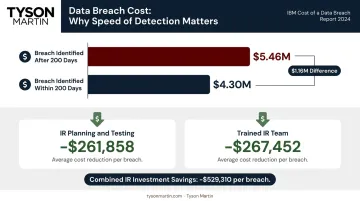
Delayed containment, conflicting executive instructions, and missed regulatory notification windows in the first 24 hours are where that cost gap opens.
Cyber Insurers Are Watching
Aon describes tabletop simulations as "strongly recommended by insurers" and a consideration in underwriting decisions. Marsh lists incident response planning among the 12 cybersecurity controls most cyber insurers ask about during underwriting. Organizations that can demonstrate exercised response protocols hold a measurably stronger position during renewals and claims negotiations than those pointing only to a documented plan.
How Enterprises Coordinate a Tabletop Exercise
Effective enterprise exercises require four to six weeks of design, scoping, and participant preparation before exercise day. What happens before the session determines whether the session produces real findings.
Step 1: Define Objectives and Scope
The first coordination task is establishing what the exercise will specifically test. "Cyber readiness" is not an objective. Specific decision points are:
- Who authorizes system isolation, and at what threshold?
- Who holds regulatory notification authority, and what triggers the clock?
- Who approves a ransom payment decision, and who is excluded from that conversation?
- When is external counsel engaged, and who makes that call?
Without pre-defined objectives, exercises drift into discussion without decisions. The scoping conversation should produce a one-page objective document that every participant and the facilitator can reference.
Step 2: Assemble Cross-Functional Participants and Assign Role Cards
An enterprise tabletop requires every function that would activate in a real incident. That typically includes:
- CEO or COO
- CFO
- CISO
- General Counsel
- HR lead
- Communications lead
- Procurement or third-party risk leads (where relevant)
Role cards are one-page briefs given to each participant before the exercise. They outline each person's specific responsibilities and the decisions they are authorized to make. This keeps injects routed to the right person rather than defaulting to whoever speaks first. When role cards are absent, authority defaults to seniority — and the wrong person ends up making calls that stall the exercise.
Step 3: Design Sector-Specific Scenarios and Injects
Scenario specificity is what forces real decisions rather than passive observation. A vague premise produces no usable findings.
An effective scenario names:
- The specific systems affected
- The regulatory clock that is already running
- The external pressures arriving in real time (media inquiry, insurer notification, dark web posting, partner escalation)
Injects (new pieces of information introduced every 20–30 minutes) escalate pressure and reveal new crisis dimensions. A ransomware scenario, for example, might open with encrypted file servers, then introduce a media call in the first inject, followed by a notification that backups are also compromised, followed by an insurer calling to request a status update. Each inject forces new decisions and surfaces new coordination gaps.
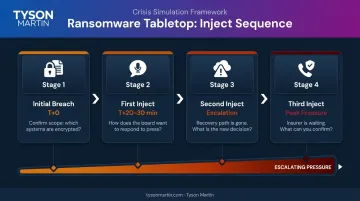
Scenario rotation matters over time. An organization that runs ransomware exercises repeatedly develops ransomware muscle memory while leaving supply chain compromise, insider threat, regulatory notification sequencing, and cloud-specific scenarios completely untested.
Step 4: Engage an Independent Facilitator
Internal facilitators have a structural problem: team members who authored the IR plan are biased toward making the exercise work. They avoid pushing hard on assumptions. They protect organizational dynamics. They won't challenge the CEO's decision in front of the room.
An independent facilitator can do all of those things. An experienced board-level cyber advisor — someone who has designed and run exercises at enterprise scale and understands current threat patterns — can challenge weak assumptions, surface leadership dynamics that internal politics would suppress, and ensure findings are framed at the governance level boards and audit committees actually need.
That's the role Tyson Martin fills: an advisor independent of the in-house security team and vendors, with enterprise incident experience and the standing to push back on decisions that wouldn't hold under real pressure — framing findings at the governance level the board actually needs.
Step 5: Conduct a Structured Debrief and Assign Ownership
The debrief is where exercise value is either captured or lost. A productive debrief produces:
- A prioritized finding list with severity ratings
- Named owners for each finding (roles, not committees)
- Resolution timelines
- Clear categorization: IR plan inaccuracies vs. communication protocol failures vs. technical response gaps
At minimum, three to five specific, time-bound remediation actions should be committed before the debrief ends. "Areas for improvement" is not a governance output. A finding that reads "the IR plan assumes the CISO holds notification authority, but legal counsel holds that authority — update the plan by [date] with [owner]" is a governance output.
Assign a dedicated scribe during the exercise itself. Memory of exercise dynamics degrades quickly; real-time documentation of decisions made, decisions deferred, and assumptions challenged is the foundation of an accurate post-exercise report.
What Makes Enterprise Tabletop Exercises Effective
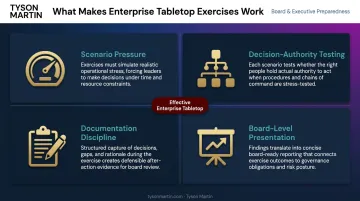
Four factors separate exercises that change behavior from those that simply confirm what participants already believe:
Scenario pressure is a design requirement. Effective scenarios incorporate incomplete information, evolving injects, time constraints, and financial or regulatory stakes — simultaneously. Exercises that remove this pressure produce false confidence rather than readiness.
Decision-authority testing is the highest-value output. The most consistent gap enterprise tabletops surface is that no one in the room is certain who holds authority for the decisions that matter most — ransom engagement, regulatory notification timing, public statement approval, and external counsel engagement. These gaps need to be found in a rehearsal, not in a real incident.
Documentation discipline during the exercise matters. Real-time capture of decisions made, decisions deferred, escalation paths tested, and assumptions challenged is non-negotiable. Post-exercise reporting built from memory is incomplete.
Board-level presentation closes the governance loop. Post-exercise findings — paired with remediation commitments, timelines, and named owners — give boards in regulated industries the evidence they need to demonstrate active oversight of cyber risk. Without it, the exercise produces no artifact regulators, auditors, or insurers can inspect.
Common Mistakes That Undermine Enterprise Tabletop Exercises
Four patterns consistently degrade the value of enterprise tabletops — and all four are preventable.
The CISO carries the whole session. When executives observe rather than decide, the exercise becomes an IT debrief with an audience. Enterprise tabletops test cross-functional decision-making. If executives aren't making decisions, the exercise isn't working.
Scenarios are designed to confirm, not challenge. Exercises built around familiar threats are low-value. High-value exercises target situations where decision authority is ambiguous, where IR plan assumptions don't match operational reality, and where departments have never coordinated under pressure.
The debrief gets filed and forgotten. Conducting the exercise isn't the goal. Behavior change is — specifically:
- Updated IR plan sections reflecting what actually broke
- Corrected escalation paths with named owners
- Funded remediation actions with deadlines
Organizations that treat the debrief as the endpoint typically rediscover the same gaps a year later.
The same scenario type runs every year. Ransomware three years running builds ransomware muscle memory. It leaves supply chain compromise, insider threat, multi-regulator notification, and cloud-specific failure modes completely unexplored.
When a Standard Tabletop Format Isn't Enough
A single discussion-based session is insufficient for several situations:
- M&A and leadership transitions: Integration periods create new decision-authority gaps. Focused drills with integration-specific participants should precede full tabletops until those gaps are mapped.
- Post-incident recovery: Organizations that recently experienced a real incident need exercises that test whether remediation actions actually changed behavior — not just validate that a plan exists.
- Multi-regulator notification obligations: Organizations managing simultaneous obligations to the SEC, state attorneys general, and sector regulators need sequenced exercises that rehearse notification timing under pressure.
Each of these situations exposes a different kind of gap — and none of them surface in a standard single-session format. Organizations that treat tabletop exercises primarily as compliance checkboxes are misusing the tool. NIST SP 800-61r3 is explicit that exercises and tests support program evaluation and prepare staff for future response — the emphasis is on demonstrated preparedness, not documented participation. Regulators and auditors are increasingly capable of distinguishing between the two.
Conclusion
Enterprise tabletop exercises close the gap between incident response plans as written and incident response as it actually unfolds under pressure. Unclear decision authority, untested escalation paths, and communication protocols that fail under stress are precisely where breaches escalate into crises.
Closing that gap requires more than scheduling an annual drill. Exercises that hold up need:
- Objective scoping tied to the organization's actual threat profile
- Cross-functional participation with clear role assignments
- Scenario specificity that forces real decisions under pressure
- Independent facilitation willing to challenge the room
- Governance-grade outputs boards and audit committees can act on
For boards and executive teams who need that level of rigor, working with an advisor who has designed and run these exercises at enterprise scale — and who is independent of the in-house security team and vendors — produces exercises that survive real-world pressure and withstand regulatory scrutiny.
Frequently Asked Questions
What are the key components of a good tabletop exercise?
Five elements are non-negotiable:
- A realistic, sector-specific scenario
- Cross-functional participants with pre-assigned role cards
- Time-pressured decision injects introduced every 20–30 minutes
- An independent facilitator
- A structured debrief that produces remediation actions with named owners and deadlines
What are the key success criteria for a tabletop exercise in a business continuity plan?
Success is measured by what changes afterward: whether IR plan gaps are corrected, decision authority is clarified in writing, and remediation actions are completed before the next exercise. Polished performance during the drill itself is not the bar.
Why would a company want to implement a tabletop exercise?
Companies run tabletop exercises to test how leadership actually responds under crisis pressure. The goal is to surface decision-authority gaps and IR plan weaknesses before a real incident does — and to demonstrate exercised preparedness to regulators, insurers, and boards.
How often should enterprises run tabletop exercises?
Best practice is at least quarterly executive-level exercises, with an annual full-board drill. Additional trigger-based exercises should follow significant incidents, major system changes, regulatory updates, or executive leadership transitions.
Who should participate in an enterprise tabletop exercise?
Every function that would activate in a real incident: CEO or COO, CFO, CISO, General Counsel, HR, communications leads, and key operational leads. Executives must be active decision-makers, not observers, or the exercise isn't testing what matters.
What is the difference between a tabletop exercise and a penetration test?
Penetration testing identifies how an attacker could get into systems — technical vulnerabilities. A tabletop exercise tests what happens after they're already inside: specifically, how leadership decisions, communication protocols, and cross-functional coordination hold up under crisis conditions. Both are necessary and serve different purposes.