Tabletop exercises exist to surface those failures before the stakes are real. IBM's 2025 Cost of a Data Breach Report found that trained and tested incident response teams contributed to $2M in average breach cost savings — a figure that reflects faster containment, not better technology.
This guide is written for the person standing at the front of the room. It covers how to plan, run, debrief, and report on a tabletop exercise from start to finish — including scenario templates, inject sequences, and after-action report components.
TL;DR: What This Guide Covers
- Tabletop exercises are discussion-based simulations — no systems touched, no changes made, just structured conversation walking your team through a crisis scenario
- The facilitator designs the scenario, controls information flow via injects, and documents gaps — not solves them alongside the team
- Effective exercises include legal, HR, communications, and executive leadership — not just IT and security
- The after-action report is where governance gaps become documented findings — and where board-level reporting gains its evidence base
- Major frameworks — PCI DSS 12.10.2, FFIEC, NIST SP 800-84, HIPAA, and ISO 27001 — all require or accept tabletop exercises as evidence of a tested incident response program
What a Tabletop Exercise Facilitator Guide Actually Is
NIST SP 800-84 defines a tabletop exercise as a "discussion-based exercise where personnel meet in a classroom setting or in breakout groups to discuss their roles during an emergency and their responses to a particular emergency situation." It is "solely discussion-based" and "does not involve deploying equipment or other resources."
That definition covers what a tabletop exercise is. A facilitator guide is what makes one actually run. It's the script, the scorecard, and the structure that keeps a room full of executives moving toward documented outcomes rather than open-ended conversation.
A complete guide includes:
- A scenario narrative establishing the backstory, setting, and initial conditions
- An inject schedule releasing new information to participants at timed intervals
- Discussion questions mapped to each inject and each exercise phase
- Participant role cards clarifying who is in the room and what decisions they own
- Evaluation criteria defining what a strong response looks like at each stage
- An after-action report template ready to populate during the debrief
Without a formal guide, exercises drift. Teams spend 90 minutes talking through a scenario and walk out with no prioritized findings, no action owners, and nothing an auditor or board can point to as evidence of preparedness. The guide is what separates a productive exercise from a conversation that disappears the moment the room clears.
Pre-Exercise Planning: The Facilitator's Checklist
Step 1 — Define the Objective First
Before building anything, decide what the exercise is actually testing:
- Technical response — detection, containment, and recovery procedures
- Executive decision-making — shutdown authority, materiality thresholds, board notification
- Cross-departmental communication — escalation paths, external messaging, legal coordination
- Regulatory notification — timing, drafting, and approval workflows under HIPAA, PCI DSS, or SEC rules
The objective shapes every other decision — who's in the room, what scenario you run, and how you measure whether the exercise worked.
Step 2 — Invite the Right Participants
Single-department exercises miss the coordination failures that cause real response breakdowns. Match your participant list to the exercise type:
| Exercise Type | Who Should Attend |
|---|---|
| Executive/Board | CEO, CISO, General Counsel, Board Chair, Communications lead |
| Operational | IR team leads, IT, HR, Compliance, Legal |
| Technical | SOC analysts, network engineers, systems architects |
Step 3 — Build a Scenario That Reflects Your Organization
Generic scenarios produce generic responses. A financial services firm rehearsing a data exfiltration tied to third-party vendor access will get far more actionable output than one running a generic phishing example. CISA's Tabletop Exercise Packages (CTEP) are a no-cost starting point with scenarios covering ransomware, insider threats, phishing, and ICS compromise — but they require customization for your industry and regulatory environment.
Step 4 — Design the Inject Schedule
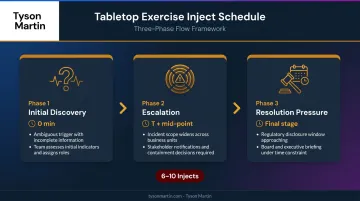
Once your scenario is set, structure the pressure. Injects simulate how incidents actually evolve — initial ambiguity, escalating pressure, decisions made with incomplete information. Plan 6–10 injects across three phases:
- Initial discovery — ambiguous trigger, first escalation decision
- Escalation — spread, additional systems affected, legal/communications questions arise
- Resolution pressure — regulatory deadlines, public exposure, board notification required
Script the facilitator's discussion questions at each inject point before the session begins.
Step 5 — Prepare the Full Facilitator Document
Write out the complete scenario narrative, each inject with its associated questions, role cards, evaluation criteria, and the after-action report template. Organizations without internal facilitation capacity often engage an independent external advisor to design and run the exercise — keeping key security staff in their participant roles rather than splitting their attention between facilitating and responding.
How to Run the Exercise: In-Session Facilitation Techniques
Setting the Stage
Open with three ground rules every time:
- This is a no-blame environment — gaps found here are cheaper than gaps found during an actual incident
- Suspend disbelief — accept the scenario's premise even if a given control would normally prevent it
- The goal is to surface gaps, not perform for leadership
Controlling Information Flow
Don't present the full scenario upfront. Start with an ambiguous trigger and release injects on schedule, just as information would arrive in an actual incident. Good opening triggers include:
- A help desk call reporting unusual account lockouts
- A performance alert from a third-party vendor
- An anonymous tip to the compliance hotline
- A brief from the SOC with no confirmed root cause
This structure forces participants to act on incomplete information — which is exactly the condition real incidents create.
Questions That Surface Real Gaps
The facilitator's job is to probe, not solve. Use prompts like:
- "Who owns that decision?"
- "Where is that documented?"
- "What happens if that tool is unavailable?"
- "Who communicates this externally, and when?"
- "What would trigger board notification?"
Silence or stumbling at these questions is data — log it immediately for the after-action report. Hesitation at the ownership and escalation questions typically reveals the largest governance gaps.
What to Watch For
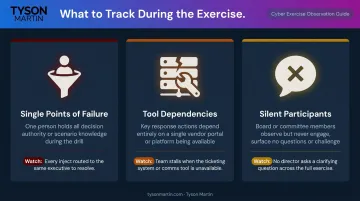
Track these patterns — they become key findings in the after-action report:
- Single points of failure — which individuals does the team keep deferring to?
- Tool dependencies — which response steps assume a system that could be offline during an actual incident?
- Silent participants — legal, HR, and communications leads often go quiet; their silence frequently masks the largest coordination gaps
A typical tabletop runs 90–120 minutes. If the group gets stuck on a technical detail, redirect to the decision or communication question and park the technical thread for written follow-up.
Sample Scenarios and Inject Sequence Templates
Scenario 1: Ransomware Affecting a Critical Business System
This scenario tests three common gaps: escalation decision rights during an active incident, backup architecture assumptions, and the sequencing of cyber insurance notification before any ransom-related decisions are made.
Opening inject: "Your monitoring system shows unusual encryption activity on file servers. The SOC has flagged it but hasn't confirmed the source."
Discussion questions:
- Who is notified first?
- What is the escalation threshold for declaring an incident?
- Does the team isolate or investigate first?
Mid-exercise inject: "Encryption has spread to a second business unit. Backups are stored on the same network segment. A ransom note has appeared."
Discussion questions:
- Who makes the decision to involve law enforcement?
- What is the public communications protocol?
- Does cyber insurance require notification before authorizing any ransom payment?
Resolution inject: "72 hours have passed. Customer data may have been exfiltrated. Regulatory counsel says notification is required within the next 48 hours."
Discussion questions:
- Who drafts the regulatory notification?
- Is there a pre-written breach notification template?
- Who briefs the board, and what format does that briefing take?
Scenario 2: Insider Threat — Privileged Access Misuse
The 2025 Verizon Data Breach Investigations Report found privilege misuse at 6% frequency across 22,052 analyzed incidents, with detection timelines often measured in months or longer and direct financial gain as a primary trigger. This scenario is valuable precisely because of that lag: most organizations lack documented decision rights for HR-to-IT escalation when a privileged employee departs, and exercises expose that gap before a real departure does.
Opening inject: "An HR flag has been raised about an employee with privileged system access who gave two weeks notice yesterday. IT has not been informed."
Discussion questions:
- What is the process for revoking access when an employee departs?
- Who coordinates between HR and IT?
- Is there a documented offboarding security checklist?
Escalation inject: "A review of access logs shows the employee downloaded a large volume of customer records in the past 72 hours. Legal is asking whether this constitutes a reportable breach."
Discussion questions:
- What evidence preservation steps are required before any access is terminated?
- Who has authority to place a legal hold?
- At what point does this require board notification?
After-Action Reporting: Turning Exercise Findings into Governance
The exercise surfaces gaps. The after-action report (AAR) is where they get fixed.
What the AAR Must Include
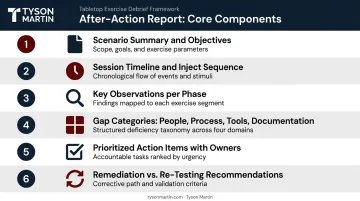
- Scenario summary and exercise objectives
- Timeline of the session and inject sequence
- Key observations for each inject phase
- Identified gaps categorized by: people, process, tools, and documentation
- Prioritized action items with owners and target completion dates
- Recommendation for which gaps require immediate remediation vs. periodic re-testing
Translating Findings for Board Reporting
Boards don't need the technical play-by-play. They need four things:
- Can the organization execute its incident response plan under pressure?
- Which gaps create material risk, and what decisions require board authorization?
- What resources or policy changes are needed to close those gaps?
- What evidence exists that the board has actively overseen this process?
A well-structured AAR answers all four. For organizations subject to SEC disclosure requirements, board meeting minutes referencing prior tabletop exercises and documented participation are precisely the governance evidence directors need when a real incident triggers materiality review.
Compliance Documentation
Retain the complete exercise package — scenario, participant list, findings, and action items. Examiners look for this documentation as proof of active oversight, and when a real incident occurs, it establishes the governance record that shows the board was engaged before the breach, not just after.
Compliance Frameworks That Require Tabletop Exercises
Frameworks That Explicitly Name Tabletops
- PCI DSS Requirement 12.10 requires annual incident response plan testing for organizations handling cardholder data; role-based tabletop exercises satisfy this requirement
- FFIEC Information Security Booklet explicitly states that incident response programs should be "periodically tested through different test types, including scenario planning and tabletop testing"; the FFIEC Cybersecurity Resource Guide for financial institutions also lists CISA tabletop resources directly
- NIST SP 800-84 provides the federal methodology for exercise design and is referenced across FISMA-governed agencies
Frameworks Where Tabletops Satisfy Testing Requirements
- HIPAA § 164.308(a)(6) and (a)(8) require policies and procedures for security incidents and periodic technical and nontechnical evaluation; auditors widely accept tabletop exercises as evidence of tested procedures
- ISO 27001 Annex A.16.1.5 requires testing of incident response effectiveness at planned intervals
- SOC 2 CC7.1 and CC7.2 require evidence that organizations regularly test incident detection and response capabilities
Practical Note for Facilitators
Map each exercise's discussion questions to the specific framework controls being tested, and include that mapping in the after-action report. That turns the exercise into documented compliance evidence auditors can reference directly.
Frequently Asked Questions
How long should a tabletop exercise last?
Most tabletop exercises run 90–120 minutes for operational and executive exercises, with technical exercises sometimes extending to three hours. Board-focused exercises can be highly effective at 60 minutes when structured around decision drills rather than technical response details.
Who should facilitate — internal staff or an external expert?
Internal facilitators are cost-effective and build institutional muscle, but they must fully step out of the problem-solving role. External facilitators bring neutrality, broader threat exposure, and let your CISO and IR lead participate fully — a real advantage when your most critical responders are also your most critical participants.
How often should tabletop exercises be conducted?
Most compliance frameworks and practitioners recommend at least one formal exercise annually. Stronger programs run quarterly executive scenario drills plus one deeper annual exercise with board-level decisions. Regulated organizations in financial services and healthcare should consider quarterly cadence given their notification and response obligations.
What is the difference between a tabletop exercise and a penetration test?
A penetration test is a technical exercise where security professionals actively attempt to exploit vulnerabilities in live systems. A tabletop exercise is a discussion-based simulation where teams walk through how they would respond to a scenario without touching any systems. Both serve different purposes and belong in the same security testing program.
What should a tabletop exercise after-action report include?
Core components include: scenario summary and objectives, key observations per inject phase, prioritized action items with owners and due dates, and a recommendation for the next exercise focus. Structure the report to serve two audiences — the security team managing remediation and board leadership evaluating program maturity.
Do tabletop exercises satisfy PCI DSS and HIPAA compliance requirements?
Yes. PCI DSS Requirement 12.10 requires annual IR plan testing, and HIPAA auditors widely accept tabletop exercises as evidence under § 164.308(a)(6) and (a)(8). In both cases, retaining documentation — scenario, participants, findings, and action items — is required to demonstrate compliance.