Introduction
When a cybersecurity incident hits, boards face an uncomfortable question: if we had an advisor, why can't we answer basic questions about our own risk posture?
The problem usually isn't that the organization lacked advice. It's that the advice never translated into governance clarity. According to a 2025 NACD survey, 57% of private-company directors rated improving management's cyber-risk reporting quality as very or extremely important — a striking signal that most advisory relationships aren't delivering what boards actually need.
That gap persists partly because most advisory firms look identical on paper: credentials, framework names, client logos. The real difference is whether their work produces governance clarity or just documentation. This guide gives boards and executive teams a practical framework for making that distinction before a crisis forces the question.
Key Takeaways
- A cybersecurity advisory firm should clarify decision rights and risk posture — not just produce reports
- Evaluate firms on six criteria: governance orientation, board communication quality, regulatory experience, credentials, methodology, and engagement model fit
- The biggest red flags: advisors who lead with tools, speak in jargon, or can't explain how their work changes board behavior
- Strong engagements end with clearer ownership, a trend-based dashboard, and a 90-day plan with named owners and measurable outcomes
What Is a Cybersecurity Advisory Firm?
A cybersecurity advisory firm is an external expert engaged by boards, CEOs, and executive leadership to assess risk posture, strengthen governance, and ensure security decisions are defensible. That's different from an MSSP that monitors your network or a consultant who configures your firewall.
A true advisory role centers on planning, advising, and managing strategy — not hands-on technical implementation, as ISACA's guidance on virtual CISOs confirms. Boards need someone who can translate risk into decisions, not someone who writes reports after the fact.
That distinction shapes which engagement model actually fits your situation.
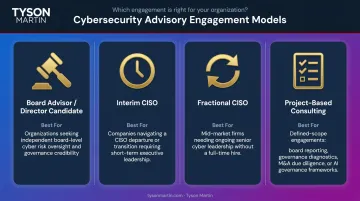
Advisory Models and When to Use Them
The right model depends on whether you need ongoing leadership or project-based guidance:
| Model | Best For |
|---|---|
| Board Advisor / Director Candidate | Governance oversight gaps; board needs clearer questions and cleaner evidence |
| Interim CISO | Post-incident recovery, leadership gaps, M&A — when stability is needed in 30–90 days |
| Fractional CISO | Ongoing executive oversight without full-time cost; mid-market organizations in transition |
| Project-Based Consulting | Defined assessments with clear scope and timeframe |
When Organizations Most Need an Advisor
- New leadership or CISO departure
- M&A activity requiring a single risk view across environments
- Post-incident recovery with scattered ownership
- Regulatory scrutiny or audit findings
- The board can't get a plain-English answer on actual risk exposure
Key Criteria for Evaluating a Cybersecurity Advisory Firm
These six criteria help executive teams assess fit, not just features. Start with governance outcomes — everything else follows from there.
Governance Orientation and Decision-Rights Clarity
This is the most overlooked criterion. A technically capable advisor who can't clarify who decides what — at what threshold, with what escalation path — leaves the board with risk awareness but not governance control.
Good governance orientation looks like this in practice:
- The advisor defines board versus management decision authority in plain terms
- Good advisors document escalation thresholds before incidents, not during them
- Deliverables are designed for board inspection, not just technical review
Ask any finalist: "Who approves a security exception in your framework, and for how long?" Vague answers are disqualifying. The right advisor maps decision rights to five questions: who accepts risk, who approves exceptions, who resolves budget conflicts, who declares incident severity, and who owns vendor go/no-go decisions.
Board-Level Communication and Reporting Quality
Findings only matter if they change board behavior — and that requires bridging two audiences: technical teams who need evidence, and executives who need plain-language risk assessment.
The sample report test: Before engaging any finalist, request a sample executive summary or board dashboard. Look for:
- Risk expressed in business impact terms (money, downtime, legal exposure) — not vulnerability counts
- "What changed since last briefing" as a named section with trend indicators
- A format that stays consistent across quarters so the board can spot drift
ISACA's board reporting guidance is direct on this point: cybersecurity reporting to boards should use strategic and economic language, not technical detail. If a sample report reads like a penetration test summary, it won't change board behavior.
Industry and Regulatory Experience
Generic security expertise isn't enough for regulated industries. Regulatory fluency varies significantly by sector:
- Financial services: SOC 2, PCI DSS, NYDFS Part 500, SEC disclosure requirements
- Healthcare: HIPAA administrative, physical, and technical safeguard requirements
- Retail: PCI DSS, state breach notification laws across all 50 states, FTC Safeguards Rule
The sector walkthrough test: Ask the advisor to walk through a past engagement in your industry:
- What compliance gaps did they find?
- How were gaps prioritized against business risk?
- How did the organization's regulatory standing improve?
Vague answers ("we've worked with several financial services clients") indicate shallow experience. Specific answers demonstrate whether the advisor has actually navigated your regulatory environment or just knows the framework names.
Credentials, Certifications, and Professional Standing
Verify credentials at the individual level, not just the firm level. The person doing the work matters more than the company that sold the engagement.
Baseline individual credentials to look for:
- CISSP — the floor for strategic advisors; requires at least 5 years of paid experience across two or more security domains
- Active membership in recognized bodies: NACD, ISC2, sector-specific executive committees
- Participation in frameworks like NIST CSF or peer-level bodies like the World Economic Forum's Centre for Cybersecurity
Active participation in governance bodies — combined with executive programs at Carnegie Mellon, MIT, or Harvard Business School — signals an advisor whose knowledge reflects current threat and regulatory conditions, not a framework they last updated during a previous role.
Methodology, Deliverables, and Execution Framework
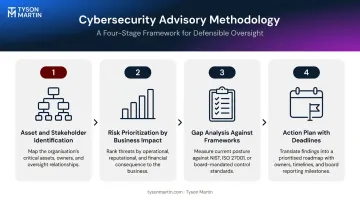
A documented methodology separates useful advisory work from shelfware. The assessment structure should include:
- Asset and stakeholder identification — maps ownership and decision authority before any gap analysis begins
- Risk prioritization by business impact — severity ranked against revenue, operations, and legal exposure, not just CVSS scores
- Gap analysis against relevant frameworks (NIST CSF 2.0, CIS Controls, ISO 27001)
- Action plan with deadlines — sequenced milestones with named owners accountable for each step
The deliverable test: Minimum acceptable outputs include:
- Plain-English risk posture summary
- Trend-based dashboard with consistent definitions quarter over quarter
- Clear delegation of remediation ownership
- Escalation criteria both board and management can act on
Ask finalists to share their assessment structure and remediation format before engagement. If they can't describe it, the deliverable will disappoint.
Engagement Model and Long-Term Fit
Match the engagement model to the organizational need:
- Interim CISO (30–90 days): Post-incident, leadership transition, M&A — fast stabilization and executive decision-making
- Fractional CISO (ongoing): Steady executive oversight without full-time cost; builds program momentum over time
- Board advisory: Governance oversight, clearer reporting, director education — when the primary gap is at the board level
ISACA notes that vCISO and advisory engagements can create accountability risks unless roles and responsibilities are clearly defined — particularly around incident response. Ask directly: if an incident happens mid-engagement, can this advisor step in as an operational leader, or are they strictly advisory?
Also assess continuity. What happens at engagement close? A good advisor builds a transition plan that doesn't leave the organization dependent on their continued presence.
Red Flags That Signal the Wrong Fit
The Three Consequential Red Flags
1. If every conversation starts with platforms, products, or technology recommendations rather than governance and risk priorities, the advisor is vendor-aligned, not client-aligned. Tools come after clarity — not before it.
2. If they can't produce a sample executive summary or explain how they measure risk trend over time, the deliverable quality will disappoint. Ask for the sample before the engagement, not after.
3. Advisors who treat each engagement as a standalone assessment produce documentation the organization never acts on. Without a structured escalation framework, cybersecurity findings stay buried in reports instead of reaching the board.
The SEC's enforcement actions against Blackbaud ($3M penalty) and R.R. Donnelley ($2.125M penalty) both trace back to exactly this failure: governance gaps where critical information never reached decision-makers.
Secondary Warning Signs
- Fear-based framing without business-impact context ("you're one breach away from disaster" with no risk quantification)
- Claims of deep expertise without verifiable credentials or named professional affiliations
- Inability to describe the actual work performed at prior clients — only the firm's general capabilities
Pre-Call Checklist for Any Finalist
Before engaging, ask these three questions:
- Can you share a sample deliverable from a comparable engagement?
- Who personally performs the work — and what are their individual credentials?
- How will we measure success 90 days after the engagement closes?
Vague or deflected answers aren't a negotiating position — they're a preview of how the firm handles hard questions from your board.
How Tyson Martin Helps Boards and Executive Teams
Tyson Martin works with boards and executive teams that need to reduce technology and cyber risk without slowing operations. He serves as a board advisor, director candidate, and steps in as an interim or fractional CISO when organizations need stable leadership quickly. His background includes leading security and technology transformation at AWS and Fortune 100 retailers including Home Depot and Best Buy.
The governance outcomes he delivers include:
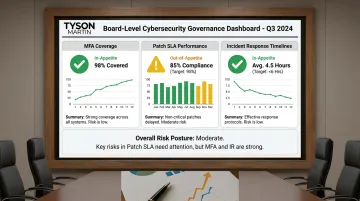
- Plain-English risk posture briefings that show trend rather than trivia
- A stable dashboard the board can inspect — tracking metrics like MFA coverage, patch SLA performance, and incident response timelines, with clear "in appetite / out of appetite" status
- Decision-rights maps that answer who accepts risk, approves exceptions, and calls incidents — before pressure hits
- A 90-day plan with named owners, sequenced milestones, and measurable outcomes
His active roles in NACD, the NRF CISO Executive Committee, and the World Economic Forum's Centre for Cybersecurity reflect current, board-level engagement — not credentials that stopped accumulating a decade ago.
Organizations in regulated industries or in transition — new leadership, M&A, post-incident recovery, or compliance pressure — can connect with Tyson on LinkedIn or reach him at tyson.martin@gmail.com to discuss which engagement model makes sense.
Conclusion
The right advisory relationship produces something specific: a board that can answer "what is our risk posture and what changed since last time" — and back that answer with defensible decisions and clear governance.
Cybersecurity advisory is not a one-time engagement. Risk posture shifts, regulatory requirements evolve, and leadership teams turn over. The right relationship is one that can be inspected, adjusted, and sustained — because the alternative is discovering during a breach response or SEC inquiry that you had an advisor on retainer but no governance that held.
Frequently Asked Questions
What is the difference between a cybersecurity advisory firm and a cybersecurity consulting firm?
Advisory firms focus on governance, board communication, and strategic risk leadership — often in ongoing or fractional roles. Consulting firms typically perform project-based technical assessments with a defined deliverable and exit point. The distinction matters: boards benefit from an ongoing governance partner who builds oversight capacity over time, not a report that arrives and sits on a shelf.
What credentials should I look for in a cybersecurity board advisor?
Look for active membership in NACD or ISC2 and participation in peer-level executive communities like the NRF CISO Executive Committee — these signal current, board-appropriate standing. CISSP remains the baseline individual certification, requiring at least five years of paid experience across two or more security domains.
When does an organization need a fractional CISO rather than a full-time hire?
Fractional or interim CISOs fit organizations in transition — leadership gaps, post-incident recovery, M&A, or compliance pressure — where executive-level security leadership is needed immediately without the cost or timeline of a full-time search. The model can continue after stabilization or convert to a permanent hire once the organization is ready.
What deliverables should a cybersecurity advisory engagement produce?
Minimum deliverables include a plain-English risk posture summary, a trend-based dashboard with consistent definitions across quarters, a remediation roadmap with named owners and clear milestones, and escalation criteria both board and management can act on without translation.
How should a cybersecurity advisor communicate with the board?
Board communication should answer three questions: what is the current risk posture, what changed since the last briefing, and what decisions does the board need to make now. The framing should use business impact terms — money, downtime, legal exposure — not technical severity scores or jargon.
What are the biggest mistakes organizations make when hiring a cybersecurity advisory firm?
The same mistakes appear repeatedly:
- Selecting on brand or tool partnerships rather than governance fit
- Failing to verify that the named advisor — not just the firm — holds relevant individual credentials
- Choosing a firm that cannot explain how its work will change board behavior within 90 days of engagement close