Introduction
Third-party vendors are now one of the most consequential sources of enterprise cyber risk. According to Verizon's 2025 Data Breach Investigations Report, third-party involvement in confirmed breaches doubled from 15% to 30% in a single year.
The scale of the damage is hard to ignore. SolarWinds compromised roughly 18,000 organizations through a trojanized software update. The Change Healthcare ransomware attack affected approximately 192.7 million individuals — a single vendor relationship cascading into the largest healthcare data breach on record.
These incidents have done something annual questionnaires never could: they moved vendor risk from an IT checklist to a board governance obligation. SEC cybersecurity disclosure rules, DORA, and FFIEC guidance now hold organizations explicitly accountable for how they oversee third-party cyber risk.
That accountability creates a direct decision: deploy a technology platform or engage a specialized assessment firm. Choosing the wrong type — or the wrong firm — leaves gaps in governance, regulatory readiness, or executive visibility.
This guide covers five top third-party risk assessment firms, the criteria used to evaluate them, and what boards and executive teams should confirm before making an engagement decision.
Key Takeaways
- Third-party involvement in breaches doubled to 30% in 2025, putting vendor oversight on every board agenda
- The best firms combine continuous monitoring, structured workflows, and regulatory framework alignment
- Boards need plain-language risk posture summaries — not raw technical data
- Top firms covered: Bitsight, SecurityScorecard, Coalfire, Deloitte Cyber, and ProcessUnity
- The right partner depends on your vendor volume, regulatory environment, and whether you need monitoring, advisory depth, or full lifecycle management
What Is Third-Party Risk Assessment in Cybersecurity?
Third-party risk assessment is the structured process of identifying, evaluating, and monitoring cybersecurity risks introduced by external vendors, partners, and service providers. Unlike an internal audit, you don't control the environment being assessed. The risk lives outside your perimeter but lands squarely inside your business.
Within the broader GRC ecosystem, third-party risk assessment sits at the intersection of vendor management, compliance, and enterprise risk — which is why gaps here tend to surface during regulatory examinations, not before them.
How the Practice Has Evolved
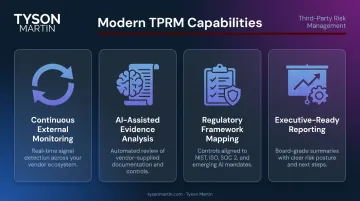
Modern third-party risk assessment looks nothing like the annual spreadsheet questionnaire it replaced. ISACA describes the current shift as moving from static questionnaires to dynamic risk profiling, and from annual reviews to continuous monitoring and reassessment. Leading firms now offer:
- Continuous external monitoring that refreshes vendor risk signals daily, not annually
- AI-assisted evidence analysis that maps vendor documentation to specific control frameworks
- Regulatory framework mapping aligned to DORA, NIST CSF 2.0, FFIEC, and SEC disclosure rules
- Executive-ready reporting that translates technical findings into board-communicable risk posture
These capabilities didn't emerge in a vacuum — regulatory pressure is driving the evolution. NIST CSF 2.0 (released February 2024) added an explicit Govern function covering supply chain and third-party risk. DORA, effective across EU financial entities from January 2025, established a formal oversight framework for critical ICT third-party providers. SEC rules now require annual disclosure of how boards oversee cybersecurity risk, including vendor risk programs.
The firms covered below are best positioned to serve enterprise organizations with significant vendor ecosystems and regulatory exposure.
Top Third-Party Risk Assessment Firms for Cybersecurity
Firms were evaluated on five criteria:
- Risk methodology — depth and defensibility of the assessment approach
- Executive reporting — quality of board-level communication and artifacts
- Regulatory coverage — breadth of framework alignment
- Scalability — capacity to handle complex, high-volume vendor ecosystems
- Client trust signals — analyst recognition, client tenure, and market reputation
The list includes both technology-led platforms and advisory-led firms to reflect how differently organizations approach this problem.
Bitsight
Bitsight is a cyber risk intelligence firm that continuously monitors the security posture of more than 40 million organizations globally. Enterprise security teams, GRC functions, and insurers use it to assess and benchmark third-party risk against empirical, externally observed data — not self-reported questionnaires.
Its AI-powered Framework Intelligence automatically maps vendor evidence to frameworks including NIST CSF, SIG Lite, and ISO 27001. For organizations that need audit-ready risk documentation at scale, this eliminates the manual control-mapping work that typically consumes weeks of analyst time.
| Category | Details |
|---|---|
| Best For | Global enterprises and regulated industries needing continuous, evidence-based vendor monitoring across large third-party ecosystems |
| Core Offerings | Continuous vendor monitoring, security ratings, AI-powered document analysis, fourth-party risk mapping, compliance gap reporting |
| Framework Alignment | NIST CSF, ISO 27001, SIG, DORA, NIS2, SEC cyber disclosure rules |
Gartner named Bitsight a 2026 Magic Quadrant Visionary for Cyber Threat Intelligence Technologies; Forrester named it a Wave Leader for Cybersecurity Risk Ratings Platforms.
SecurityScorecard
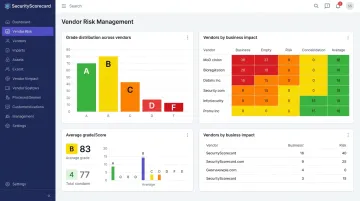
SecurityScorecard evaluates vendor security posture across ten risk factor categories — including endpoint security, patching cadence, IP reputation, and DNS health — and communicates results through an A-through-F letter-grade system. Enterprises, insurers, and government contractors use it to gain rapid visibility into third-party cyber exposure.
The A-F scoring system is genuinely useful for non-technical stakeholders. A board member doesn't need to understand CVE taxonomy to read that a critical vendor scored a C and has been declining for two quarters. The Atlas platform adds automated questionnaire management with access to 40+ industry-standard framework questionnaires including NIST, ISO, and PCI.
One consideration: approved dispute resolutions update scorecards within 48–72 hours, so organizations should understand the refresh cadence before relying on ratings for time-sensitive decisions.
| Category | Details |
|---|---|
| Best For | Organizations needing rapid, board-communicable vendor risk ratings and streamlined questionnaire workflows across a large vendor portfolio |
| Core Offerings | Security ratings, vendor risk assessments, board summary reporting, automated questionnaire workflows, remediation impact projections |
| Framework Alignment | NIST 800-171, ISO 27001, SOC 2, GDPR, and sector-specific regulatory frameworks |
SecurityScorecard was named a Leader in the Forrester Wave: Cybersecurity Risk Ratings Platforms, Q2 2024, with the highest Current Offering ranking.
Coalfire
Coalfire is a purpose-built cybersecurity advisory and assessment firm. Where Bitsight and SecurityScorecard deliver external ratings from outside the vendor's environment, Coalfire deploys certified practitioners to conduct hands-on assessments, compliance audits, and penetration testing engagements inside it.
This matters in regulated industries. A FedRAMP authorization or HITRUST certification isn't produced by an algorithm — it requires practitioner-led assessment against a defined assurance framework. Coalfire is one of the most active FedRAMP Third Party Assessment Organizations, supports all active versions of the HITRUST CSF, and is one of the largest PCI QSAC organizations globally.
For healthcare organizations preparing for OCR scrutiny, financial institutions facing OCC examinations, or defense contractors pursuing FedRAMP, Coalfire's practitioner-led model fills a gap that continuous monitoring platforms cannot.
| Category | Details |
|---|---|
| Best For | Organizations in regulated industries requiring practitioner-led third-party assessments and compliance audit support |
| Core Offerings | Third-party risk assessments, compliance audits (HITRUST, PCI DSS, FedRAMP), penetration testing, managed security services, regulatory advisory |
| Framework Alignment | NIST CSF, HITRUST, FedRAMP, PCI DSS, HIPAA, ISO 27001 |
Deloitte Cyber & Strategic Risk
Deloitte's Cyber & Strategic Risk practice helps organizations identify, assess, and manage risks posed by interconnected third-party networks — at the scale of global enterprises, financial institutions, and government entities.
The differentiator here is multidisciplinary integration. A vendor risk finding doesn't live in isolation: it connects to regulatory obligations, operational resilience posture, M&A diligence, and board governance design. For organizations navigating a major acquisition, a leadership transition, or significant regulatory scrutiny, that integration has real value.
Deloitte's managed TPRM service also provides ongoing program management for organizations that want external delivery, not just technology.
| Category | Details |
|---|---|
| Best For | Large enterprises and Fortune 500 organizations needing strategic TPRM program design, board governance advisory, and integrated regulatory compliance support |
| Core Offerings | TPRM program design and maturity assessments, vendor due diligence, regulatory compliance advisory, M&A cyber risk, board/executive reporting frameworks |
| Framework Alignment | NIST CSF, ISO 31000, DORA, SEC cyber rules, SOX, GDPR, and sector-specific regulatory expectations |
ProcessUnity
ProcessUnity is a purpose-built third-party risk management platform that supports the complete vendor lifecycle — from sourcing and onboarding through ongoing monitoring, performance reviews, and offboarding. Forrester named it a Leader in the Forrester Wave: Third-Party Risk Management Platforms, Q1 2026, with the top Current Offering score.
Its Global Risk Exchange is a practical differentiator: organizations can access pre-validated vendor assessments from a library of several thousand third parties, reducing the questionnaire duplication that consumes significant analyst time in high-volume programs.
For organizations managing hundreds of vendors across multiple regulatory frameworks, ProcessUnity's configurable workflows allow risk scoring, control frameworks, and reporting to match specific regulatory environments.
| Category | Details |
|---|---|
| Best For | Organizations with mature TPRM programs and large vendor portfolios seeking workflow automation, configurable risk frameworks, and pre-validated vendor assessment data |
| Core Offerings | Vendor lifecycle management (onboarding to offboarding), configurable risk assessments, Global Risk Exchange, continuous monitoring integrations, compliance reporting |
| Framework Alignment | ISO 27001, NIST CSF, SOC 2, GDPR, DORA, and custom regulatory frameworks |
SMB plans start at $25,000 according to ProcessUnity's published pricing. Enterprise pricing for Bitsight and SecurityScorecard is available through direct engagement.
How These Firms Were Selected — and What the Criteria Reveal
The evaluation lens here reflects what boards and audit committees actually need from a TPRM partner, not what looks compelling in a vendor demo. Five criteria drove the selection:
- Risk methodology depth — questionnaire-only vs. continuous external monitoring vs. practitioner-led assessment
- Executive reporting quality — does the output answer the questions a board actually asks?
- Regulatory framework coverage — particularly for U.S. enterprise environments in financial services, healthcare, and retail
- Scalability — can the firm serve organizations with hundreds or thousands of vendors?
- Client trust signals — analyst recognition, audit defensibility, and industry-specific track record
The Maturity Mismatch Problem
The most common and costly selection mistake isn't picking a bad firm — it's picking the wrong type of firm for where your program actually is.
- Early-stage TPRM programs benefit most from advisory-led firms like Coalfire or Deloitte that help design governance foundations, establish risk tiering, and create board reporting structures before technology is introduced
- Mature programs managing hundreds of vendors benefit from platforms like ProcessUnity or Bitsight that automate scale without requiring proportional headcount growth
Choosing a technology platform when you need governance design is like buying a sophisticated dashboard before you know what you're measuring. The dashboard runs; the program doesn't.
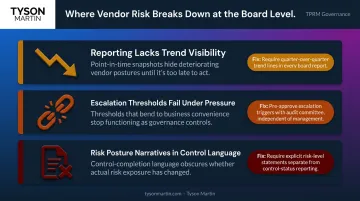
That vantage point — built across enterprise environments including AWS and Fortune 100 retailers, and through governance contributions at the World Economic Forum and NACD — reveals a consistent pattern of what breaks down when vendor risk reaches the board agenda:
- Reporting that lacks trend visibility
- Escalation thresholds that don't hold under pressure
- Risk posture narratives written in control language rather than business terms
Organizations uncertain about where to start often benefit from resolving those gaps first. A board-level cybersecurity advisor who can translate vendor risk findings into governance decisions will help you get more out of whichever platform or advisory firm you ultimately choose.
What Boards and Executives Should Confirm Before Engaging a TPRM Firm
The most important pre-engagement question isn't which firm has the best technology. It's: what decisions does this firm's output need to support?
Each stakeholder layer has distinct requirements:
- Board reporting needs plain-language risk posture summaries with trend visibility
- Audit committees need evidence trails and regulatory mapping
- Management needs escalation thresholds and remediation workflows
A technically sound methodology can still produce output your governance structure cannot use.
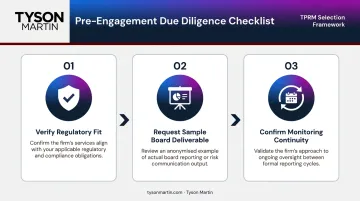
Three Due Diligence Steps
Before signing an engagement:
Verify regulatory fit. Confirm the firm has documented experience with your specific regulatory environment — HIPAA for healthcare, DORA for EU-regulated financial services, SEC rules for public companies. Generic framework alignment claims aren't the same as examination-ready expertise.
Request a sample board or executive deliverable — not a product demo. Ask for an actual executive summary or board report, then assess whether a non-technical director could read it, understand the current risk posture, and identify what decision is being requested.
Confirm monitoring continuity. Point-in-time assessments leave risk gaps between review cycles. The 2023 interagency banking guidance from the Federal Reserve, FDIC, and OCC explicitly requires ongoing monitoring throughout the third-party relationship. Clarify upfront whether continuous monitoring is included or requires a separate engagement.
Due diligence tells you what to look for. These two selection patterns tell you what to avoid.
Two Selection Mistakes to Avoid
- Selecting on brand or market share rather than alignment with your organization's risk profile and governance needs — a firm that serves Fortune 500 financial institutions well may not produce output calibrated to a mid-market healthcare organization's audit committee
- Treating TPRM as a procurement exercise rather than an ongoing program — third-party risk evolves as vendors change, regulations update, and your vendor ecosystem grows; a one-time assessment is not a program
Conclusion
Selecting the right third-party risk assessment firm comes down to fit: does their methodology, reporting format, and regulatory coverage align with how your organization governs risk — and how your board needs to see it communicated?
Before selecting a firm, assess your current TPRM approach directly: does it produce outputs that enable board-level decisions? Does it satisfy regulatory expectations? Does it create clear escalation paths when a vendor issue emerges? If the answer to any of those is no, the gap is usually governance design — not just tool selection.
Organizations that need help translating third-party risk findings into board governance structures, building a vendor risk reporting framework, or standing up a TPRM reset plan can engage Tyson Martin as a fractional CISO or board advisor.
His background spans enterprise security leadership at AWS and Fortune 100 retailers, with active contributions to the World Economic Forum's Centre for Cybersecurity and the NACD. That combination puts him in a position to connect technical vendor risk data to the boardroom oversight structures that actually hold up under scrutiny.
Frequently Asked Questions
What is the difference between a third-party risk assessment firm and a TPRM software platform?
Assessment firms deploy practitioners and proprietary methodologies to evaluate vendor risk and produce governance-ready findings. TPRM software platforms are tools your internal team uses to manage that process. Many providers offer both, but if your program needs governance design, you need advisory depth — not software.
How often should organizations conduct third-party cybersecurity risk assessments?
Frequency should match vendor criticality. Critical vendors typically require annual assessments plus continuous monitoring; lower-risk vendors can be assessed every two to three years. DORA and FFIEC guidance increasingly require documented, risk-tiered cadences rather than blanket annual reviews.
What should boards look for when reviewing third-party risk assessment results?
Boards should look for plain-language risk posture summaries, trend visibility on whether the overall vendor profile is improving or deteriorating, and clear identification of high-criticality vendors. Escalation thresholds and remediation ownership should be explicitly assigned to named individuals.
Which industries are most exposed to third-party cybersecurity risk?
Financial services, healthcare, and retail carry the highest exposure due to the volume of sensitive data flowing through vendor relationships and the density of regulatory requirements governing those relationships. The average breach cost in financial services reached $6.08 million in 2024. Industries with complex supply chains — manufacturing and technology — also face significant fourth-party risk from their vendors' own vendor networks.
How do third-party risk assessment firms support regulatory compliance?
Leading firms map vendor assessment findings directly to applicable regulatory frameworks — NIST CSF, HIPAA, DORA, SEC cyber disclosure rules — and generate audit-ready evidence trails. This allows organizations to demonstrate to regulators and auditors that vendor oversight meets required standards, which is especially valuable for financial institutions and healthcare organizations subject to regular examination.
What is the typical cost of engaging a third-party risk assessment firm?
Technology platforms charge subscription fees tied to vendor volume — ProcessUnity's SMB plans start at $25,000; Bitsight and SecurityScorecard price through direct engagement. Advisory firms like Coalfire and Deloitte bill by scope or retainer. Factor in the alternative: IBM's 2024 Cost of a Data Breach Report puts the global average breach at $4.88 million, and vendor-originated incidents add reputational exposure on top of that.