Introduction
Most organizations have a Change Control Board. The problem surfaces when something goes wrong — a production outage, a failed deployment, a security incident — and what gets revealed is that the CCB was a recurring calendar invite with a shared inbox, not a control mechanism with teeth.
The gap between having a process and having enforceable governance is wider than most boards realize. According to research on production outages, the majority of major incidents are self-inflicted — caused by changes that bypassed, rushed through, or paper-approved a process that looked functional on paper.
That distinction — between documentation theater and governance with real teeth — is what this guide addresses. It's written for boards, audit and risk committees, CISOs, CIOs, and executive teams who need to close that gap. It covers what a CCB is and isn't, how to structure roles and decision rights, the governance lifecycle, risk tiering, and the failure signals that precede most major incidents.
Key Takeaways
- A CCB is the decision body that governs whether changes are approved, implemented, and verified — not just discussed.
- Effective CCBs run on explicit decision rights: who approves what, at what risk level, with what evidence.
- Risk tiering is what separates a governance bottleneck from a governance enabler.
- "Approved" and "effective" are two different states — collapsing them is a design flaw, not an execution flaw.
- CCB failure has predictable signals — and the most reliable is decisions that can't survive an audit retrieval test.
What Is a Change Control Board (and What It's Not)
A Change Control Board is the formal, cross-functional group responsible for reviewing, approving, scheduling, and verifying changes to a project, system, or operational environment. It can operate at the project level, the department level, and the enterprise level — with defined escalation paths between them.
Change control is the process. The CCB is the governance mechanism that enforces it. Having forms and workflows is not the same as having a board with defined authority, quorum rules, and enforceable gates.
That distinction matters because it determines whether your gates are enforceable. Performative CCBs generate documentation — they hold meetings, log approvals, and maintain change logs — but they don't prevent uncontrolled change, because their gates are advisory rather than mandatory.
What a CCB Is Not
Three misconceptions come up repeatedly:
- Bottlenecks are a design failure, not a feature. When risk tiering is absent and every change routes to the same review level, the board stalls — regardless of actual impact.
- Reviewing is not the same as authoring. The CCB decides; it doesn't write documentation, run tests, or manage implementation.
- Approval is not implementation. A signed-off change can still fail in execution. Verification is a separate, governed step.
A CCB with proper risk tiering enables faster, safer change by making the approval path predictable. When that structure is absent, speed gains at the front end tend to surface as incidents, rework, and audit findings on the back end — costs that rarely get attributed to the governance gap that caused them.
CCB Roles and Decision Rights: Who Should Own What
CCB effectiveness depends on clearly defined decision rights — not job titles. The board must have an explicit scope boundary: it makes decisions and enforces gates. When boards drift into execution, one of two things happens: they drown in operational detail, or they start rubber-stamping to clear the backlog. Either outcome erodes the governance function the board exists to provide.
Core Roles
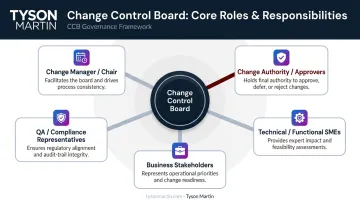
| Role | Primary Contribution |
|---|---|
| Change Manager / Chair | Owns the process, leads meetings, manages the queue |
| Change Authority / Approvers | Accepts or rejects changes — individually or collectively |
| Technical / Functional SMEs | Assesses feasibility and downstream impact |
| Business Stakeholders | Evaluates business risk and strategic alignment |
| QA / Compliance Representatives | Ensures regulatory defensibility |
Segregation of Duties
High-risk changes must not be self-approved. NIST SP 800-53 AC-5 explicitly addresses separation of duties as a security control — the individuals or teams initiating a change should not hold sole authority to approve it.
In technology and cybersecurity environments, the team requesting a change often has a direct interest in its approval. Structural separation creates the audit trail and accountability that regulators, auditors, and boards rely on when reviewing high-risk decisions.
Quorum and Escalation Rules
Define which functions must be present for which change categories. Security-impacting changes, for example, should require the CISO or equivalent. Decisions made without quorum should be recorded as provisional, not final, and should trigger a follow-up review.
The Board Charter
A CCB needs a written charter — just as any governance body does. That document should define:
- Purpose and authority scope
- Membership criteria and role responsibilities
- Operating procedures and meeting cadence
- Decision-making process and quorum requirements
- Escalation thresholds to senior leadership
Without a charter, authority is assumed rather than granted. When an incident occurs or an auditor asks who approved a high-risk change, assumed authority produces disputed ownership — and disputed ownership produces findings.
The Change Control Governance Lifecycle
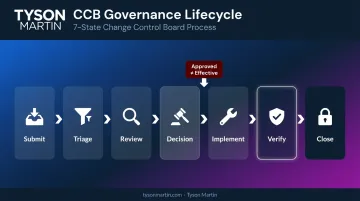
The lifecycle is a sequence of enforced states, not a checklist. Each transition has a defined gate — conditions that must be met before a change moves forward.
The Seven-State Model
Submit → Triage → Review → Decision → Implement → Verify → Close
Here's where most organizations break down:
Submission and Triage
Changes must arrive with a minimum evidence package before triage begins:
- Scope and rationale
- Affected systems and dependencies
- Proposed implementation approach
- Preliminary risk assessment
Incomplete submissions should be returned, not reviewed. Accepting weak packages sets the floor for what the organization considers adequate work.
Triage assigns a risk tier and routes the change to the appropriate approval path. This is where tiering does its job — not every change needs full board review.
The Decision Phase
The CCB's decision must include explicit conditions. SOC 2 CC8.1 and related change management criteria align with this principle — approval requires documented authorization, defined testing, and evidence of change completion before a change is considered effective.
Without conditions, approval is just a vote. The record must specify:
- What tests must pass
- What training must be completed
- What the effective date is
- What constitutes a rollback trigger
Approved vs. Effective
Most organizations collapse two distinct states — and that design flaw drives more failed changes than poor execution ever does.
- Approved: the board has authorized the change to proceed under defined conditions
- Effective: implementation is complete and evidence has been reviewed and attached to the record
Collapsing these two states causes organizations to repeatedly approve changes that aren't actually ready, then blame execution for what is a governance design flaw. A change is not effective until implementation evidence is attached and verified.
Closure Requirements
Once the effective state is confirmed, the record moves to closure — but only when all three conditions are met:
- Implementation evidence is attached
- Verification is complete
- The record is audit-ready
The decision trail must be reconstructable quickly — not assembled after the fact from email threads. Record retention requirements vary by framework and industry, but the principle is consistent: NIST SP 800-128 addresses configuration change control documentation as a foundational security control, requiring that change records support audit and accountability functions.
Risk Tiering: How Mature CCBs Stay Fast Without Losing Control
If every change routes to the full board, one of two things happens: the board becomes a bottleneck, or it starts rubber-stamping to clear the queue. Both outcomes destroy governance. Tiering routes changes to the right level of scrutiny based on actual risk — not organizational habit.
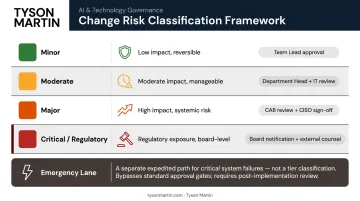
A Practical Four-Tier Model
| Tier | Characteristics | Approval Path |
|---|---|---|
| Minor | Low impact, low blast radius | Delegated approval under defined rules |
| Moderate | Defined scope, known dependencies | Formal review with verification tasks |
| Major | Broad impact, regulatory exposure | Mandatory CCB decision, gated release |
| Critical / Regulatory | High risk, compliance implications | CCB plus senior escalation, rollback plan required |
The emergency lane is a separate path, not a tier. Emergency changes are permitted, but they are never silent: each one requires mandatory after-action documentation and should feed back into the tiering review process.
The Two Failure Modes of Tiering
Even well-designed tiering systems break down in predictable ways:
- Misclassification: Teams route changes as "minor" to avoid scrutiny. The tier exists on paper, but enforcement doesn't follow.
- Decorative labels: Tiers change the approval path but not the evidence burden. If a "major" change requires the same documentation as a "minor" one, the distinction is cosmetic.
Tiers must change both behavior and evidence requirements — not just who signs off.
Who Sets and Audits the Criteria
Tiering rules should be defined during CCB charter development, reviewed at least annually, and enforced by the Change Manager. Boards should ask to see the tiering distribution over time. A high percentage of emergency changes or a sudden spike in major-tier changes are early warning signals that warrant direct inquiry, not passive logging.
CCB Best Practices and Board-Level Oversight
The "Ready for Decision" Standard
The board should never convene to build an evidence package in the meeting. A pre-defined readiness checklist must be complete before board time is spent:
- Scope and affected systems documented
- Baseline reference identified
- Risk assessment completed
- Affected artifacts listed
- Verification plan in place
- Rollback plan documented
If the package is incomplete, the right answer is "defer with a gap list," not "approve with caveats."
What Boards Should Receive
Boards and executive teams don't need change logs or meeting minutes. They need a stable trend view. Effective board-level reporting on change governance should include:
- Volume by tier over time
- Cycle time from submission to close
- Post-change incident rate
- Emergency lane utilization (trending up or down)
- Changes with open verification items past target date
The NACD's Director's Handbook on Cyber-Risk Oversight consistently emphasizes that boards need trend data against defined thresholds — not status reports. Change governance metrics should be reported the same way: in appetite or out of appetite, with context for what changed.
That framing points to what Tyson Martin calls decision-shaped reporting. Each metric should answer one clear question: are we within the risk thresholds the board approved? If emergency changes are trending up, that's a board-level signal — not just an IT metric.
Organizations in Transition
For organizations in post-incident recovery, M&A integration, leadership transitions, or active modernization programs, CCB governance structures often need to be rebuilt quickly. The design that worked before a triggering event rarely holds for what comes after.
This is where Tyson Martin's advisory work focuses — establishing decision rights, clarifying approval authority, and building inspectable execution frameworks when organizations need stability fast without disrupting operations. The starting point is consistent: confirm who can make which decisions, make it explicit, and create a governance rhythm that surfaces choices before pressure forces them into the wrong hands.
What CCB Failure Looks Like — and How Boards Can Spot It
The Four Failure Signals
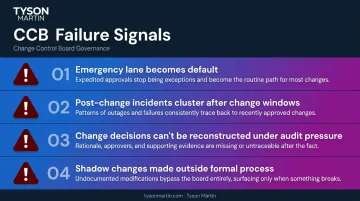
Boards and risk committees should watch for these:
- The emergency lane becomes the default — a high percentage of "urgent" changes signals weak planning or deliberate bypass of the standard process.
- Post-change incidents cluster after specific change windows — implementation gates exist on paper, but changes are going live without verified completion.
- Change decisions can't be reconstructed under audit pressure — no meaningful audit trail exists, and approvals live in email threads and verbal agreements.
- Changes are being made to live systems outside any formal process — shadow change paths running alongside the official CCB.
The Structural Root Causes
These are design failures, not people failures. Each one is fixable — once it's named correctly:
- No risk tiering: everything routes to the full board
- No "ready for decision" standard: meetings become evidence-gathering sessions
- Self-approval is possible for high-risk changes: segregation of duties is absent
- "Approved" and "effective" treated as identical: implementation is never verified
The Board's Fast Diagnostic
Ask one question: Can your organization block a change from being declared effective unless verification evidence is attached and approved?
If the answer is no, the board has documentation, not control.
A second test: ask the team to produce a complete decision and implementation record for a recent major change within one business day. If it takes a week to assemble, or arrives with gaps, that's the finding — no matter what the process documentation says.
Frequently Asked Questions
Is change control part of governance?
Yes. Governance defines who has the authority to make decisions and how those decisions are enforced. Change control is one of the primary mechanisms through which that authority operates in practice — particularly for technology, cybersecurity, and operational risk. Without it, decision authority exists on paper but not in execution.
What are the responsibilities of a Change Control Board?
The four core responsibilities are: reviewing and approving (or rejecting) change requests, scheduling changes to avoid conflicts, verifying that approved changes are properly implemented, and maintaining complete records of all decisions and their outcomes. Verification and recordkeeping are where most CCBs fall short.
Who organizes the Change Control Board?
The Change Manager — also called the CCB Chair or Change Authority — sets the agenda, enforces submission standards, leads meetings, and communicates decisions. In larger organizations this is a dedicated role; in smaller ones, it typically falls to the project manager or a senior IT or operations leader.
What is the difference between a Change Control Board and a Change Advisory Board?
A CCB has formal decision-making authority — it approves or rejects changes. A Change Advisory Board (CAB) is consultative, providing recommendations that a separate authority then acts on. Many organizations use the terms interchangeably, but the distinction matters: accountability and audit defensibility depend on clarity about who actually made the decision.
How often should a Change Control Board meet?
Frequency should match the organization's change volume and risk profile — typically weekly or bi-weekly for active IT or operational environments, with defined criteria for emergency sessions. Boards without a clear cadence default to ad-hoc approvals that erode governance over time.
What are the 5 C's of change management?
The 5 C's — Context, Collaboration, Communication, Commitment, and Change Sustainability — describe the human and organizational conditions that determine whether change management succeeds. A functioning CCB depends on all five: without clear context, risk tiering breaks down; without commitment, governance gates get bypassed under pressure.