
Introduction
Picture this: a ransomware alert fires at 2 a.m. Your CISO wants to isolate affected systems. Legal wants to call outside counsel first. The CFO is asking whether this requires an SEC disclosure. And three executives are on a call, each waiting for someone else to make the call.
Nobody's being negligent. Nobody was ever formally assigned the authority to decide.
Versions of this scenario play out across mid-market and enterprise organizations every day — especially in regulated industries like financial services, healthcare, and retail. According to a 2024 survey by the American Arbitration Association, only 33% of organizations have defined escalation pathways when governance systems fail. That's a governance failure, and it starts with undefined decision-making rights.
This guide breaks down what legal decision-making rights are, how to allocate them across your organization, and what boards should formalize before the next crisis forces the question.
Key Takeaways
- Decision-making rights define who holds formal authority to make, approve, delegate, or escalate specific categories of decisions.
- Without defined rights, organizations face delayed responses, approval bottlenecks, and direct regulatory exposure.
- Authority and accountability must align — separating them creates dysfunction and, increasingly, personal legal liability.
- Boards hold oversight authority; management holds execution authority — conflating the two is among the costliest governance errors organizations make.
What Are Legal Decision-Making Rights?
Legal decision-making rights are the formally recognized authority granted to an individual, role, or body to make binding decisions within a defined scope. That scope can cover strategy, capital allocation, risk acceptance, technology investment, regulatory compliance, or incident response.
This isn't the same as accountability or responsibility — but confusing the three is where most governance structures break down.
| Concept | Meaning |
|---|---|
| Decision Right | Who has formal authority to make or approve the decision |
| Accountability | Who answers for the outcome |
| Responsibility | Who does the execution work |
| Consultation | Who provides input before the decision is made |
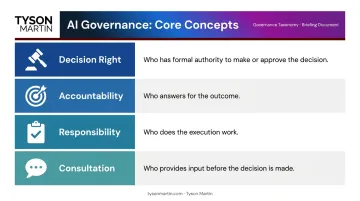
In practice, organizations routinely collapse these distinctions. A CISO gets held accountable for breach outcomes but never received authority over the security budget. A board committee gets consulted on a technology investment but believes they approved it. When pressure arrives, the gap becomes a liability.
Why This Gets Complicated in Regulated Environments
In corporate governance, decision rights exist at multiple levels: board, committee, C-suite, and department. The legal weight behind those rights connects directly to fiduciary duties, regulatory frameworks like SOX, HIPAA, and the SEC's cybersecurity disclosure rules, and documented governance structures.
NIST CSF 2.0, published in February 2024, makes this explicit: its Govern category requires that cybersecurity "roles, responsibilities, and authorities" be established and communicated, treating decision authority as a governance control, not an org-chart assumption.
When decision rights live only in informal understanding or slide decks, they aren't enforceable. That's precisely the gap regulators flag in enforcement actions and disclosure deficiency findings.
The Four Key Categories of Decision-Making Rights
Category 1 — Strategic and Financial Decisions
The board's decision rights here involve approving the framework, not dictating daily execution. That distinction matters.
Board-reserved authorities typically include:
- Capital allocation above defined materiality thresholds
- Mergers, acquisitions, and divestitures
- Major shifts in enterprise risk appetite
- Executive leadership changes
The CEO and executive team hold execution authority within those boundaries. When boards start making operational calls — choosing vendors, setting IT priorities, approving individual projects — they've crossed from oversight into management. That creates liability exposure in both directions: boards face Caremark claims for overreach, and management loses accountability clarity.
Category 2 — Technology and Cybersecurity Decisions
This is where authority confusion causes the most damage in practice.
The SEC made the stakes explicit. Under rules adopted in July 2023, public companies must disclose material cybersecurity incidents within four business days of determining materiality — not discovery — and must annually describe the board's oversight structure and management's role in cybersecurity risk. The SEC now requires identifying which board committee holds cybersecurity oversight responsibility.
According to the 2024 Deloitte/CAQ Audit Committee Practices Report, 58% of respondents assign primary cybersecurity oversight to the audit committee, with 25% assigning it to the full board. That means the majority of organizations have a designated committee.
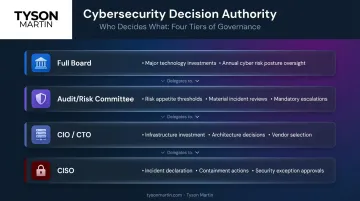
Designation alone isn't decision authority. The charter must specify what that committee actually approves versus what it reviews. In practice, authority splits like this:
- CISO: Decision authority within approved policy bounds — incident declaration, containment actions, security exception approvals up to defined thresholds
- CIO/CTO: Infrastructure investment, architecture decisions, vendor selection within budget authority
- Audit/Risk Committee: Approves risk appetite thresholds, reviews material incidents, receives mandatory escalations
- Full Board: Approves major technology investments above materiality limits, oversees cyber risk posture annually
Category 3 — Risk and Compliance Decisions
Risk acceptance is where governance ambiguity becomes legal exposure. The question isn't just who manages risk — it's who has the formal authority to accept it.
Clear allocation across key roles:
- General Counsel: Owns legal exposure assessment, regulatory notification decisions, and privilege protections during incidents
- Chief Risk Officer: Owns enterprise risk framework, risk appetite calibration, and escalation thresholds
- CISO: Owns cybersecurity risk identification, accepts or escalates based on defined thresholds
- Audit Committee: Receives escalated risks above management's acceptance authority, reviews audit findings with ownership and deadlines
The common failure: audit findings that repeat quarter after quarter because no single owner has both the accountability and the authority to remediate them.
Category 4 — Incident Response and Escalation Decisions
These rights must be pre-assigned and tested — not improvised under pressure.
During an active incident, the following authorities need a named owner before the event starts:
- Who declares the incident and at what severity threshold
- Who can authorize containment actions that disrupt systems
- Who approves external communications — customers, regulators, media
- Who decides to engage outside counsel and cyber insurance
- What the board chair receives in the first update, and in what timeframe
The SEC's enforcement record shows exactly what happens when these rights are unclear. In 2021, the SEC charged First American Financial Corporation with disclosure controls failures after security personnel identified a vulnerability exposing over 800 million document images — but never escalated it to the executives responsible for disclosure. Penalty: $487,616. In 2023, the SEC charged Blackbaud with a $3 million civil penalty after technical staff failed to communicate data exfiltration to senior management, resulting in materially misleading disclosures.
Both cases share the same root cause: no documented escalation authority connecting operational findings to disclosure decisions.
Reserved vs. Delegated: The Core Distinction
Boards reserve certain authorities and formally delegate others to management. The delegation isn't informal — it's documented, with thresholds that define when delegation ends and escalation begins. Without written thresholds, every high-pressure decision defaults to improvisation.
Principles for Allocating Decision Rights Effectively
Principle 1 — Match Authority to Accountability
Whoever is legally accountable for an outcome should hold the corresponding decision right. This sounds obvious. It's violated constantly.
The CISO example is illustrative: if a CISO can be personally named in regulatory proceedings following a breach, they need actual authority over security priorities, budget tradeoffs, and exception approvals. Holding someone accountable for outcomes they couldn't control isn't just unfair — it's a governance defect that exposes the organization to dysfunction and talent loss.
The FTC's 2023 order against Drizly extended personal obligations to its CEO at future companies where he holds security responsibility. Individual accountability is increasing — matching authority to accountability is now a legal necessity, not just good management practice.
Principle 2 — Define Decision Types Explicitly
A structured model like RACI (Responsible, Accountable, Consulted, Informed) prevents the most common failure: treating people with input rights as de facto decision-makers.
The practical version:
- Responsible: Who does the work
- Accountable: Who owns the outcome (one person)
- Consulted: Who provides input before the decision
- Informed: Who receives the outcome after
The breakdown almost always happens at the C/I boundary. Legal gets consulted on a vendor contract and believes they approved it. The CFO gets informed of a security exception and believes they authorized it. Writing down the distinction — and communicating it explicitly — prevents months of governance drift.
Principle 3 — Set Escalation Thresholds, Not Just Paths
Knowing who to escalate to is different from knowing when escalation is required. Both matter. Only the threshold prevents judgment calls in high-pressure moments.
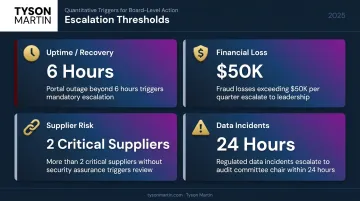
Effective thresholds are quantitative:
- "Customer portal must be restored within 6 hours of a major outage"
- "We accept up to $50,000 in confirmed fraud loss per quarter; anything above escalates"
- "No more than 2 critical suppliers can operate without current security assurance evidence at any time"
- "Any incident affecting regulated data escalates to the audit committee chair within 24 hours"
Vague thresholds like "significant impact" or "material risk" leave too much room for interpretation precisely when interpretation is most dangerous.
Principle 4 — Document and Inspect, Not Just Design
Decision rights that exist in slide decks aren't enforceable. Rights that have been tested through tabletop exercises and reviewed after real events become organizational muscle memory.
Testing should specifically cover:
- Who declares an incident, and at what severity level
- Who can authorize system shutdowns
- Who approves external communications
- How conflicting recommendations from legal, IT, and operations get resolved
A 60-minute executive tabletop that forces real decisions with limited information surfaces more governance gaps than most formal audits.
Principle 5 — Revisit During Transitions
Decision rights that made sense under a previous structure often become misaligned without deliberate review. Leadership changes, M&A integrations, regulatory shifts, and technology modernization all create conditions where inherited rights no longer match current realities.
In the first 30 days of any major transition, map decision authority across each role:
- CEO: Risk appetite and final arbitration
- COO: Operational continuity
- CTO/CIO: Engineering and infrastructure
- General Counsel: Legal exposure and notifications
- CISO: Risk clarity and security execution
When reporting lines change, decision authority needs to follow. Otherwise, teams fill the gap by guessing.
When Decision Rights Break Down
Three Structural Failures
Authority vacuum: No one is formally empowered to decide, so decisions stall. Approvals happen by default, or not at all.
Authority overlap: Multiple parties believe they hold the same right. Conflict, delay, and inconsistent messaging follow — most damaging during incidents.
Shadow authority: Informal influence overrides documented rights. Governance becomes performative. This is the hardest failure to detect and the most corrosive over time.
Warning Signs
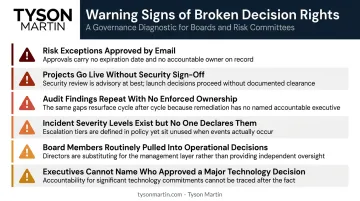
These patterns consistently signal broken decision rights:
- Risk exceptions approved by email with no expiration date
- Projects go live without documented security sign-off
- Audit findings repeat because owners and deadlines aren't enforced
- Incident severity levels exist but nobody agrees on who declares them
- Board members get pulled into operational decisions routinely
- After a major technology decision, executives can't name who approved it
The Downstream Consequences
Each warning sign above points toward the same endpoint: documented enforcement. The SEC cases referenced throughout this guide show what happens when escalation authority isn't formalized. Beyond regulatory penalties, organizations face:
- Personal director liability under fiduciary duty standards when oversight systems demonstrably fail
- Disclosure failures that trigger SEC enforcement (as Blackbaud and First American demonstrate)
- Reputational damage from inconsistent or delayed incident communications
- IBM's 2024 data breach research puts the average breach cost at $4.88 million — a figure that grows when response authority is unclear
How Boards Can Implement Clear Decision Rights
Start with a Decision Rights Audit
Map the 10–15 highest-stakes decisions the organization makes. For each, answer:
- Who currently holds decision authority?
- Who is accountable for the outcome?
- Is there a documented threshold that triggers escalation?
- Has this been tested or reviewed in the past 12 months?
The audit itself resolves disputes. Making implicit assumptions explicit — on paper, with named owners — often surfaces overlaps and gaps that leadership didn't know existed.
A practical starting point covers five categories: risk acceptance thresholds, security exception approvals, budget tradeoff authority during delivery conflicts, incident severity declaration and shutdown authority, and vendor go/no-go decisions for critical suppliers.
Formalize Through Governance Charters
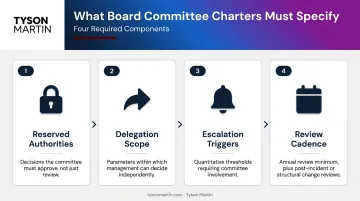
Board committee charters should specify:
- Reserved authorities: What the committee must approve (not just review)
- Delegation scope: What management can decide within defined parameters
- Escalation triggers: The quantitative thresholds that require committee involvement
- Review cadence: At minimum annually, or following material incidents or structural changes
The SEC requires public companies to identify the committee responsible for cybersecurity oversight in annual filings. NACD's 2026 Cyber-Risk Oversight guidance takes this further, recommending that nominating and governance committees define and document cyber-risk oversight responsibilities across all committees in writing. In regulated industries, charter documents carry legal weight — and regulators expect them to reflect how authority actually flows, not just how it was intended to flow.
When Outside Perspective Accelerates the Process
Organizations navigating leadership transitions, post-incident recovery, or technology modernization often benefit from an external perspective to establish or restore clear decision rights quickly. Internal politics frequently blur authority lines, and a board advisor without vendor relationships or internal reporting obligations can provide neutral ground for resolving them.
This is the core of Tyson Martin's advisory practice: establishing decision rights and escalation thresholds that hold under real pressure, not just in governance documents. That work typically covers:
- Decision rights mapping and named ownership
- Governance gap diagnostics
- Tabletop exercises that test actual escalation authority
- Committee charter architecture that makes oversight inspectable
For organizations mid-transition or recovering from an incident, getting that structure in place quickly is often what separates governance that functions from governance that merely exists on paper.
Frequently Asked Questions
What are decision-making rights?
Decision-making rights are the formally assigned authority determining who can make, approve, delegate, or escalate specific decisions within an organization. Defining them explicitly is essential because undocumented rights create gaps that default to informal influence — which isn't enforceable and doesn't hold up under regulatory scrutiny.
What are the 7 principles of decision-making?
Well-established principles include:
- Clarity of authority
- Proportionality
- Timeliness
- Reversibility consideration
- Stakeholder input
- Documentation
- Periodic review
In governance contexts, clarity of authority and documented escalation thresholds most directly prevent regulatory exposure and operational paralysis.
What are the 5 C's of decision-making?
The 5 C's — Clarify, Consider, Consult, Commit, Communicate — map directly to governance practice. The most frequently misapplied is Consult. Stakeholders who provide input during that step don't hold decision authority, and treating them as though they do is among the most common sources of authority overlap.
What are the 4 R's of decision-making?
In governance contexts, one applied framework uses Rights, Roles, Rules, and Review. Rights establish who decides; Roles define who executes versus who oversees; Rules set the thresholds and escalation criteria; Review ensures the structure stays current as the organization changes.
How do boards legally assign decision-making authority for cybersecurity and technology?
Boards formalize this authority through committee charters, documented risk appetite statements, and CISO/CIO delegation frameworks with defined thresholds. The SEC now requires public companies to identify the committee responsible for cybersecurity oversight in annual disclosures, making documented, demonstrable authority a compliance requirement.
What happens when decision-making rights are unclear during a cyber incident?
Unclear rights produce approval bottlenecks, inconsistent external communications, SEC disclosure failures, and post-incident disputes about who authorized what. Pre-assigned, tested escalation authority is one of the highest-value governance investments an organization can make. Incident time should be spent resolving the problem, not establishing who has standing to act.