Introduction
A cybersecurity incident hits. The security team is working the problem. But in the first 90 minutes, three executives are on a call debating a question no one can answer: who actually has authority to authorize the containment action that might take down a revenue-generating system?
This is not a technology failure. It is a governance failure — specifically, a decision rights failure.
Many organizations discover this gap at the worst possible moment. They have org charts, reporting lines, and job descriptions. What they lack is documented clarity about who is empowered to decide, at what threshold, and under what conditions.
The RACI matrix is the practical tool that maps roles across tasks and decisions. Decision rights are the governance layer that determines who has authority to act. Neither works well without the other.
Organizations that get this right move faster under pressure and make fewer costly missteps. Those that don't often find out during an incident, a board meeting, or a regulatory inquiry — when the cost of ambiguity is highest.
Key Takeaways
- RACI maps four roles — Responsible, Accountable, Consulted, Informed — across tasks and decisions
- Each task must have exactly one Accountable owner — multiple A's is not shared governance, it is the absence of governance
- Decision rights answer who is empowered to decide, not just who does the work
- Only 20% of organizations excel at decision-making, per McKinsey — a structural gap, not a talent problem
- Boards belong as Accountable for risk appetite and Informed on operational metrics — reversing those roles is one of the most common governance failures
What Is a RACI Matrix?
The RACI matrix — formally called a Responsibility Assignment Matrix — is a tool for clarifying who does what across tasks, processes, and decisions. As documented by PMI, a RACI chart "spells out the roles of all stakeholders" and supports governance by specifying who receives information, at what frequency, and in what form.
Most project management tools track timelines or deliverables. RACI tracks people and authority. It's the only widely used governance tool built specifically to answer one question: who owns this?
Who Uses RACI and When
RACI gets introduced most often at the start of a project or major initiative. But for boards and executive teams, it earns its place in high-stakes decisions where confusion has consequences:
- Escalation paths during incidents
- Regulatory reporting obligations
- Technology risk approvals and exceptions
- Security investment decisions and risk acceptance
RACI vs. Similar Frameworks
| Framework | Primary Purpose |
|---|---|
| RACI | Maps who holds each role across tasks and deliverables |
| DACI / RAPID | Describes how decisions get made |
The distinction matters. RACI defines ownership; DACI and RAPID define process. Organizations with mature governance typically deploy both — RACI to assign accountability, and a decision framework to govern how that accountability gets exercised.
The 4 Components of RACI Explained
Responsible (R): Who Does the Work
The Responsible role belongs to the person or persons who carry out a task. More than one person can be Responsible on a single task — but each must have a clearly defined scope.
The risk of too many R assignments: work gets duplicated, or worse, ignored because everyone assumes someone else is covering it.
Accountable (A): Who Owns the Outcome
This is the role that governs everything else. The Accountable individual has final sign-off authority and owns the outcome — not the activity.
The rule is non-negotiable: one Accountable per task or decision.
When organizations assign multiple Accountable parties, they create the appearance of oversight while producing none. In practice, diffused accountability means that when something goes wrong, no one owns it — and regulators and auditors expect a single named owner.
Multiple A's on a governance obligation is one of the most consistent gaps Tyson Martin identifies when stepping into organizations as an interim CISO or board advisor. It is also among the fastest to correct once someone names it directly.
Consulted (C): Who Provides Input
Consulted parties are subject matter experts whose input must be sought before a decision is finalized. This is a two-way relationship — information flows back and forth, unlike the one-way flow of the Informed role.
In regulated industries, Consulted roles almost always include Legal, Compliance, and Risk. Omitting them from a RACI is not just an administrative gap — it can void regulatory safe harbors or expose the organization during a post-incident review.
Informed (I): Who Receives Updates
Where Consulted is a two-way exchange, Informed is one-way: these parties receive updates but do not make decisions or shape outcomes. Boards and audit committees are often correctly placed as Informed on operational security metrics.
The critical failure is placing them as Informed on decisions where they should be Accountable — specifically:
- Risk appetite and tolerance thresholds
- Major technology investments
- Incident response authority and escalation triggers
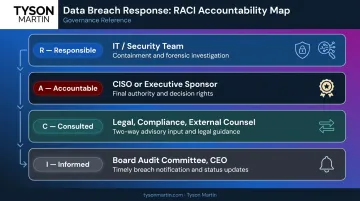
A Practical Example: Data Breach Response
| Role | Party |
|---|---|
| Responsible | IT/security team (containment, investigation) |
| Accountable | CISO or named executive sponsor |
| Consulted | Legal, Compliance, external counsel |
| Informed | Board audit committee, CEO |
This mapping resolves authority before the incident starts. When containment decisions need to move in minutes, a pre-mapped RACI eliminates the escalation debate that costs organizations time — and often, money — during a live breach.
Decision Rights: The Strategic Layer Above RACI
RACI answers "who does what." Decision rights answer "who decides and under what authority." Both are required for governance that holds under pressure.
Why Decision Rights Are a Blind Spot
Most leaders assume that clear org charts and reporting lines are sufficient. They are not — organizational structure describes hierarchy, while decision rights describe authority. Conflating the two is expensive.
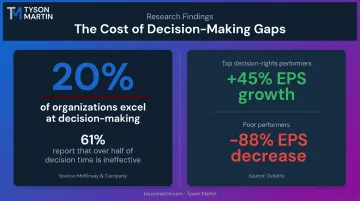
McKinsey research found that only 20% of organizations report excelling at decision-making, and 61% say at least half of their decision-making time is ineffective. That is not a technology problem. It is a governance design problem.
The business impact is measurable. Deloitte reports that public companies excelling in five decision-rights areas increased earnings per share by an average of 45% year over year, while poor performers averaged an 88% EPS decrease.
The Three Components of a Decision Rights Model
Most organizations have none of these documented explicitly:
- Decision inventory — the list of decisions that need to be made and by whom
- Governance model — which individuals or cross-functional groups are empowered to make which decisions
- Decision-making process — the forums, escalation paths, and evidence standards that govern how decisions get made
Decision Rights as a Risk Management Tool
In regulated industries and organizations under stress — M&A, new leadership, post-incident — unclear decision rights create direct legal exposure. When an audit or regulatory inquiry asks "who approved this?" and the answer is unclear, the consequences extend beyond operations into legal and reputational territory — consequences that governance design could have prevented.
Escalation Thresholds: Where RACI and Decision Rights Connect
A mature RACI framework includes documented thresholds that define when a decision must escalate — from the Responsible level to the Accountable level, or from management to the board. Without these thresholds, RACI charts become static documents rather than live governance instruments.
Tyson Martin's advisory work helps organizations define these triggers with specificity:
- Dollar thresholds for fraud or unplanned spend
- Downtime windows for critical systems
- Data sensitivity classifications
- Regulatory materiality triggers
When escalation rules are pre-approved, organizations spend incident time solving the problem rather than negotiating authority.
How to Build a RACI Matrix That Actually Holds
Step 1: Start With a Decision Inventory
This is the most commonly skipped step. Before building the chart, list the decisions — not just the tasks — that matter most for the initiative or process in scope.
For board-level governance, this means identifying explicitly which decisions belong to management and which belong to the board. Common undocumented categories include:
- Policy exception approvals (who grants them, and for how long)
- Risk acceptance (what thresholds require CEO, General Counsel, or board awareness)
- Incident escalation (who declares severity, who notifies counsel and insurer)
- Vendor go/no-go decisions for critical suppliers
Step 2: Resist Over-Including Stakeholders
Large RACI matrices with too many entries become unmanageable. Each row should have one A, a limited number of R's, and disciplined use of C and I.
The practical test: if every task has five or more entries, the matrix is not a governance tool. It is a political document designed to make everyone feel included.
Step 3: Assign Roles Collaboratively
RACI works only when the people assigned to roles have agreed to them. A brief review session with key stakeholders is a required step — not to negotiate endlessly, but to surface mismatches before they become incidents.
Step 4: Define Escalation Thresholds
For each Accountable role, document the conditions under which the decision must escalate. A practical starting point is a tiered model:
- Low-impact: management accepts within policy
- Medium-impact: executive approval required with time limits
- High-impact: escalates to CEO and board committee chair within 24 hours; full board when defined thresholds are crossed
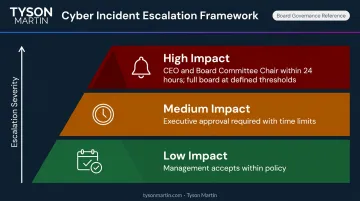
This specificity is what separates a RACI chart that gets filed away from one that guides real decisions under pressure.
Step 5: Revisit at Defined Intervals
RACI matrices decay. People change roles, structures shift, and new risks emerge. At minimum, review annually. Also trigger a review after:
- Major incidents
- Leadership changes
- M&A activity
- Significant regulatory changes
A RACI that is more than 12–18 months old without review is actively misleading stakeholders about who owns what.
RACI in Cybersecurity and Board Governance
Cybersecurity decisions carry regulatory, legal, and reputational consequences that can materialize faster than most governance structures can respond. Clear RACI mapping for cyber risk — covering incident response, vendor approvals, breach notification, and security investment — gives boards the oversight capability they need without requiring them to manage operational detail.
The Board's Correct RACI Position
| Decision Type | Board Role |
|---|---|
| Security posture and operational metrics | Informed |
| Risk appetite (acceptable risk threshold) | Accountable |
| Incident response execution | Informed |
| Disclosure decisions on material incidents | Accountable |
| Major security investment strategy | Consulted or Accountable |
When these lines blur, boards either over-reach into operations or under-perform on oversight. Both are governance failures. Getting this right requires explicitly documented decision rights — not just a shared understanding that erodes the moment a real incident lands.
The Regulatory Dimension
Frameworks across regulated industries effectively mandate decision rights documentation:
- SEC Item 106 requires public companies to describe board oversight of cybersecurity risk and management's role in assessing material cyber threats
- HIPAA (45 CFR 164.308(a)(2)) requires covered entities to identify a named security official responsible for required policies and procedures
- PCI DSS v4.0 added explicit emphasis on documenting, assigning, and understanding roles and responsibilities
- NIST CSF 2.0 (GV.RR-02) states that roles, responsibilities, and authorities related to cybersecurity must be established, communicated, and enforced
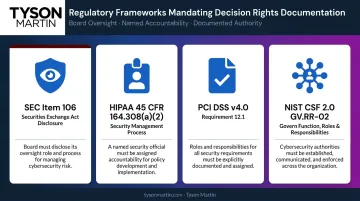
A RACI matrix aligned to these obligations is a regulatory expectation — one auditors will test against documented evidence, not stated intent.
Frequently Asked Questions
What are the decision rights of RACI?
Decision rights in a RACI context refer primarily to the Accountable (A) role : the single individual empowered to make a final decision or approve an outcome. More broadly, decision rights define who is authorized to decide what, and RACI operationalizes this by mapping those authorities to specific tasks and processes.
What are the 4 components of the RACI matrix?
- Responsible: executes the work
- Accountable: owns the outcome and holds sign-off authority (exactly one per task)
- Consulted: provides expertise or input before decisions are finalized
- Informed: receives updates but does not influence the decision
What is the difference between Responsible and Accountable in RACI?
Responsible refers to the person doing the work. Accountable refers to the person who owns the outcome and has final authority. A task can have multiple Responsible parties but must have exactly one Accountable : no exceptions.
When should a RACI matrix be updated?
At minimum annually, and after any significant organizational change : new leadership, M&A activity, major incidents, or regulatory changes. A RACI that no longer reflects how the organization operates is a governance liability, not a governance tool.
What makes RACI fail in large organizations?
The most common failure modes: assigning multiple Accountable owners (which eliminates true accountability), building matrices for compliance documentation rather than live decision-making, and never revisiting them after initial creation.
How does RACI apply to board-level cyber risk oversight?
Boards are typically Informed on operational security metrics and Accountable for risk appetite decisions. The CISO and executive team hold Accountable and Responsible roles for execution. Mapping these clearly prevents both board over-reach and accountability gaps in cyber governance.