
Introduction
A breach occurs. Customer records are exposed. The board convenes an emergency session — and within the first 20 minutes, the room fractures. Legal says IT should have escalated. IT says the risk acceptance process wasn't clear. The CISO thought the Data Owner had flagged it weeks ago. Nobody can produce a record showing who had authority to act.
This pattern repeats across regulated industries. The governance failure isn't technical — it's architectural. Decision rights were never written down, and without them, every crisis becomes a jurisdiction dispute.
Gartner predicted in 2024 that 80% of data and analytics governance initiatives will fail by 2027 due to lack of a real or manufactured crisis. Most organizations have governance on paper. What they lack is a mechanism that forces decisions to the right level, at the right time, with a durable record — and assigns liability when those decisions are missed.
A decision rights matrix provides that mechanism. This guide covers what it is, the six decision categories it must address, how to build one, and what board-level oversight should look like at the top of the structure.
TLDR
- A decision rights matrix is not a RACI chart — it maps authority, not tasks
- Every decision in the matrix needs exactly one accountable role, not a committee
- Governance owns decisions requiring enterprise consistency, formal accountability, or risk-based control
- Escalation thresholds must trigger without relying on someone's judgment call
- Boards retain oversight of the framework — operational decisions belong to named management roles
What Is a Data Governance Decision Rights Matrix?
A decision rights matrix is a structured document that records, for each recurring governance decision, who holds final authority, who must be consulted beforehand, what evidence the decision requires, and where it escalates if disputed or time-sensitive.
A policy document states rules. An org chart shows hierarchy. A decision rights matrix shows who decides — a distinction that matters most when a decision crosses team boundaries and no one is sure whose call it actually is.
How It Differs from a RACI Chart
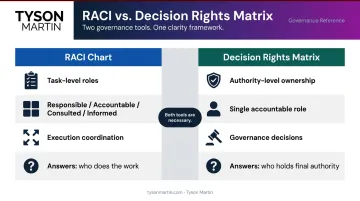
RACI operates at the task level — assigning Responsible, Accountable, Consulted, and Informed roles for completing work such as running a quality remediation workflow, executing an access review, or producing a compliance report. A decision rights matrix operates at the authority level, answering who holds final authority on matters that cross team boundaries, affect enterprise standards, or require a durable record. Both tools are necessary and neither replaces the other.
The Five Columns Every Matrix Must Have
| Column | What It Contains |
|---|---|
| Decision | What is being decided, stated specifically (not "data access" — "approval of access to restricted customer PII for non-standard roles") |
| Accountable Role | One named role with final authority — not a committee |
| Advisory Roles | Who must be consulted before the accountable role decides |
| Evidence Required | What documentation must exist before and after the decision |
| Escalation Path | Where the decision goes if disputed, blocked, or time-sensitive — with specific trigger conditions |
Why "Who Decides" Outweighs "Who Does the Work"
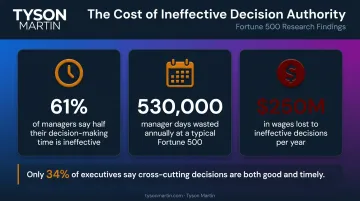
McKinsey's research across 1,200+ managers found that 61% said at least half of time spent on decision-making was ineffective, and a typical Fortune 500 company may waste 530,000 manager days and approximately $250M in wages annually on ineffective decision-making. Only 34% of executives reported that cross-cutting decisions were both good and timely.
More process rarely solves this. What moves the needle is clarity about who owns which call. Organizations that assign single accountable owners and make escalation thresholds explicit report faster decisions and fewer governance failures — particularly on the cross-functional data decisions where ambiguity is most costly.
The Six Decision Categories Governance Must Own
Governance authority should be specific, not sprawling. These six categories represent where ambiguity creates the most risk.
1. Definition and Ownership Decisions
Governance approves key business terms, enterprise metrics, reference data standards, and the assignment of accountable owners for data domains and critical data elements.
Without this, different functions operate with incompatible definitions. "Who owns customer data?" becomes genuinely unanswerable when a regulator asks — because no one ever formally decided.
2. Access Decisions
Governance defines approval paths for sensitive or restricted data, including segregation rules, role eligibility criteria, and the conditions under which exceptions can be granted.
HIPAA's administrative safeguards require explicit policies ensuring workforce members have appropriate access to ePHI and that inappropriate access is prevented. Access decisions are particularly dangerous precisely because of their routine nature. Without a defined path, informal approvals accumulate quietly and become a compliance liability that only surfaces at audit time.
3. Quality Decisions
Governance establishes thresholds for critical data elements, determines how quality issues are classified by severity, and owns resolution accountability when issues cross team boundaries.
Quality decisions without an accountable owner default to "everyone's problem" — which means no one acts until the issue surfaces in a board report or a regulatory filing.
4. Control and Classification Decisions
Governance defines how data is classified for sensitivity and risk, sets retention and lineage expectations for high-risk assets, and designs or approves controls required for compliance and audit.
These decisions create the evidentiary record auditors and regulators will request. When the SEC asks how a company managed access to material non-public information, the answer lives in classification and control decisions. If those decisions were never made, neither does the answer.
5. Change Decisions
Governance reviews material data changes that affect shared consumers, regulated outputs, or downstream model performance.
A schema change or modified enterprise metric released without governance review can silently break reporting, compliance controls, or AI model behavior. By the time anyone notices, the damage is in production.
6. What Governance Does NOT Own
Governance also needs a hard boundary around what it doesn't touch:
- How individual teams structure dashboards or build pipelines
- Application development sequencing and sprint planning
- Line management accountability for operational performance
When governance drifts into execution decisions, it loses credibility. Teams route around it entirely — creating the illusion of oversight while real decisions happen elsewhere.
How to Build Your Decision Rights Matrix: A Step-by-Step Approach
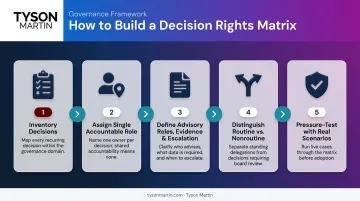
Step 1 — Inventory Recurring Governance Decisions
Before assigning authority, list the decisions governance will actually face. Focus on decisions that:
- Affect multiple functions or domains
- Require a durable record others will rely on later
- Carry material risk if made inconsistently
A short, accurate inventory beats a comprehensive list no one maintains. Ten well-defined decisions with clear owners will outperform 50 entries that confuse responsibility with authority.
Step 2 — Assign a Single Accountable Role Per Decision
For each decision, name one role with final authority. Not a committee. Not "the data team." One role, using real job titles.
This step is harder than it sounds. Assigning committees or dual owners is politically easier, but it guarantees delay and erodes accountability. Harvard Business Review's guidance on accountability is explicit: accountability should fall to one and only one person per item, even when many roles contribute. If a governance council holds the decision, name the accountable chair — not the council as a body.
Step 3 — Define Advisory Roles, Evidence Requirements, and Escalation Paths
For each decision, document:
- Who must be consulted before the accountable role decides
- What documentation must be created or referenced
- Exactly where it escalates — with specific trigger conditions, not vague direction
"Escalate to senior leadership" is functionally useless. A working escalation path looks like: "If the Data Owner cannot resolve a cross-domain quality dispute within five business days, escalate to the Governance Council Chair. Include a written issue summary and the documented positions of both domain owners."
Step 4 — Distinguish Routine from Nonroutine Decisions
Governance decisions split into two tiers with different handling requirements:
- Routine decisions (access provisioning, standard quality remediations) can run under standing standards with named roles
- Nonroutine decisions (cross-domain conflicts, policy exceptions, new enterprise metrics) require formal review
Set explicit time-based service expectations. How quickly must a standard request be decided? How long can an issue remain unresolved before automatic escalation? Without these parameters, governance becomes a nominal control layer rather than an operating commitment.
Step 5 — Pressure-Test Against Real Scenarios Before Publishing
Walk the matrix through two or three incidents that have actually occurred — a data quality failure that crossed team lines, a regulatory inquiry about retention, an access request that stalled for three weeks.
Does the matrix give a clear answer in each case? If it doesn't, the matrix isn't ready.

A governance structure that only works in hypothetical situations will be ignored the first time a real decision is under pressure.
One structured method for this validation: 60-minute tabletop exercises with cross-functional participants, including executive leadership, legal, communications, and IT. Tyson Martin runs these sessions using "injects" — data theft claims, backup failures, regulatory inquiries — to test how the decision structure holds under evolving conditions, not just calm ones.
Roles and Accountability: Where RACI Fits In
Four governance roles must be explicitly defined and kept distinct in the matrix:
| Role | Core Accountability |
|---|---|
| Data Owner | Final accountability for decisions within a domain; accepts risk at the domain level |
| Data Steward | Working-level coordination, definition management, and issue tracking |
| Data Custodian | Technical management of access and infrastructure |
| Governance Council | Authority for cross-domain and enterprise-level decisions |
The most common failure point is confusion between Data Owner and Data Steward. Owners hold final decision authority. Stewards handle coordination and workflow. When organizations conflate the two, governance decisions drift toward whoever is most available — rarely the person with the right accountability.
How RACI and the Matrix Work Together
RACI maps who is involved in executing governance processes. The decision rights matrix maps who holds final authority on governance matters. A concrete example:
- RACI shows who runs the data quality remediation workflow (Responsible = Data Steward, Accountable = Data Owner)
- Decision rights matrix shows who accepts a material quality exception that crosses domain boundaries (Accountable = Governance Council Chair, with explicit evidence requirements and a 72-hour resolution window)
The RACI without decision rights produces task clarity but no authority structure. The matrix without RACI leaves execution coordination undefined. Both tools are necessary — they answer different questions.
The Single-Accountability Rule in Practice
Group accountability diffuses responsibility. When a committee "owns" a decision, the collective incentive to act is low — each member assumes someone else is moving. When one named role owns it, the accountability is visible and inescapable.
This is the principle Tyson Martin builds into every decision rights engagement: map who approves risk acceptance, who funds remediation, who owns outcomes when things go wrong, and who has standing to escalate when a decision stalls. A plain-language RACI handles the execution layer; the decision rights matrix handles the authority layer. Separating them prevents the ambiguity that typically surfaces during incidents — when clarity matters most.
Common Failure Modes and How to Fix Them
The Matrix Gets Built but Never Used
The matrix gets approved in a kickoff meeting, filed in a document repository, and never opened again — until an auditor asks for it. That's governance theater.
Fix: Embed the matrix into actual decision workflows — access request forms, change review processes, issue escalation procedures. It should be consulted as part of routine operations, not retrieved after the fact. If the form doesn't reference it, it doesn't exist in practice.
Too Many Decisions Routed to Senior Forums
When every governance matter requires executive review, the system becomes a bottleneck. Executives disengage, and teams learn to route around governance entirely.
Fix: Explicitly delegate routine decisions to named roles operating under agreed standards. Reserve formal forums for cross-domain conflicts, material exceptions, and decisions that alter enterprise standards. An exhaustive matrix that nobody follows creates more risk than a short one that gets used every time.
Escalation Paths Are Undefined in Practice
Organizations define escalation in theory ("escalate to the governance council") but skip the trigger conditions, timing expectations, and the named role responsible for initiating escalation. During a real incident, this produces the same paralysis the matrix exists to prevent.
Fix: Write escalation triggers as explicit conditions:
- Cross-domain quality dispute unresolved after five business days → escalate to Governance Council Chair
- Access exception request outside defined risk thresholds → escalate to CISO and Legal
- Regulatory reporting impact identified → escalate to CEO and General Counsel within 24 hours
Each trigger needs a named role, a named recipient, and a hard timeline. Without all three, the escalation path exists on paper but fails under pressure.
Board and Executive Oversight: The Top Layer of the Matrix
What Belongs at the Board Level
Boards should retain oversight of the governance program itself — approving the decision rights framework, reviewing material risk exceptions, and receiving evidence that escalation thresholds are being enforced.
They should not appear in the matrix as decision-makers for operational governance questions. The matrix should include a clearly defined "board-visible" tier that surfaces only the decisions and exceptions requiring executive awareness.
Per NACD guidance, management determines asset maintenance, deprecation, and associated risks; the board oversees the risk analysis and management strategy. That boundary matters. When boards wade into operational governance, they crowd out management accountability and slow both layers down.
Escalation Thresholds That Hold Under Pressure
The SEC's 2023 cybersecurity rules require public companies to disclose material cybersecurity incidents on Form 8-K within four business days after materiality determination — and to describe board oversight and management's role in cybersecurity risk.
That clock starts the moment someone determines materiality. The decision rights matrix must specify, in advance, who makes that determination and what evidence they need to make it.
The escalation thresholds Tyson Martin consistently recommends as board-visible criteria include:
- Financial impact at pre-defined dollar thresholds
- Regulated data exposure — any incident involving customer PII or ePHI triggering disclosure obligations
- Critical system downtime exceeding agreed duration thresholds
- AI or financial model quality failures affecting regulated outputs
- Unresolved cross-domain ownership disputes past the defined resolution window
- Regulatory penalties that could constitute material events
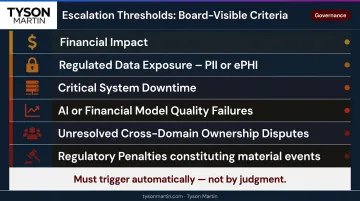
Escalation thresholds built during calm conditions are the ones that matter during crises. They must trigger automatically — not hinge on someone deciding whether a situation feels serious enough to escalate.
Organizations in Transition
Companies navigating CISO departures, M&A activity, regulatory pressure, or post-incident recovery often lack the governance infrastructure to build this matrix from the inside. The First American case is instructive: the SEC charged the company after a vulnerability involving 800 million document images was not escalated to senior executives responsible for disclosures — resulting in a $487,616 penalty.
The failure wasn't technical. Information-security personnel simply did not have a defined escalation path to the disclosure chain.
For organizations in these transitions, establishing the decision rights architecture quickly — before the next board briefing or regulatory inquiry — is the priority. Tyson Martin's interim CISO engagements specifically address this: within the first 30 days, clients receive a decision rights map, escalation thresholds, and a reporting cadence for executives and the board. The governance baseline is defensible from day one — not built after an auditor asks for it.
Frequently Asked Questions
Frequently Asked Questions
What are the five pillars of data governance?
No single authoritative framework uses a universal five-pillar model — DAMA uses 11 knowledge areas, EDM Council's DCAM v3 uses eight components. The most widely referenced elements (people and roles, policies, processes, data quality, and technology) are a useful shorthand. Decision rights underpin all of them by establishing who holds authority within each area.
What is a decision rights matrix in data governance?
It's a structured document that specifies, for each recurring governance decision, who holds final authority, who must be consulted, what evidence the decision requires, and where it escalates if disputed or time-sensitive. It documents authority, not just responsibility.
How does a RACI chart differ from a decision rights matrix?
RACI maps task-level roles for executing work — Responsible, Accountable, Consulted, Informed. A decision rights matrix maps authority-level ownership for governance decisions that cross team boundaries or require a durable record. Both are needed; neither replaces the other.
Who should own data governance decision rights in an organization?
Ownership is distributed across four levels: Data Owners (domain accountability), Data Stewards (working-level coordination), a Governance Council (enterprise and cross-domain decisions), and executive sponsors (escalation endpoints). Each decision must have exactly one accountable role — not a committee.
What decisions should the board retain versus delegate to management?
Boards retain oversight of the governance framework itself and receive escalations for material risk exceptions, regulatory reporting impacts, and unresolved ownership disputes. Operational governance decisions belong to clearly named management roles, with clear triggers that surface the right issues back to the board without overwhelming board agendas with routine matters.
How do you know if your decision rights matrix is working?
Three signals: governance decisions are being made at the right level without unnecessary escalation; escalations that reach senior forums are well-documented with clear evidence; and the matrix is consulted during real incidents rather than reconstructed afterward. A matrix that gets ignored between annual reviews isn't governing anything — it's decoration.