
Introduction
Directors are being asked to govern AI risk, cybersecurity exposure, ESG compliance, and financial oversight — often simultaneously. Nominating committees and institutional investors have responded by scrutinizing qualifications more closely than ever. Operating credentials alone no longer close the deal.
SEC cybersecurity disclosure rules adopted in 2023 now require public companies to disclose how their boards oversee cyber risk — which means a director's qualifications are a matter of public record. Formal certification has moved from a differentiator to a credibility signal — one that nominating committees can verify before the first conversation.
This guide covers 10 board certification programs recognized by nominating committees, NACD, and governance professionals. Each entry covers what the program actually teaches, who it fits, and the logistics you need to make a real decision.
Key Takeaways
- The NACD Directorship Certification® is the most recognized board credential for US public company directors — exam-based, with mandatory continuing education.
- Stanford, Wharton, HBS, Michigan Ross, UCLA Anderson, and Cambridge offer well-regarded alternatives across different formats and price points.
- Expect commitments ranging from 6 weeks to 6 months, delivered fully online, blended, or intensive in-person.
- Technology and cybersecurity executives have a specialized option: the NACD CERT Certificate in Cybersecurity Oversight.
- The right choice hinges on career stage, target board type, and budget — first credential or recertification credits matter too.
Why Board Certification Programs Matter Now
Governance expectations have expanded well beyond financial oversight. Directors are now expected to demonstrate fluency in technology risk, regulatory compliance, stakeholder management, and crisis decision-making — all at once.
According to PwC's 2025 Annual Corporate Directors Survey, institutional investors are applying growing pressure on boards to show that directors hold relevant, current expertise across these domains.
Certificate vs. Certification: A Critical Distinction
Many candidates conflate these two terms when building their board biography. The difference matters to nominating committees:
- Certificate of completion — proof you finished a course. No exam, no experience threshold, no continuing education requirement.
- Board certification — requires passing a proctored exam, meeting experience eligibility criteria, and committing to ongoing recertification credits. The NACD Directorship Certification® is the clearest example of a true certification in the US governance context.
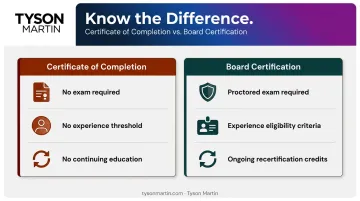
Misrepresenting a certificate as a certification on a board biography is a credibility risk, not just a semantic one.
Why Regulators Are Paying Attention
The SEC's 2023 cybersecurity disclosure rules require companies to describe their board's oversight of cyber risk — making director qualifications a governance disclosure item. Major institutional investors including BlackRock, Vanguard, and State Street have incorporated director expertise into their proxy voting frameworks.
For directors, that shift has a practical consequence: structured board education now carries reputational weight on both sides of the boardroom table — for the director and for the organization they govern.
10 Best Board Certification Programs for Directors and Executives
The programs below span US and global institutions, cover general governance and specialist tracks, and range from six weeks to six months. Each entry includes what it teaches, who it's best suited for, and key logistics.
1. NACD Directorship Certification®
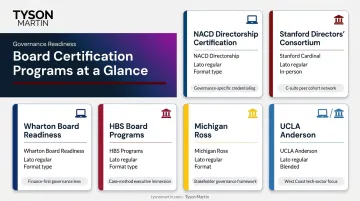
The NACD Directorship Certification® (NACD.DC) is the most widely recognized board credential in the US corporate governance community. It's backed by NACD's network of over 25,000 directors and explicitly recognized by major institutional investors and nominating committees as a governance quality signal.
Candidates must complete the Director Professionalism foundation course (or meet equivalent board experience requirements), then pass a proctored two-part exam covering governance principles and case analysis. The format includes multiple-choice questions and applied case scenarios — not just rote knowledge.
What separates it from other programs: it's the only US board credential tied to a mandatory continuing education recertification structure. Holding the NACD.DC isn't a one-time achievement — it requires ongoing engagement with governance education, which is exactly what institutional shareholders are looking for.
Best for: Aspiring and current directors targeting US public company boards who want the credential with the broadest nominating committee recognition.
| Detail | Info |
|---|---|
| Duration | Self-paced exam prep; exam is approximately 3 hours 45 minutes |
| Format | Proctored exam at Pearson VUE testing centers; foundation course available online |
| Cost | Varies by membership tier; check NACD's current pricing for member and non-member rates |

2. Stanford Directors' Consortium
Offered through a partnership between Stanford Graduate School of Business and Stanford Law School, this is a five-day intensive for current or newly appointed directors of public and private companies. The curriculum covers finance, cybersecurity, director liability, shareholder activism, and financial reporting — updated annually to reflect emerging boardroom challenges including digital governance and AI oversight.
Completed hours count toward NACD Directorship Certification recertification credits, making it useful as a standalone program or as continuing education for already-certified directors.
Best for: Directors who want academic rigor, peer learning with a high-caliber cohort, and NACD recertification credit in a compressed format.
| Detail | Info |
|---|---|
| Duration | Approximately 5 days |
| Format | In-person, Stanford campus |
| Cost | Historically $14,000–$16,000; confirm current pricing at Stanford GSB Executive Education |
3. Wharton Board Readiness Program
This 12-week online program from Wharton Executive Education combines "Executive Presence and Influence" with "Corporate Governance" into a structured multiprogram journey. It targets aspiring and early-stage directors who need both substantive governance knowledge and the boardroom presence to use it effectively.
Participants earn three Wharton digital certificates upon completion. The fully online format removes the geographic constraint that makes in-person programs inaccessible for executives who can't step away from operating roles for a week. Wharton Executive Education joined the NACD Education Network, giving graduates a pathway toward NACD recertification credit.
Best for: Senior executives preparing for a first board seat who need flexible scheduling and want to address governance knowledge and executive presence in one program.
| Detail | Info |
|---|---|
| Duration | 12 weeks |
| Format | Fully online, self-paced with live elements |
| Cost | Check current pricing at Wharton's Board Readiness Program page |
4. Harvard Business School Board Programs
HBS offers multiple governance programs through Executive Education, including "Making Corporate Boards More Effective," the "Advanced Corporate Director Seminar," and the well-known "Women on Boards" program. The curriculum covers board structure, shareholder engagement, compensation strategy, and director selection — taught through HBS's case-method approach that puts real governance failures and successes in the room.
The HBS alumni network provides long-term access to relationships with nominating committee members, which often matters as much as the credential itself in a first board search.
Best for: Senior executives who want case-method immersion and HBS network access, and directors looking for a recognized brand on their board biography.
| Detail | Info |
|---|---|
| Duration | Typically 4–5 days (varies by program) |
| Format | In-person, Cambridge, MA |
| Cost | Historically in the $10,000–$15,000 range; current pricing at HBS Executive Education |
5. Michigan Ross Board Director Program
Offered through Emeritus, this five-month blended program combines live online modules with a five-day in-person immersion at the Ann Arbor campus. It's designed for senior executives with at least 10 years of experience who are transitioning into or deepening board roles.
The curriculum covers fiduciary duties, digital transformation, cybersecurity risk, and ethics. Graduates earn a digital badge for LinkedIn plus credits toward Michigan Ross's Distinguished Leader Certificate — making it easy to layer with other executive credentials for professionals building a deliberate governance portfolio.
Best for: Mid-to-senior executives who want a structured multi-month program with both online convenience and in-person depth.
| Detail | Info |
|---|---|
| Duration | 5 months |
| Format | Blended (live online + 5-day in-person immersion, Ann Arbor) |
| Cost | Current pricing at Michigan Ross on Emeritus |
6. UCLA Anderson Board Director Program
UCLA Anderson's four-month blended program covers board structures, ESG integration, financial oversight, AI and cybersecurity governance, and stakeholder management. The program includes mock board meetings and individual coaching — two features that set it apart from purely lecture-based alternatives.
The program earns 15 recertification credits toward NACD Directorship Certification®, and the optional certification exam at the end gives candidates a formal credential to add to their board biography. UCLA Anderson's West Coast perspective gives particular depth to digital risk, AI governance, and sustainability — domains increasingly material to tech-sector and retail boards.
Best for: Executives targeting tech-sector, retail, or sustainability-focused boards who want NACD recertification credit plus mock boardroom experience.
| Detail | Info |
|---|---|
| Duration | 4 months |
| Format | Blended (live online + 5-day in-person, Los Angeles) |
| Cost | Current pricing at UCLA Anderson Executive Education |
7. Northwestern Kellogg Governance Executive Programs
Kellogg offers a suite of specialized governance programs — including corporate governance, family enterprise boards, and a women's director development program — delivered in three-to-four-day in-person formats at the Evanston or Miami campuses.
The flexibility to select a track specific to your board context is the differentiator here. A director joining a family enterprise board has different governance dynamics than one joining a public company audit committee — Kellogg addresses both. Faculty bring focused expertise in board dynamics, executive compensation, and governance under activist shareholder pressure.
Best for: Directors who want short-format, focused programming aligned to a specific board type rather than a general governance overview.
| Detail | Info |
|---|---|
| Duration | 3–4 days per program |
| Format | In-person (Evanston, IL or Miami, FL) |
| Cost | Current pricing at Kellogg Executive Education |
8. Cambridge Board Director Programme
Offered through Cambridge Judge Business School in collaboration with Emeritus, this four-month blended program includes two in-person modules on the Cambridge, UK campus. It covers strategic foresight, director fiduciary duties, leadership and stakeholder influence, and ethical governance — with an international cohort that brings cross-border governance perspectives you won't find in US-only programs.
Completion grants select Cambridge Judge Business School alumni benefits, including access to a network of over 14,000 global alumni. For executives serving on multinational boards, the international cohort and Cambridge immersions offer context US-only programs don't replicate.
Best for: Senior executives with international board aspirations or those already serving on cross-border or multinational boards.
| Detail | Info |
|---|---|
| Duration | 4 months |
| Format | Blended (live online + 2 in-person modules, Cambridge, UK) |
| Cost | Current pricing at Cambridge Board Director Programme |
9. Corporate Governance Institute – Diploma in Corporate Governance
The Corporate Governance Institute's Diploma is a university credit-rated qualification designed by serving directors for aspiring directors. It covers board structures, fiduciary duties, risk evaluation, ethics, board culture, and how to evaluate and apply for board roles — fully online, globally accessible, with flexible self-paced study.
It's one of the few university-accredited governance qualifications available without geographic restrictions. For professionals who need a recognized credential but cannot commit to US-based in-person programs, this is the most accessible option. The qualification carries recognition across the UK, Europe, and US governance circles.
Best for: Professionals outside the US, or those who need full online flexibility, seeking a university-accredited credential with global recognition.
| Detail | Info |
|---|---|
| Duration | Self-paced (typically several months) |
| Format | Fully online, globally accessible |
| Cost | Current pricing at The Corporate Governance Institute |
10. NACD CERT Certificate in Cybersecurity Oversight
Developed in partnership with Carnegie Mellon University's CERT division, this credential targets board directors and C-suite executives who need to govern — not just understand — organizational cybersecurity risk. The curriculum covers cyber risk frameworks, incident response oversight, SEC regulatory disclosure obligations, and how to evaluate a CISO's reporting.
This is the only board-level cybersecurity governance credential directly tied to NACD's certification ecosystem. It addresses a gap no general governance program fills: helping directors ask the right questions of their CISO rather than requiring them to interpret raw technical data themselves.
Tyson Martin, who has completed the CISO Executive Program at Carnegie Mellon and works directly with boards on cyber risk oversight structures, points to this kind of governance translation work as the critical bridge between technical security teams and board-level decision-making.
Best for: Technology and cybersecurity executives transitioning to board roles, and current directors on audit, risk, or technology committees in regulated industries.
| Detail | Info |
|---|---|
| Duration | Multi-day program; check current format at NACD |
| Format | In-person (Washington D.C. and other locations; verify current schedule) |
| Cost | Current pricing at NACD CERT Certificate page |
How to Choose the Right Program
This list was evaluated on four factors:
- Nominating committee recognition — does the credential signal governance quality to search firms and institutional investors?
- Curriculum relevance — does it cover what boards actually face today: AI, cybersecurity, ESG, financial oversight?
- Recertification credit value — does it count toward NACD or another recognized governance body?
- Format accessibility — can executives at different career stages and geographies realistically complete it?
The distinction that matters most: programs that prepare directors to perform versus programs built for credential-collecting. Tyson Martin, an active NACD member with governance programs completed at Carnegie Mellon, Harvard Business School, and MIT, applied that practitioner standard throughout this evaluation.
Three Mistakes to Avoid
- Brand over substance — confirm the program leads to a formal certification with an exam component, not just a completion certificate
- Ignoring recertification credit value — a program that earns NACD credits has compounding value; one that doesn't is a one-time investment
- Skipping format analysis — in-person immersions offer networking and mock-boardroom dynamics that online-only programs genuinely cannot replicate; that tradeoff is real
Format Matters as Much as Content
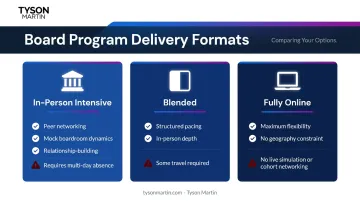
| Format | What It Offers | What It Lacks |
|---|---|---|
| In-person intensive | Peer networking, mock boardroom dynamics, relationship-building | Requires multi-day absence from operating role |
| Blended | Structured pacing with in-person depth | Requires some travel; less flexibility |
| Fully online | Maximum flexibility, no geography constraint | No live boardroom simulation or cohort networking |
Conclusion
The right board certification closes a specific credibility gap — between where you are today and where a nominating committee needs you to be. For some executives, that's foundational governance knowledge. For others, it's cybersecurity oversight fluency or a formal NACD credential recognized by public company nominating committees.
Certification opens the door. Once you're in, what matters is whether you can translate that knowledge into decisions that hold under pressure — clear oversight, credible reporting, and governance structures that don't collapse during an incident.
For executives and board candidates who need to operationalize what they learn — translating certification into governance structures, reporting frameworks, and decision rights that work from day one — Tyson Martin works directly with boards and executive teams on that transition. Connect via LinkedIn or direct inquiry to explore board advisory and fractional executive engagements.
Frequently Asked Questions
Which is the best board director certification program for independent directors?
The NACD Directorship Certification® is the most recognized credential for independent directors on US public company boards — it's exam-based, tied to continuing education, and explicitly referenced by institutional investors. Directors serving on international boards may also benefit from the Corporate Governance Institute's Diploma, which carries broad recognition across the UK and Europe.
Which board of directors certification is most valuable?
For US public company boards, the NACD Directorship Certification carries the most nominating committee weight. Executives with a technology or cybersecurity background will find the NACD CERT Certificate in Cybersecurity Oversight adds differentiated credibility that general governance programs don't provide. For global roles, the Cambridge or CGI Diploma programs have the broadest international recognition.
How do I become a certified director?
Build senior executive experience first, then complete a recognized governance program with an exam component. The NACD.DC requires completing the Director Professionalism course, passing a proctored two-part exam, and maintaining ongoing continuing education credits.
What is board governance training?
Board governance training educates current and aspiring directors on board structures, fiduciary duties, legal obligations, committee roles, risk oversight, and boardroom decision-making. It ranges from short workshops to multi-month certification programs, equipping directors to fulfill oversight responsibilities — including legal obligations.
What qualifications are required to become an independent director?
There are no universal legal qualifications for independent directors in the US. Nominating committees typically look for senior executive experience, relevant domain expertise, a clean conflict-of-interest profile, and increasingly, formal governance certification as a signal of readiness.
How do I become a director on a board?
Start by defining your board value proposition — the specific expertise you bring that a board actually needs. From there:
- Complete a governance certification program to signal readiness
- Gain initial experience on nonprofit or private company boards
- Network with current directors and executive search firms
- Build a board-specific biography that leads with governance credentials, not just operating history