Governance frameworks that fit a company three years ago can quietly become obstacles to good oversight as the organization grows, acquires, or faces new regulatory pressure. Directors start getting pulled into operational decisions that should stay with management. Reporting cycles deliver backward-looking data that doesn't support real decisions. Escalation paths that were never formally documented fail under pressure.
This guide is for board members, audit committee chairs, CEOs, and risk leaders who want to understand what a governance review actually examines, how to recognize the signs one is overdue, and what to do when it is.
Key Takeaways
- A governance review examines the framework itself, not individual board performance
- Common triggers include leadership transitions, M&A, cyber incidents, and strategic pivots
- Key warning signs: blurred board/management lines, stale reporting, and structures that no longer match organizational complexity
- Reviews done proactively yield better results than those done under crisis conditions
- Output: clear decision rights, updated structures, and a prioritized action plan — not a report for the shelf
Board Governance Review vs. Board Evaluation: Understanding the Difference
These two tools often get conflated, and that confusion costs boards time and money. They operate at completely different levels.
A board evaluation asks: How well are we doing our job within our current structure? A governance review asks: Is our structure still the right one?
What a Governance Review Actually Covers
According to NACD's governance review framework, a governance review provides an in-depth analysis of an organization's governance structure, processes, and drivers — and assesses current practices against recommended best practices. KPMG's guidance is more specific: a performance-oriented review examines:
- Corporate governance guidelines and committee charters
- Board minutes and formal terms of reference
- Decision rights and delegations of authority
- Information infrastructure and reporting protocols
- Whether the framework reflects how decisions are actually made
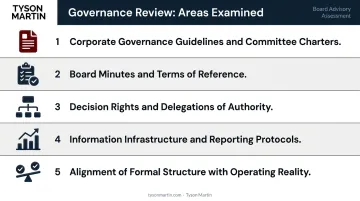
That last point matters. A governance review isn't a document audit — it's a test of whether the formal structure and the operating reality are aligned.
Frequency and Who Should Lead It
Board evaluations can be done internally and typically happen annually. Governance reviews are broader, less frequent, and almost always require external facilitation.
The UK Corporate Governance Code (2024 edition), which applies to FTSE 350 companies from January 1, 2025, requires externally facilitated board performance reviews at least every three years. US boards don't face a directly equivalent mandate, but most governance advisors and institutional investors treat every three to five years as the practical benchmark.
External facilitation isn't optional at this scope. An external reviewer brings objectivity, benchmarking against peer organizations, and the ability to identify structural blind spots the board itself cannot see — especially when those blind spots involve incumbent relationships or long-standing norms no one has challenged.
The Output Difference
A board evaluation ends with an action plan to improve how directors work together. A governance review may recommend changes to committee structures, board composition, officer roles, decision thresholds, and multi-year transformation plans. That distinction matters when deciding who commissions the work, who leads it, and how much disruption the board should expect.
Warning Signs Your Board Is Overdue for a Governance Review
Most boards don't wake up one day and decide their framework is broken. The signs accumulate gradually — which is exactly what makes them easy to miss.
Blurred Lines Between Governance and Management
When directors are routinely pulled into operational decisions, or management is making calls that should require board-level input, the governance framework itself has likely broken down. This isn't a performance issue with individual directors or executives — it's a structural failure.
Decision rights that were never formally documented get filled in informally over time. The board ends up either over-involved in operations or under-informed on strategy. Both outcomes carry real oversight risk.
Reporting That Doesn't Support Real Decisions
Boards get flooded with numbers that don't answer board questions. When reporting cycles deliver backward-looking data rather than trend-based insight — or when directors can't tell what changed since the last briefing — the governance infrastructure is failing its oversight function. This is a structural problem, not a management communication problem. The solution isn't asking the CISO to present differently; it's redesigning what governance requires the reporting to show.
Structures That Haven't Kept Pace
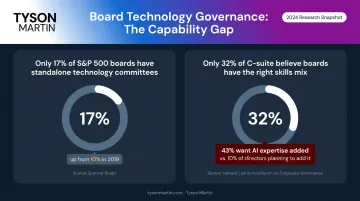
Two recent data points frame the gap. Spencer Stuart's 2024 U.S. Board Index found only 17% of S&P 500 boards have standalone science and technology committees, up from 10% in 2019. A 2025 Harvard Law School Forum / Russell Reynolds survey found only 32% of C-suite executives believe their boards have the right skills mix — with 43% wanting AI expertise added while only 10% of directors planned to do so.
A committee structure designed for a simpler organization, or one that hasn't assigned oversight of cybersecurity, AI, or supply chain risk to any committee, is operating on an outdated foundation. That gap won't surface in a routine board evaluation — which means it compounds quietly until an incident forces the question.
Repeated Escalation Failures
When incidents or emerging risks reach the board too late — or when there's no agreed escalation threshold — that's a structural problem. A board evaluation might flag it as a process concern, but it can't fix the absence of a formal escalation framework. Only a governance review can.
When a Governance Review Becomes Especially Urgent
Some circumstances make a governance review more than best practice. They make it necessary.
Leadership Transitions
A new CEO, incoming chair, or significant board turnover creates natural inflection points where inherited governance assumptions should be examined rather than perpetuated. The cost of inheriting a broken framework without recognizing it is paid later, typically during a crisis. 44% of directors in Spencer Stuart's Director Pulse Survey say CEO succession requires more meeting discussion time than it currently gets — governance structure is part of that conversation.
M&A and Strategic Change
Mergers, acquisitions, and significant business model shifts — a digital transformation, entry into a regulated market, major international expansion — can make existing governance frameworks misaligned with the actual risk and decision complexity the organization now faces.
Post-acquisition governance failures are common. Integration work collapses when decision rights across IT, security, legal, and the integration team haven't been mapped. The acquired company arrives with regulatory obligations, infrastructure, and risk exposures the existing board structure was never designed to oversee. A governance review closes those structural gaps before an incident forces the issue.
Cyber Incidents and Regulatory Pressure
A cyber incident, regulatory action, or significant compliance failure almost always reveals governance gaps alongside technical ones. The SEC's 2023 cybersecurity disclosure rules now require public companies to describe board oversight of cybersecurity risks, identify any responsible committee, and explain how the board is informed — for fiscal years ending on or after December 15, 2023.
The enforcement record makes the risk concrete:
- SEC vs. First American Financial (2021): The company failed to maintain disclosure controls ensuring senior management was informed of a known vulnerability.
- FTC vs. Drizly (2022): The action cited failure to appoint a senior executive responsible for data security.
These aren't purely technical failures — they're governance failures that played out under regulatory scrutiny.

When a review is triggered by an incident, having an advisor who bridges technical risk and board-level governance matters most. The findings need to be translated into governance language the full board can act on — decision rights, escalation thresholds, committee mandates — not buried in a risk register that management maintains and the board never sees.
Falling Behind Peer Governance Maturity
When investor feedback, NACD guidance, or regulatory expectations signal that a board has fallen behind peers, a governance review with an external scan of comparator organizations establishes where the gaps actually are — and what closing them requires. What does modern governance look like in financial services, healthcare, or retail right now? Boards that engage with organizations like NACD and the World Economic Forum's Centre for Cybersecurity gain direct visibility into that peer standard — and can benchmark against it honestly.
What a Board Governance Review Actually Examines
A well-run governance review has three layers.
Document and Structure Review
This covers bylaws, committee charters, board officer role descriptions, delegation of authority frameworks, and governance policies. The goal is to test whether the formal structure matches how decisions are actually made — not simply to confirm the documents exist.
Committee charters that haven't been updated in five years, or that don't assign oversight of cybersecurity or AI risk to any committee, are structurally insufficient regardless of how well the board performs within them.
Process and Relationship Review
This is where a governance review goes beyond what any document audit can capture. It examines:
- How the board-CEO relationship operates in practice
- The quality of management reporting (does it show trends, owners, and decisions — or just activity counts?)
- Whether agenda design allocates board time to strategy and oversight versus updates that could be delegated
- Whether pre-read materials actually prepare directors to make decisions in the meeting
The question being asked throughout: does the governance infrastructure create the conditions for real oversight, or does it create the appearance of it?
Review Outputs
A governance review should not end with a findings document. According to KPMG's governance guidance, effective reviews produce:
- Updated committee mandates reflecting current risk areas
- Refined corporate performance measures
- Calendared, prioritized action items with named owners
For organizations where the review surfaces technology or cybersecurity governance gaps, findings need to be converted into explicit board decisions: who accepts which risks, what the escalation thresholds are, and what the board will inspect at subsequent meetings.
Without that translation, structural findings stay structural. The governance risk they represent stays unaddressed.
How to Run a Governance Review That Leads to Real Change
Governance reviews fail when treated as compliance exercises. Boards too often approach reviews as benchmarking exercises — checking against peers rather than asking hard questions about their own performance. The commitment to act on findings has to be real before the review starts — including when recommendations challenge long-standing norms or incumbent relationships.
Selecting the Right Facilitator
Independence is non-negotiable. SEC disclosure norms and NYSE/Nasdaq governance standards both reflect this expectation: a reviewer with prior relationships to board members cannot deliver the objectivity that makes findings credible to investors, regulators, or the board itself.
Beyond independence, look for a facilitator who brings:
- Experience with peer organizations to provide meaningful benchmarking
- Demonstrated ability to conduct director interviews and observe board meetings
- Board-level fluency in technology governance, cybersecurity oversight, or AI risk — if those areas are in scope
- The ability to translate technical findings into governance language: decision rights, committee mandates, escalation frameworks
Technical insights that can't be expressed in governance terms won't produce governance change.
Converting Findings Into Execution
This is where most reviews either succeed or stall. The action plan structure matters:
- Near-term (90 days): Named owners, specific deliverables, decisions that can be recorded now — risk acceptance, policy exceptions, committee mandate updates
- Medium-term (6–12 months): Committee restructuring, reporting redesign, board composition changes that require longer planning cycles
- Longer horizon: Multi-year improvements to governance infrastructure that need sequencing and budget
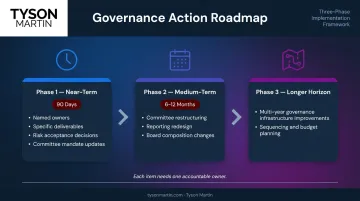
Each action item needs one accountable owner — not a committee. And the board needs a mechanism to inspect progress at subsequent meetings. The review is the start of a governance improvement cycle, not the end of a project.
Frequently Asked Questions
What is a board governance review?
A board governance review is a structured, typically externally facilitated examination of an organization's governance framework — including bylaws, committee structures, decision rights, and board-management relationships. It assesses whether the structure itself is fit for the organization's current complexity and risk environment, not just how well the board performs within it.
What are the four pillars of governance?
Frameworks vary, but the G20/OECD Principles of Corporate Governance identify accountability, transparency, equitable treatment of shareholders, and board responsibility as core pillars. A governance review tests whether the board's structure, reporting, and decision-making practices actually support all four in practice — not just on paper.
How is a board governance review different from a board evaluation?
A board evaluation asks how well the board performs within its current governance structure. A governance review questions whether that structure itself is still appropriate. Governance reviews are broader in scope, less frequent, and far more likely to recommend structural changes to committees, decision rights, and board composition.
How often should a board conduct a governance review?
Best practice calls for a governance review every three to five years — a cadence consistent with NACD guidance and expectations from institutional investors. Significant organizational changes — new leadership, M&A, a major incident — can warrant an earlier review regardless of the scheduled cycle.
Who should lead a board governance review?
Governance reviews are most effective when led by qualified, independent third parties who bring objectivity, peer benchmarking experience, and no existing relationship with the board. Internal self-reviews tend to miss structural blind spots and may lack credibility with investors or regulators.
What should a governance review produce?
A governance review should produce more than a written report. It should yield clear decision rights, updated committee mandates and governance policies, and a prioritized action plan with named owners and measurable timelines — outcomes the board can inspect and act on at subsequent meetings.