
Introduction
A board of directors cannot govern effectively alone. As regulatory requirements multiply, cyber threats intensify, and stakeholder expectations grow more demanding, full boards lack the time and depth to scrutinize every critical domain at the level the job requires.
Board committees solve this by creating focused, accountable working groups that do the deep preparatory work the full board cannot — examining financial controls, executive compensation, director recruitment, and technology risk before those issues reach the boardroom table.
This post is written for directors, audit and risk committee members, CEOs, General Counsel, and executives at regulated organizations. It covers:
- Why committees exist and how they're structured
- The core four committees and their legal obligations
- What every committee charter must include
- Emerging committee types boards can no longer afford to ignore
- The structural failures that expose boards to liability
Key Takeaways
- Board committees are delegated working groups — accountable to the full board, not independent of it
- U.S. public companies must maintain Audit, Compensation, and Nominating/Governance committees under Sarbanes-Oxley and exchange listing rules
- Every committee needs a formal charter covering purpose, composition, meeting cadence, duties, and reporting obligations
- Technology, cybersecurity, and ESG committees are now governance necessities — boards that lack them face growing regulatory and investor scrutiny
- Most oversight failures trace back to unclear decision rights, activity-based reporting, and untested escalation paths — structural gaps, not individual failure
What Are Board Committees and Why Do They Exist
A board committee is a subset of directors — and in some cases qualified non-directors — tasked by the full board with overseeing a defined function. Committees report back to and remain accountable to the full board. Their authority is delegated, not independent.
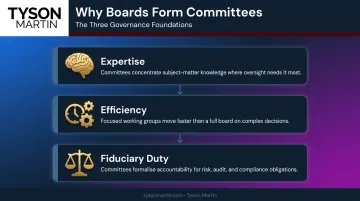
Three core reasons boards form committees:
- Expertise — directors with relevant backgrounds go where their knowledge matters most
- Efficiency — detailed preparatory work stays out of full board meeting time
- Fiduciary duty — documented, diligent committee work demonstrates the Duty of Care before recommendations reach the full board
That delegated authority has a legal foundation. Under Delaware General Corporation Law Section 141(c), a board may designate one or more committees by majority resolution, with authority to exercise board powers to the extent provided.
Most governance frameworks distinguish between two committee types:
- Standing committees — permanent bodies with an ongoing mandate (Audit, Compensation, Nominating/Governance)
- Ad hoc committees or task forces — time-limited groups created for a specific purpose, such as a CEO search or M&A review
In practice, boards go well beyond these two categories. According to the 2025 Spencer Stuart U.S. Board Index, S&P 500 boards averaged 4.1 standing committees, with three-quarters maintaining at least one committee beyond the three required by exchange listing rules.
The Four Core Committees of Corporate Governance
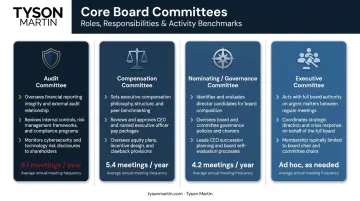
While board structures vary, four committees appear most consistently across public companies, nonprofits, and mature private organizations. Each has a distinct mandate. Confusing those mandates is one of the most common governance errors boards make.
The Audit Committee
The Audit Committee's primary mandate: ensuring the integrity of financial reporting, the effectiveness of internal controls, and the independence of the external auditor.
Sarbanes-Oxley (2002) significantly expanded that authority. Under SOX Section 301, the committee has sole responsibility for appointing, compensating, and overseeing the external auditor, and must establish procedures for anonymous employee complaints on accounting matters.
SOX Section 407 added a separate disclosure requirement: companies must state whether the committee includes at least one financial expert.
Core responsibilities include:
- Reviewing annual (10-K) and quarterly (10-Q) financial statements before SEC filing
- Overseeing the internal audit function
- Maintaining whistleblower procedures
- Monitoring compliance with legal and regulatory requirements
NYSE rules require at least three members, all independent. S&P 500 audit committees met an average of 8.1 times per year in 2025. 62% of audit committees surveyed by Deloitte/CAQ in 2025 carried primary oversight of cybersecurity risk. That's a significant scope expansion — one that ideally belongs in a dedicated technology or risk committee, not piled onto an already-loaded audit agenda.
The Compensation Committee
The Compensation Committee sets executive pay programs that balance market competitiveness with long-term shareholder alignment. NYSE and Nasdaq rules require members to be fully independent, with the committee holding sole authority to hire and dismiss compensation consultants.
Key responsibilities:
- Setting all components of CEO compensation against pre-determined performance goals
- Reviewing compensation for other senior executives
- Designing and administering short- and long-term incentive plans
- Producing the Compensation Discussion and Analysis (CD&A) in the proxy statement, required under Regulation S-K Item 402(b)
Median S&P 500 CEO pay reached $16.9 million in 2025, with a 94.5% say-on-pay support rate, according to ISS's 2025 Proxy Season Review. High approval rates don't mean the work is easy — they reflect how much discipline goes into structuring defensible pay programs before proxy season arrives.
The Nominating and Governance Committee
This committee shapes the board's composition, governance practices, and director pipeline. Get it wrong, and every other committee operates with the wrong people, the wrong skills, or the wrong accountability structure.
Responsibilities include:
- Recruiting and nominating qualified director candidates
- Assessing board composition for skills, experience, and diversity
- Developing corporate governance guidelines
- Leading annual board self-evaluations
- Recommending which directors chair and serve on other committees
99% of S&P 500 boards conducted some form of annual evaluation in 2025, with 27% using an independent third-party facilitator. 58% had a Rooney Rule-equivalent policy requiring diverse candidates in director recruitment pools (Spencer Stuart, 2025).
The Executive Committee
A smaller subset — typically the board chair, CEO, and committee chairs — empowered by bylaws to act on behalf of the full board on urgent matters between scheduled meetings.
One caution: boards must be deliberate about scope. An Executive Committee that routinely handles substantive decisions effectively displaces full-board authority, which creates accountability gaps and potential legal exposure. It's a mechanism for genuine emergencies, not a shortcut around the full board.
What Must a Committee Charter Include
A committee charter is the formal governing document approved by the full board — the committee's constitution. Without a clear, current charter, a committee risks scope creep, accountability gaps, and legal exposure if it fails to follow its own rules.
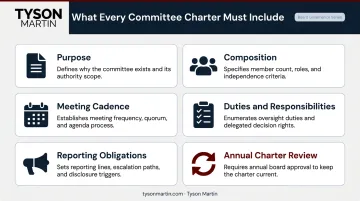
Every charter must address six elements:
| Component | What It Covers |
|---|---|
| Purpose | The specific oversight mandate and why the committee exists |
| Composition | Member count, independence requirements, expertise qualifications (e.g., financial expert for audit) |
| Meeting cadence | Minimum frequency and conditions requiring additional meetings |
| Duties and responsibilities | The enumerated list of specific oversight tasks |
| Reporting obligations | How and when the committee reports to the full board |
| Annual charter review | A built-in requirement to reassess and update each year |
Nasdaq rules require both the Audit and Compensation committees to review and reassess charter adequacy annually. NYSE requires charter publication on the company's website.
These exchange requirements set the floor — drafting quality determines whether the charter actually works. Vague language and overlapping responsibilities are the two most common failures. A Finance Committee charter should not duplicate Audit Committee duties around financial reporting. Where a separate Risk or Technology Committee exists, the Audit Committee charter should clearly distinguish financial risk oversight from operational and technology risk oversight.
Emerging Committees Boards Can't Ignore
The traditional three exchange-required committees were designed for a different era of risk. Today's boards — particularly in financial services, healthcare, and retail — face threats that don't fit neatly inside an audit mandate.
The Technology and Cybersecurity Committee
A Technology or Cybersecurity Committee provides focused, ongoing oversight of the organization's technology strategy, major IT investments, digital transformation, and cybersecurity preparedness. This is work that requires board-level attention — and technical fluency most Audit Committees don't have.
The SEC's 2023 cybersecurity disclosure rule (effective for fiscal years ending December 15, 2023 or later) requires annual disclosure of the board's oversight of cybersecurity risks. That requirement raised the bar for boards to demonstrate meaningful engagement — not just receive a briefing once a year.
Only 18% of S&P 500 boards had a standalone science and technology committee as of 2025 (Spencer Stuart). That gap is a governance risk, not a structural efficiency.
The key questions a Technology/Cybersecurity Committee should be able to answer:
- Is the organization's cyber risk posture understood in business terms, not just technical metrics?
- Are escalation thresholds defined and tested before an incident occurs?
- Do the metrics reported to the board show meaningful trend data — or just activity counts?
Many boards still receive cybersecurity briefings that are too technical to inform decisions and too infrequent to reflect actual risk movement. That's a governance structure problem — not an IT problem.
Boards navigating an incident, leadership transition, or regulatory review can benefit from an independent advisor who defines committee mandates, establishes plain-English reporting, and builds escalation structures that hold when a real event forces the question.
The ESG Committee
The same governance logic that applies to cyber risk applies to ESG. Investor scrutiny, emerging disclosure requirements, and human capital pressures are pushing more organizations to formalize ESG governance rather than absorbing it into Audit or Governance mandates.
As of 2025, 15% of S&P 500 boards had a dedicated Environment, Health and Safety committee and 6% had a Public Policy/Corporate Responsibility committee (Spencer Stuart). The SEC's climate disclosure rules remain stayed pending litigation as of 2026, but the governance expectation — that boards can speak credibly to environmental and social risk oversight — isn't going away with the regulation.
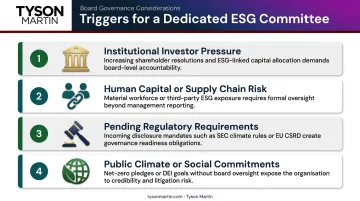
Key triggers that prompt boards to formalize a dedicated ESG committee:
- Institutional investor pressure or proxy advisor scrutiny on ESG disclosures
- Human capital or supply chain risk that Audit can't adequately monitor
- Pending or anticipated regulatory disclosure requirements
- Public commitments on climate or social impact that require board-level accountability
The Risk Committee
Where ESG and technology committees address specific risk domains, a dedicated Risk Committee takes a broader enterprise view. It's most appropriate in financial services, healthcare, or organizations with complex enterprise-wide risk profiles where Audit Committee bandwidth is insufficient. Federal Reserve Regulation YY (12 CFR 252.22) requires covered bank holding companies to maintain a risk committee with a formal board-approved charter.
11% of S&P 500 boards had a risk committee in 2025, with 57% of those concentrated in the financials sector. In the broader market, ERM oversight landed with the Audit Committee at 52% of organizations, the full board at 28%, and a dedicated Risk Committee at just 19% (Deloitte/CAQ, 2025). That distribution reflects how much oversight pressure falls on audit committees that were never designed to carry it.
Where Board Committee Oversight Breaks Down
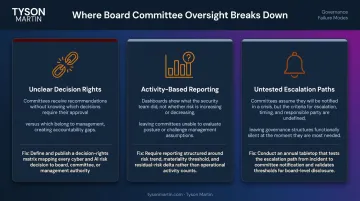
Most committee oversight failures don't come from bad intent. They come from three structural problems that are fixable — but only if the board names them.
Unclear Decision Rights
Committees often operate without clear boundaries between what the committee can approve, what it recommends to the full board, and what requires immediate escalation. The result: either the committee overreaches into management decisions, or management decisions escape board-level scrutiny entirely.
A clear decision rights map answers three questions for every material risk category: Who decides? Who executes? Who must be consulted before action?
Activity-Based Reporting
Committee reports are typically built around activity — what happened — rather than trend and posture — what it means. A well-designed report gives directors a stable dashboard view that shows:
- What changed since the last briefing
- Why it matters in business terms
- What management is doing about it
- Where a decision is required from the board
When reports describe motion rather than progress, directors can't distinguish a worsening risk from a managed one. And when the format changes every quarter, the board can't see trajectory at all.
Untested Escalation Paths
A meeting cadence is not an escalation protocol. Few committees have a tested procedure for what happens between meetings when a material event occurs. The gap surfaces during incidents — when decision rights, thresholds, and communication chains that were never defined under normal conditions suddenly become critical under pressure.
Pre-defining what triggers an emergency committee session — and rehearsing it through a tabletop exercise — is the difference between a governance structure that holds and one that reveals its weaknesses in the worst possible moment.
Effective committee governance requires:
- Written decision rights and escalation thresholds
- Reporting built around stable metrics and plain-language framing
- Annual charter reviews that reflect current risk
- Committee membership that brings genuine expertise, not just seniority
For boards rebuilding governance after an incident, leadership transition, or regulatory review, an independent advisor accelerates the process. The value is structural: credible oversight frameworks built without relying on the management team to assess itself.
Frequently Asked Questions
What should be included in a committee charter?
A complete committee charter covers six elements:
- Purpose statement
- Composition and independence requirements
- Meeting cadence
- Enumerated duties and responsibilities
- Reporting obligations to the full board
- Annual charter review provision
Charters should avoid vague language and must not overlap with the responsibilities of other standing committees.
What is the structure of a governance committee?
The Nominating and Governance Committee is typically composed entirely of independent directors, led by an independent chair. It meets as needed to manage director recruitment, board composition assessments, corporate governance policy development, and the annual board self-evaluation process.
What are the four committees of corporate governance?
The four most consistently cited committees are Audit, Compensation, Nominating and Governance, and Executive. U.S. public companies listed on NYSE or Nasdaq are legally required to maintain the first three under exchange listing standards, with Sarbanes-Oxley requirements reinforcing the Audit Committee mandate.
What are the four C's of auditing?
The "four C's" isn't a standardized PCAOB or AICPA framework; different practitioners use different formulations. The IIA describes a five-attribute approach: condition, criteria, effect, cause, and recommendation. If your organization uses a four C's framework, confirm the definitions with your internal audit team.
Do private companies need to have board committees?
Private companies are not legally required to maintain board committees, but many form them voluntarily for governance maturity, IPO preparation, or to satisfy investor agreement requirements. Simpler structures are usually better for early-stage companies — a single advisory board often outperforms multiple underpopulated committees with no real mandate.
How often should board committees meet?
Meeting frequency is defined in each committee's charter and varies by function. Audit Committees typically meet at least four times annually, though S&P 500 audit committees averaged 8.1 meetings per year in 2025. Compensation and Governance Committees generally meet two to four times annually, with additional sessions as circumstances require.