
Yet many boards still treat independence as a compliance checkbox rather than an operational discipline. A director technically qualifies as independent. The proxy discloses it. And then the board proceeds to defer to management on exactly the decisions independent oversight was designed to scrutinize.
This article covers what independence actually means in regulatory terms, what NYSE and Nasdaq require, the specific responsibilities independent directors carry, how key committees function, and what good oversight looks like when things get complicated.
Key Takeaways
- Independent directors have no material financial, professional, or personal ties to the company beyond their director fees, which enables objective oversight of management.
- Both NYSE and Nasdaq require a majority of board members to be independent.
- The Audit, Compensation, and Nominating/Governance committees must consist entirely of independent directors.
- Core responsibilities include CEO accountability, succession planning, executive compensation, and overseeing material risks—including cybersecurity.
- Annual independence reviews should go beyond the legal minimum — long tenure, charitable ties, and outside relationships can raise investor concerns even when technically compliant.
What Is an Independent Director—and What Makes Someone "Independent"?
An independent director is a board member with no material financial, professional, or personal relationship with the company beyond their director compensation. This contrasts with "inside directors"—the CEO, CFO, or other executives who are employees and cannot, by definition, provide objective oversight of themselves.
"Independent" isn't just a general concept of objectivity — it has a specific regulatory meaning under NYSE and Nasdaq listing standards.
Both exchanges require the board to make an affirmative annual determination of each director's independence, disclosed in the company's proxy statement under SEC Regulation S-K Item 407(a). The board can't simply assume independence continues from year to year—it must actively evaluate it.
Why does this matter? Independent directors are, in practice, the primary check on management power. To qualify, a director must be free of:
- Employment ties to the company (current or recent)
- Material financial relationships beyond board compensation
- Close personal or family connections to executives
That freedom lets them evaluate management proposals, set executive compensation, and assess strategic decisions without the conflicts that insiders carry. According to the 2024 Spencer Stuart U.S. Board Index, independent directors made up 85% of all S&P 500 directors in 2024. For any public company board that hasn't reached that threshold, that number is a signal investors and regulators notice.
NYSE and Nasdaq Independence Standards: What the Rules Actually Require
The "No Material Relationship" Test
Both exchanges apply a principles-based foundation: a director is not independent if they have any relationship—direct or indirect—that would interfere with independent judgment. This is NYSE Section 303A.02(a) and Nasdaq Rule 5605(a)(2) in plain terms.
This principles test covers situations the specific rules don't enumerate. A director can pass every bright-line test and still fail the material-relationship standard if the board can't articulate why a particular tie leaves judgment intact.
Bright-Line Disqualifiers
Alongside the principles test, both exchanges impose specific disqualifying rules. Any one of these automatically blocks an independence determination:
- Was an employee of the company within the past three years
- Received more than $120,000 in direct compensation from the company in any 12-month period within the last three years (excluding board and committee fees)
- Is a current or recent partner, employee, or affiliate of the company's external auditor (within three years)
- Serves on a compensation committee of another company whose executive serves on this board's compensation committee
- Leads a company with payments to or from the listed company exceeding the greater of $1 million or 2% of consolidated gross revenues (NYSE), or 5% of the recipient's revenues or $200,000, whichever is greater (Nasdaq)
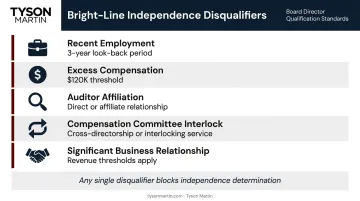
These tests carry a three-year look-back period. A relationship that ended four years ago doesn't disqualify—but one that ended two years ago does.
Stricter Rules for Key Committees
The Audit and Compensation committees face enhanced requirements beyond the base independence standard:
- Audit Committee (SEC Rule 10A-3, per Sarbanes-Oxley): Members may not accept any consulting, advisory, or other compensatory fee from the company other than director fees. No exceptions for indirect payments through affiliated entities.
- Compensation Committee (SEC Rule 10C-1, per Dodd-Frank): The board must consider all sources of compensation paid to the director and any affiliations with the issuer when making independence determinations.
Going Beyond the Minimum
Annual independence reviews should examine more than the bright-line rules. Long tenure, charitable ties, and family connections that fall below the disqualification thresholds can still draw investor scrutiny. If the board can't explain why a relationship leaves judgment intact, that explanation belongs in the proxy—not just in the boardroom.
Core Roles and Responsibilities of an Independent Director
Objective Oversight of Management
The most fundamental responsibility is asking the questions that internal executives can't—or won't—ask themselves. Is this the best use of capital? Have we adequately stress-tested the downside? What are we not seeing?
This requires real preparation, not passive presence. Directors who show up to board meetings without having read management's materials and who don't push back on weak assumptions aren't providing oversight—they're providing cover.
CEO Accountability and Succession Planning
Independent directors set CEO performance goals, conduct annual evaluations, determine compensation, and manage the succession pipeline. This is the highest-stakes function on the board, because senior managers are rarely positioned to challenge the CEO directly—that accountability falls to the independent directors.
Succession planning isn't just an emergency protocol. Boards that maintain ongoing succession visibility—including internal candidates and external benchmarks—are far better positioned when leadership transitions become urgent.
Overseeing Material Risk—Including Cybersecurity
Independent directors are responsible for overseeing financial, legal, operational, and technology risk. Cybersecurity has moved squarely into this category. SEC Release No. 33-11216 now requires public companies to describe the board's oversight of cybersecurity threats in annual filings—including which committee handles it and how the board receives relevant information.
Directors without deep technical backgrounds face a real challenge here. The answer isn't necessarily to add a director with a cybersecurity resume. Boards can engage independent advisors who translate technical exposure into governance-ready reporting without changing board composition. That's the gap Tyson Martin's board advisory work addresses directly — delivering:
- Decision-ready risk briefings framed for governance, not operations
- A stable dashboard showing trend indicators rather than raw metrics
- Defined escalation thresholds that hold under real incident conditions
The goal is giving boards what they need to make defensible decisions, not overwhelming them with technical detail.
Delaware courts have made clear that passive oversight creates real liability. In In re Boeing Co. (2021) and Marchand v. Barnhill (2019), courts allowed Caremark claims to proceed where boards allegedly failed to establish adequate monitoring systems for mission-critical risks. The standard isn't perfection: it's whether the board had a genuine system in place and paid attention to what it showed.
Executive Sessions
NYSE Section 303A.03 requires non-management directors to meet in regularly scheduled executive sessions without management present. Nasdaq requires independent directors to hold these sessions at least twice a year.
These sessions give directors space for frank conversations about performance, leadership concerns, and sensitive issues—without the CEO present to shape the room.
Key Committees Led by Independent Directors
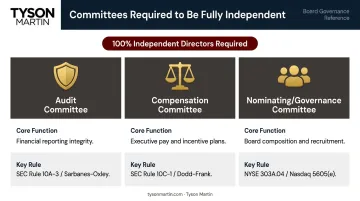
NYSE and Nasdaq listing standards require three board committees to be composed entirely of independent directors.
| Committee | Core Function | Key Requirements |
|---|---|---|
| Audit | Financial reporting integrity, internal controls, external auditor relationship | At least one financial expert (SEC Item 407(d)(5)); enhanced independence under Rule 10A-3 |
| Compensation | Executive pay structure, incentive plan approval, pay-for-performance alignment | Enhanced independence analysis under Rule 10C-1 (Dodd-Frank) |
| Nominating/Governance | Board composition, director recruitment, skills matrix, governance practices | Fully independent under NYSE 303A.04 / Nasdaq Rule 5605(e) |
In 2024, 65% of S&P 500 audit committee chairs had financial backgrounds, and 28% of all S&P 500 directors were identified as audit committee financial experts—reflecting how seriously companies treat this qualification.
Serving effectively on these committees requires more than attendance. Committee work is where detailed oversight actually happens, and passive participation creates genuine governance risk for the entire board.
Directors who contribute substantively tend to share three habits:
- Bring relevant expertise to the specific committee's scope
- Review pre-read materials in depth before meetings
- Challenge management presentations rather than simply ratify them
The Lead Independent Director: Why the Role Matters
When the CEO and Board Chair roles are held by the same person—still the case at 40% of S&P 500 companies as of 2024—a Lead Independent Director is typically appointed to provide formal independent leadership. In 2024, 66% of S&P 500 boards had a lead or presiding director, with lead directors accounting for 91% of those roles.
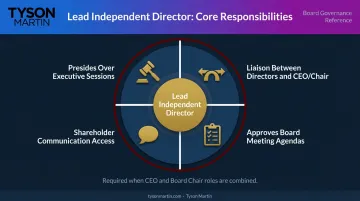
The Lead Independent Director's core responsibilities:
- Presides over executive sessions of independent directors
- Serves as the primary liaison between independent directors and the CEO/Chair
- Approves board meeting agendas to ensure independent priorities get airtime
- Is available for direct communication with shareholders when appropriate
The SEC requires disclosure of this structure. When the CEO and Chair roles are combined, Item 407(h) of Regulation S-K requires companies to explain why, and to describe the specific role of any lead independent director.
That disclosure requirement carries real weight with institutional investors. Glass Lewis has stated it will recommend voting against governance committee chairs at companies with neither an independent chair nor a lead independent director. Proxy advisors and sophisticated shareholders treat the role as a meaningful signal of whether independent leadership actually functions.
What Independent Directors Need from Management to Do Their Job Well
Independence on paper means very little if independent directors receive filtered, delayed, or incomplete information. The information problem is more common than most boards acknowledge.
What Good Reporting Looks Like
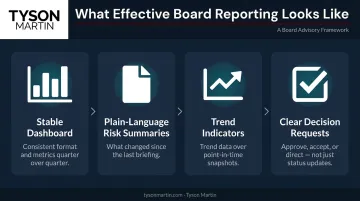
Effective board reporting for independent oversight should include:
- Stable dashboard — consistent format, definitions, and metrics quarter over quarter, so directors can see whether risk is actually improving or just being described differently
- Plain-language risk summaries — what changed since the last briefing, not just what the current state is
- Trend indicators over point-in-time snapshots — a single data point can look fine while underlying risk quietly accumulates
- Clear decision requests — what the board needs to approve, accept, or direct, not just status updates
Reporting clarity only solves half the problem. The other half is knowing who acts on what it reveals.
Decision Rights and Escalation Thresholds
Good governance requires clarity about who decides what. Boards operating in high-risk domains — regulated industries, digital-native businesses, companies with significant technology or cybersecurity exposure — benefit from explicit escalation thresholds defined before pressure hits.
That means documented answers to questions like: who declares incident severity, who can approve containment actions that affect operations, and when does management escalate to the board versus handling internally.
This is exactly the structure Tyson Martin builds for board clients: a one-page risk appetite statement paired with a one-page escalation ladder, so the board isn't negotiating authority mid-crisis.
The True Test of Oversight
Independent directors should insist on reporting structures that hold in actual incidents, not just routine quarters. The Boeing and Marchand cases are instructive—what courts and shareholders examine isn't whether the board received information at one meeting, but whether the board had a functioning system and acted on what it showed over time.
Independent advisory support — separate from the in-house CISO and security vendors — validates that those reporting structures and escalation thresholds will actually hold when an incident hits, not just on paper.
Frequently Asked Questions
How much do independent directors earn?
According to Pearl Meyer's 2024 data, median total director compensation runs approximately $242,000 — from roughly $165,000 at micro-cap firms to over $323,000 at large S&P 500 companies. At S&P 500 companies, that typically combines a $144,000 cash retainer with $190,000 in stock awards.
What is the difference between a director and an independent director?
All independent directors are directors, but not all directors are independent. "Inside" directors—such as the CEO or CFO—are employees of the company. Independent directors have no material financial or employment relationship with the company beyond their board compensation, enabling objective oversight of management.
What are the eligibility criteria for an independent director?
Common disqualifiers include:
- Employment at the company within the past three years
- More than $120,000 in direct compensation (beyond board fees) in any 12-month period within the past three years
- Affiliation with the company's auditor or interlocking directorships
- Significant business relationships above defined revenue thresholds
The board must make an affirmative annual independence determination and disclose it in the proxy.
Are public companies required to have independent directors?
Yes. Both NYSE and Nasdaq listing standards require that a majority of the board be independent. Additionally, all members of the Audit, Compensation, and Nominating/Governance committees must be independent directors under exchange rules.
What is a lead independent director?
A Lead Independent Director is a formally designated board member who presides over executive sessions, liaises between independent directors and the CEO/Chair, and approves board agendas. The role is most common when the CEO and Chair positions are combined. SEC rules require disclosure of the Lead Director's specific responsibilities when that structure exists.
Which board committees must be composed entirely of independent directors?
The Audit, Compensation, and Nominating/Governance committees must be composed entirely of independent directors under NYSE and Nasdaq listing standards. The Audit Committee faces additional requirements under SEC Rule 10A-3 (Sarbanes-Oxley), including a prohibition on members receiving any compensatory fees beyond director compensation.