Introduction
Cybersecurity has become a board-level responsibility — yet most security reporting still arrives in the boardroom as a wall of technical metrics that directors cannot translate into strategic decisions. Patch compliance rates, alert volumes, vulnerability counts: these numbers tell security teams something useful. They tell boards nothing actionable.
According to a 2025 Gartner survey, 90% of non-executive directors lack a measure of confidence in cybersecurity value. That gap isn't a communication style problem — it's a structural one. Boards are receiving the wrong information.
A cybersecurity balanced scorecard fixes that structure. This guide explains what one is, how its four perspectives work together, and how to build one — including how to select the right metrics, map them to business risk, and present a dashboard that trends over time rather than drowning leadership in noise.
If you govern, oversee, or report on cybersecurity risk — as a board member, CISO, CEO, COO, or audit committee chair — this guide is built for you.
Key Takeaways
- A cybersecurity BSC adapts Kaplan and Norton's classic framework to measure security across four perspectives: financial, customer, internal process, and learning and growth
- It moves boards from reviewing technical data to evaluating business risk, resilience, and investment alignment
- Each perspective needs both leading indicators (activity signals) and lagging indicators (outcomes)
- The goal is to surface decisions that matter and clarify who owns them — not to track everything
- Done well, it reduces board-level surprises and gives the CISO a repeatable, jargon-free way to report posture
What Is a Cybersecurity Balanced Scorecard?
A cybersecurity balanced scorecard is a structured performance management tool that maps an organization's security goals, metrics, and initiatives across four business perspectives. The purpose is to give boards and executive teams a way to evaluate cyber risk in context — not in isolation from the business decisions they're responsible for making.
The tool is designed to translate cybersecurity from a technical discipline into a governance instrument. With it, directors can ask sharper questions, make defensible resource decisions, and hold management accountable for outcomes rather than activities.
How It Differs from Other Security Tools
Three tools often get conflated, and the distinction matters:
| Tool | Audience | Primary Question |
|---|---|---|
| Security operations dashboard | Technical security teams | What threats are active right now? |
| Compliance checklist | Compliance and audit functions | Are required controls in place? |
| Cybersecurity BSC | Board and executive leadership | Is the organization genuinely resilient, and is investment justified? |
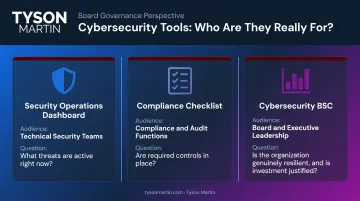
The BSC integrates signals from both operations and compliance into a strategic view. It doesn't replace either tool. That distinction matters most when a board needs to make a resource decision under pressure — or explain its oversight to regulators.
Why Boards and Executive Teams Need a Cybersecurity BSC
The gap shows up in the data. The NACD's 2023 Cyber Risk Oversight Handbook found that 72% of boards review management's approach to protecting critical assets — but only 52% review the potential material financial implications of a breach. Boards are tracking controls more closely than consequences.
Without a structured scorecard, the result is predictable: security teams pull data from disparate sources, present inconsistent metrics from one briefing to the next, and frame risk in technical language that doesn't connect to revenue exposure, regulatory liability, or business continuity.
A few specific failure patterns appear repeatedly in board reporting:
- Activity reported as success — "MFA deployed," "training completed," "patching on schedule" — all of which can be true while serious exposure remains hidden
- Always-green dashboards that prevent directors from distinguishing urgent risk from routine activity
- No trend data, making it impossible to tell whether posture is improving or deteriorating
- Missing escalation thresholds, so every event becomes a debate at the worst possible time
The Regulatory Dimension
The pressure isn't only internal. SEC Release No. 33-11216 requires public companies to disclose material cybersecurity incidents within four business days of determining materiality, and to provide annual disclosure covering:
- Risk management approach and strategy
- Governance structure and board oversight
- Management's role in cybersecurity
HIPAA, PCI-DSS v4.0, and GDPR create parallel accountability obligations across healthcare, payments, and data privacy.
Boards need a defensible, documented basis for demonstrating they understood and questioned their organization's security posture. A cybersecurity BSC creates exactly that record: consistent metrics, visible trend lines, and evidence of structured oversight that holds up to regulatory scrutiny.
The Four Perspectives of a Cybersecurity Balanced Scorecard
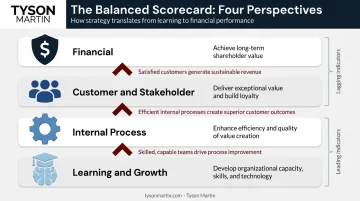
The cybersecurity BSC inherits its architecture from Kaplan and Norton's original framework, adapted so each quadrant reflects a distinct dimension of how cyber risk creates or destroys business value. The perspectives cascade: learning and growth enables better processes, which produces better stakeholder outcomes, which ultimately protects financial performance.
One discipline applies across all four perspectives: every section should include leading indicators (what predicts future performance) and lagging indicators (what has already occurred). A scorecard built entirely of lagging indicators tells you what went wrong but gives you no levers to pull.
Financial Perspective
This perspective answers the question boards ask first: what is cyber risk actually costing us, and are our investments justified?
Key metrics include:
- Estimated cost of a data breach — direct costs (forensic investigation, regulatory fines, breach notification) and indirect costs (customer churn, lost revenue, reputational damage, and regulatory remediation)
- Cybersecurity budget as a percentage of total IT spend
- Return on security investment (ROSI)
The benchmarks are material. IBM's 2025 Cost of a Data Breach Report puts the global average breach cost at $4.44M, with the U.S. average reaching $10.22M. Healthcare remained the most expensive industry at $7.42M per breach; financial services came in at $6.08M — 22% above the 2024 global average.
To make financial metrics actionable rather than decorative, connect breach cost estimates to business variables the board already tracks: customer lifetime value, number of records at risk, estimated churn rate following an incident. The goal is risk quantification grounded in the organization's actual exposure, not a generic industry average that directors can't act on.
Customer and Stakeholder Perspective
This perspective addresses how cybersecurity performance affects trust — from customers whose data the organization holds to regulators, partners, and investors who expect demonstrable controls.
Key metrics include:
- Weighted risk index categorizing incidents by severity
- Compliance rate against applicable frameworks (GDPR, HIPAA, PCI-DSS)
- Data protection readiness score
- Time to notify affected parties following a breach
Customer trust operates on two timelines simultaneously: it's a lagging outcome damaged after a breach, and a leading indicator of resilience before one. Organizations with strong compliance posture and transparent breach communication recover faster and retain more customers. Lagging metrics (incident severity, notification time) pair with leading ones (compliance rate, readiness score) to capture both dimensions.
Internal Process Perspective
This is where execution becomes visible. The two most important lagging indicators are Mean Time to Detect (MTTD) and Mean Time to Respond/Recover (MTTR). IBM's 2025 data puts the average global breach lifecycle at 241 days. Organizations using security AI and automation extensively reduced that lifecycle by 80 days and saved an average of $1.9M in breach costs.
Leading indicators that drive better detection and response:
- Number of penetration tests and red team exercises conducted
- Percentage of sensitive data covered by DLP tools
- Privileged account count and access review cadence
- Vulnerability remediation time on crown-jewel systems
- Percentage of systems running current security patches
- Speed at which compromised credentials are deactivated
- Automation coverage percentage

Embed a complexity index directly in the scorecard. IT and data complexity is a proven risk multiplier: the more systems, access points, and manual processes exist, the larger the attack surface. Tracking privileged user count, unsanctioned devices, and automation coverage makes that risk visible rather than assumed.
Learning and Growth Perspective
This perspective measures the organization's capacity to improve. It covers employee security awareness, training effectiveness, audit cadence, and the ability to learn from incidents and near-misses.
Key metrics include:
- Security training penetration rate
- Phishing simulation success rate (which should improve over time as training matures)
- Percentage of systems regularly assessed for vulnerability
- Frequency of risk model updates
Verizon's 2025 DBIR Executive Summary found human element involvement in breaches remained around 60% — making this perspective the one with the highest leverage for risk reduction. KnowBe4's 2025 benchmarking data shows the global phish-prone percentage fell from 33.1% to 4.1% after 12 months of structured training — an 86% reduction in simulation susceptibility.
Training should be evaluated on behavioral outcomes, not completion rates. "100% of employees completed training" and "phishing reporting rates are low and privileged access is loose" can both be true at the same time. The scorecard should track whether employees actually recognized and avoided phishing attempts — not just whether they clicked through a module.
How to Build Your Cybersecurity BSC: A Step-by-Step Approach
Step 1: Anchor to Business Strategy, Not Security Wishes
Before selecting a single metric, identify the organization's top two or three strategic priorities and map how a cyber incident would threaten each one. A retailer's priorities might be transaction availability and customer data trust. A healthcare organization's might be patient record integrity and regulatory standing.
Every goal in every perspective must connect explicitly to these priorities. Without that connection, the BSC becomes an IT document that sits outside the board's decision-making frame — and gets ignored.
Step 2: Define Goals Before Selecting Metrics
For each perspective, write clear goal statements before choosing KPIs. Examples: "minimize the financial impact of a data breach" or "ensure early detection and fast response to incidents."
This sequencing prevents the most common scorecard mistake: building it around whatever data is already easy to collect. Each goal should carry both a leading indicator (what predicts the outcome) and a lagging indicator (what confirms it happened).
Step 3: Establish Baselines, Targets, and Escalation Thresholds
A metric without a target is an observation, not a performance indicator. Set baseline values from current data and define what "good" looks like for each KPI. Then define the threshold at which a metric escalates to the board versus stays at the CISO or management level.
A practical four-level escalation framework:
- Routine — stays at management level
- Medium — requires executive approval with a time limit
- High — escalates to CEO and board committee chair quickly
- Critical — full board notification when thresholds are crossed
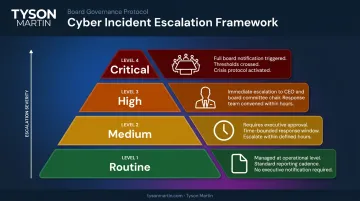
Board-level triggers worth defining upfront:
- Downtime exceeding 24 hours for critical services
- A data breach affecting more than 10,000 records or any regulated data
- Financial impact exceeding $500,000
- Any incident requiring public disclosure
Calibrating these against sector benchmarks — not internal intuition — is what separates defensible thresholds from ones that collapse under pressure.
Step 4: Assign Owners and Update Intervals
Each KPI needs a named owner accountable for data accuracy and for explaining significant changes. Update intervals should match the nature of the metric — automated vulnerability scans may update weekly, penetration test results quarterly, risk model reviews semi-annually.
When ownership is split across IT, legal, and risk functions without clear accountability, gaps are guaranteed — and the board notices the inconsistency before anyone flags it internally.
Step 5: Design for the Board Briefing, Not the SOC
The board-facing output should include:
- Trend over time — is posture improving or degrading?
- Plain-language narrative — what changed since the last review and why it matters
- Stoplight or rating per perspective — based on performance against approved thresholds
- Top one or two risks — with a named mitigation plan and a decision needed from the board
Technical detail belongs in supporting documentation, not in the board presentation itself. A one-page format that stays consistent quarter over quarter allows directors to track movement rather than relearn formats each meeting.
Common Mistakes That Undermine Your Cybersecurity Scorecard
Three patterns consistently degrade scorecard value — and all three are avoidable.
1. Tracking activity instead of outcomes. The most common failure is filling the scorecard with metrics that prove the security team is busy — tickets closed, training sessions held, alerts reviewed — without connecting those activities to business risk reduction. A board that sees rising closed-ticket counts has no basis for judging whether the organization is more or less resilient than last quarter.
2. Presenting protection metrics when resilience indicators are missing. Boards need to see cyber resilience, not just cyber protection — because no organization can protect itself out of every threat scenario. MIT CAMS research makes this point directly: adding protection investments alone is insufficient. A mature BSC must include recovery-oriented metrics (MTTR, tested incident response plan status, backup integrity verification) alongside prevention metrics. Without them, boards underinvest in resilience relative to prevention.
3. Letting the scorecard drift from strategic alignment. A BSC built during aggressive digital expansion has different priorities than one built during post-breach recovery or M&A integration. When organizational strategy shifts, the scorecard must shift with it. Treating it as a static document is the most reliable way to ensure it stops being used.
Frequently Asked Questions
What is the balanced scorecard for cybersecurity?
A cybersecurity balanced scorecard is a strategic performance management framework that structures security goals and metrics across four perspectives — financial, customer, internal process, and learning and growth. It enables boards and executive teams to evaluate cyber risk in business terms rather than technical ones.
What are the four perspectives of a cybersecurity balanced scorecard?
The four perspectives are:
- Financial — cost and ROI of security investment and incidents
- Customer/Stakeholder — trust, compliance, and reputational impact
- Internal Process — detection, response, and operational efficiency
- Learning and Growth — workforce capability, training effectiveness, and continuous improvement
What KPIs should be included in a cybersecurity balanced scorecard?
KPIs vary by organization. Core examples include:
- Estimated cost of breach incidents
- Weighted risk index
- Mean Time to Detect and Respond (MTTD/MTTR)
- Phishing simulation success rate
- Security training penetration rate
- Compliance rate against applicable regulatory frameworks
How does a cybersecurity BSC differ from a security operations dashboard?
A security operations dashboard is a real-time tool for technical teams monitoring active threats. A cybersecurity BSC is a strategic governance tool designed for board and executive oversight, focusing on business risk, trends over time, and alignment with organizational strategy — not real-time threat activity.
How often should a cybersecurity balanced scorecard be reviewed by the board?
Most organizations review the board-facing BSC quarterly, with individual metrics updated more frequently at the management level. A full strategic recalibration of goals and targets should happen at least annually or following a significant business event — an acquisition, an incident, or a leadership change.
Who is responsible for owning and maintaining the cybersecurity balanced scorecard?
The CISO typically owns the BSC and is accountable for data accuracy, metric ownership assignments, and the board briefing. Without a full-time CISO, that role typically goes to an interim or fractional CISO — or a designated security leader reporting to the CEO or audit committee.