Introduction
Most boards leave their quarterly security briefing with the same unanswered question they walked in with: Are we actually getting better, or just getting updates?
The problem isn't a lack of information. CISOs present dashboards, vulnerability counts, and tool outputs, and directors still can't tell whether the organization's risk posture is improving or eroding. That's not a data shortage — that's a translation problem.
According to NACD's 2025 board survey, over 33% of directors rated acquiring accurate cybersecurity metrics as "very important," and another 34% flagged improving the quality of management reporting as a priority.
A cybersecurity risk scorecard is built to close that gap. It converts security posture into structured, trackable information that boards can actually use: what changed, where escalation is required, and what decision belongs to the board versus management.
This article explains what a scorecard is, how it differs from a single risk score, what it should contain, and what separates a scorecard that drives decisions from one that just adds noise.
Key Takeaways
- A cybersecurity risk scorecard is a governance tool: a structured view across five to eight risk domains with trend indicators and escalation thresholds
- A risk score tells you where you stand — a scorecard tells you what action to take next
- Boards need scorecards to meet SEC and NIST CSF 2.0 expectations and demonstrate credible, documented oversight
- The most common failures: too many metrics, no escalation thresholds, and a format that changes every quarter
- An effective scorecard can be read in minutes and drives decisions — not just awareness
What Is a Cybersecurity Risk Scorecard?
A cybersecurity risk scorecard is a structured governance instrument that translates an organization's security posture into a set of tracked metrics — showing not just where risk stands today, but how it has moved and where leadership attention is required.
It's built for boards, audit committees, and senior executives — not the security operations team. Its job is to answer leadership questions, not translate technical ones.
What a Scorecard Actually Contains
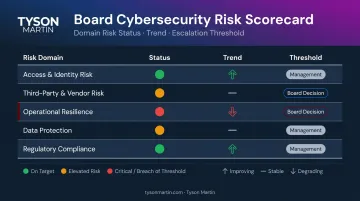
A well-designed scorecard organizes risk into a manageable set of domains — typically five to eight — that correspond to areas of genuine board-level concern. Common domains include:
- Access and identity risk — coverage of MFA, privileged account exposure
- Third-party and vendor risk — exposure through critical suppliers
- Operational resilience — time to contain and recover from incidents
- Data protection — coverage on highest-value systems
- Regulatory compliance posture — audit finding aging, open obligations
Each domain carries three things: a current status (on-track, at-risk, or requires escalation), a trend indicator (improving, stable, or degrading), and a defined threshold that determines when the board must act rather than simply be informed.
The Trend Function Is What Makes It Useful
A single-point status doesn't tell you much. What matters is direction: Is patching coverage improving? Has third-party exposure grown since last quarter? Did time-to-contain get faster or slower after the last incident?
The scorecard's job is to show movement — and to flag when movement crosses a line that requires a board decision. A tool that only shows current state gives directors a snapshot; one that tracks trend and triggers escalation gives them the basis for a decision.
Inputs can come from internal assessments, vulnerability scans, vendor risk ratings, compliance status, and incident history. The output is always translated into terms a non-technical director can interpret and act on.
Risk Scorecard vs. Risk Score: Why the Distinction Matters
A cyber risk score is a single numeric or letter-grade output that aggregates data into one number representing overall exposure. Tools like SecurityScorecard use letter grades from A to F based on factors like endpoint security, patching cadence, and network security. BitSight uses a 300–820 scale, similar to a credit score.
These tools have real value — but a score is a snapshot that tells you where you stand, not what to do next.
The Governance Gap a Score Can't Fill
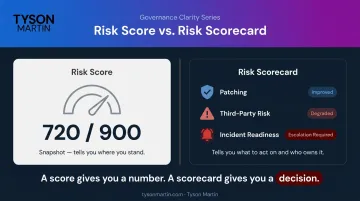
Consider a CISO presenting a score of 720 out of 900 to the board. That's a data point. A scorecard built for the same meeting would show something far more useful:
- Patching domain: improved (threshold maintained)
- Third-party risk: degraded (two critical vendors fell below acceptable threshold)
- Incident readiness: escalation required (time-to-contain metric crossed the defined board decision line)
The score gave the board a number. The scorecard gave them a decision.
The regulatory stakes reinforce this. SEC Release No. 33-11216 requires public companies to disclose the board's active oversight of cybersecurity risk — not just confirmation that a briefing occurred. The SEC rules specifically require describing how the board oversees processes for assessing, identifying, and managing material cybersecurity risks. A single score doesn't produce that evidence trail. A structured, recurring scorecard does.
Forrester's 2026 analysis found that traditional cyber risk ratings have historically lacked the ability to translate signals into direct action, and scanning external infrastructure alone is insufficient for prioritization.
What Goes on a Cybersecurity Risk Scorecard
The domains are the organizational backbone. Rather than cataloging every vulnerability, a scorecard groups risk into categories that correspond to board-level concerns. NIST CSF 2.0's Govern, Identify, Protect, Detect, Respond, and Recover functions provide a natural mapping — but the domains on a board scorecard should be fewer and more decision-focused.
The five core outcome domains that anchor board-level scorecards are:
- Material risk reduction — top risks, what changed, what decisions are needed
- Time to contain and recover — resilience metrics, not just prevention
- Critical control coverage on highest-value systems — crown jewels, not everything
- Security debt burn-down — how fast prioritized gaps are being closed
- Third-party exposure on most important vendors — measured by business dependency
These five stay stable. Supporting metrics can rotate quarterly — but the core framework shouldn't change, because consistency is what makes trends legible.
KRIs vs. KPIs: The Right Metric Type for Board-Level Reporting
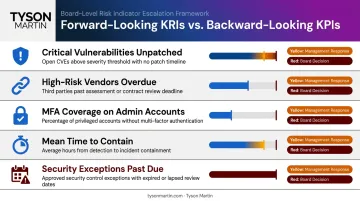
Most security reports rely on KPIs — measures of past performance. How many incidents occurred. How many patches were applied. These have their place, but boards are better served by key risk indicators (KRIs): metrics that signal increasing risk before an incident occurs.
Practical KRI examples for board scorecards:
- Percentage of critical vulnerabilities unpatched beyond the defined threshold
- Number of high-risk vendors past their review window
- MFA coverage on admin and remote access accounts
- Mean time to contain high-severity incidents (trend, not just point-in-time)
- Security exception count past due
The distinguishing test is forward-looking: a KRI gives visibility into rising exposure before an incident forces the conversation. Each metric should have a defined escalation threshold — the point at which yellow requires a management response and red requires a board decision.
What Doesn't Belong on a Board Scorecard
The KRI framework only holds if the scorecard stays disciplined about what it excludes. These belong in operational reporting, not board governance:
- Raw vulnerability counts
- Tool-level scan outputs
- Individual ticket or remediation logs
- Metrics without trend context or escalation thresholds
A common mistake is treating the underlying security data as the scorecard itself. The scorecard is a filtered, interpreted view built for decisions — not a forwarded CISO report.
Common Scorecard Pitfalls and How to Avoid Them
Pitfall 1 — Metric Overload
Boards cannot act on 30 metrics. They can act on five to eight well-defined domains with clear status and trend. An effective scorecard is filtered by deliberate choices about what belongs — not comprehensive by default.
The failure mode here is adding metrics because they're available, not because they drive decisions. If a metric wouldn't change how the board allocates attention or resources, it doesn't belong on the board scorecard.
Pitfall 2 — No Escalation Thresholds
A scorecard without thresholds is a passive reporting exercise. If every metric gets reported but nothing triggers a required decision, the board isn't exercising oversight — it's receiving updates.
Thresholds define the line between "management handles it" and "the board needs to decide." That line should be drawn in advance (before pressure hits) with specific, measurable triggers. Not "high risk" but: "If two or more critical vendors fall below the acceptable rating threshold, escalate to the audit committee within 10 days."
CISA makes a related point: boards should ensure thresholds for malicious activity reporting aren't set too high and should be briefed on near-misses, not just confirmed incidents.
Pitfall 3 — Stale or Inconsistent Metrics
A scorecard that changes its structure, definitions, or data sources from quarter to quarter prevents trend analysis and erodes trust. If the format shifts every meeting, directors can't tell whether a number improved because the program improved — or because you changed how you measured it.
The core framework should stay stable. Treat any structural change as a governance decision, not a formatting refresh. That discipline is what makes oversight credible — and what keeps trend data trustworthy over time.
To maintain consistency, three rules help:
- Lock metric definitions at the start of each fiscal year or after a deliberate governance review
- Document any methodology change and show before/after comparisons for one cycle
- Flag format updates separately from performance updates so directors can distinguish the two
How to Build a Scorecard That Holds Up Under Pressure
Step 1 — Start with the Decisions, Not the Data
Before selecting metrics, identify the five to eight questions the board needs to answer every quarter:
- Is our third-party risk within acceptable limits?
- Are we closing the gaps identified in the last audit?
- Is our time-to-contain improving or degrading?
- Have we crossed any escalation thresholds requiring a board decision?
Let those questions define the domains. The data comes second — chosen because it answers the question, not because it was easy to export.
Step 2 — Define Thresholds and Decision Rights Before First Use
The governance design work that separates a functional scorecard from a reporting exercise happens before the scorecard is presented for the first time. Establish in advance:
- What score or status change triggers escalation to the board vs. staying within management's remit
- Who can accept risk at each threshold level
- What the expected response time is once a threshold is crossed
A board advisor or fractional CISO can accelerate this design work considerably. Tyson Martin's advisory practice focuses specifically on building these decision rights and escalation frameworks — setting measurable thresholds anchored to business impact rather than abstract risk language. The output is a one-page escalation ladder that answers "when does this move from management to the board?" before the question ever arises mid-incident.
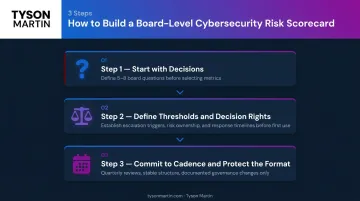
Step 3 — Commit to a Cadence and Protect the Format
Quarterly is the standard for most boards; audit and risk committees often review more frequently — monthly dashboards for trend signals, quarterly deep dives on specific domains. The exact cadence matters less than the consistency.
Resist the urge to revise the scorecard format between cycles. When the format changes, the trend breaks. Revisit thresholds annually, or after major events that materially change the risk profile:
- M&A activity or significant divestitures
- Regulatory shifts affecting your industry
- Material security incidents
Any change to thresholds should flow through a documented governance decision, not an ad hoc update between reporting cycles.
Frequently Asked Questions
What is the difference between a cybersecurity risk scorecard and a cyber risk score?
A cyber risk score is a single aggregated number representing overall exposure at a point in time. A scorecard is a governance tool that tracks multiple risk domains over time, shows trend direction, and connects each domain's status to specific escalation thresholds and leadership decisions. The score tells you where you stand. The scorecard tells you what to act on — and who owns it.
How often should a cybersecurity risk scorecard be reviewed by the board?
Most boards review the scorecard quarterly, while audit and risk committees may use a monthly dashboard for leading indicators and open decisions. The key is consistency — a scorecard's value comes from tracking trends across periods, which requires a stable, recurring cadence.
What are the most important metrics to include on a cybersecurity risk scorecard?
Effective scorecards organize key risk indicators (KRIs) into domains: material risk reduction, time to contain and recover, critical control coverage on highest-value systems, security debt burn-down, and third-party vendor exposure. Each domain needs a current status, trend direction, and escalation threshold. Raw technical data belongs in the management layer, not the board scorecard.
How does a cybersecurity risk scorecard support regulatory compliance?
The SEC's cybersecurity disclosure rules and NIST CSF 2.0 both expect boards to demonstrate active, structured oversight of cyber risk. A recurring, documented scorecard provides the evidence trail that oversight is real — not reactive or ad hoc — and supports the disclosures now required of public companies regarding board oversight processes.
What makes a cybersecurity risk scorecard actionable rather than just informational?
Predefined escalation thresholds and clear decision rights. When a domain crosses a threshold, the scorecard should trigger a specific board-level decision or management action with a named owner and timeline. Without that structure, the scorecard reports the problem but nobody owns fixing it.
Can a small or mid-size organization benefit from a cybersecurity risk scorecard?
Yes — organizations without large security teams often benefit most. A well-structured scorecard forces prioritization and ensures leadership attention stays on the highest-impact domains rather than spreading across every possible metric. The format also scales down: three core outcome areas with three to four metrics each, kept to one page, is a practical starting point.