Introduction
When a security incident hits at 2 a.m., organizations learn very quickly whether their documentation is fit for purpose. Those that confuse runbooks with playbooks tend to discover one of two problems: their technical teams are executing steps with no strategic context, or their leadership has a high-level response framework with no actionable path to execution.
This isn't a terminology debate. It reflects a real gap between governance and operational execution — one that shows up in regulatory examinations, M&A due diligence reviews, and post-incident analyses.
This article clarifies what each document is, how they differ, and when each applies. The distinction matters for boards, executives, and regulated-industry leaders who need their organizations to respond to incidents both effectively and defensibly.
Key Takeaways
- A runbook is a step-by-step instruction guide for a specific, bounded task — narrow, repeatable, and often automatable.
- A playbook is a strategic document defining roles, decision points, escalation paths, and coordination protocols across complex, multi-team scenarios.
- Runbooks are used by technical staff during execution; playbooks align both technical teams and leadership.
- Organizations need both: playbooks set strategy and escalation thresholds, runbooks deliver that strategy in execution.
- For boards and executives: do both documents exist, are they current, and have they been tested?
Runbooks vs. Playbooks: At a Glance
| Dimension | Runbook | Playbook |
|---|---|---|
| Scope | Task-specific | Process-wide |
| Purpose | Execution | Strategy and coordination |
| Primary Audience | Technical responders | Cross-functional teams and leadership |
| Format | Sequential steps | Adaptive decision framework |
| Automation Potential | High — easily automated | Limited — requires human judgment |
| Update Frequency | Frequently, as systems change | Periodically, as strategy evolves |
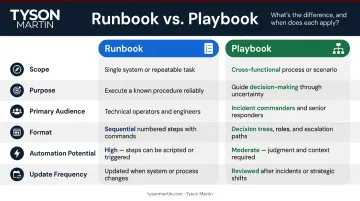
These documents are not competitors. A mature organization runs both — and most playbooks reference or include multiple runbooks.
What Is a Runbook?
A runbook is a documented set of step-by-step instructions for completing a specific, repeatable operational task or responding to a defined technical event. A well-written runbook is precise enough that a competent team member who has never encountered the situation before can execute it correctly — no guesswork, no improvising under pressure.
Runbooks exist on a spectrum:
- Manual runbooks — documented procedures executed by humans, step by step
- Automated runbooks — scripts or tools that execute tasks without human intervention (AWS Systems Manager, Azure Automation, and similar platforms all support this model)
- Collaborative/hybrid runbooks — automation handles repeatable steps while humans control decision gates
The right format depends on the task. Credential rotation can often be fully automated. Deciding whether to take a production system offline at 2 a.m. requires a human.
What Makes a Runbook Effective
A runbook that works under pressure typically includes:
- Clearly defined trigger conditions (what starts the runbook)
- Numbered, sequential steps with no ambiguity
- Required tools, credentials, and access listed upfront
- A documented escalation path if the runbook fails or produces unexpected results
- Version control and a last-tested date
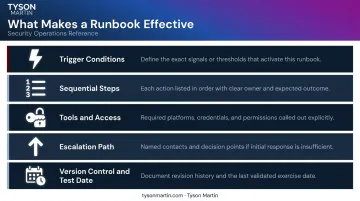
Version control isn't ceremonial. A runbook that hasn't been tested in 18 months may reference systems, tools, or access paths that no longer exist.
Common Runbook Use Cases
In cybersecurity and IT operations, runbooks typically cover:
- Isolating a compromised endpoint during a security incident
- Executing a data backup and verification procedure
- Responding to a failed authentication spike
- Onboarding or offboarding user access
- Deploying a patch to production systems
Each task is bounded — a defined start, a defined end, a verifiable result. That structure is exactly what makes runbooks governable. Auditors, regulators, and board advisors look for whether runbooks are documented, tested, and assigned to owners with measurable outcomes.
What Is a Playbook?
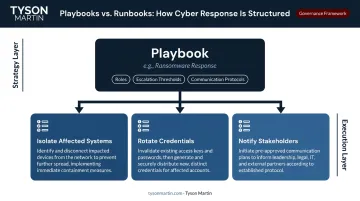
A playbook is a strategic-level document that outlines the overall approach, roles and responsibilities, decision-making framework, communication protocols, and escalation thresholds for managing a complex, multi-step scenario. Unlike a runbook, a playbook does not prescribe every action. It provides the context and structure within which teams make decisions and execute tasks — often by triggering runbooks at specific decision points.
CISA's Federal Government Cybersecurity Incident and Vulnerability Response Playbooks, published in 2021, illustrate this clearly: they provide a standard set of operational procedures for planning and conducting response activities across agencies — not a checklist of technical steps, but a framework for coordinated action.
Playbooks are built around scenarios, not tasks. Each defines who is responsible, who is notified, what thresholds trigger escalation to leadership or the board, and what outcomes constitute resolution.
What a Mature Playbook Includes
- The scenario it covers and its trigger conditions
- Defined roles: Incident Commander, communications lead, legal and compliance liaison, executive sponsor
- Escalation thresholds and decision rights — including when board notification is required
- Communication protocols, both internal and external
- Links to relevant runbooks for execution
- Post-incident review requirements
Common Playbook Use Cases
- A cybersecurity breach response playbook coordinating IT, legal, communications, and executive leadership
- A disaster recovery playbook governing system restoration priority and stakeholder communication
- A third-party vendor incident playbook
- A regulatory compliance audit response playbook
These scenarios involve multiple teams, judgment calls, and stakeholder communication — step-by-step instructions alone don't cover them. NIST SP 800-61 Rev. 3, published in April 2025, explicitly distinguishes incident response plans, playbooks, and procedures as separate but complementary artifacts. That distinction matters: regulators increasingly expect organizations to show not just that they have documentation, but that it's structured, tiered, and tested.
In financial services, healthcare, and retail, playbooks are reviewed by regulators and examiners as evidence of a structured, defensible approach to incident management. FFIEC's Cybersecurity Assessment Tool, HIPAA's security incident requirements under 45 CFR 164.308(a)(6), and PCI DSS v4.0's Requirement 12.10 all expect documented, tested incident response capabilities.
Playbooks are how organizations demonstrate that capability — both on paper and when an incident actually hits.
Runbooks vs. Playbooks: Which Should You Use?
The short answer: in most real incidents, you need both simultaneously.
The decision framework is straightforward:
- Use a runbook when the task is bounded, repeatable, and can be assigned to a single executor with a clear definition of done.
- Use a playbook when the scenario involves multiple teams and stakeholders, requires judgment at decision points, and demands coordination across functions.
The Nesting Relationship
Playbooks contain or reference runbooks. A ransomware playbook, for example, will direct the incident commander to trigger specific runbooks — "isolate affected systems," "rotate credentials," "notify stakeholders" — at defined decision points. The playbook drives sequencing and judgment. The runbooks drive execution.
This nesting relationship reflects how NIST, AWS, and Microsoft each treat these artifacts: as distinct but complementary, not interchangeable.
The Two Most Common Mistakes
Runbooks without playbooks. Technical teams have executable procedures but no strategic coordination. When a serious incident unfolds, no one knows who declares it, who notifies legal, when the board gets called, or who speaks to the press. Execution happens in isolation.
Playbooks without runbooks. Leadership has a response framework but no actionable execution path. The playbook says "contain the affected systems" — but there's no documented procedure for how, no tested process, and the engineer on call at 2 a.m. is improvising.
Both gaps are dangerous, both are common, and both become highly visible during regulatory examinations, post-incident reviews, and M&A due diligence.
During interim CISO engagements, the pattern that surfaces repeatedly is a structural disconnect between what leadership believes the response capability to be and what actually exists in practice. The documentation is rarely absent entirely — it's fragmented:
- A playbook drafted two years ago and never tested
- Runbooks that reference systems since decommissioned
- Escalation paths listing people who no longer hold those roles
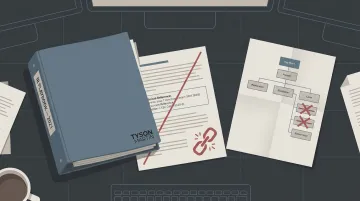
That gap between the document and the reality is where incidents become crises.
What Boards and Executives Should Know
For boards and executive teams, the goal is not to write runbooks or playbooks — it is to ensure these documents exist, are owned, are tested, and are current.
Questions to Ask Your CISO
- Are our incident response playbooks documented and assigned to named owners?
- When were our critical runbooks last tested, and what was the outcome?
- Do our playbooks define escalation thresholds that trigger board notification — and are those thresholds tied to our risk appetite statement?
- Are our runbooks and playbooks aligned with our current regulatory requirements?
- Where is the single source of truth during an incident, and can you show it to me?
NACD's 2026 Cyber Risk Oversight guidance frames this as a board governance responsibility, not a technical one: boards should ask whether realistic tabletop exercises have occurred in the last 12 months and whether there is a board-level escalation process in place.
The Governance and Liability Dimension
The absence of maintained runbooks and playbooks is a governance risk, not just an operational one. During M&A due diligence, regulatory examinations, and post-incident reviews, acquirers and examiners will ask to see these documents as evidence of operational maturity. An organization that cannot produce them — or produces versions that are years out of date — faces credibility and liability exposure.
The SEC's cybersecurity disclosure rules, adopted in July 2023, require public companies to disclose material cybersecurity incidents within four business days of determining materiality — and to describe their processes for managing cybersecurity risk.
Boards that cannot point to tested playbooks and maintained runbooks as evidence of those processes are poorly positioned when that disclosure conversation happens under pressure.
When stepping into an organization as an interim or fractional CISO, one of the first assessments involves evaluating whether these governance documents exist, whether they reflect actual practice, and whether decision rights and escalation thresholds are clearly defined and actually hold during real incidents — not just on paper.
Conclusion
Runbooks handle execution — they give your team precise, tested instructions for specific tasks. Playbooks handle coordination and strategy — they ensure the right people are doing the right things with the right authority when a complex event unfolds.
In a mature security program, both are required — one without the other leaves either a strategy with no execution path or an execution team with no coordinating authority.
For boards and executives in regulated industries, having both documents — maintained, tested, and tied to defined owners — is a marker of inspectable execution. The real accountability question is whether you can produce both, show they have been tested, and demonstrate they are wired into your actual incident response process.
Frequently Asked Questions
What is the difference between a runbook and a playbook?
Runbooks are step-by-step execution guides for specific tasks, precise enough for any team member to follow under pressure. Playbooks govern the broader response: roles, decision points, escalation paths, and communication protocols. Playbooks typically reference runbooks for the hands-on execution steps.
Should every organization have both a runbook and a playbook?
Yes. Without both, you either have strategy with no execution path or execution with no coordination. Regulated industries and enterprise organizations are expected to demonstrate both, and to prove they function under real conditions.
What is an example of a cybersecurity playbook?
A ransomware incident response playbook defines who leads the response, when to notify legal and the board, what the communication protocol is with affected parties, and which runbooks to trigger at each decision point — such as isolating affected systems or initiating backup restoration.
What is the difference between a runbook and a standard operating procedure (SOP)?
SOPs govern routine business processes like onboarding, procurement, and compliance checks. Runbooks are more technical and scenario-specific, built for execution under pressure during incidents or system changes, and carry significantly higher automation potential in IT and security operations.
How often should runbooks and playbooks be updated?
Runbooks should be reviewed whenever the systems, tools, or processes they reference change, at minimum annually. PCI DSS v4.0 explicitly requires annual review of incident response plans. Playbooks should be reviewed at least annually and after any significant incident, organizational change, or regulatory update.
How do runbooks and playbooks support regulatory compliance?
Both documents serve as audit evidence that an organization can execute its security program, not just describe it. Regulators in financial services, healthcare, and retail expect structured, documented incident response capabilities they can inspect and test.