This post is written for the people who own that conversation: directors, CEOs, general counsel, and risk committee members who need to understand how cyber posture reads to investors, acquirers, and rating agencies — not just to incident responders.
The core argument is straightforward: cyber risk now functions as a valuation signal. Companies that govern it well can convert that into a measurable advantage. Those that don't carry a quantifiable discount that shows up at the worst possible moment — during a deal, a credit review, or a breach disclosure.
Key Takeaways
- Markets reprice breach risk at disclosure — equity drops are measurable, immediate, and well-documented
- Breach costs compound well beyond remediation — fines, litigation, customer attrition, and deal deterioration all follow
- Investors and acquirers evaluate governance quality, not just technical controls — oversight cadence and disclosure transparency are scored
- Strong cyber governance can generate a "governance premium" that protects and actively enhances enterprise value
Why Cyber Risk Is Now a Valuation Variable
Cybersecurity has become a financial reporting issue, not an IT footnote. The Allianz Risk Barometer 2025 ranked cyber incidents as the #1 global business risk for the fourth consecutive year, cited by 38% of 1,450 risk management experts. That's not a technical finding — it's an enterprise risk signal that boards and CFOs need to own.
The SEC Changed the Rules
The SEC's 2023 cybersecurity disclosure rule reshaped how public companies handle breach reporting. Under the new Item 1.05 on Form 8-K, companies must disclose material cybersecurity incidents within four business days of determining materiality. Annual Form 10-K filings now require disclosure of processes for assessing and managing cyber risk, along with board oversight structures.
The practical effect: breach reporting is now a near-real-time market signal. A material incident triggers mandatory public disclosure that moves investor sentiment and equity pricing before most companies have finished their internal response.
Rating Agencies Are Paying Attention
Credit analysis now includes cyber exposure. Moody's has identified $22.3 trillion of collectively rated debt — roughly 28% across 71 sectors — as carrying high or very high cyber risk exposure. S&P has noted that cyber attacks can rapidly deteriorate credit profiles. Fitch treats cyber risk as a component of credit ratings.
For CFOs managing debt covenants and credit outlooks, cyber maturity and incident response speed are now measurable inputs — ones rating analysts weigh alongside revenue and leverage ratios.
The Investor Perspective
Institutional investors have shifted from counting incidents to evaluating governance quality. NACD reporting indicates that investors view current cyber disclosures as inconsistent, boilerplate, and lacking quantifiable metrics.
BlackRock's Investment Stewardship team treats data privacy and security as material for many companies and actively engages boards on oversight, policies, and transparency — a sign that disclosure quality now shapes capital allocation decisions.
When investors engage boards directly on cyber governance, the question is no longer whether a breach occurred — it's whether the board had the visibility to see it coming and the structure to respond.
The Real Costs: How a Breach Erodes Enterprise Value
The financial impact of a breach doesn't hit once. It arrives in waves, and the later waves are often larger than the first.
Immediate Market Reaction
Markets respond fast. Capital One shares closed down 5.9% the day its 2019 breach was disclosed. Comparitech's analysis of NYSE-listed companies found breached firms fell 3.5% on average after 14 market days. A 2025 Springer event study found companies lost an average of $309 million in market value on the day cyber attack news was reported.
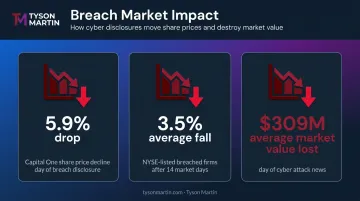
For boards managing investor relations and disclosure obligations, that reaction window is tighter than most response plans assume.
Direct Financial Costs
IBM's 2025 Cost of a Data Breach Report puts the global average breach cost at approximately $4.4 million — covering data recovery, legal fees, regulatory fines, notification costs, and crisis management. For mid-market companies without dedicated breach reserves, that figure can represent a significant portion of annual operating budget.
Key cost categories that boards should factor into financial planning:
- Regulatory penalties — GDPR fines reach up to €20 million or 4% of global annual turnover; HIPAA penalties now reach $2.19 million per violation category annually; CCPA fines run up to $7,988 per intentional violation
- Legal and notification costs — class action exposure, regulatory coordination, and mandatory consumer notification
- Crisis management — outside counsel, PR, forensics, and executive time
Operational and Long-Tail Damage
Maersk's NotPetya experience puts operational scale in concrete terms. The shipping company estimated its cyberattack bill at $200–$300 million, covering lost revenue, recovery costs, and supply chain disruption — not a fine, just the cost of being taken offline.
Beyond downtime, the long-tail costs are often underestimated:
- Customer attrition and brand value erosion
- Loss of intellectual property and competitive positioning
- Goodwill impairment on balance sheets following reputational damage
- Elevated cyber insurance premiums post-incident
Compliance failure compounds all of it. When regulatory penalties layer onto remediation costs and revenue loss, the combined valuation impact can dwarf the initial incident estimate.
The Governance Premium vs. The Cyber Risk Discount
There are two sides to this equation, and most boards are only aware of the downside.
What Creates a Governance Premium
Companies with strong, transparent cyber governance earn measurable credibility with capital markets. ISS analysis of Russell 3000 companies found that firms reporting significant cyber incidents underperformed the market by nearly 5% on average — implying that companies demonstrating strong governance hold a relative advantage. A 2025 study in the Journal of Financial Economics found that cybersecurity governance lifts corporate market value, mostly through reputation effects.
What drives that premium in practice:
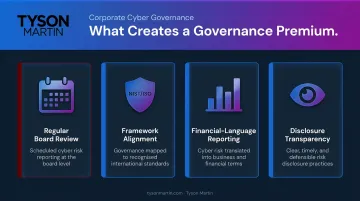
- Regular board review of cyber strategy — not just after incidents
- Recognized framework alignment — NIST CSF 2.0 (updated February 2024) and ISO/IEC 27001 provide the governance benchmarks investors and rating agencies reference
- Reporting in financial terms — trend data, escalation thresholds, and business impact language rather than technical metrics
- Disclosure transparency — investors reward predictability; they penalize opacity
What Triggers the Cyber Risk Discount
The discount materializes when governance signals break down: unclear accountability, reactive posture, fragmented oversight, or disclosure that arrives late and incomplete. Analysts now track incident frequency and response quality as governance indicators — similar to how credit spreads widen when creditworthiness deteriorates.
Closing the Governance Gap
One of the most practical ways boards close this gap is through independent advisory oversight — someone who can translate technical risk into the financial language that audit committees and investors actually use.
Tyson Martin's board advisory work is built around that translation. His methodology starts with business priorities rather than threat lists, mapping cyber risks to outcomes boards already track: revenue loss, operational downtime, legal exposure, delivery delays, and customer trust erosion.
A ransomware scenario gets reframed as five days of billing disruption, delayed shipments, contract penalties, and missed quarterly targets — not a malware problem.
The practical output is a board reporting dashboard that fits on one page. It covers five to eight metrics with trend arrows and agreed thresholds, top risks with owners and next milestones, and a clear statement of what changed and what decision is needed. When metrics turn amber or red, the board's job is to clarify impact in business terms, approve tradeoffs, and confirm accountable owners with dates.
That structure, built before an incident forces the conversation, is the difference between reactive governance and defensible oversight.
What Investors and Acquirers Are Actually Evaluating
Cybersecurity due diligence is now standard in M&A transactions. The Yahoo/Verizon deal made that permanent: Verizon reduced its acquisition price by $350 million — to $4.48 billion — after disclosed breaches were factored into valuation. West Monroe found that 40% of acquirers discovered cyber problems or undisclosed data breaches after closing, and 80% of senior executives and PE partners consider cyber issues highly important in due diligence.
The Four Areas Acquirers Examine
| Area | What They're Looking For |
|---|---|
| Data inventory and regulatory exposure | What sensitive data exists, where it lives, and what regulations apply |
| Vulnerability and risk assessment maturity | Whether risks are identified, tracked, and remediated systematically |
| Third-party and supply chain risk | ISS found roughly one-third of reported incidents involved suppliers |
| Incident response readiness | Whether plans are tested, not just documented |
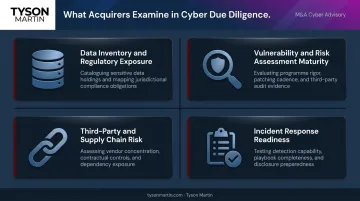
Weak performance in any of these areas triggers price renegotiation, deal delays, or withdrawal. Strong performance accelerates timelines and protects valuation.
Pre-M&A Assessment for Private Companies
Private equity firms and strategic acquirers increasingly require security assessments as a precondition of deal closing — and that expectation now applies to non-public companies preparing for investment, fundraising, or sale.
Tyson Martin's M&A cyber due diligence engagements are designed for mid-market deal teams that can't afford to inherit silent liabilities absent from the balance sheet. Each assessment is conducted independently of the target's CISO and security vendors, and delivers:
- A target risk profile
- A board red-flag memo
- A post-close remediation roadmap
- A valuation impact assessment
When significant weaknesses surface during diligence, findings can be structured directly into deal terms: holdbacks, purchase price adjustments, representations and warranties, or remediation escrows. Discovering the same problems after close eliminates every one of those options.
How Strong Cybersecurity Becomes a Valuation Asset
The PwC 2025 Global Investor Survey found that 88% of investors support companies spending more on cybersecurity, and 55% reported high or extreme cyber risk exposure at companies they invest in or cover. NACD data shows that almost two-thirds of global institutional investors are concerned about cybersecurity's impact on their investments.
Both findings point to the same conclusion: investor appetite for cyber transparency has crossed from risk management into commercial territory.
The Trust Dividend
Organizations that disclose with precision, maintain stable governance metrics, and demonstrate repeatable control performance build investor confidence that stabilizes equity pricing during volatility. Capital markets reward predictability.
A board that reviews the same dashboard format quarter after quarter — against agreed thresholds, with clear ownership and follow-through — signals the kind of management discipline that institutional investors price positively.
Tyson Martin's approach to this consistency is deliberate: same format, same definitions, same impact model each quarter. The goal isn't to produce reports — it's to build the kind of trust that "lowers drama" because directors stop feeling surprised, and investors can see whether the program is reducing risk or just producing activity.
Framework Alignment as Market Differentiation
Companies aligned with NIST CSF 2.0 or ISO/IEC 27001 have a clear advantage in regulated sectors. In cyber insurance markets, the Lloyd's/HITRUST consortium offers a starting 25% premium credit for HITRUST-certified organizations. Marsh reported average US cyber insurance rates declined 5% in Q4 2024 — but organizations with demonstrable control strength negotiate from a better position regardless of market cycles.
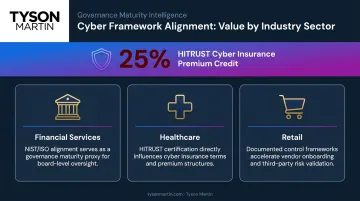
In sectors where partners, customers, and regulators actively scrutinize security posture, framework alignment does more than satisfy auditors:
- Financial services: Regulators and counterparties treat NIST/ISO alignment as a proxy for governance maturity
- Healthcare: HITRUST certification directly affects insurance terms and business associate agreements
- Retail: Major retail partners require documented control frameworks before vendor onboarding
When security is governed rather than assumed, the program becomes an asset that survives due diligence — not a liability that surfaces during it.
Frequently Asked Questions
How does a cyberattack affect a company?
A cyberattack creates immediate financial losses through remediation, legal costs, and regulatory fines, while simultaneously damaging customer trust and disrupting operations. For publicly traded companies, it also triggers near-instant market repricing — Capital One's stock dropped nearly 6% the day its breach was disclosed.
Does cybersecurity posture affect M&A valuation?
Yes — cybersecurity due diligence is now standard in M&A transactions. Weak security posture can result in price renegotiation, deal delays, or cancellation. Verizon's $350 million reduction to the Yahoo acquisition price remains the most cited example of discovered vulnerabilities directly reducing deal value.
What is a cyber risk discount?
A cyber risk discount is the valuation penalty applied when a company's cyber governance, transparency, or control maturity falls short of investor expectations. It reflects the market's preference for measurable, well-communicated risk management over opacity. The penalty compounds when incidents occur without clear board-level accountability.
What is the SEC's cybersecurity disclosure requirement for public companies?
The SEC's 2023 rule requires publicly traded companies to disclose material cybersecurity incidents on Form 8-K within four business days of determining materiality. Annual 10-K filings must also describe risk management processes and board oversight structures, making cyber governance a standing item visible to investors in every annual filing.
How should boards oversee cybersecurity to protect company value?
Boards should review cyber strategy on a regular cadence, not only after incidents, and demand reporting in financial and business terms rather than technical jargon. Establishing clear escalation thresholds and aligning oversight with recognized frameworks demonstrates the governance discipline that investors and rating agencies reward.
Can strong cybersecurity actually increase company valuation?
Yes. A demonstrably strong and well-governed cyber posture can generate a governance premium — attracting better investment terms, supporting higher M&A valuations, reducing insurance costs, and signaling management quality that capital markets price positively. The 88% of investors who support increased cybersecurity spending treat it as a value driver — evidence that the market already prices governance quality into its expectations.