
Boards and executives face a real tension: they want to move fast, pursue acquisitions, launch digital initiatives, and enter new markets. But they're also increasingly aware that one serious incident can erase months of momentum. The argument here isn't that security slows growth — it's that disciplined risk management is what makes growth sustainable.
Here's what the data shows and what experience confirms: organizations that govern cyber risk well don't just avoid disasters. They close deals faster, win regulated-industry contracts their competitors can't, and make strategic decisions with less friction at every stage.
Key Takeaways
- Cybersecurity and risk management drive revenue, deal velocity, and board confidence — not just technical controls.
- Mature security governance builds trust faster, helping you pass vendor assessments that stall less-prepared competitors.
- Clear board-level decision rights accelerate M&A, cloud adoption, and digital transformation.
- Skipping risk management defers costs rather than eliminating them: breach recovery, regulatory fines, and lost customers compound fast.
- High-performing programs rely on stable metrics, clear escalation paths, and board-ready reporting.
What Cybersecurity and Risk Management Mean in Business Terms
Cybersecurity and risk management — taken together — are the practice of identifying what matters most to the business, understanding what threatens it, and making deliberate choices about how much exposure to accept, reduce, transfer, or avoid. Framed correctly, it's a business governance function, not a technical one.
The scope spans more than firewalls and software patches. It covers:
- Cloud environments, applications, and operational systems
- Third-party and vendor relationships — where most modern breaches originate
- Data handling and privacy obligations, especially in regulated industries
- Board-level decision rights, accountability structures, and risk appetite
- Regulatory requirements: HIPAA, GLBA, PCI DSS, SEC disclosure rules
The goal is to make risk-informed decisions consistently — so growth initiatives proceed with appropriate safeguards rather than blind spots. When a board can answer "what risks are we carrying, and are they within acceptable limits?" the business moves faster, not slower.
Key Advantages of Cybersecurity and Risk Management for Business Growth
Building Customer and Partner Trust That Opens Doors
In regulated industries, security posture isn't a differentiator anymore — it's a qualification criterion. Enterprise buyers in financial services, healthcare, and retail now conduct formal security due diligence before signing contracts. Organizations without documented risk programs, clean audit trails, and demonstrable governance get filtered out early.
Cisco's 2024 Data Privacy Benchmark Study found that 94% of organizations said their customers would not buy from them if their data wasn't properly protected — and 98% said external privacy certifications are important in the buying process. That's not a soft preference. It's a procurement filter.
The practical advantage works like this: organizations with mature governance pass vendor assessments faster, reduce friction in enterprise procurement cycles, and retain accounts that would otherwise move to more secure competitors. The ones that struggle — those with inconsistent questionnaire answers, scattered evidence, and no clear policy ownership — lose deals without ever knowing exactly why.
Regulatory compliance also functions as a market access requirement:
- HIPAA — Business associate agreements require documented safeguards and breach reporting; healthcare contracts aren't available without them
- GLBA — Covered financial firms must maintain a documented information security program; the breach-notification requirement became effective May 2024
- PCI DSS — Payment environments require compliance with defined security standards; non-compliance eliminates access to card networks
- SEC cyber disclosure rules — Public companies and their partners face heightened scrutiny on governance practices
KPIs directly affected: customer retention rate, contract win rate in regulated verticals, vendor assessment pass rate, time-to-close on enterprise deals.
Enabling Confident, Faster Strategic Decisions
The most underappreciated cost of weak cyber governance isn't a breach — it's the strategic paralysis it creates. When boards and executives can't get a clear view of the organization's risk posture, they slow down or abandon initiatives that carry ambiguity: acquisitions, cloud migrations, new digital products, and expansion into new markets.
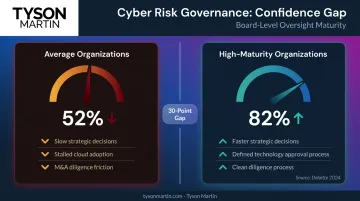
Deloitte's 2024 Global Future of Cyber survey put a number on this gap: only 52% of decision-makers overall were confident in their board's ability to navigate cyber risk, compared to 82% in high-maturity organizations. That 30-point gap in confidence has real consequences for how decisively leadership acts.
When decision rights are clear — the board knows what it owns versus what's delegated to management, escalation thresholds are defined, and risk reporting is in plain business language — strategic decisions move faster. Security stops being the department of no.
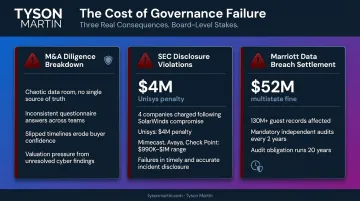
M&A is where this advantage shows up most clearly. When diligence requests arrive and a company lacks a clear risk posture, the data room turns into chaos. Customer questionnaires get inconsistent answers. Governance gaps surface late, deal timelines slip, and valuation pressure rises at exactly the wrong moment. Companies with mature governance frameworks go through diligence differently: risk is already quantified, documentation is in order, and governance structures transfer cleanly into integration planning.
The same governance structure that speeds up M&A diligence also accelerates technology adoption. PwC's 2024 Global Digital Trust Insights found that 47% of organizations cited cloud-related threats as their top cyber concern. Organizations with a clear risk evaluation framework move faster on cloud and AI platforms because the process for assessing and approving new technology is already defined — each decision isn't treated as a novel problem from scratch.
KPIs directly affected: time-to-decision on strategic initiatives, M&A integration timelines, speed of new product or technology adoption, reduction in board-level surprise disclosures.
Protecting Revenue and Reducing the True Cost of Cyber Risk
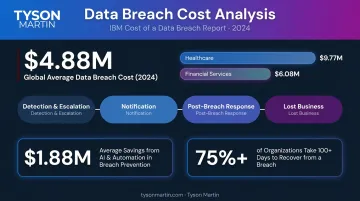
The financial case for proactive security investment is concrete. IBM's 2024 Cost of a Data Breach Report puts the global average breach cost at $4.88 million — a 10% increase over 2023. Healthcare breaches averaged $9.77 million (the highest of any industry, for the 14th consecutive year). Financial services came in at $6.08 million, 22% above the global average.
But the headline number understates the real cost. IBM identifies four primary cost categories:
- Detection and escalation — identifying and containing the incident
- Notification — regulatory and customer disclosure obligations
- Post-breach response — legal, support, and remediation costs
- Lost business — revenue loss from downtime, customer attrition, and reputational damage
Beyond those categories, 70% of breached organizations reported significant or very significant business disruption — and only 12% had fully recovered at the time of study. Among those who did recover, more than 75% took longer than 100 days to return to normal operations. Extended recovery at that scale is a revenue problem, not just a technical one.
The compounding math favors prevention:
- Organizations extensively using security AI and automation saved an average of $1.88 million in breach costs compared to those that didn't
- Regulatory fines above $50,000 hit a higher share of breached organizations — up 22.7% year over year
- 63% of breached organizations passed costs to customers through price increases — meaning breach costs ripple outward
Proactive risk management creates a different financial profile. By identifying and prioritizing exposures with the highest potential business impact, organizations avoid over-investing in low-probability threats while protecting the vulnerabilities that could genuinely interrupt operations. That same discipline affects insurance terms directly: Marsh reported US cyber rates declining 5% in Q4 2024 — a benefit available only to organizations that can demonstrate security maturity to underwriters.
KPIs directly affected: breach cost avoided, cyber insurance premiums, regulatory fine exposure, operational downtime, incident recovery time.
What Happens When Cybersecurity and Risk Management Are Treated as Afterthoughts
Organizations that defer security governance don't eliminate risk — they accumulate it silently. The pattern is predictable: reactive firefighting replaces deliberate execution, incident costs spike when they arrive, and regulatory scrutiny intensifies at the moments when the organization is least prepared.
The operational consequences that don't make headlines are equally damaging:
- Risk exceptions get approved informally, with no expiry dates — "temporary" quietly becomes permanent
- Projects go live without documented security sign-off, and teams learn to route around security
- Nobody can say with certainty where the most critical data lives or who can prove controls work
- Incident response breaks down not from lack of capability but from unclear ownership — IT wants to shut down systems, legal wants facts, the CEO wants to protect revenue, and nobody owns the call
The governance gap creates acute pressure during strategic events:
- M&A diligence: Organizations without a clear risk posture watch the data room turn chaotic. Questionnaires get inconsistent answers, deal timelines slip, and valuation pressure rises at exactly the wrong moment.
- Regulatory audits: Evidence lives in scattered folders, control owners aren't sure what they own, and each audit feels like starting over.
- Enterprise contract cycles: The absence of board-level risk documentation creates direct sales friction that no one in the room can explain clearly.
That friction has a legal dimension too. In 2024, the SEC charged four companies with misleading cybersecurity disclosures related to the SolarWinds compromise — Unisys paid $4 million in penalties, with others ranging from $990,000 to $1 million. A multistate settlement required Marriott to pay $52 million over a breach affecting more than 130 million guest records, with mandatory independent security assessments every two years for 20 years.
Undermanaged cyber risk doesn't wait for a breach to cost the business. It shows up at the fundraising table, in the data room, and on the contract renewal call — long before any incident occurs.
How to Get the Most Value from Your Cybersecurity and Risk Management Program
Organizations that extract genuine business value from cybersecurity treat it as a continuous governance practice, not a project. Three areas determine whether that practice actually holds.
Decision Rights Are Clear
The board approves risk appetite, funds priorities, and holds leaders accountable. Management executes and escalates. When those roles blur, decisions stall, exceptions pile up, and every security initiative competes with every other business priority at once.
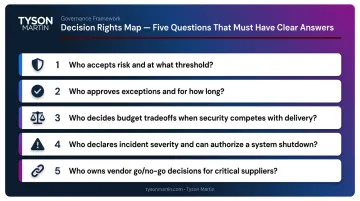
A decision-rights map should answer five questions without ambiguity:
- Who accepts risk, and at what threshold?
- Who approves exceptions, and for how long?
- Who decides budget tradeoffs when security competes with delivery?
- Who declares incident severity, and who can authorize a system shutdown?
- Who owns vendor go/no-go decisions for critical suppliers?
Reporting Is Built for Oversight, Not Status Updates
Board reporting should lead with trend, exposure, and decision points, not vulnerability counts or technical metrics. A useful board update covers:
- What changed since the last meeting
- Which risks increased or decreased, and why
- What management is doing about it
- Where a board decision is actually required
Format matters as much as content. Consistent structure, consistent definitions, and a stable impact model quarter over quarter give boards the ability to judge whether the program is reducing risk or simply producing activity.
Insights Actually Change How the Business Operates
The value of a risk program isn't in the report. It's in whether the insights change decisions. If a metric can't trigger a decision, it's noise. If a risk posture briefing doesn't end with a clear ask — funding approval, risk acceptance, policy confirmation — the board can't govern.
When a program produces noise rather than clarity, the starting point is establishing what the board is accountable for overseeing versus what belongs to management, then structuring reporting to support that distinction. Tyson Martin works with boards and executive teams on exactly this: adopting a governance framework built on defensible decision-making and inspectable execution, with a 90-day plan, named owners, and measurable outcomes from day one.
A well-governed risk program builds value over time. Trend data becomes meaningful. Escalation decisions move faster. The board develops the context to ask the right questions rather than react to surprises.
Conclusion
Cybersecurity and risk management aren't a tax on growth. They're the governance infrastructure that makes sustainable growth possible.
The three advantages compound over time:
- Customer trust that opens regulated-market doors
- Decision velocity that accelerates M&A and technology adoption
- Revenue protection that removes unpredictable costs before they derail momentum
None of these show up only when something goes wrong. They show up in every enterprise contract cycle, every board meeting, and every strategic initiative that moves forward with clarity instead of ambiguity.
Boards and executive teams that understand their cyber risk posture in business terms don't just avoid disasters. They enter markets with more confidence, close deals with less friction, and meet the governance scrutiny that growth inevitably invites — with credible answers already in hand.
Frequently Asked Questions
How does cybersecurity contribute to business growth?
Cybersecurity creates the governance conditions for growth by protecting revenue and building the trust that speeds up strategic decisions. Well-managed risk expands what an organization can confidently pursue — because leadership can see exposures clearly and act on them deliberately, rather than hedging against unknowns.
What is the difference between cybersecurity and cyber risk management?
Cybersecurity refers to the controls and technologies used to protect systems and data. Cyber risk management is the broader discipline of identifying, prioritizing, and making deliberate decisions about those threats in the context of business objectives. Without that strategic direction, security teams spread effort uniformly across low and high risks alike — and material exposures get the same attention as noise.
How should a board oversee cybersecurity risk without getting lost in technical detail?
Boards should receive risk posture reporting in plain business language — trend data, material changes since the last briefing, and clear decision thresholds — rather than vulnerability counts or patch percentages. The reporting structure should clearly separate what the board owns (risk appetite, funding, accountability) from what management is delegated to handle operationally.
What does a cyber incident actually cost a business beyond the immediate breach?
The direct breach cost is often the smallest component. Beyond it, organizations absorb regulatory fines, legal fees, reputational damage, operational downtime, customer attrition, and higher insurance premiums. IBM's 2024 Cost of a Data Breach report found that more than 75% of fully recovered organizations took longer than 100 days to return to normal operations.
Can cybersecurity posture become a competitive advantage in winning business?
In regulated industries and enterprise procurement, it already is. Organizations with documented risk programs and clean governance pass vendor assessments faster, reduce deal friction, and win contracts that require demonstrable security maturity — particularly where buyers operate under HIPAA, GLBA, PCI DSS, or SEC disclosure requirements.
When does a business need a fractional CISO or board-level cybersecurity advisor?
Organizations in transition — new leadership, M&A activity, a recent incident, or a major technology modernization — typically need expert governance support before a full-time hire makes sense. An advisor like Tyson Martin steps in quickly, establishing structured risk reporting and clear decision rights. Meaningful progress is typically visible within 30 to 90 days.