For boards, audit committees, and executive teams in regulated industries, that gap is no longer acceptable. Regulators expect evidence of active maintenance. Investors expect defensible governance. And when an incident occurs, "we had a risk register" is a very different statement than "we used one."
This article explains what a risk register actually is, what it must contain, how to build one step by step (including managing action plans through to resolution), and where organizations consistently go wrong.
Key Takeaways
- A risk register is a living document that identifies, scores, assigns ownership to, and tracks every significant organizational risk, including the action plans to address them.
- It differs from a risk management plan: the plan describes your methodology; the register is the specific inventory of risks, scores, owners, and responses.
- Every entry needs a named owner, a priority score, a defined response strategy, and a tracked action plan — not just a description.
- Without escalation thresholds and residual risk tracking, even a well-built register becomes a static document — reviewed quarterly, acted on never.
- For boards, the register should show trend over time — not just a quarterly snapshot.
What Is a Risk Register?
NIST defines a risk register as "a repository of risk information including the data understood about risks over time" — a central record of current risks for a given scope or organization, including accepted risks and those with planned mitigation paths.
In practice, it's the operational backbone of an enterprise risk management program: a structured, continuously updated document (or system) that captures every identified risk alongside its probability, potential impact, assigned owner, response strategy, and current status. Think of it as a living record — not a snapshot taken once a year.
The goal: give leadership a single, prioritized view of what could go wrong, who is accountable, what is being done, and whether the risk posture is improving or deteriorating.
Risk Register vs. Risk Management Plan
These two are frequently confused. Conflating them leads to governance gaps — treating a methodology document as an operational tool, or vice versa.
| Risk Management Plan | Risk Register | |
|---|---|---|
| What it is | Your methodology for handling risk | Your inventory of actual risks |
| Scope | Applies across projects or periods | Always specific and current |
| Content | How you identify, score, and respond | The actual risks, scores, owners, actions |
| Audience | Governance and process design | Operational decision-making |
The plan describes how your organization will handle risk in general. The register is the execution artifact: specific risks, their scores, and what's being done about them today.
Key Components of a Risk Register
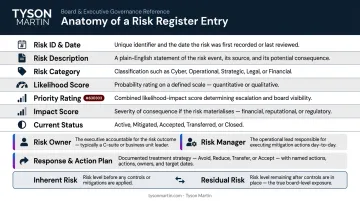
NISTIR 8286 identifies the core fields every risk register entry should contain. A complete entry includes:
- Risk ID and date — unique identifier and when the risk was logged
- Risk description — written as "because of X, Y may occur, causing Z impact"
- Risk category — cyber, operational, financial, compliance, or strategic
- Likelihood score — probability of occurrence
- Impact score — magnitude of harm if it materializes
- Priority/severity rating — combined score used to rank and compare
- Current status — open, in progress, mitigated, accepted, closed
Those seven fields get a register off the ground. Two additional layers separate a functional register from a compliance checkbox.
Accountability: Each entry needs a named risk owner (the executive accountable for the outcome and controlling the resources to address it) and a designated risk manager responsible for day-to-day monitoring. These are not the same role. When they collapse into one person — usually the CISO — accountability becomes theoretical.
Response and action plan: Each entry should capture:
- The response strategy: avoid, mitigate, transfer, or accept
- Specific action steps with named owners and due dates
- A contingency plan if the risk materializes despite mitigation
Inherent vs. residual risk: Inherent risk is the raw exposure before any controls are applied. Residual risk is what remains after mitigation. A mature register tracks both so leadership can see whether controls are working — not just whether they exist.
Why Regulated Industries Can't Afford to Skip It
Regulators and auditors no longer accept a risk register as a one-time deliverable. They expect evidence that it's actively maintained, reviewed at appropriate intervals, and connected to governance decisions.
The specific requirements vary by sector:
- SEC (public companies): Regulation S-K Item 106 requires annual disclosure of processes for assessing, identifying, and managing material cybersecurity risks — including board oversight and management's role. A functioning, documented risk inventory is the practical mechanism for meeting that standard — even though the rule doesn't mandate one by name.
- HIPAA: 45 CFR 164.308(a)(1)(ii)(A) requires covered entities to conduct an accurate and thorough assessment of potential risks to ePHI — documenting threats, vulnerabilities, likelihood, impact, and corrective actions. HHS OCR ransomware enforcement settlements have cited failure to conduct accurate risk analyses as a direct finding.
- NYDFS (financial services): 23 NYCRR Part 500 requires periodic risk assessments that identify, estimate, and prioritize cybersecurity risks to operations and assets.
Without a functioning risk register, the consequences are concrete:
- Leadership operates on anecdotal risk awareness rather than structured analysis
- Ownership is diffuse and disputed when incidents occur
- Board reporting becomes vague and undefensible
- The organization cannot demonstrate a credible decision-making process during audits or after breaches
Risk registers also serve a translation function. They convert technical findings — vulnerability scans, control gaps, third-party assessment results — into prioritized, business-impact language that boards, audit committees, and general counsel can act on.
How to Build a Risk Register and Manage Action Plans
Building a risk register is an iterative process, not a one-time task. The register only has value if it's treated as a living governance artifact that evolves as the organization and its threat landscape change.
Step 1: Identify and Categorize Risks
Risk identification should draw from multiple inputs simultaneously:
- Cross-functional brainstorming sessions with business unit leaders
- Historical incident data and near-miss logs
- Industry threat intelligence and peer benchmarking
- Framework-based assessments (NIST CSF 2.0, ISO 27001 control gap analysis)
- Third-party assessments and vendor risk findings
Risks must span all categories — cyber, operational, compliance, financial, strategic, and reputational. A register that only captures IT risks will miss the exposures that regulators and boards care most about.
Step 2: Score Each Risk by Likelihood and Impact
NIST SP 800-30 defines risk as a function of the likelihood of a threat event's occurrence and the magnitude of potential adverse impact. Both dimensions must be scored consistently.
Scoring approaches:
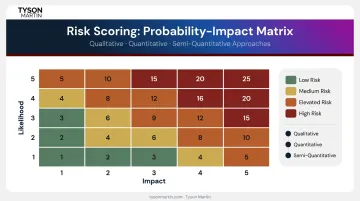
- Qualitative: High/medium/low scales — accessible and fast, but harder to compare across categories
- Quantitative: Numerical scales tied to expected monetary value — more precise, requires more data
- Semi-quantitative: Numbered tiers (1–5) that translate to qualitative descriptors — practical for most organizations
A probability-impact matrix (commonly 5×5) produces an exposure rating for each risk that allows meaningful prioritization across the full register. The visual output — a risk heat map — gives leadership an at-a-glance view of where attention is concentrated and where it's been reduced over time.
Scoring must be uniform across teams. If your cyber team uses different scales than your compliance team, the register can't support meaningful cross-portfolio prioritization.
Step 3: Assign Ownership and Accountability
Every risk must have a named owner — ideally an executive who controls the resources and decisions needed to address it. A designated risk manager handles day-to-day monitoring and action plan execution.
Diffuse or unnamed ownership is one of the most common reasons risk registers fail. When the CISO or risk team is listed as owner of every item, it creates the appearance of governance without the substance. The business unit or functional leader actually responsible for the underlying process should own the risk.
A simple ownership test: Who can fund, prioritize, and accept this risk? That person is the owner.
Step 4: Develop Response Plans and Action Items
NIST SP 800-39 identifies four response strategies:
| Strategy | When to Use |
|---|---|
| Avoid | Eliminate the activity or technology generating the risk |
| Mitigate | Apply controls to reduce likelihood or impact |
| Transfer | Shift financial liability (cyber insurance, contracts) — note: this doesn't reduce the underlying risk |
| Accept | Document a deliberate decision that the risk falls within tolerance |
"Accept" deserves special attention. It is not a default for risks that haven't been addressed. Per NIST SP 800-37 Rev. 2, risk acceptance is a formal decision that must be assigned to an authorizing official and documented — with a time limit.
Undocumented acceptance is just deferred management.
Each strategy translates into specific, dated, owner-assigned action items in the register. Progress must be inspectable.
Step 5: Define Escalation Thresholds
A register without escalation logic is incomplete governance. Organizations need to define in advance:
- What risk score or status change triggers escalation to senior leadership
- What requires board or audit committee visibility
- Who can accept risk at what level — and what decisions require board approval
When these thresholds are vague, two things happen: minor issues get escalated unnecessarily, consuming board time, and material risks sit at the management level longer than they should. When escalation rules are pre-approved, organizations spend incident time solving the problem rather than negotiating authority.
Tyson Martin's advisory work with boards focuses heavily on this step — establishing a clear escalation ladder that answers "when does this move from management to executives to the board?" with defined triggers, notification paths, response timelines, and required information content. Most registers never reach this level of specificity, which is precisely why escalation decisions get made under pressure instead of in advance.
Step 6: Monitor, Review, and Update Continuously
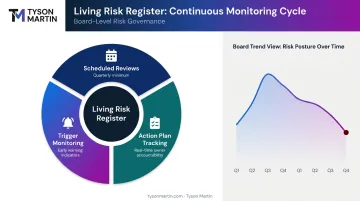
Monitoring has three components:
- Scheduled reviews: Quarterly at minimum for enterprise risk; more frequently for high-severity cyber risks or when significant organizational changes occur
- Action plan tracking: Real-time visibility into whether assigned owners are executing against their commitments
- Trigger monitoring: Early warning indicators that a risk is materializing before it becomes an incident
Residual risk scores should be updated as controls are implemented. Add new risks as the environment changes — new systems, M&A activity, regulatory developments, emerging threats.
The register should show trend lines. Boards need to see whether high risks are declining, what moved up or down since last quarter, and where action plans are stalled. A single-quarter snapshot answers "where are we?" — consistent trend data answers "are we actually getting safer?" That's the question that matters to directors and auditors.
Common Mistakes That Make Risk Registers Fall Apart
The "Build It and File It" Failure Mode
Organizations create a register during a compliance exercise, present it to auditors, and let it sit static for months. ISACA describes a cybersecurity risk register as a dynamic framework for prioritizing and managing security risks — not a static checklist. A register only has value if it's referenced in operational decisions, not just compliance submissions.
The Ownership and Accountability Gap
Risks listed without named owners, or with the CISO listed as owner of every item, create the illusion of governance without the substance. When everyone owns a risk, no one does.
The fix is pushing ownership to the business leader accountable for the underlying process. If a payment processing risk sits with the VP of Finance, the CISO is an advisor — not the owner. That distinction matters when accountability is tested.
The Board Communication Disconnect
NACD research shows that 57% of private-company directors consider better-quality management cyber-risk reporting very or extremely important for the coming year. Most boards currently receive either a technical dump (CVE lists, control gap inventories) or something too vague to act on (a heat map with no trend data or action plan status).

The register should be the source of truth behind a plain-English board briefing that answers five questions:
- What are the top risks right now?
- What changed since last quarter, and why?
- What action plans are in progress?
- What decisions does the board need to make?
- Is the overall risk posture improving or deteriorating?
Translating a risk register into that format is the gap an experienced board advisor bridges. Tyson Martin's board advisory work includes a structured reporting methodology — a one-to-two page briefing with a stable quarterly format, a risk register tied to business impact with named owners and due dates, and a "decisions requested" section limited to the items that actually require board action.
The result: a board that reviews risk posture in ten minutes and leaves with clear decisions made.
Conclusion
A risk register is not a compliance artifact. It's an operational governance tool that gives boards, executives, and risk teams a shared, prioritized view of what threatens the organization and what is being done about it.
The value isn't in creating the register — it's in maintaining it. That means updating scores as controls mature, tracking action plans to completion, assigning ownership to the right leaders, and bringing it into board conversations as a live instrument — not a one-time deliverable. When the register reflects current reality, it earns the trust that makes defensible decisions possible.
Frequently Asked Questions
What are the key steps and components of the risk management process?
The core steps are:
- Identify risks
- Assess likelihood and impact
- Assign ownership
- Develop and execute a response plan
- Monitor continuously
The risk register is the execution layer — containing the risk description, scores, named owner, response strategy, action plan status, and both inherent and residual risk ratings for each item.
What is the difference between a risk register and a risk management plan?
The risk management plan defines your organization's methodology — how you will identify, score, and respond to risk. The risk register is the specific, living inventory of identified risks, their scores, owners, and action plans, tied to the organization at a given point in time. The plan is the process; the register is the output.
Who is responsible for maintaining a risk register?
The CISO, CRO, or risk management office typically owns the process and format. Individual risks should be owned by the business leaders accountable for the underlying activities — not consolidated under a single technical owner — making it a cross-functional effort reviewed by senior leadership, not managed in isolation by the security team.
How often should a risk register be reviewed and updated?
Quarterly reviews are the minimum for enterprise and cyber risk registers. More frequent updates are needed when high-severity risks change status, new threats emerge, or significant organizational changes occur — M&A activity, new system deployments, or regulatory shifts that alter exposure.
What is the difference between inherent risk and residual risk?
Inherent risk is the raw exposure before any controls or mitigations are applied. Residual risk is what remains after controls are in place. Tracking both allows leadership to evaluate whether investments in risk mitigation are actually reducing exposure — or whether controls exist on paper but aren't moving the needle.
How does a risk register support board-level cyber risk reporting?
The register serves as the data source behind board briefings — translating technical findings into prioritized risks with ownership, trend data, and action plan status. Boards should see what changed since last quarter, what action plans are in progress, and what decisions require their attention — a static heat map without trend or ownership data doesn't meet that bar.