Introduction
Boards are being asked to decide faster on AI and technology risk — while the materials they receive keep getting longer, not shorter. Board Intelligence and NACD's 2024 research found that 72% of public-company board packs exceed 200 pages, with average reading time approaching four hours. Yet only 13% of directors rate those packs as "extremely effective."
The problem isn't the volume. It's that most board reports inform rather than direct action. Directors receive activity data, tidy dashboards, and compliance checklists — then walk into the boardroom without a clear decision in front of them.
AI-powered tools are changing how reports get built, summarized, and used. That matters — but only if the governance framework underneath is designed for decisions, not status updates. This article covers where AI genuinely helps, where it introduces new risks, and what boards need to get right regardless of which tools they use.
Key Takeaways
- 72% of public-company board packs exceed 200 pages — yet only 13% of directors rate them as extremely effective at enabling decisions.
- AI tools now automate assembly, surface key insights, flag risk language, generate draft minutes, and track follow-up accountability.
- Speed and polish mean nothing without clear decision options, named owners, and a target accountability date.
- Confidentiality exposure, hallucination risk, and litigation discoverability are real risks that make mandatory human review essential at every stage.
- The goal is a cleaner governance process with defensible decisions and clear accountability — not just a shorter meeting.
Why Traditional Board Report Management Falls Short
The Assembly Problem
Board reports are typically compiled manually from disconnected sources — financial data, risk summaries, compliance updates, operational metrics. Each source has its own format, owner, and update cycle. The result is version-control errors, stale data by the time directors read it, and inconsistent formatting that erodes the credibility of the entire pack.
Governance teams spend the majority of their preparation time on document assembly rather than governance quality control. Nasdaq Boardvantage estimates its AI summarization capabilities save governance teams 10 to 30 hours of manual work per month — time that wasn't going toward analysis.
The Output Problem
Even when reports arrive on time and look polished, they tend to fail at the most important job: driving a decision.
The same 2024 Board Intelligence/NACD research found:
- 60% of directors say board packs are too operational at the expense of strategy
- 50% say reports are light on the implications of the information presented
- 44% say materials are too internally focused
- Only 15% rate packs as extremely effective at conveying key messages
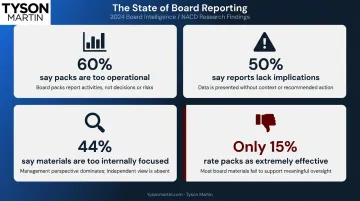
This is a widespread governance gap, not an isolated complaint. Reports arrive full of activity data and short on risk context, clear ownership, or decision framing. Directors end up interpreting technical information rather than making governance decisions.
The Real Stakes
That director dissatisfaction has a real cost. A board pack that reads like an audit file is a governance liability — when directors can't tell what changed, what matters, and what they need to decide, oversight breaks down at the moment it matters most.
"Everything looks on track, then an incident hits and the story changes overnight" is a pattern that emerges precisely when reporting has been informing rather than directing.
How AI Transforms Each Stage of Board Report Management
Preparation and Assembly
AI tools can synthesize raw documents, financial reports, compliance data, and prior board materials into structured board books with minimal manual input. Platforms like Diligent's Smart Book Builder build initial drafts from prior company materials and action items. Nasdaq Boardvantage AI assembles and summarizes board materials, including translation into more than 17 languages.
The practical benefit goes beyond speed. When one tool pulls from canonical sources and produces a single structured draft, governance teams can shift attention from document management to governance quality control — which is where their expertise actually belongs.
Executive Summary and Insight Extraction
A 200-page board pack with a one-page AI-generated summary changes how directors prepare. AI can auto-summarize dense materials into concise executive briefs, giving directors time to absorb critical points before entering the room.
One important caveat: the summary is a draft, not a final product. AI cannot supply organizational context, historical nuance, or the judgment to know when a "green" metric is actually masking a worsening trend. Someone with real knowledge of the organization has to review it before it goes to directors.
Candor and Balance Analysis
Some AI writing tools can scan board papers for positivity bias — flagging where reports underrepresent bad news or downplay risk. Directors consistently report that board papers lack candor. Using AI as a neutral check against that tendency is one of the more underrated governance applications available to boards today.
Meeting Documentation and Minutes
AI minute-generation tools — including OnBoard's Minutes AI, Diligent's Smart Minutes, and BoardEffect's Smart Minutes — capture decisions, votes, and action items during meetings and produce structured draft minutes in minutes rather than hours.
The AICD and Governance Institute of Australia's 2025 joint statement is clear: AI can improve efficiency, but it should not replace human oversight of the corporate record. Corporate secretaries and governance professionals must review and approve all AI-generated minutes before they enter the record. That review step is not discretionary.
Follow-Up and Accountability Tracking
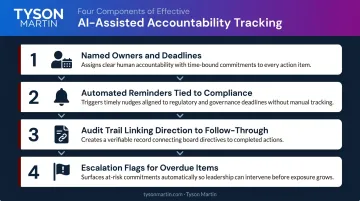
AI-powered platforms can assign post-meeting action items with named owners and deadlines, send automated reminders, and link follow-ups to compliance obligations. This is where many governance programs fail silently — the board gives direction, management nods, and nothing closes. Automated tracking makes that gap visible before the next meeting, not after the next incident.
What effective AI-assisted accountability tracking delivers:
- Named owners and deadlines assigned at the point of decision, not reconstructed afterward
- Automated reminders tied to compliance obligations and board calendar
- Audit trail linking board direction to documented follow-through
- Escalation flags when action items age past deadline without resolution
What AI-Assisted Board Reports Must Actually Deliver for Governance
Faster assembly and smarter summarization only matter if the report they produce is built to drive decisions. Here's what that actually requires.
Decision Framing, Not Status Updates
Every significant board report item should answer one question: do we need to do something about this now? That means presenting clear options — accept the risk, fund mitigation, require changes, pause, or escalate — rather than leaving interpretation to directors in the room.
A report that only informs isn't doing its job. If the board pack has ten charts and zero decisions, it's documentation, not oversight.
Plain-Language Risk Translation
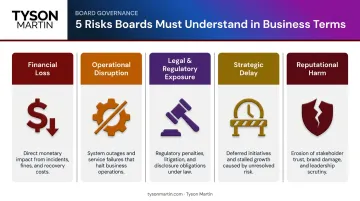
AI-generated content defaults to technical language if it isn't prompted and structured correctly. Directors need risk communicated in business terms:
- Financial loss — revenue impact, recovery costs, insurance gaps
- Operational disruption — downtime, service availability, customer commitments
- Legal and regulatory exposure — fines, disclosure obligations, litigation risk
- Strategic delay — deals, product launches, vendor relationships at risk
- Reputational harm — customer trust, partner confidence, media exposure
Model names, compliance framework citations, and control IDs belong in appendices, not in board-level summaries.
Stable Trend Metrics, Not Activity Volume
Boards need a small, consistent set of trend lines they can follow across meetings. Useful board-level metrics include:
- Top material risk scenarios (what moved up, down, or stayed stuck)
- Time to contain and recover from incidents
- Critical vulnerability remediation time on crown-jewel systems
- Third-party risk coverage on critical vendors
- Incident readiness snapshot (last exercise, key gaps, next test)
Vanity metrics — total prompts processed, training sessions completed, alerts blocked — add noise. If a metric can't trigger a decision, it's reporting, not oversight. AI tools must be configured to surface trend, not trivia.
Clear Ownership and Decision Rights
Every item in an AI-assisted report should name who owns the issue, who approves exceptions, and who escalates if the risk moves. Action items need a single named executive — not a committee, not a shared inbox — with a specific due date and a clear definition of done. "Vendor committed to fix" is not done. "Evidence received and validated" is done.
Without defined decision rights underneath the report, even a well-formatted AI output produces no accountability. The tool can draft the structure. The governance has to already exist.
Working with a Board Advisor
AI surfaces information quickly. Translating that information into a governance structure with clear escalation thresholds, inspectable execution, and defensible decisions requires organizational judgment that no tool provides.
An experienced board advisor — a fractional CISO or dedicated board governance advisor — helps organizations build the oversight framework that makes AI-assisted reporting credible rather than decorative. The concrete deliverables include:
- A board packet draft with real risk prioritization
- Defined decision rights that hold under pressure
- A 90-day plan with named owners and measurable outcomes
- Incident readiness tested through actual exercises
AI produces faster drafts. A qualified advisor produces governance you can defend in front of regulators, investors, or a courtroom.
The Governance Risks of AI in Board Reporting
Confidentiality and Data Security
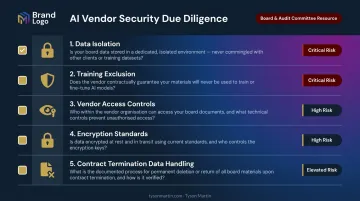
Board materials contain privileged, strategic, and regulatory-sensitive information. Before any AI vendor touches that content, organizations should get clear answers on:
- Is board content isolated from other clients' data?
- Is board content excluded from training external AI models?
- Who at the vendor can access board materials, under what conditions?
- What encryption standards apply in transit and at rest?
- What happens to content if the contract ends?
White & Case notes that without sufficient limits, AI tools may jeopardize the confidentiality of board communications and create risk that legal advice privilege is lost if information is disclosed to third-party vendors on terms that don't protect privilege. For boards in regulated industries, these questions belong in vendor contract negotiations.
Accuracy and Hallucination Risk
Stanford HAI's 2024 research found that even legal-specific AI models hallucinate in one out of six or more benchmark queries. General-purpose models hallucinated on legal tasks at rates between 58% and 82%.
Board materials aren't legal briefs, but the risk profile is similar: ambiguous source material, high-stakes decisions, and consequences when details are wrong. AI-generated summaries, minutes, and risk assessments require mandatory human review before circulation or entry into the corporate record. Skipping that review step is a governance failure, not an efficiency gain.
The Chartered Governance Institute UK and Ireland found in 2025 that 74% of governance professionals are concerned about the accuracy of AI-generated content in corporate reporting. That concern is well-founded.
Privilege and Litigation Exposure
Accuracy risk is only part of the exposure. AI tools also create new legal risk simply by running in the room.
AI transcription and summarization tools generate a detailed, searchable record of board discussions. Duane Morris notes that AI-transcribed conversations and meeting summaries may become discoverable in litigation — producing a permanent record that wouldn't otherwise exist.
Several jurisdictions require participant consent before recording conversations, including California, Florida, and Pennsylvania. Organizations should establish clear protocols covering:
- When to disable AI tools during discussions involving attorney-client privilege
- How to handle active litigation or confidential regulatory matters
- Who is responsible for enforcing those protocols at each meeting
The presence of an AI transcription tool doesn't change what directors say — it changes what opposing counsel can demand in discovery.
From AI-Generated Content to Defensible Board Decisions
The Gap Between Polish and Governance
AI can produce a well-structured, professionally formatted board pack quickly. That's useful. But polish is not governance.
The report is only valuable if it ends with a clear choice the board can make, a named owner, and a follow-up date. Without that structure, AI accelerates the production of noise, not oversight. A faster version of a report that didn't drive decisions before AI is still a report that doesn't drive decisions.
What a Decision-Ready AI-Assisted Report Looks Like
Every AI-assisted board report should close with:
- A short action list — specific items only, with named executive owners, due dates, and defined completion criteria
- Clear risk decisions — options presented (accept, fund, escalate, pause), not just descriptions of the situation
- A named executive accountable for each open item between meetings
- Escalation triggers — amber and red thresholds defined in advance, not determined in the moment
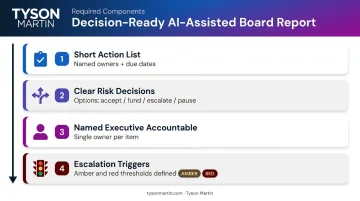
The one-page executive summary goes at the front. The action list goes at the back. What's in between should support both.
Establishing Governance Before Leaning on AI
AI tools work best when embedded in a governance structure that already has defined decision rights, clear escalation paths, and named accountability. For organizations in transition — new leadership, post-incident, post-M&A — the right sequence is to establish that framework first.
As Tyson Martin advises organizations in transition: "Don't buy tools to compensate for missing decision rights. Fix who decides what first, then fund the plan." An AI-assisted report built on top of undefined governance produces fast, well-formatted confusion.
Measuring Whether AI-Assisted Reporting Is Actually Working
The measure isn't the number of reports produced or the time saved in preparation. It's whether governance quality improved. Useful leading indicators:
- Are directors making clearer, documented decisions in meetings?
- Are action items closing on schedule with evidence, not just verbal commitments?
- Has risk visibility improved between meetings — fewer surprises, faster escalation?
- Are board conversations becoming more disciplined over time, with less time spent re-explaining the basics?
If none of that is moving, the tooling isn't the problem. The process it's sitting on top of is.
Frequently Asked Questions
Frequently Asked Questions
What is the best AI tool for creating board reports?
There is no single best tool — the right choice depends on organizational size, security requirements, and governance maturity. Purpose-built platforms designed for board-level confidentiality (such as Nasdaq Boardvantage AI, Diligent GovernAI, or OnBoard) are generally safer than generic generative AI tools for sensitive board materials.
How does AI improve the accuracy of board reports?
AI improves accuracy by automating data aggregation and reducing manual transcription errors during compilation. However, AI-generated content still requires human review — tools can hallucinate details or miss organizational context that changes the meaning of a risk statement entirely. Accuracy is better than manual assembly on routine tasks; it is not reliable enough to bypass human review before materials enter the corporate record.
What are the risks of using AI for board reporting?
Three risks matter most: confidentiality exposure if board data is processed by AI models that use it for external training, accuracy risk from hallucinated or misleading content in AI-generated drafts, and litigation risk from detailed AI transcripts that may be discoverable in legal proceedings. All three are manageable with the right vendor controls and review protocols — but none can be ignored.
How do AI tools help boards make better decisions?
AI helps by surfacing critical insights from dense materials, flagging risk language that lacks business context, and structuring reports around decision options rather than status updates. Whether that efficiency translates into better oversight depends on the governance framework underneath — reports built to drive action outperform those built to share information.
Can AI replace a board advisor or CISO when preparing board reports?
No. AI produces faster drafts; it cannot supply the judgment, organizational context, or accountability that a skilled board advisor or CISO brings. A qualified advisor ensures risks are properly surfaced, decisions are clearly framed, and the governance architecture underneath the report holds up under real pressure — not just on paper.
What should every AI-assisted board report include?
Every AI-assisted board report should include:
- A one-page executive summary
- Top risks framed in business terms (revenue, operations, legal exposure, customer harm)
- Clear decision options for each significant item
- A named executive owner for every open action
- Stable trend metrics with thresholds
- A closing action list with due dates
AI can help draft all of these — none of them work without human oversight and organizational judgment behind them.