Introduction
AI has entered the boardroom from two directions at once: as a tool directors can use to prepare, challenge, and govern more effectively — and as a risk boards are now responsible for overseeing inside their own organizations. Most boards are not yet equipped for either role.
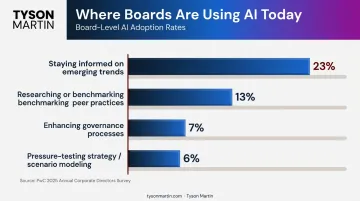
According to PwC's 2025 Annual Corporate Directors Survey, only 35% of directors say their boards have incorporated AI into their oversight roles. The gap is even wider when you look at specific use cases: just 13% use AI for peer benchmarking, 7% for governance process improvement, and 6% for scenario modeling.
Board effectiveness has always depended on the quality of information directors receive and the questions they can ask. The persistent problem is structural: boards relying almost entirely on management for the information they use to oversee management. AI directly addresses this gap.
This guide identifies the top AI tools serving boards today, the use cases where they add real value, the risks boards must manage before deploying them, and what to look for when making a selection.
Key Takeaways
- Two distinct tool categories: process tools (meeting prep, reporting, minutes) and oversight tools for governing the company's own AI and technology risk.
- Public AI platforms don't belong in the boardroom: confidentiality exposure makes them inappropriate for board-level work.
- Good tools sharpen director judgment, not replace it — the goal is better questions, not automated decisions.
- Regulated industries face added urgency: SEC, OCC, and EU AI Act frameworks all require active, documented board oversight of AI risk.
- Tool selection is a governance decision, not a technology procurement.
How AI Is Changing Board Oversight
The Agency Problem AI Can Disrupt
Boards face a structural challenge that predates AI: they receive nearly all their information from the management teams they are tasked with overseeing. That creates an inherent gap in independent judgment.
As the Harvard Law School Forum on Corporate Governance noted in November 2025, AI can address this "longstanding issue of information asymmetry between boards and management" by enabling directors to:
- Independently benchmark management disclosures against peer data
- Analyze historical board materials for pattern and precedent
- Pressure-test strategy before approving it
That independent oversight capability — not process efficiency — is the governance rationale for bringing AI into the boardroom.
Where Boards Are Starting
PwC's data shows board AI adoption is real but narrow. Current use breaks down as follows:
| Use Case | % of Directors Reporting Use |
|---|---|
| Staying informed on emerging trends | 23% |
| Researching or benchmarking peer practices | 13% |
| Enhancing governance processes | 7% |
| Pressure-testing strategy / scenario modeling | 6% |
These numbers reflect early-stage adoption. The gap between trend-monitoring (23%) and actual strategy pressure-testing (6%) suggests most boards are using AI for awareness, not yet for the independent oversight it can provide.
Top AI Tools for Board Effectiveness and Corporate Governance
The tools below were selected based on governance focus, security posture, relevance to board-level use cases, and their ability to support director oversight without replacing director judgment.
Diligent
Diligent is one of the most widely deployed governance platforms globally, used by 75% of the Fortune 500 and over 700,000 directors and leaders across 130 countries. Its core offering has expanded from a secure board portal into a broader GRC platform covering entity management, ESG reporting, audit and risk committee workflows, and AI-powered governance intelligence.
Its Governance Intelligence layer surfaces risk trends, regulatory changes, and peer governance benchmarks directly within the secure portal. That reduces the pressure directors feel to turn to personal or generic AI tools for independent research.
| Attribute | Details |
|---|---|
| Best For | Boards seeking a unified, secure platform combining board portal functionality with AI-assisted governance intelligence and peer benchmarking |
| Key AI Features | Smart Minutes, Smart Summary, SmartPrep 360, AI Risk Scanner, peer benchmarking, third-party risk triage, GovernAI |
| Security | ISO/IEC 27001 aligned, 256-bit AES-GCM encryption at rest, SSL/TLS 1.2 in transit, role-based access, secure collaboration; purpose-built for regulated and publicly traded companies |
Board Intelligence (IQ)
Board Intelligence is a UK-based platform purpose-built for board meeting preparation and report quality. Its IQ product is an AI thinking partner designed specifically for board packs—not a generic summarization tool, but a structured analysis layer that maps board materials against a proven governance framework.
Where generic AI stops at summarizing content, Board Intelligence IQ surfaces what is missing—the context, the options not considered, the unstated assumptions. Its Insight Driver maps reports against a framework covering context, options, and expected impact. Directors arrive at meetings with sharper questions, not just shorter documents.
The research behind the product is hard to ignore:
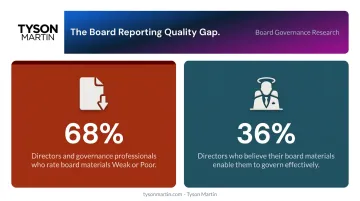
- 68% of directors and governance professionals rate board materials "Weak" or "Poor"
- Only 36% believe their board materials enable them to govern effectively
That is the problem IQ is built to solve.
| Attribute | Details |
|---|---|
| Best For | Boards and governance teams focused on improving the quality and clarity of board materials and reducing time spent on administrative governance work |
| Key AI Features | AI-powered board pack analysis with gap identification, AI Minute Writer with source traceability, agenda planning automation |
| Security | Data not used for model training; ring-fenced private environments; designed for confidential board-level materials |
OnBoard
Accessibility is OnBoard's design priority. The platform supports directors across a wide range of technical comfort levels, with AI capabilities covering meeting preparation, document review, and board self-assessment workflows—used across nonprofit, healthcare, financial services, and enterprise sectors.
OnBoard's AI Assist allows directors to ask plain-English questions against the governance record, retrieving answers based on their permissions. AI Minutes creates transcripts, key points, and editable draft minutes stored within the governed workspace. Board Assessments support committee and CEO evaluations with anonymous input and year-over-year comparisons—a function boards often struggle to execute consistently.
| Attribute | Details |
|---|---|
| Best For | Mid-market and nonprofit boards seeking an accessible AI-assisted board portal without significant technical onboarding |
| Key AI Features | Conversational AI for board document queries, AI minutes drafting, board self-assessment tools, action item tracking |
| Security | SOC 2 Type II certified (renewed March 2025), ISO 27001, ISO 27701, GDPR and HIPAA support; appropriate for healthcare and financial services environments |
Microsoft Copilot for Microsoft 365
Microsoft Copilot is not a board-specific tool, but it has become one of the most actively discussed AI capabilities in the boardroom—because most directors and governance teams already operate within the Microsoft ecosystem.
When deployed within a company-approved Microsoft 365 tenant, Copilot allows directors to summarize documents, draft questions, synthesize research, and run scenario analyses against information within the secure organizational boundary. Microsoft confirms that prompts, responses, and data accessed through Microsoft Graph are not used to train foundation LLMs, and that Copilot respects existing Microsoft 365 permissions.
The critical caveat: Copilot's value in a board context depends entirely on deployment discipline. It must operate within the organization's Microsoft 365 tenant with Microsoft Purview DLP policies configured—directors must not use personal Microsoft accounts or public AI interfaces for board work.
| Attribute | Details |
|---|---|
| Best For | Boards already operating in the Microsoft 365 ecosystem who want AI-assisted document analysis, research, and drafting within existing infrastructure |
| Key AI Features | Document summarization and gap analysis, meeting notes and minutes drafting, research synthesis from approved data sources, scenario question drafting |
| Security | Operates within organization's M365 tenant; does not train on customer data; requires proper tenant configuration and Purview DLP policies before board use |
Credo AI
Credo AI is a governance platform for managing AI risk, compliance, and policy enforcement across an organization's AI portfolio. For boards, it matters not as a tool directors use directly, but as the governance infrastructure management deploys—and that boards should understand and be asking about.
Its Policy Packs are pre-built governance components that translate regulations into actionable requirements, covering the EU AI Act, NIST AI RMF, ISO 42001, SOC 2, GDPR, and HITRUST. Its GAIA capability handles AI intake and review, guided AI registration, risk and compliance mapping, and shadow AI visibility.
The Deloitte AI Board Governance Roadmap is a useful reference for the questions boards should be putting to management about their AI governance infrastructure.
| Attribute | Details |
|---|---|
| Best For | Boards and audit committees that need to understand and oversee management's AI governance program, particularly in regulated industries |
| Key AI Features | AI asset inventory and risk tiering, regulatory compliance mapping (EU AI Act, NIST AI RMF, ISO 42001), agentic AI oversight (GAIA), policy enforcement and audit trail generation |
| Security | Private cloud and self-hosted deployment options; integrates with AWS, Azure, Databricks, ServiceNow; designed to generate audit-ready compliance documentation |
Key Use Cases: Where AI Adds the Most Value for Boards
Meeting Preparation and Independent Research
AI's highest-value application for directors is reducing information asymmetry. The goal is not summarizing the board pack faster: it is equipping directors to benchmark what management presents against external disclosures, analyst reports, and peer governance data before approving strategic decisions.
That distinction matters. A director who arrives having independently validated the assumptions in a management presentation can ask fundamentally different questions than one who received the same deck 24 hours before the meeting.
Board Reporting Quality
AI tools are being used both upstreamto help management teams write cleaner, more focused board papers, and downstream to help directors identify what is missing or unclear before they reach the table. With 24% of board packs exceeding 200 pages, and only 36% of directors saying their materials enable them to govern effectively, the quality problem is structural, not incidental.
AI-assisted report writing addresses the root cause: papers that describe activity rather than surface decisions, bury risk in context, and leave directors with awareness but no action.
Oversight of Technology and Cybersecurity Risk
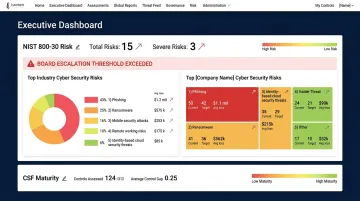
NACD's 2026 Cyber Risk Handbook frames board cybersecurity oversight around meaningful, actionable metrics organized across five categories, not technical alerts. AI-generated dashboards and trend analyses can help boards move from episodic, slide-heavy security briefings to metric-driven oversight.
The value depends on getting the inputs right first. Tyson Martin's board advisory work sits precisely at this intersection: defining what those metrics should actually measure, what escalation thresholds should trigger board action, and how AI-generated insights get validated before directors act on them. A dashboard that consistently produces the wrong numbers is worse than no dashboard. It produces false confidence.
Governance Process Efficiency
AI-assisted minute writing, agenda planning, and action item tracking currently consume disproportionate governance team time. Freeing that capacity shifts governance teams toward higher-order work that tends to get deferred when administrative burden is high:
- Board self-assessment design and facilitation
- Committee structure and charter review
- Director onboarding and continuing education
- Escalation threshold calibration and policy refresh
The pattern is consistent: when routine tasks are automated, governance functions that actually require judgment finally get scheduled.
Risks Boards Must Address Before Adopting AI Tools
Data Security and Confidentiality
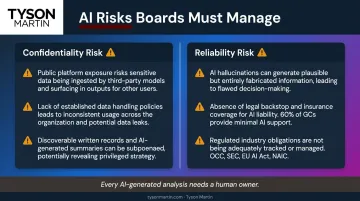
Board materials contain some of the most sensitive information in any organization: M&A activity, incident response details, executive compensation, regulatory exposure. The guidance from PwC and the Harvard Law School Forum is direct: directors "should not put board packages and company information into public or personal AI platforms."
Generic public platforms—personal ChatGPT accounts, consumer-grade AI assistants—are not appropriate for board work. Any AI used for board purposes must operate within a company-approved, secure environment with documented data-handling policies.
AI Hallucinations and False Confidence
AI outputs can be plausible but factually wrong. That risk is sharpest when directors use AI to challenge or corroborate management data—the scenario where independent judgment matters most.
Two additional facts make this governance gap harder to close:
- 60% of public company general counsels provide minimal to no support to boards on AI matters, meaning directors cannot assume a legal backstop is in place.
- Boards in regulated industries face specific AI oversight obligations—OCC model risk guidance (Bulletin 2026-13), NAIC AI Model Bulletin, SEC cybersecurity disclosure requirements, EU AI Act—that require active board oversight, not just management delegation.
Every AI-generated analysis that reaches the boardroom should have a human owner who can defend it. These tools sharpen the questions directors ask—they don't replace the judgment behind them.
That distinction matters especially as AI use creates a new category of governance exposure: the written record.
Board Overreach and the Written Record
Two governance risks are unique to AI use in the boardroom:
- Use AI to sharpen oversight questions, not to direct operations. Independent analysis that crosses into management territory—second-guessing decisions in real time—blurs the oversight line in ways that create liability, not accountability.
- AI prompts and outputs create a written record that may be discoverable in litigation or regulatory review. Retention and documentation policies for board AI use must be agreed upon with general counsel before deployment, not after an incident.
How to Select the Right AI Tool for Your Board
Most boards get tool selection wrong in the same three ways: choosing based on vendor demos rather than governance fit, skipping security review before deployment, and treating adoption as a one-time decision rather than a commitment that requires periodic reassessment.
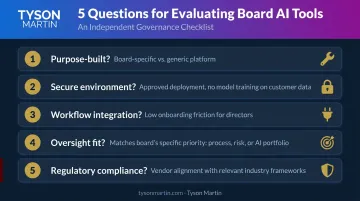
The right evaluation framework asks five questions:
- Is the tool purpose-built for board use, or adapted from a generic platform?
- Does it operate within a secure, company-approved environment with documented data handling and no training on customer data?
- Does it integrate with existing workflows without requiring significant technical onboarding for directors with varying technical backgrounds?
- Does it match the board's specific oversight priorities—process efficiency, risk reporting, or oversight of the company's own AI portfolio?
- Can the vendor demonstrate compliance with the regulatory frameworks relevant to your industry?
The governance layer matters as much as the technology.
Selecting and deploying AI tools for board effectiveness is a governance decision, not just a technology one. It requires clarity on decision rights, escalation thresholds, and measurable outcomes before any tool goes live.
Boards navigating this need advisors who have operated at both the executive and board levels—not just technologists. Tyson Martin works with boards and executive teams to define what should be measured, structure how AI-generated insights get validated, and establish the governance infrastructure that makes adoption defensible.
Frequently Asked Questions
What is the difference between AI tools for board effectiveness and AI governance tools?
Board effectiveness tools—like Diligent, Board Intelligence, and OnBoard—help directors improve board processes: meeting preparation, report analysis, and minute writing. AI governance tools like Credo AI help organizations manage their own AI systems through compliance tracking, bias detection, and AI asset inventory. Both categories are distinct, and boards need a working understanding of each.
Should boards allow directors to use personal AI tools like ChatGPT for board work?
No. Personal and public AI platforms are not appropriate for board work involving sensitive or confidential materials. Any AI used for board purposes must operate within a company-approved, secure environment with documented retention and data-handling policies agreed upon with general counsel in advance.
Can AI tools replace the need for a board advisor or a CISO?
No. AI tools can surface information and flag patterns, but they cannot exercise fiduciary judgment, define decision rights, structure escalation thresholds, or translate technical risk into board-level strategy. Those functions require experienced human advisors who understand both the governance context and the business stakes.
How do AI tools help boards oversee cybersecurity and technology risk?
AI-powered dashboards and trend reporting can convert complex security data into stable, readable metrics for boards. The value depends on defining the right indicators upfront, ensuring the underlying data is trustworthy, and establishing clear escalation protocols before an incident occurs—not after.
What questions should boards be asking management about the company's own AI programs?
Start with four: Does management have an inventory of how AI is used across the organization? Who owns AI risk? What policies govern AI deployment and data use? How are AI-related risks reported to the board? The absence of clear answers to any of these is itself a governance finding.
Are AI governance tools appropriate for regulated industries like financial services and healthcare?
Regulated industries face specific AI oversight obligations under OCC model risk management guidance, the NAIC AI Model Bulletin, HIPAA, and SEC cybersecurity disclosure rules. Purpose-built governance platforms with pre-built compliance mapping—rather than generic tools—are the right starting point for boards in these environments.