Introduction
Most boards now acknowledge that AI is embedded in their organization's strategy, operations, and risk profile. Far fewer have a stable set of metrics to govern it with.
According to PwC's 2025 Annual Corporate Directors Survey, only 35% of directors said their boards had incorporated AI and GenAI into oversight roles — yet 67% said boards should spend more time on AI in the next 12 months. That gap is the governance problem.
The real barrier is translation, not director capability. Boards are receiving operational counts — tools discovered, policies violated, incidents blocked — when what they need are business-level signals: dollar exposure, trend direction, and clear decision points.
Those are different things. Conflating them is how boards end up informed but not equipped to act.
This guide delivers three things:
- The five metrics that belong on every board's AI governance dashboard
- A ready-to-use one-page reporting template
- The questions directors should be asking management every cycle
Key Takeaways
- Boards need AI governance metrics that show dollar exposure and trend direction, not raw operational counts
- Five core metrics: AI system inventory coverage, high-risk AI control maturity, incident response readiness, regulatory compliance posture, and third-party AI risk coverage
- A one-page dashboard showing current state, trend, and required action outperforms any detailed technical briefing
- Oversight belongs to the board; execution and reporting belong to management
- Without defined escalation thresholds, AI risk goes untracked between reporting cycles
Why AI Governance Has Become a Board-Level Priority in 2026
The Regulatory Shift From Voluntary to Mandatory
AI governance is no longer a best-practice conversation. It is a compliance obligation with enforceable deadlines.
The EU AI Act's general provisions became applicable on August 2, 2026, with high-risk AI system obligations under Article 6(1) following in August 2027. For organizations operating in or selling into the EU, this means documentation requirements, human oversight obligations, and conformity assessments are live requirements now — not planning items.
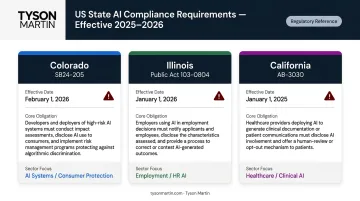
US state-level laws are compounding this pressure:
| State | Law | Effective Date | Core Obligation |
|---|---|---|---|
| Colorado | SB24-205 | February 1, 2026 | Deployers of high-risk AI in lending, insurance, healthcare, and employment must protect against algorithmic discrimination |
| Illinois | Public Act 103-0804 | January 1, 2026 | Employers using AI in hiring, promotion, or discipline face anti-discrimination and notice requirements |
| California | AB-3030 | 2025 | Health facilities using generative AI for patient communications must include disclosure and human-contact instructions |
For boards in financial services, healthcare, and retail, the risk of non-compliance is no longer theoretical.
Fiduciary Duty Now Includes AI
Regulators, shareholders, and insurers have each assigned accountability to the board specifically — not just to management. Three frameworks now create direct board exposure:
- SEC disclosure rules require public companies to report board oversight of cybersecurity risk, and AI risk falls within that scope
- NAIC's AI bulletin holds senior management accountable to the board or a board committee for AI governance programs
- Glass Lewis's 2025 guidelines state that boards should take active steps to mitigate material AI risks, with poor oversight potentially affecting director recommendations
"We left it to the tech team" is not a defensible governance posture after an incident or regulatory inquiry. Each of these frameworks places the accountability question at the board table — not in the technology organization.
The Speed Problem
AI deployment timelines have outpaced quarterly review cycles. Shadow AI — employees adopting unapproved tools that connect to internal systems — creates exposure that accumulates between meetings. IBM's research found that 1 in 5 organizations studied experienced breaches connected to shadow AI, adding an average of $670,000 to breach costs. Those incidents don't wait for the next board meeting.
What Boards Are Actually Responsible For in AI Oversight
Setting the Boundary
Board oversight and management execution are different functions, and confusing them is one of the most common governance failures in practice.
Boards set risk appetite, approve policy guardrails, and hold management accountable. They do not review every model, approve every deployment, or evaluate vendor contracts line by line.
Getting this boundary wrong in either direction causes problems. Boards that slip into micromanagement create friction without improving oversight; boards that stay entirely passive create accountability gaps.
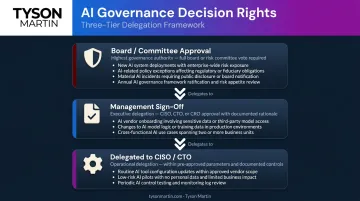
A workable starting point is a simple decision-rights map:
- Requires board or committee approval: Deploying high-risk AI in a regulated context, crossing a defined dollar exposure threshold, responding to a material AI incident, accepting a risk that falls outside stated appetite
- Requires management sign-off: Deploying AI systems classified as medium risk, onboarding material AI vendors, approving policy exceptions with a defined expiration
- Fully delegated to the CISO/CTO: Routine AI tool evaluations, low-risk deployments with standard controls in place, operational monitoring decisions
Undefined decision rights are not a minor administrative gap. When an AI incident occurs, unclear ownership delays response and creates regulatory exposure.
Committee Structure vs. Documented Ownership
Most boards can integrate AI oversight into existing audit or risk committee structures. A dedicated AI subcommittee makes sense when the AI program is extensive, high-stakes, or spans multiple regulated sectors.
The determining factor is not committee structure — it is documented ownership and a defined review cadence. That means having written answers to:
- Who reviews AI governance metrics, and how often?
- What thresholds trigger escalation to the full board?
- Who is accountable when a response decision needs to be made under time pressure?
Without those answers on paper, the first serious AI incident will expose the gap — and regulators will notice before the board does.
The 5 Core AI Governance Metrics Every Board Should Track
Metric 1 — AI System Inventory Coverage
What it measures: The percentage of AI systems in production that are formally registered, assigned an owner, and classified by risk level.
What "good" looks like: 90%+ coverage, with every high- and critical-risk system registered. Zero unclassified systems in production.
What a gap signals: Shadow AI exposure. Unregistered systems have no owner, no controls review, and no incident path.
Escalation trigger: Coverage dropping below a defined threshold (set this at 85% as a starting point), or any new high-risk system appearing in production without registration.
Metric 2 — High-Risk AI Control Maturity
What it measures: For AI systems classified as high or critical risk — what percentage have completed a formal risk assessment, a deployment checklist review, and active monitoring?
Rate each system on a simple 1–4 scale:
- 1 — Absent: No controls documented or in place
- 2 — Defined: Controls documented but not yet implemented
- 3 — Implemented: Controls in place and operating
- 4 — Tested: Controls verified through active review or audit
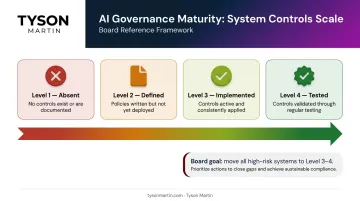
Moving systems from level 2 to level 4 is a meaningful improvement. Updating documentation without changing what's actually running is cosmetic. Boards should know which one they're getting.
The right question: Did controls change in practice, or just on paper?
Metric 3 — AI Incident Response Readiness
What it measures: Whether the organization has a documented, tested escalation path for the three main AI incident types:
- Fairness or bias incidents
- Accuracy or performance degradation
- Security or privacy breaches
Having a playbook and having tested one are not the same metric. A document sitting in a SharePoint folder is not incident readiness.
Escalation trigger: Any incident involving customer-facing AI, regulated data, or estimated exposure above a defined dollar threshold requires board notification — not just management resolution.
Metric 4 — Regulatory Compliance Posture
What it measures: Which AI obligations apply to the organization, current compliance status for each, and what gaps remain open.
This metric should always show trend — is the compliance gap closing or widening since last cycle? A static snapshot tells the board where you are. Trend tells them where you're heading.
Track it by obligation:
| Obligation | Applicability | Current Status | Gap Trend |
|---|---|---|---|
| EU AI Act (General) | Yes — EU operations | In progress | Closing |
| Colorado SB24-205 | Yes — financial products | Partial | Stable |
| Illinois AI Employment Law | Yes — HR systems | Not started | Widening |
Metric 5 — Third-Party and Vendor AI Risk Coverage
What it measures: The percentage of material AI vendors and tools that have completed a documented evaluation covering:
- Data retention policies
- Subprocessor transparency
- Breach notification requirements
- Security certifications (SOC 2 Type II, ISO 27001)
Why this matters now: Employee-adopted AI agents frequently access internal systems without IT or security approval. IBM found that 38% of employees acknowledge sharing sensitive work information with AI tools without employer permission. That exposure stays invisible until something goes wrong — and third-party AI risk coverage is how boards track whether the organization can see it before then.
The Board-Ready AI Governance Dashboard Template
A one-page dashboard converts five governance metrics into a format directors can interpret without technical background. Each metric row should answer three questions: what is the current state, what direction is it moving, and what does the board need to decide?
Any metric reported without all three elements does not support board decision-making.
AI GOVERNANCE BOARD DASHBOARD As of: [Date] | Next Review: [Date] AI Risk Posture: [One sentence — e.g., "Posture is stable with two escalation items requiring board input this cycle."]
Metric Status Current Value Trend Decision Required AI Inventory Coverage 🟡 Watch 78% registered ↑ +6% vs. last cycle Approve remediation timeline for 14 unregistered systems High-Risk Control Maturity 🔴 Escalate 3 of 7 systems at Level 3+ → Stable Approve additional monitoring investment Incident Response Readiness 🟢 On Track Playbook tested Q2 ↑ Improved None — management to maintain cadence Regulatory Compliance Posture 🟡 Watch 2 open gaps ↓ Colorado gap widening Review and accept or remediate Colorado SB24-205 gap Third-Party AI Risk Coverage 🔴 Escalate 61% of material vendors evaluated → Stable Approve vendor evaluation sprint Open Board Decisions:
- [Decision from this cycle with owner and deadline]
Management Commitments from Prior Cycle:
- [Prior commitment — status: complete / in progress / overdue]
The executive summary paragraph that opens the dashboard should contain exactly three things: the AI risk posture in one sentence, what changed since last briefing, and the one item requiring a board decision this cycle. That is not a summary of everything — it is the signal that determines where attention goes.
On showing trend without noise: A rolling three-cycle directional indicator (improving / stable / deteriorating) per metric is more useful than a single number. Boards should be skeptical of dashboards that only ever improve. Audit committees notice when nothing ever deteriorates. Green-only dashboards signal measurement problems, not performance.
For organizations building this structure from scratch, working with an advisor who has stood up this reporting across enterprise and regulated-industry environments means adapting a tested framework — not reverse-engineering one from a blank template under board scrutiny.
How to Present AI Governance Metrics to Your Board
The Translation Rule
Every metric must connect to a dollar value, a strategic consequence, or a regulatory obligation before it belongs in a board update.
"We discovered 47 AI tools" communicates nothing actionable. Compare that to: "47 AI tools have access to customer PII — 12 are unreviewed, representing an estimated exposure based on IBM's reported $178 per record cost for shadow-AI-related intellectual property breaches, applied to our customer data footprint." That version creates urgency and a decision point.
The translation is not optional. Directors are not equipped to assess operational counts — they are equipped to weigh business exposure.
Agenda Discipline
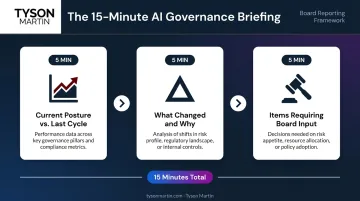
Effective AI governance briefings follow a tight structure:
- Five minutes — current posture versus last cycle
- Five minutes — what changed and why
- Five minutes — the one or two items requiring board input
Boards do not need a full technical briefing every quarter. They need a consistent, predictable signal that tells them whether the trend is acceptable and what decision is in front of them.
Framing the Ask
Management should come to the board with a defined request, not an open-ended resource conversation. Two formats that generate decisions:
- "Approve additional monitoring investment at $X for an estimated $Y reduction in exposure based on current coverage gap"
- "Acknowledge and accept the Colorado compliance gap as within appetite, with management to remediate by [date]"
Vague asks — "we need more resources for AI governance" — do not generate board action. Specific asks with exposure framing do.
The Understatement Problem
Nearly 4 in 5 CISOs report pressure to downplay the severity of cyber risks, according to Cybersecurity Dive. That pressure creates a governance failure distinct from overstating risk — it leaves directors unable to make informed decisions and strips away the evidentiary record that protects them in an inquiry.
Boards that receive sanitized reports cannot govern, and cannot defend their oversight decisions if those reports are later examined. Plain-English risk posture with what changed since last briefing is the signal that makes both possible.
Common AI Governance Mistakes Boards Make in 2026
Mistake 1 — Delegating oversight entirely. Boards that leave AI governance to the CISO or CTO without a defined reporting structure, escalation path, or committee accountability lose the ability to provide meaningful oversight. Active oversight means reviewing metrics with trend, asking whether escalation thresholds have been crossed, and holding management accountable for commitments made in prior cycles.
Receiving a briefing without interrogating it isn't governance. It's fulfilling a calendar obligation.
Mistake 2 — Tracking metrics that don't support decisions. Compliance percentages, tool counts, and incident totals are operational metrics. They tell management how to run AI programs; they do not tell boards what decisions to make.
- Operational metric: "We reviewed 134 AI tool requests this quarter."
- Decision-grade metric: "31% of material AI vendors lack a completed security evaluation, representing exposure to unreviewed data retention and breach notification terms across systems that touch customer PII."
The first describes activity. The second creates a decision.
Mistake 3 — No escalation thresholds. Without defined triggers, escalation becomes ad hoc. A usable starting structure:
- 🟡 Amber trigger: A metric trend worsening for two consecutive cycles, a near-miss incident, or a regulatory gap that has not closed since last review
- 🔴 Red trigger: A defined dollar-exposure threshold crossed, a high-risk AI system without active controls, or an incident involving regulated data
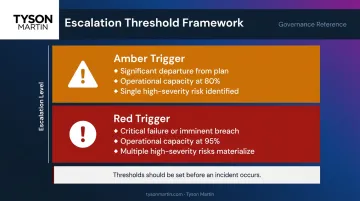
Defined thresholds protect both the board and management. When something goes wrong, the record demonstrates that governance was structured and that escalation was triggered on criteria set in advance — not improvised after the fact.
Frequently Asked Questions
What is a good AI governance framework?
A good AI governance framework defines who owns AI risk decisions, establishes a risk classification system, sets recurring review and escalation processes, and ties AI risk to enterprise risk appetite. The NIST AI RMF and EU AI Act offer useful starting structures — but both require adaptation to your organization's specific risk profile and operating context.
How do you measure AI governance?
Measure across five dimensions: AI inventory coverage, control maturity for high-risk systems, incident response readiness, regulatory compliance status, and third-party AI risk coverage. Each metric needs a defined baseline and an escalation threshold — trend comparison across cycles matters more than any single snapshot.
What is the state of AI governance in 2025 and 2026?
AI governance has shifted from voluntary best practice to enforceable obligation. The EU AI Act's general provisions apply from August 2026, and US state laws in Colorado, Illinois, and California have added sector-specific requirements. Boards now have explicit oversight responsibilities — and "we left it to IT" is no longer a defensible governance posture in an incident or regulatory inquiry.
What metrics should a board's AI risk dashboard include?
The board dashboard should present five metrics — AI inventory coverage, high-risk control maturity, incident response readiness, regulatory compliance posture, and third-party AI risk coverage — each with a current value, a trend direction, and a specific decision the board needs to make or ratify. Raw counts and status-only indicators don't support governance decisions.
How often should boards review AI governance metrics?
Quarterly board review is the standard cadence. Organizations with active or high-risk AI programs should add monthly committee-level (audit or risk) review between full board cycles. Continuous monitoring surfaced through a stable dashboard reduces the risk of material exposure accumulating undetected between formal reviews.
Who on the board should own AI governance oversight?
Ownership belongs with the audit or risk committee, with full board awareness of material issues. The specific committee matters less than documented ownership, a defined reporting relationship with the CISO or CDO, and escalation criteria that are written down and tested before they're needed.