This guide covers the legal foundation of board oversight, the core mechanisms every board should have in place, the growing challenge of technology and cyber risk, and how to build an oversight posture that holds up under scrutiny.
Key Takeaways
- The board governs; management operates. Confusing the two is a failure in either direction.
- Fiduciary duties — including the Caremark standard — create personal director liability for failing to build oversight systems, not just for bad decisions.
- Effective oversight requires formal structure: committee charters, risk appetite statements, and defined escalation thresholds.
- Cyber and technology risk is squarely board territory — and most boards lack the structure to govern it credibly.
- Boards that can't describe their top risks — or how they surfaced them — have no credible defense when things go wrong.
What Is the Board's Role as an Oversight Mechanism?
The board of directors is a collective fiduciary body. Its job is to oversee strategy, risk, compliance, and executive performance — not to execute any of those things directly. Oversight means monitoring, questioning, and holding management accountable. It does not mean managing.
The governance-management distinction matters enormously in practice:
- Management sets operating plans, hires teams, runs processes, and executes strategy
- The board approves strategic direction, monitors performance against it, and holds leadership accountable when execution misses the mark
A board that micromanages has compromised its independence. A board that rubber-stamps has abdicated its function. Both are governance failures.
Why Oversight Is Structurally Necessary
The principal-agent problem is the underlying reason boards exist. Executives and shareholders — or, in nonprofits, beneficiaries — have different incentive structures. Management has information advantages and shorter time horizons. The board's role is to ensure executives act in the organization's long-term best interest, not just their own.
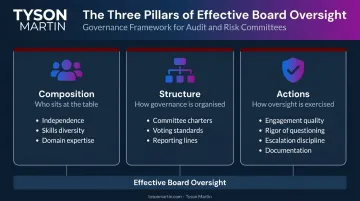
Structurally, an effective board operates across three dimensions:
- Composition — who sits on the board: independence, skills diversity, and domain expertise relevant to the organization's actual risk profile
- Structure — how the board is organized: committee charters, voting standards, reporting lines
- Actions — how the board actually behaves: engagement quality, the rigor of questioning, escalation discipline, and documentation
The accountability scope varies by organization type. Public company boards answer to shareholders. Nonprofit boards answer to beneficiaries. In regulated industries — financial services, healthcare, retail — boards also answer to regulators and the public. Each constituency adds its own standard of scrutiny, which means oversight failures carry consequences well beyond the boardroom.
The Legal Foundation: Fiduciary Duty and the Caremark Standard
Directors are fiduciaries. That's not just governance language. It carries personal legal exposure.
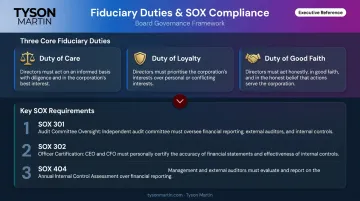
The three core duties:
- Duty of care — act as a reasonably prudent person in a similar position would, with appropriate inquiry and deliberation
- Duty of loyalty — act in the organization's interest, not personal interest; avoid conflicts
- Duty of good faith — don't consciously disregard oversight responsibilities
The Caremark Doctrine
The In re Caremark International Inc. Derivative Litigation decision (Delaware Court of Chancery, 1996) established a foundational principle: directors are personally exposed to liability not only for bad decisions, but for failing to implement a system that would surface mission-critical compliance and risk information to the board. The absence of an oversight system is itself a legal violation.
Two more recent cases illustrate how courts apply this standard:
- Marchand v. Barnhill (2019) — The Delaware Supreme Court allowed a Caremark claim to proceed against Blue Bell Creameries' board, which allegedly had no committee, no regular board process, and no protocols for monitoring food safety — a mission-critical risk for an ice cream company.
- In re Boeing (2021) — The Delaware Court of Chancery found that ad hoc management reports focused on business strategy did not substitute for a board-level safety reporting and monitoring system.
The Business Judgment Rule — and Its Limits
Courts generally protect directors from liability for good-faith business decisions that result in losses. That protection disappears when the loss stems from a structural failure to monitor. Courts won't second-guess strategy, but they will scrutinize whether a functioning oversight system existed at all. The line is between a judgment call and the absence of any oversight structure.
Key statutes that translate fiduciary principles into enforceable requirements:
- Sarbanes-Oxley Section 301 — audit committees must oversee external auditors and establish procedures for accounting complaints
- SOX Section 302 — principal officers must certify internal control effectiveness
- SOX Section 404 — annual reports must include management's assessment of internal control over financial reporting
- Sector-specific mandates from the SEC, banking regulators, and other agencies add another compliance layer for regulated industries
Core Oversight Mechanisms Every Board Should Have in Place
Governance Documents and Committee Structure
The foundation of board oversight is formal structure. That means comprehensive bylaws, clearly defined committee charters, and explicit documentation of which committee owns which oversight domain. Ambiguity about ownership is where oversight gaps form.
Core committees and their oversight domains:
| Committee | Primary Oversight Responsibility |
|---|---|
| Audit | Financial reporting accuracy, internal controls, external audit |
| Risk (or Audit/Risk combined) | Enterprise risk management, risk appetite |
| Compensation | Executive incentive structures, pay-for-performance alignment |
| Nominating/Governance | Board composition, governance practices, director succession |
Each committee must report back to the full board — committee work cannot silo. The board governs as a body; committees do the detailed work that makes full-board governance possible.
Risk Appetite and Strategic Alignment
Boards must formally define the organization's risk appetite — the level and type of risk the organization is willing to accept in pursuit of its strategy — and monitor whether management operates within those boundaries.
Most boards haven't done this. According to NC State's 2025 State of Risk Oversight report, only 35% of organizations have formally articulated risk appetite or tolerance in the context of strategic planning. Among large organizations specifically, that number drops to 29%.
That gap has practical consequences. Annual budget approval and strategic plan review are oversight tools, not administrative tasks — and when the board approves a budget, it sets the parameters within which management can act without returning for further authorization.
Performance Monitoring and the Governance Dashboard
Boards must establish measurable goals, then actively monitor progress against them. Not just receive reports — question them.
A governance dashboard should contain:
- Trend data on key risk indicators (direction matters more than point-in-time precision)
- Compliance status across regulatory obligations
- Financial performance versus budget with variance explanations
- Escalation flags requiring board attention or decision
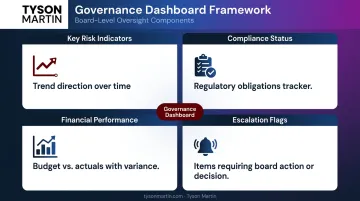
The goal is trend visibility, not data volume. A dashboard that floods directors with activity metrics but offers no decision-relevant signals has failed its governance purpose.
Complement the dashboard with a board action calendar — a documented schedule of required governance actions (committee meetings, annual disclosures, CEO evaluations, charter reviews, regulatory filings). This ensures the board never misses a governance obligation simply because no one tracked it.
Technology and Cyber Risk: The Board Oversight Gap That Creates the Most Exposure
Cyber and technology risk is no longer a technical footnote. Data breaches, ransomware, AI governance failures, and technology transformation risks carry material financial, regulatory, and reputational consequences.
The numbers establish the stakes: the global average cost of a data breach reached $4.4 million in 2025, and the Verizon 2025 Data Breach Investigations Report found ransomware present in 44% of confirmed breaches — up from 32% in the prior year.
The Expertise Gap
Most boards lack the technical depth to evaluate cyber risk independently. Most CISOs and CIOs struggle to translate technical risk into language that drives board-level decisions. That combination creates a governance blind spot: risk gets reported, but not understood or acted upon.
Board composition data makes the gap concrete. A Harvard Law School Forum study found that only 5% of mid- to large-cap companies had a cybersecurity expert on the board. Among S&P 500 directors, those with cybersecurity expertise have grown — from 13% in 2020 to 26% in 2024 — but that still leaves three-quarters of S&P 500 boards without cyber-credentialed directors.
What Meaningful Cyber Oversight Looks Like
Effective board-level cyber oversight is not a 40-slide technical briefing. It's a structured conversation focused on decisions. Tyson Martin structures board cyber briefings around five questions that translate technical exposure into governance language:
- What's most likely to hurt financial impact, uptime, or trust?
- What changed since last quarter?
- What decision does the board need to make?
- What happens if the board does nothing?
- What's the fastest path to reduce exposure?
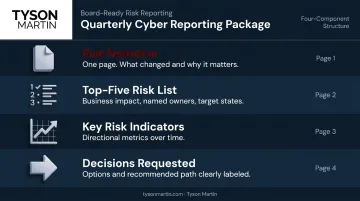
The reporting package should stay consistent across quarters:
- A one-page risk narrative showing what changed and why it matters
- A top-five risk list tied to business impact, with named owners and target states
- A stable set of key risk indicators showing direction over time
- A clearly labeled "decisions requested" section with options and a recommended path
Governance Structure for Technology Oversight
Whether through a dedicated technology committee, the audit/risk committee, or a board-level advisor, organizations need a defined channel through which technology risk reaches the board in decision-relevant form.
The SEC's 2023 cybersecurity disclosure rules formalized this requirement. Under Item 106 of Regulation S-K, public companies must annually disclose the board's oversight structure for cybersecurity risk. Item 1.05 of Form 8-K requires disclosure of material cybersecurity incidents within four business days of determining materiality.
Boards without a structured cyber oversight mechanism face two compounding exposures: the underlying risk itself, and regulatory non-compliance for failing to govern it.
Many organizations address the expertise gap by engaging a board advisor who bridges the technical and governance divide — someone who understands both the risk environment and how boards make decisions.
Tyson Martin serves that function. His work with boards covers three areas:
- Converting cybersecurity findings into business decisions boards can act on
- Building reporting architecture that shows trend and context, not technical noise
- Defining escalation thresholds before an incident — so they hold when one occurs
How Effective Boards Receive and Act on Risk Information
Information flow is the functional core of board oversight. Boards that only see what management chooses to present have compromised their oversight function before a single report is reviewed.
Designing the Reporting Structure
A credible board risk report answers specific questions in a consistent format:
- What changed since the last briefing — and why does it matter?
- What are the top risks by category (financial, operational, regulatory, technology)?
- Which decisions does the board need to make versus which are management's to handle?
- What do the trend indicators show over the past three quarters?
The stable dashboard matters more than the dense report. Boards should actively push back on updates that describe activity but offer no decision-relevant signal. Consistency across quarters is what makes trends visible. Rotating metrics each meeting destroys the comparative baseline that governance depends on.
Reporting structure also determines independence. Audit, compliance, and risk officers should have defined channels to reach relevant board committees, bypassing the CEO when necessary to preserve objectivity.
Escalation Thresholds as an Oversight Mechanism
Boards shouldn't wait for management to volunteer bad news. Formal escalation thresholds — pre-agreed criteria that trigger mandatory board notification regardless of management's own assessment — are what keep the board in the loop on the incidents that could define their tenure.
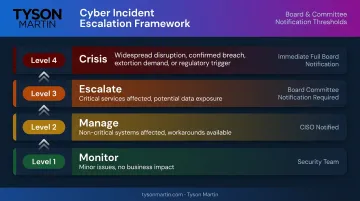
Tyson Martin structures escalation thresholds by tying triggers to business impact rather than technical severity. A concrete four-level example:
- Monitor — Minor issues, no business impact; security team handles
- Manage: Non-critical systems affected, workarounds available; CISO notified, management authority
- Escalate: Critical services affected, potential data exposure, or business unit shutdown; board committee notification required
- Crisis — Widespread disruption, confirmed sensitive data breach, extortion demand, or regulatory trigger; immediate full board notification
Pre-agreeing these thresholds before incidents occur — and testing them through tabletop exercises — eliminates the real-time debates that erode trust and slow response when an actual incident unfolds.
Common Board Oversight Failures and How to Avoid Them
The Passive Reporting Trap
The most common structural failure is over-reliance on passive reporting — where the board only reviews what management presents, with no independent inquiry and no direct access to compliance and audit functions. Boards in this posture cannot demonstrate good-faith oversight because they have no mechanism for discovering what management doesn't surface voluntarily.
Red Flag Neglect
When boards receive warning signals — audit findings, whistleblower reports, regulatory inquiries, management's own risk disclosures — and fail to demand investigation or remediation plans, they cross from oversight into abdication. Courts and regulators treat the failure to act on known red flags as conscious disregard of oversight duty. That's the clearest path to personal director liability under Caremark.
How Boards Protect Themselves
Both failure patterns share a common fix: build a record that proves the board was actually governing, not just attending meetings. Documentation is the primary protection mechanism. Board minutes must reflect active inquiry, not passive receipt of information. Silence in the minutes is evidence against the board in litigation.
Boards protect themselves through:
- Documented deliberation: minutes showing questions asked, concerns raised, and follow-up required
- Updated committee charters with clear ownership for each risk domain, reviewed annually
- Defined escalation protocols: pre-agreed thresholds that trigger mandatory board notification
- Direct reporting access for audit, compliance, and risk functions to relevant committees
The goal isn't procedural defense for its own sake. It's building the kind of governance infrastructure that surfaces the right information at the right time, so the board can exercise judgment rather than discover failures after the fact.
Frequently Asked Questions
What is the oversight function of the board of directors?
The board's oversight function is to monitor strategy execution, risk management, regulatory compliance, and executive performance on behalf of the organization's stakeholders — without running day-to-day operations. Oversight means holding management accountable through structured reporting, active questioning, and governance mechanisms that surface what the board needs to know.
Does a board of directors have a fiduciary responsibility?
Yes. Directors are fiduciaries bound by the duties of care, loyalty, and good faith. The Caremark doctrine extends this to a duty of oversight: directors can face personal liability not just for bad decisions, but for failing to implement systems that would surface mission-critical compliance and risk information to the board.
What is the difference between board oversight and management?
Management executes strategy and runs operations. The board governs — setting direction, approving key decisions, monitoring performance, and holding leadership accountable. A board that crosses into managing the business has compromised its governance independence; a board that stops questioning management has abandoned its function.
What are the key oversight committees of a board of directors?
The core committees are:
- Audit — financial integrity and internal controls
- Risk — enterprise risk management
- Compensation — executive pay and incentives
- Nominating/Governance — board composition and governance practices
Committee charters should explicitly define each committee's oversight responsibilities and reporting obligations to the full board.
How does a board oversee cybersecurity and technology risk?
Effective cyber oversight requires a defined reporting channel (through the audit/risk committee or a dedicated technology committee), plain-language reporting that surfaces what changed and what decisions are needed, and formally defined escalation thresholds for incidents. Many boards engage an independent board advisor or interim CISO to bridge the expertise gap and build reporting architecture that enables defensible governance.
What happens when a board fails in its oversight duties?
Oversight failures expose directors to shareholder derivative actions under Caremark, regulatory enforcement, and personal financial liability. Courts ask whether the board had a functioning oversight system and acted on known red flags — not simply whether a bad outcome occurred.