Introduction
Most organizations believe they're prepared for a cyberattack. The data says otherwise.
According to the 2025 Cisco Cybersecurity Readiness Index, 34% of organizations feel very confident in their cyber resilience — yet only 4% have actually reached a Mature readiness stage. That gap isn't a measurement anomaly. It's a governance failure hiding behind a feeling of readiness.
When boards and executives assume their defenses are adequate, they stop asking hard questions. Budget goes to the wrong places. Ownership stays fuzzy. When an incident happens, the organization discovers its confidence was built on assumption, not evidence.
This problem hits hardest in regulated industries — financial services, healthcare, retail — and during transitions like M&A, leadership changes, or technology modernization. In those moments, the exposure window widens and the cost of being wrong rises sharply.
A cybersecurity readiness assessment is how organizations move from assumption to evidence. This post breaks the process into four steps, structured for both security teams and the board members who need to act on what they find.
Key Takeaways
- Most organizations dramatically overestimate their cyber readiness — assessments expose the gap between perception and actual maturity
- A readiness assessment evaluates people, processes, and technology — not just technical vulnerabilities
- The 4-step framework: scope your environment → identify threats and controls → analyze and prioritize risk → build a prioritized remediation roadmap
- Outputs should include a board-ready risk summary, a prioritized gap register, and a 90-day execution plan with named owners
- Assessments aren't one-time events — they need to be revisited as your threat landscape, workforce, and regulatory environment change
What Is a Cybersecurity Readiness Assessment?
A cybersecurity readiness assessment is a systematic, evidence-based review of an organization's ability to anticipate, withstand, and recover from cyber threats. Unlike a vulnerability scan or a compliance audit — both useful, but narrow — a readiness assessment tells you whether your organization can actually manage risk under pressure.
A vulnerability scan finds technical weaknesses in specific systems. A compliance audit checks whether defined requirements are met. A readiness assessment examines the full organizational picture: governance, ownership, evidence, and follow-through.
Three Dimensions of Readiness
Every well-structured assessment evaluates readiness across three dimensions:
- People — security awareness, training, incident response roles, and whether staff can act quickly and correctly under pressure
- Processes — policies, incident response plans, third-party oversight, and whether procedures exist and are actually followed
- Technology — preventive and detective controls, monitoring capabilities, patch discipline, and access management
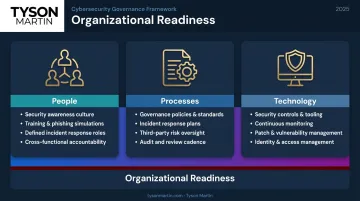
NIST CSF 2.0, published in February 2024, introduced a dedicated Govern function that frames cybersecurity as an enterprise risk management discipline — not an IT function. Readiness lives at the intersection of governance and execution, not just inside the firewall — which is precisely where boards and risk committees need visibility.
Why Organizations Can't Afford to Skip This Evaluation
The "overconfident and underprepared" posture has a direct financial consequence. According to IBM's 2025 Cost of a Data Breach Report, the average global breach cost $4.44 million — and that figure represents direct costs only. It excludes the regulatory penalties, reputational damage, and operational disruption that compound over the months following an incident.
That number understates the real exposure. When leadership believes controls are adequate, they don't pressure-test that belief. Budget goes to low-priority fixes. High-risk gaps don't get escalated. The organization finds out what it didn't know at the worst possible time.
Regulatory Defensibility Is Now Table Stakes
In regulated industries, an assessment isn't just a security exercise — it's a documentation requirement. The exposure is real:
- SEC rules (2023) require public companies to disclose their processes for assessing material cyber risks, board oversight mechanisms, and management roles
- HIPAA guidance from HHS requires ongoing risk analysis as the first step in Security Rule compliance
- FTC Safeguards Rule requires written information security programs, risk assessments, and at least annual written reporting to the board
- PCI DSS v4.x introduced targeted risk analysis requirements for payment environments
A completed assessment creates the documented evidence trail that satisfies these requirements. The absence of one creates a defensibility gap that regulators — and plaintiff attorneys — will notice.
Organizational Transitions Amplify Risk
Companies undergoing M&A activity, leadership transitions, or technology modernization face elevated exposure during the transition window itself. Ownership is unclear. Controls that worked under the old structure may not map to the new one.
Each scenario creates a distinct risk profile:
- M&A integration: Inherited systems may carry unpatched vulnerabilities, shadow IT, or access controls that don't align with the acquirer's policies
- Leadership transitions: Incoming CISOs or CIOs often inherit undocumented decisions and informal workarounds that formal controls don't reflect
- Technology modernization: Cloud migrations and platform consolidations routinely expose gaps in identity management and third-party access
An assessment during these windows provides the baseline needed to make those gaps visible — before they become incidents.
The 4-Step Cybersecurity Readiness Assessment Framework
These four steps are designed to be completed in sequence. Each builds on the last. The output of the full process should be usable by a security team on Monday morning and presentable to a board of directors the same week.
Step 1: Scope Your Environment and Inventory Your Assets
Before you can assess anything, you need to know what you're assessing.
Map all systems, data, cloud resources, network components, and third-party connections. More importantly, identify your crown jewels — the assets whose loss would most severely impact operations, compliance, or reputation. These are the systems that get prioritized in every subsequent step.
Document ownership alongside each asset category. This isn't administrative overhead — it's operationally critical. Ownership ambiguity during an incident is one of the most reliable contributors to delayed response and escalating damage.
When a breach happens, "I thought they handled that" is not an acceptable answer.
What good scoping looks like:
- Systems and data mapped by sensitivity and business criticality
- Cloud resources and SaaS applications included (not just on-premise infrastructure)
- Third-party and vendor connections documented
- Crown jewels identified with named owners and impact ratings
- Gaps in asset visibility flagged as findings in their own right
Skipping this step creates blind spots that undermine every finding that follows.
Step 2: Identify Threats, Vulnerabilities, and Existing Controls
With scope established, the next step is understanding what's threatening those assets and how well your current controls hold up against those threats.
The 2025 Verizon Data Breach Investigations Report identified the most common attack patterns organizations need to test against:
| Attack Vector | 2025 Prevalence |
|---|---|
| Human involvement | ~60% of breaches |
| Ransomware | 44% of breaches |
| Stolen credentials | 22% as initial access vector |
| Vulnerability exploitation | 20% as initial access vector |
| Third-party involvement | 30% of breaches |
| Misconfiguration/errors | 12% of breaches |
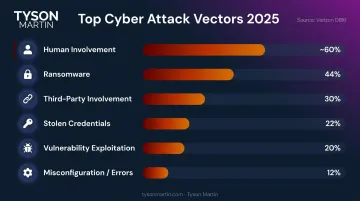
Both technical scans and policy reviews are required here. A vulnerability scan surfaces what's broken. What's missing entirely — the control that was never implemented — is often the more dangerous finding, and only a policy and governance review will catch it.
Evaluate existing controls against a recognized framework. NIST CSF, CIS Controls v8, and ISO 27001:2022 each provide structured taxonomies for mapping controls — preventive, detective, and corrective — against identified threats. The goal is to determine not just whether controls exist, but whether they're operating as intended and delivering the outcomes they were designed for.
Pay particular attention to incident response plans. Many organizations have documentation. Far fewer have tested it recently enough to trust it.
Step 3: Analyze Risk and Prioritize Gaps
Not every gap requires immediate remediation. That sounds obvious, but organizations consistently fail here by treating all findings as equally urgent — or by documenting everything without making any decisions at all.
Apply a likelihood-times-impact prioritization model, consistent with NIST SP 800-30 guidance. For each identified gap, score the probability that it gets exploited and the business impact if it does. That scoring drives a ranked risk register that gives leadership a clear view of where attention and resources belong.
Translating technical findings into business language is where most risk registers fail. Boards don't manage CVE scores — they manage business outcomes. Each priority gap should connect to a specific consequence:
- Financial loss — estimated breach cost, regulatory fine, or ransom exposure
- Operational downtime — how long critical systems would be unavailable, and what that costs per hour
- Reputational harm — customer trust, market perception, and post-incident recovery
- Regulatory exposure — which specific requirements are at risk and what the disclosure obligations are
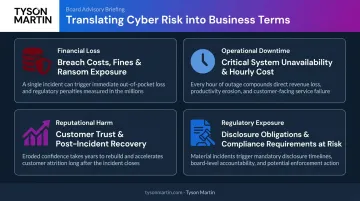
A risk register that speaks in business terms gets acted on. One that speaks only in technical terms sits on a shelf.
Step 4: Build an Actionable Improvement Roadmap
A findings report with no owners is not an output. It's a liability.
The roadmap converts findings into a structured plan: what needs to be fixed, who owns each item, what resources are required, and when completion is expected. It should include both short-term quick wins and longer-term structural improvements — with sequencing that reflects dependencies, not just priority scores.
The 90-day plan structure Tyson Martin uses with clients:
- Days 1–30: Stabilization — tighten privileged access, close MFA gaps, verify backup integrity, establish incident response roles
- Days 31–60: Alignment — translate findings into a prioritized roadmap with options, cost ranges, and board-ready plain language
- Days 61–90: Execution — move owners and milestones from planning into weekly accountability, simplify policies, begin capability building
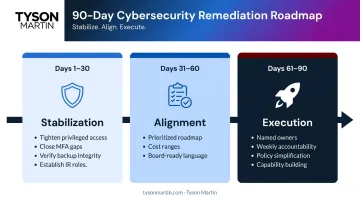
Each item in the roadmap carries a named owner, a due date, a cost range, and the proof that will confirm closure. Progress is tracked through a small set of stable metrics — not a rotating scorecard that hides trends — and reviewed on a defined cadence that keeps execution moving without creating meeting overload.
What a Completed Assessment Should Produce
A finished assessment should answer three questions that any board member or audit committee chair should be able to ask:
- What is our current exposure?
- What are we doing about it?
- How will we know it's working?
If the output can't answer all three, the assessment hasn't done its job.
The Deliverables That Matter
A board-ready assessment produces:
- Plain-English risk posture summary — top risks tied to business impact, not technical descriptions
- Prioritized gap register — ranked by likelihood and impact, with owners and target dates
- 90-day action plan — sequenced fixes with named owners, cost ranges, and proof requirements
- Decision-rights map — who accepts risk at what threshold, who approves exceptions, who declares incident severity
- Escalation thresholds — specific triggers (financial loss, downtime duration, data exposure) that clarify when decisions move from management to the board
- Draft metrics pack — a stable scorecard showing trends across prevention, detection, response, and governance
Cadence Matters As Much As Output
Those deliverables only hold value if they stay current. Findings need to be refreshed when the threat landscape shifts, when significant organizational changes occur, and at least once a year. Regulatory guidance from HIPAA, the FTC Safeguards Rule, and NIST SP 800-30 all treat ongoing assessment as a continuous governance discipline — not a project you close out and file.
How Tyson Martin Can Help
For organizations that need both the assessment and the governance structure to act on it, Tyson Martin brings an unusual combination: technical depth from leading security transformation at AWS, Home Depot, and Best Buy. That experience pairs with board-level fluency developed through active roles in the World Economic Forum's Centre for Cybersecurity and the NRF CISO Executive Committee.
His cybersecurity program assessment is structured as a focused 10-to-15 business day sprint. It produces a specific set of artifacts that leaders can immediately use:
- Decision-rights map with clear ownership
- Top risks assigned to named owners
- Control maturity snapshot
- Evidence gaps list
- 90-day action plan
- Draft board metrics
The emphasis throughout is on governance and follow-through, not a technical report that gets filed and forgotten.
When organizations need more than a one-time assessment, Tyson steps in as an interim or fractional CISO to run the 90-day roadmap, establish operating governance cadences, and build the reporting structure that keeps risk visible to the board without creating noise.
His work is deliberately independent of in-house security teams and vendors. He advises and validates rather than operating security himself, which gives boards an unfiltered view of where the program actually stands.
That independence matters most in the sectors Tyson serves: financial services, healthcare, and retail organizations where readiness assessments must satisfy both internal security goals and regulatory defensibility requirements. In those environments, documentation, evidence chains, and control narratives need to hold up under examiner review, not just internal sign-off.
Frequently Asked Questions
What is cybersecurity readiness?
Cybersecurity readiness is an organization's proactive capacity to prevent, detect, and recover from cyber threats. It covers not just tools and technology, but governance structures, people, processes, incident response capability, and organizational culture — the complete picture of how an organization manages risk, not just the technical controls.
How is a cybersecurity readiness assessment different from a cybersecurity risk assessment?
A risk assessment identifies and scores specific vulnerabilities and threats. A readiness assessment goes a level up — evaluating whether the organization has the governance maturity, incident response effectiveness, and leadership decision-making capability to actually manage those risks when they materialize.
What frameworks are typically used in a cybersecurity readiness assessment?
NIST CSF 2.0, CIS Controls v8, and ISO/IEC 27001:2022 are the most commonly applied frameworks. NIST CSF works well for executive risk framing, CIS Controls for prioritized safeguards, and ISO 27001 when the assessment needs to map to a formal information security management system. The right choice depends on your industry, regulatory environment, and current maturity level.
How often should a cybersecurity readiness assessment be conducted?
Conduct a full assessment at minimum annually, with additional reviews triggered by significant events: M&A activity, a security incident, leadership or board transitions, major technology changes, or new regulatory requirements. HHS, the FTC, and NIST all support ongoing assessment as a continuous discipline rather than a periodic checkbox.
What does a cybersecurity readiness assessment cost, and how long does it take?
Scope, organizational complexity, evidence availability, and whether you engage an external advisor all affect cost and timeline. A focused sprint-based assessment can typically be completed in 10 to 15 business days.
Who should be involved in a cybersecurity readiness assessment?
Effective assessments require input from IT and security teams, legal and compliance, executive leadership, and ideally the board or audit committee. Readiness is an organizational capability, not a technical one — and gaps in governance and ownership only surface when the right stakeholders are in the room.