NIST CSF 2.0, published in February 2024, changed that. By creating GV.SC — a dedicated Cybersecurity Supply Chain Risk Management category under the new Govern function — NIST made a deliberate statement: third-party cyber risk requires strategic oversight, not just operational controls.
This article covers what GV.SC actually requires, why it belongs on the board agenda, and what governance leaders need to do differently as a result.
Key Takeaways
- GV.SC is a new category under the Govern function in NIST CSF 2.0 — it makes supply chain risk management a strategic, enterprise-level responsibility
- It contains 10 subcategories spanning supplier identification, risk assessment, due diligence, contracts, monitoring, and incident coordination
- Senior leadership and boards must own documented oversight and accountability for third-party cyber risk
- Organizations without a C-SCRM program should treat GV.SC as a starting framework, not a compliance checkbox
- Governance infrastructure — defined policies, clear roles, and decision rights — must be in place before monitoring tools matter
Why NIST Gave Supply Chain Risk Its Own Governance Category
The Shift from Identify to Govern
In CSF 1.1, published in 2018, supply chain risk lived under the Identify function as ID.SC — five subcategories covering supplier assessment, contract requirements, and incident planning with suppliers. It existed, but without governance-level accountability attached to it.
CSF 2.0 relocated supply chain risk to the new Govern function. That's not a cosmetic change. The Govern function is where NIST placed everything that requires leadership ownership: risk strategy, policy, roles and authorities, and oversight mechanisms. Moving supply chain risk there signals that operational controls alone are not sufficient.
The Threat Landscape Made This Necessary
The timing reflects reality. Verizon's 2025 Data Breach Investigations Report found third-party involvement in 30% of all breaches analyzed — roughly double the prior year's figure. Supply chain compromise is no longer an edge case.
The SolarWinds incident illustrated the scale of the exposure. CISA confirmed in January 2021 that an advanced persistent threat actor compromised the SolarWinds Orion software supply chain, with up to 18,000 customer installations affected — including federal agencies and Fortune 500 companies. Log4Shell demonstrated a different dimension: a critical vulnerability embedded in a widely used open-source library, present in enterprise products that organizations didn't even know they were running.
Both incidents shared the same root problem: the organization had no direct control over the failure point. Technical controls on systems they didn't own couldn't close the gap. The only viable response was governance — policy, contracts, monitoring, and clear escalation paths.
Regulatory Alignment
GV.SC doesn't exist in a vacuum. Several regulatory frameworks now explicitly require what GV.SC codifies:
- SEC disclosure rules (July 2023): Public companies must describe processes for managing material risks from third-party service providers
- Financial sector interagency guidance (2023): Boards must maintain ultimate oversight of third-party risk management programs
- HHS cybersecurity performance goals: Healthcare organizations face explicit vendor and supplier risk requirements
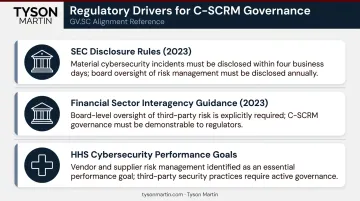
Organizations already operating under GV.SC-aligned governance can point to existing structure when regulators ask — rather than building documentation under pressure after a disclosure event.
What GV.SC Actually Requires: The 10 Subcategories in Plain Language
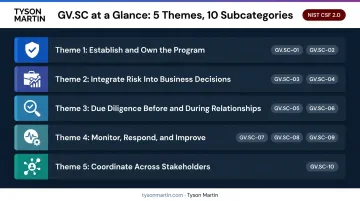
GV.SC contains 10 subcategories (GV.SC-01 through GV.SC-10). Rather than walking through each individually, the five themes below map to how executives and boards need to think about supply chain risk.
Establish and Own the Program (GV.SC-01, GV.SC-02)
GV.SC-01 requires an enterprise-wide C-SCRM program with documented policies, objectives, roles, and resources — agreed to by organizational stakeholders. This cannot live only inside the security team.
GV.SC-02 requires that cybersecurity roles and responsibilities for suppliers, customers, and partners are established, communicated, and coordinated both internally and externally. Who is accountable for what — on both sides of every supplier relationship — needs to be explicit, not assumed.
Integrate Risk Into Business Decisions (GV.SC-03, GV.SC-04)
Under GV.SC-03, C-SCRM must be integrated into enterprise risk management — not siloed as a security function. Supply chain risk belongs in the same conversation as financial, operational, and legal risk.
GV.SC-04 requires that suppliers are known and prioritized by criticality. You cannot manage risk across a supplier population you haven't inventoried and tiered. A "critical vendor list" with 120 names is an unmanaged catalog, not a tier.
Due Diligence Before and During Relationships (GV.SC-05, GV.SC-06)
These two subcategories address what must happen before a supplier relationship is formalized:
- GV.SC-05 — Cybersecurity requirements are built into contracts and agreements, not added as afterthoughts
- GV.SC-06 — Due diligence happens before the relationship starts; "we signed a BAA" or "they filled out a questionnaire" doesn't meet this standard
Pre-relationship assessment must verify that suppliers can actually meet required controls — not just attest to them.
Monitor, Respond, and Improve (GV.SC-07, GV.SC-08, GV.SC-09)
These three subcategories address the ongoing work:
- GV.SC-07 — Supplier risks are understood, recorded, prioritized, assessed, responded to, and monitored over the life of the relationship
- GV.SC-08 — Relevant suppliers are included in incident response and recovery planning
- GV.SC-09 — Supply chain security practices are integrated into enterprise risk management and monitored across the technology lifecycle
None of these are one-time activities. GV.SC expects continuous inspection, not periodic audits followed by years of silence.
Coordinate Across Stakeholders (GV.SC-10)
GV.SC-10 requires C-SCRM plans to address what happens after a supplier relationship ends: offboarding, access termination, and data handling. It also reflects the cross-functional reality that runs through the entire program.
This is where many organizations stall. Legal, procurement, IT, security, and business units all touch supplier relationships — but no single function owns the program end-to-end. GV.SC requires that cross-functional accountability be explicitly designed, not assumed.
What This Means for Boards and Executive Teams
Supply Chain Risk Belongs on the Governance Agenda
GV.SC is one of the clearest signals in any major cybersecurity framework that supply chain risk requires board-level attention — not just inclusion in the CISO's quarterly report. GV.SC expects senior leadership to set risk tolerance for third-party relationships, approve C-SCRM policy, and receive regular reporting on program status.
The NACD's 2023 Director's Handbook on Cyber-Risk Oversight reinforces this directly, with a dedicated section on supply chain and third-party risks and explicit guidance that boards should integrate cyber-risk discussions into regular meeting agendas.
What Board-Level Ownership Actually Looks Like
A board or audit committee with genuine C-SCRM oversight should be able to answer:
- Who are our most critical suppliers from a cyber risk standpoint?
- What is our escalation path if a top-tier supplier is breached?
- What cybersecurity requirements are contractually enforceable with critical suppliers?
- What does our incident response plan say about supplier involvement?
If the board cannot answer these questions on demand, the governance gap is material — not theoretical.
The Decision Rights Problem
Those questions expose a deeper structural problem. GV.SC requires that roles and authorities for supply chain risk decisions are clearly defined — yet in most organizations, no one has explicit authority to terminate a supplier relationship based on cybersecurity risk, or to enforce contract terms when a supplier fails a security assessment.
This ambiguity is exactly what GV.SC is designed to address. The governance infrastructure must answer: who accepts risk, who can override a procurement decision on security grounds, and what thresholds trigger escalation to the board?
The SEC Disclosure Connection
The SEC's rules require public companies to describe board oversight of cybersecurity risks, including third-party service providers. Boards that cannot demonstrate structured oversight of material supply chain risks face both regulatory and reputational exposure — particularly if a vendor incident triggers a disclosure obligation.
Getting ahead of that exposure requires more than a policy update. Governance teams need the right questions framed, a reporting cadence defined, and an accountability model documented before a disclosure event forces the conversation.
Tyson Martin works with boards and executive teams specifically on this translation problem — converting technical supply chain risk requirements into board-readable formats and defensible oversight structures that hold up under regulatory scrutiny.
Building Your C-SCRM Governance Program: Where to Start
Start With a Gap Assessment
Before building anything, you need to know what you already have. Work through the 10 GV.SC subcategories and ask whether your organization can document:
- A written C-SCRM program with defined roles and resources?
- A prioritized supplier inventory organized by criticality?
- Contractual cybersecurity requirements for critical suppliers?
- A defined process for ongoing supplier monitoring?
- A supplier incident response plan?
NIST's CSF 2.0 Reference Tool provides a free, structured way to work through the framework and identify gaps. For organizations that need deeper implementation guidance, NIST SP 800-161r1-upd1 covers C-SCRM program design in detail — including governance structures, roles, and assessment methods.
Tier Your Suppliers Before Anything Else
Not all suppliers carry equal risk. A practical tiering approach uses business-impact questions rather than technical complexity:
- Does this supplier have production access or admin rights?
- Do they store customer or employee sensitive data?
- Would an outage stop revenue, service delivery, or a compliance function?
- Do they process payments or handle regulated data?
Most organizations land 10 to 30 vendors in the critical tier. That's a manageable scope for intensive governance. If your critical list runs to 120 vendors, the criteria are too broad — and the tiering isn't doing its job.
Governance Infrastructure Comes First
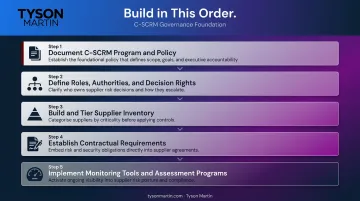
The most common mistake organizations make is investing in monitoring tools before the governance foundation exists. Without defined decision rights, escalation thresholds, and policy authority, organizations accumulate supplier data without the structure to act on it.
Build in this order:
- Document the C-SCRM program and policy
- Define roles, authorities, and decision rights
- Build the supplier inventory and tier it
- Establish contractual requirements
- Implement monitoring tools and assessment programs
How to Know If Your C-SCRM Governance Program Is Working
Observable Governance Outcomes
GV.SC expects organizations to measure and improve their C-SCRM program. A functioning program produces visible governance outcomes:
- Leadership has regular, structured visibility into supplier risk posture
- Escalation thresholds are defined and have been tested
- The board can articulate the organization's top third-party cyber risks at any point
- Supplier risk decisions have documented owners and are tracked over time
Mature governance shows up as explicit decisions with clear owners. If the answer to every risk question is "we're working on it," that's a governance gap, not a status update.
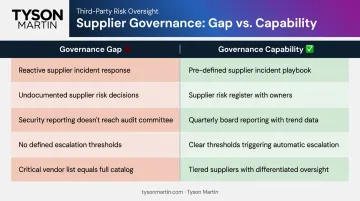
Governance Gap vs. Governance Capability
The table below separates programs that document activity from those that actually govern it:
| Governance Gap | Governance Capability |
|---|---|
| Reactive response to supplier incidents | Pre-defined supplier incident playbook |
| Undocumented supplier risk decisions | Supplier risk register with owners |
| Security reporting doesn't reach audit committee | Quarterly board reporting with trend data |
| No defined escalation thresholds | Clear thresholds that trigger escalation automatically |
| Critical vendor list = full vendor catalog | Tiered suppliers with differentiated oversight |
Metrics That Signal Program Health
Track a small, stable set of indicators quarterly:
- Critical vendor reviews completed on schedule
- High-finding remediation cycle time (and trend)
- Percentage of critical suppliers with contractual security requirements
- Supplier incidents included in tabletop exercises
Presenting these metrics in a format that boards and audit committees can actually act on requires connecting supplier risk to business services, showing trend over time, and linking scores to escalation thresholds. Tyson Martin's board advisory work is built specifically for that translation — producing third-party risk reporting designed for governance oversight, not security operations.
Frequently Asked Questions
What is GV.SC in NIST CSF 2.0?
GV.SC is the Cybersecurity Supply Chain Risk Management category under the Govern function in NIST CSF 2.0. Its 10 subcategories define how organizations should identify, assess, monitor, and improve third-party cyber risk — governed at the enterprise level, not delegated to procurement alone.
How does GV.SC differ from how CSF 1.1 handled supply chain risk?
In CSF 1.1, supply chain risk was embedded within the Identify function as ID.SC — five subcategories focused on operational controls. GV.SC elevates it to the Govern function, requiring senior leadership accountability, enterprise-wide policy, and continuous oversight rather than just procurement-level assessments.
Is NIST CSF 2.0 compliance mandatory?
NIST CSF 2.0 is voluntary for most private sector organizations but mandatory for federal agencies. Regulated industries — financial services, healthcare — face related requirements through sector-specific regulators, and alignment with CSF 2.0 signals credibility to regulators, auditors, and board-level stakeholders.
What role does the board play under GV.SC?
Under GV.SC, the board or appropriate governance committee is expected to approve C-SCRM policy, set risk tolerance for third-party relationships, and receive regular reporting on supply chain risk posture. Documented oversight with clear accountability is required, not passive awareness.
How many suppliers do we need to assess to comply with GV.SC?
GV.SC does not prescribe a specific number. It requires organizations to identify and prioritize suppliers by criticality, then calibrate assessment depth and monitoring frequency to that risk tier. Not every supplier requires the same scrutiny — proportionality matters more than volume.
Where do I start if my organization has no C-SCRM program?
Start with a self-assessment using the NIST CSF 2.0 Reference Tool against the 10 GV.SC subcategories. Then build governance infrastructure first — policy, defined roles, and a prioritized supplier inventory — before layering in monitoring tools. Organizations with limited internal resources often benefit from interim advisory support to build this foundation in a form boards can actually use and defend.