Introduction: What Your Vendors Know About You (And Why That Should Keep You Up At Night)
Most organizations spend more time negotiating coffee contracts than scrutinizing the third-party software with read access to their customer database. That imbalance has consequences.
Cybersecurity vendor due diligence isn't a security checklist. It's a governance discipline—one that sits squarely at the intersection of board accountability, regulatory exposure, and operational resilience. The organizations that treat it as a procurement formality tend to discover its importance the hard way.
That governance gap is what this guide addresses. It covers:
- What to assess before a vendor touches your environment
- How to structure the due diligence process so it scales
- Which red flags warrant deeper scrutiny—and why
- How to maintain meaningful oversight after a vendor is onboarded
It's written for boards, executives, and risk leaders who need to make defensible decisions—not just compliant ones.
Key Takeaways
- 48% of breaches now involve a third party, up from 30% the prior year—vendor risk is board-level risk
- Effective due diligence covers five distinct domains, not a single questionnaire
- Vendor tiering by risk is the foundation of a defensible, scalable process
- Contracts must include audit rights, notification SLAs, and termination provisions — security addenda alone are not sufficient
- Ongoing oversight requires continuous monitoring, not just annual renewals
Why Cybersecurity Vendor Due Diligence Can't Be an Afterthought
According to Verizon's 2026 Data Breach Investigations Report, third-party involvement reached 48% of total breaches—up from 30% the prior year. That's a 60% increase in a single reporting period.
Once a vendor is embedded in your operations, their security posture becomes part of your attack surface. Inadequate upfront due diligence creates downstream liability for the organization, its board, and in regulated industries, its regulators.
The Change Healthcare incident illustrated this precisely. Attackers used compromised credentials to access a Citrix portal that lacked multi-factor authentication, disrupting healthcare and billing systems nationwide. The vendor's control failure became everyone's operational crisis.
The Regulatory Dimension
Frameworks and regulators are increasingly holding organizations accountable for their vendors' security practices—not just their own:
- NIST CSF 2.0 (published February 2024) introduced a Govern function with explicit Cybersecurity Supply Chain Risk Management outcomes (GV.SC)
- SEC cyber disclosure rules require disclosure of material incidents even when the affected systems belong to a third party, with Form 8-K filings generally due within four business days of materiality determination
- PCI DSS v4.0 requires formal due diligence before vendor engagement and compliance monitoring at least every 12 months (Requirement 12.8)
- DORA (effective January 17, 2025) mandates ICT third-party risk management with contractual access, audit, and termination provisions for EU-facing financial entities
- HIPAA requires business associate agreements that flow down to subcontractors
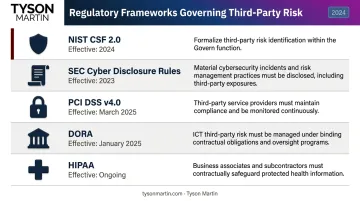
Across every framework, the governance obligation is the same: organizations are accountable for what their vendors do with their data, systems, and access—whether or not the breach originated inside their own walls.
The Core Domains to Assess in Vendor Due Diligence
Treating due diligence as a single questionnaire is one of the most common and costly mistakes organizations make. Effective vendor DD covers five distinct domains, each with different questions, evidence types, and risk tolerances.
Security Posture and Technical Controls
Assess the vendor's security architecture, patch management, encryption standards, access controls, and penetration testing cadence. On certifications:
- SOC 2 Type II — meaningful independent validation of operating effectiveness over a defined period, but scoped to a specific system and trust criteria. Always check what's included and what's carved out.
- ISO 27001:2022 — confirms an ISMS meets defined requirements, but certification applies to the declared scope only—not every product, subsidiary, or geography automatically.
- FedRAMP — useful evidence for cloud services in government contexts; relevance in commercial assessments depends on whether the service boundary matches your use case.
A three-year-old SOC 2 report that excludes the service you're actually buying provides almost no assurance. Currency and scope matter as much as the certification itself.
ISACA's 2026 guidance explicitly frames static questionnaires as a problem — recommending contextual assurance, continuous monitoring, and dynamic risk profiling instead. For high-dependency vendors, continuous external monitoring of attack surface is no longer optional.
Data Handling, Access, and Privacy
Before signing, understand:
- What data the vendor will touch, store, process, or transmit
- How they segment customer data from other clients
- What data residency or cross-border transfer restrictions apply
- Whether their subprocessors (fourth parties) have equivalent controls
This is a governance requirement, not an IT exercise. Boards and executives need to know where their data lives before they discover it during a breach notification.
Incident Response and Breach Notification
Preventive controls only go so far — how a vendor responds when those controls fail is equally consequential. Look for:
- Defined SLAs for breach notification (hours, not "promptly")
- Tested IR playbooks with documented escalation chains
- Alignment between their response timeline and your regulatory obligations
- Named contacts in their security organization, not just a generic inbox
Business Continuity and Concentration Risk
What happens to your operations if this vendor suffers a ransomware event, major outage, or exits the market? Ask whether the vendor has documented and tested BCP/DRP.
Ask, too, whether your organization has mapped the single points of failure across your entire vendor portfolio. Boards rarely see concentration risk clearly until a critical vendor goes down.
Subcontractors and Fourth-Party Risk
Vendors rarely operate in isolation. The MOVEit incident demonstrated this: Maximus disclosed that personal information of 8 to 11 million individuals was accessed after a third party exploited a vulnerability in Progress MOVEit software—a fourth-party exposure that cascaded across hundreds of organizations.
Due diligence scope must extend to understanding the vendor's own supply chain. Contractual flow-down provisions — requirements your vendor must pass down to their own subcontractors — are the primary mechanism for managing this. NIST SP 800-161 Rev. 1 and CISA's Vendor SCRM Template both support this approach explicitly.
How to Build a Vendor Due Diligence Process That Actually Holds
Start With Risk Tiering
Not every vendor warrants the same depth of scrutiny. A SaaS tool with read access to HR data carries different risk than a managed security service provider with privileged network access into your environment.
A practical tiering approach:
| Tier | Definition | DD Depth |
|---|---|---|
| Critical | Failure disrupts core operations, exposes sensitive data, or creates material compliance risk | Full assessment, independent validation, executive approval |
| High | Significant data access or operational dependency | Formal questionnaire + certification review |
| Standard | Limited data access, low operational impact | Lightweight screening |
Keep the critical vendor list small—10 to 30 vendors for board visibility. Trying to apply deep due diligence to every vendor in the portfolio produces fatigue without proportional risk reduction.
The Core DD Process Stages
- Pre-engagement screening — inherent risk rating based on data access, operational dependency, and service type
- Formal security questionnaire or assessment — structured, documented, not an email exchange
- Independent validation — certifications, audit reports, external attack surface scans for high-risk vendors
- Contractual requirements — security baseline embedded in the agreement, not a separate addendum that never gets enforced
- Internal approval with documented sign-off — clear owner, documented rationale, identified residual risks
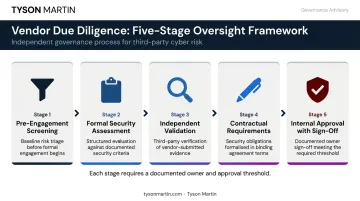
Each stage needs a clear owner and an approval threshold. The output of due diligence should be an auditable record: findings summary, residual risks, mitigating controls in place, and the business justification for proceeding.
That auditable record is only as useful as the contract behind it.
What Belongs in the Contract
Vendor contracts should include, at minimum:
- Right-to-audit clauses — DORA mandates these for critical ICT services; they're good practice regardless of jurisdiction
- Security baseline requirements — specific, not vague references to "industry standards"
- Incident notification timelines — defined in hours, aligned to your regulatory obligations
- Data return and destruction provisions — including confirmation of destruction at offboarding
- Remediation and termination rights — the ability to require fixes within a defined window and exit if they don't happen
Defining Decision Rights
Who has authority to approve a vendor at each risk tier? What triggers escalation to the CISO, general counsel, or board-level risk committee? How are exceptions documented and reviewed?
Organizations that lack a dedicated security leader often struggle here. Without pre-agreed thresholds, every high-risk vendor decision becomes a negotiation rather than an execution. Boards move faster when the rules are set in advance, not contested during the approval itself.
For organizations without a full-time CISO, engaging an interim or fractional CISO to own or validate this process for high-risk vendor decisions provides the independent judgment that procurement and legal teams aren't positioned to supply.
Two early outputs anchor that work: a one-page risk appetite statement and a one-page escalation ladder. Both define what "acceptable" looks like before the next vendor lands on someone's desk.
Red Flags That Signal a High-Risk Vendor
These aren't automatic disqualifiers. They're signals requiring deeper scrutiny and stronger contractual safeguards.
Documentation red flags:
- Cannot produce a current SOC 2 Type II report or equivalent certification
- Offers lengthy questionnaire responses but cannot produce supporting evidence (audit reports, pen test findings)
- Unable to describe their incident response process clearly when asked directly
- Security team is inaccessible or unresponsive during the DD process
Behavioral red flags:
- Resists independent audits or right-to-audit clauses in the contract
- Has experienced undisclosed breaches or security incidents
- Cannot name who leads security or who would handle a breach notification
Compliance theater is a pattern that often hides inside the behavioral category: vendors who complete detailed questionnaires with affirmative responses but cannot produce the evidence behind them. Detailed answers with no supporting documentation aren't a security posture — they're unverified assertions that transfer risk directly to your organization.
Organizational red flags:
- Security function reports to IT or engineering with no independent standing
- No dedicated security leadership at or above the director level
- High security team turnover in the past 12–18 months
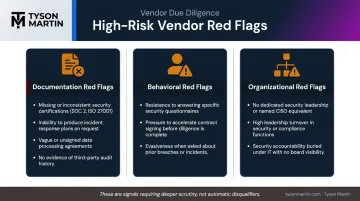
Organizational structure failures carry real legal exposure. In the SolarWinds case, the SEC alleged the company and its CISO overstated security practices and failed to disclose known risks before the SUNBURST disclosure — a governance failure with direct consequences for investors and customers alike.
Ongoing Vendor Oversight: From Onboarding to Offboarding
Due diligence is a starting point, not a finish line. The shift from point-in-time approval to continuous oversight is where most programs fall short.
Continuous Monitoring and Reassessment
Critical and high-risk vendors require formal reassessment at least annually — and more often when circumstances shift. NIST CSF 2.0 (GV.SC-07) calls for continuously monitoring suppliers through inspections, audits, and tests; PCI DSS sets a floor of annual TPSP compliance monitoring for payment-card environments.
Event-triggered reviews should follow:
- A vendor-disclosed breach or security incident
- Ownership change or acquisition
- Significant product or architecture change
- New subcontractor relationships that affect your data
Continuous external monitoring fills the gaps between formal assessments—particularly important for vendors where your visibility into their internal controls is limited.
That monitoring output only drives decisions if it reaches the right people in a usable form.
Board and Executive Reporting
Board-level vendor risk reporting should not be a catalog of every vendor and every finding. What directors need is a tiered view of:
- Concentration risk (where single-vendor failure could stop the business)
- Critical vendor security posture trends over three to four quarters
- Material changes or incidents since the last reporting period
- Open exceptions with owners and expiration dates
- Decisions requested—with options, cost ranges, and a recommended path
A stable dashboard showing trend and exposure is what enables defensible governance decisions.
Boards working with an independent cyber advisor can establish this reporting infrastructure without building a full internal security function. The framework pairs each vendor risk with impact, likelihood, and a confidence rating — so directors know when the underlying data is thin or self-reported, not just when a score turns red.
Offboarding as a Risk Event
Most organizations have rigorous onboarding processes and weak offboarding ones. That asymmetry creates lingering risk. NIST GV.SC-10 is direct on this: organizations should verify that supplier access is deactivated promptly once it's no longer needed.
Vendor offboarding requires the same rigor as onboarding:
- Data destruction confirmation (with certificate of deletion)
- Access revocation across all systems, not just primary accounts
- API key rotation
- Documentation of what data the vendor held and when access terminated
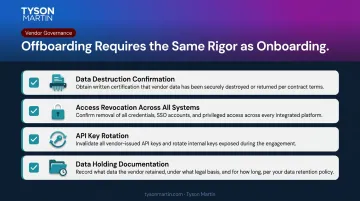
ISACA's 2024 termination guidance specifically recommends verifying physical and system access, including APIs, and securing data reacquisition or deletion with confirmed documentation.
Governance Infrastructure at Scale
Maintaining vendor oversight across a portfolio requires:
- A vendor risk register with business owners, renewal dates, access types, and last review dates
- A defined reassessment cadence with event-based triggers, not just calendar dates
- Clear ownership at both the business and security levels
- Integration with procurement and legal so security requirements are enforced at contract renewal—not just initial onboarding
When decision rights are vague, the gap shows up at the worst possible time — mid-incident, when a vendor's access scope is disputed and no one owns the call. Building that clarity into the governance structure in advance is what separates defensible oversight from reactive cleanup.
Frequently Asked Questions
What is cybersecurity vendor due diligence?
Cybersecurity vendor due diligence is the structured process of evaluating a vendor's security posture, data handling practices, and risk exposure before and during a business relationship. Treated as a governance discipline—not a one-time questionnaire—it creates documented, defensible accountability for third-party risk decisions at the executive and board level.
What is the difference between vendor due diligence and third-party risk management?
Vendor due diligence is the upfront evaluation conducted at or before the point of engagement. Third-party risk management (TPRM) is the broader, ongoing discipline of monitoring and managing vendor risk across the full relationship lifecycle—from intake through offboarding.
What certifications should a cybersecurity vendor have?
SOC 2 Type II, ISO 27001:2022, and FedRAMP (for government contexts) are the most meaningful independent certifications. Currency and scope matter as much as the credential itself—a SOC 2 report that's two years old or excludes the service you're actually purchasing provides limited assurance.
How often should cybersecurity vendors be reassessed?
Critical and high-risk vendors should be formally reassessed at least annually. Event-triggered reviews—following incidents, ownership changes, or significant product updates—should supplement the scheduled cadence. Continuous monitoring fills the gaps between formal assessments.
What should the board know about cybersecurity vendor risk?
Boards need visibility into vendor concentration risk, security posture trends, material incidents, and whether the organization has a defensible process for approving high-risk relationships. Directors should be able to name which single vendor failure could stop the business and confirm a mitigation plan exists.
What happens if a vendor fails to meet security requirements after onboarding?
Without contractual remediation provisions, organizations have limited recourse. Contracts should specify defined timelines for issue resolution, escalation paths, and clear termination rights. "The vendor committed to fix it" is not a remediation—evidence received and validated is.