Introduction
Most organizations declare victory the moment systems come back online. The incident bridge call ends, the all-clear goes out, and everyone returns to their normal workload. What happens next — or more accurately, what doesn't happen next — is where organizations stay exposed.
The same phishing vector. The same misconfigured endpoint. The same gap in escalation authority. These persist not because organizations lack talent, but because they closed the incident without ever completing the review.
A post-incident review (PIR) is the mechanism that turns a security event into lasting organizational improvement. Done well, it converts raw incident data into governance-grade intelligence that boards and executive teams can actually act on — not a compliance checkbox, not a blame session.
According to IBM's 2025 Cost of a Data Breach Report, the global average breach cost reached $4.88 million, with internally identified breaches averaging $4.18M compared to $5.08M when disclosed by an attacker. That $900,000 gap is partly a detection story — and PIR is how organizations get better at it.
Key Takeaways
- PIR is a structured retrospective conducted after a security incident to understand root cause, evaluate response, and prevent recurrence.
- Done well, it translates technical findings into board-ready insights that serve as a governance asset.
- The process covers five stages: define scope, reconstruct the timeline, identify root cause, evaluate response, and build an action plan with owners.
- PIR ≠ RCA: root cause analysis explains what broke; PIR also evaluates how the organization responded and made decisions under pressure.
- The most common failure is a report no one acts on; the goal is owner-assigned, time-bound improvements, not documentation.
What Is Post-Incident Review?
A post-incident review is a formal, retrospective process conducted after a confirmed cybersecurity or operational incident. Its purpose is to document what happened, why it happened, how the organization responded, and what must change to prevent recurrence.
This distinguishes it from real-time incident response, which focuses on containment and recovery. PIR begins where response ends.
Where PIR Sits in the Incident Lifecycle
PIR follows the recovery phase and feeds directly into the preparation phase of the next cycle. It applies at any severity level — not just major incidents — across incident types including:
- Ransomware and extortion events
- Data breaches and unauthorized access
- Insider threats and privilege misuse
- Supply chain and third-party compromises
- Operational and technology outages
Where it fits:
- Preparation → Detection → Containment → Recovery → Post-Incident Review → Stronger Preparation
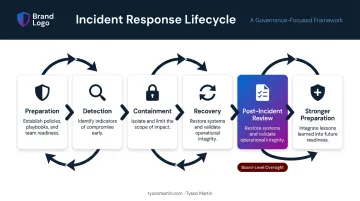
The terminology varies by industry and context. Post-incident review, postmortem, after-action review, lessons-learned report — these terms are often used interchangeably. The goal is the same: structured reflection that produces documented findings with named owners and measurable outcomes.
Why Post-Incident Review Matters for Boards and Executive Teams
Security incidents carry legal liability, regulatory exposure, reputational risk, and direct business impact — all of which boards are accountable for. A rigorous post-incident review (PIR) is how leadership demonstrates due diligence, validates the organization's response, and makes defensible decisions about future investment.
The Dwell Time Problem
Many organizations treat an incident as starting at detection. Attackers know better. According to Mandiant's M-Trends 2026 report, based on over 500,000 hours of incident investigations, the global median attacker dwell time rose to 14 days — and for nation-state and cyber espionage incidents, that number jumps to 122 days.
Organizations that skip a thorough PIR often remediate the visible symptom while leaving the original entry point intact. The ransomware gets removed. The initial phishing compromise that enabled it three weeks earlier? Still unaddressed.
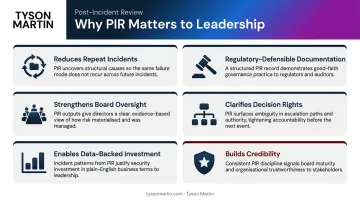
What a Rigorous PIR Delivers to Leadership
- Reduces repeat incidents from the same vulnerability or failure mode
- Provides regulatory-defensible documentation of the organization's response — regulators including HIPAA, NYDFS, PCI DSS, and the FTC all require incident documentation, root cause analysis, or post-event plan revision
- Strengthens board oversight by converting technical findings into risk posture updates
- Clarifies decision rights and escalation thresholds before the next incident demands them
- Enables data-backed investment based on actual gap evidence, not assumptions
- Builds credibility with customers, regulators, and cyber insurers by demonstrating accountability
How to Conduct a Post-Incident Review — Step by Step
The stages below reflect how PIR works in practice across enterprise environments. One common mistake worth naming upfront: organizations rush this process or run it with only technical staff, producing findings that never reach the people with authority to fund and implement the fixes.
Step 1 — Define Objectives and Scope
Before gathering any evidence, establish what the review is trying to answer:
- Was this targeted or opportunistic?
- Where did detection fail?
- Did the response plan hold under real conditions?
- Who was impacted — and by how much?
Clear objectives prevent scope creep and ensure the right stakeholders are engaged from the start. Document the incident classification (severity, type, regulatory notification requirements) so the PIR output is calibrated to what leadership actually needs — not just what the security team found interesting.
Step 2 — Reconstruct the Full Timeline
Compile a chronological account of the incident from the earliest detectable signal through detection, containment, and recovery. This must go as far back as the data allows.
Evidence sources typically include:
- SIEM logs and EDR telemetry
- Network forensics
- Ticketing and change records
- Communication logs (email, Slack, incident bridge transcripts)
- Stakeholder interviews
The interviews matter more than most teams realize. Automated logs give you a technically accurate picture — but skipping conversations with the people who made real-time decisions under stress leaves it organizationally incomplete.
The human decisions — who called whom, what information they had, what they chose to escalate — are often where the most significant gaps surface.
Step 3 — Identify Root Cause (Not Just the Trigger)
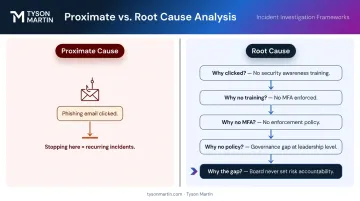
There's a distinction that gets missed in most PIRs: the difference between the proximate cause (a phishing email was clicked, a server was misconfigured) and the root cause (why that vulnerability existed and persisted — absent patch governance, no MFA enforcement, insufficient access controls).
Addressing only the proximate cause is how organizations end up back in the same incident six months later.
Apply structured methods — the 5 Whys or fault tree analysis — to push past surface-level findings. A common mistake is declaring root cause too early, before all evidence has been reviewed. That leads to incomplete fixes and a false sense of closure.
Step 4 — Evaluate Response Effectiveness
This step assesses how people, processes, and technology actually performed. Key questions:
- Were detection and escalation thresholds clear — and followed?
- Did communication reach the right people in the right sequence?
- Did the incident response plan hold, or did teams improvise around it?
- When did the board get notified, and was that timing appropriate?
Critically, this step must acknowledge what worked, not only what failed. Google's SRE postmortem culture frames blamelessness around the assumption that people acted with good intentions based on the information available at the time. Etsy's foundational work on blameless postmortems confirmed the same: non-punitive reviews produce more complete, honest accounts.
Blame-driven reviews produce self-protective ones — which means the findings that matter most never surface. That's exactly the problem a trackable action plan is designed to fix.
Step 5 — Build a Trackable Action Plan
Every finding must produce a specific, owner-assigned, time-bound action item. Not a suggestion — an item with a named owner, a deadline, and a verification checkpoint.
This is where most PIRs fail. The report gets filed. The action items die quietly.
A follow-up cadence is non-negotiable: who reviews progress, at what interval, and what happens if items slip. The PIR is only complete when the action plan has been executed and verified — not when the document has been written.
Post-Incident Review in Action — A Simplified Example
This is a composite example drawn from common patterns in enterprise cybersecurity incidents. It illustrates how PIR stages connect in practice.
The scenario: A mid-sized organization experiences a ransomware event that disrupts operations for 72 hours. Initial response contains the threat and restores systems. The PIR begins 48 hours after recovery.
Scope-setting: The team defines what's in scope (three business-critical systems, the 30-day log window, five key stakeholders to interview, two third-party vendors with system access) and what's out of scope (unaffected subsidiaries, legacy systems with no network connectivity to the incident environment).
Timeline reconstruction surfaces a 19-day gap: The initial phishing email arrived 19 days before the ransomware deployed. The first-stage compromise (a credential harvesting payload) was never flagged.
The root cause finding shifts immediately: not "ransomware was deployed," but "phishing reached a high-privilege inbox without multi-factor authentication, and the resulting credential compromise went undetected for 19 days due to insufficient correlation rules and alert fatigue in the SOC."
That's a fundamentally different remediation conversation.
Response evaluation surfaces two distinct categories:
What worked: Containment was fast once the ransomware was detected. Executive communications were clear and timely. Backup restoration proceeded without issues.
What failed: No pre-defined threshold for when to notify the board — leadership was looped in at hour 14, but the criteria for that call didn't exist in writing. No playbook for third-party vendor notification. The IR plan named roles that had changed due to recent turnover.
The resulting action plan:
| Finding | Owner | Deadline | Verification |
|---|---|---|---|
| Implement MFA on all high-privilege accounts | Director of IT | 30 days | Coverage report to CISO |
| Update correlation rules for credential misuse | SOC Lead | 21 days | Tabletop test |
| Define board notification threshold in IR plan | General Counsel + CISO | 14 days | Board committee sign-off |
| Establish vendor notification playbook | Legal + Vendor Risk | 45 days | Document review |
| Update IR plan with current role assignments | IR Lead | 7 days | Verified roster |
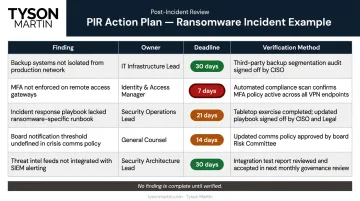
No vague recommendations. No "consider implementing." Named owners, hard dates, and a defined check.
How Tyson Martin Can Help
For many organizations, the PIR process fails not because of technical limitations but because of governance structure: unclear decision rights, no pre-defined escalation thresholds, and board reporting that describes what happened without enabling defensible decisions about what to do next.
Tyson Martin works with boards, audit and risk committees, and executive teams to close that gap. His background leading security and technology transformation at AWS, Home Depot, and Best Buy includes building incident response protocols that created board-level confidence in operational resilience. That experience spans environments where stakeholders range from the SOC to the boardroom.
His engagement model fits two common post-incident scenarios:
Interim or fractional CISO post-incident: When a breach leaves an organization without steady leadership, Tyson steps in to run the command structure, direct forensics, preserve evidence, coordinate communications, and lead the post-incident review. By day 30, the engagement produces a named-role incident response plan with escalation rules and a PIR output — root cause, control gaps, funded remediation — formatted for executive and board review.
Board advisor reviewing PIR outputs: For audit and risk committees receiving PIR reports from management or an MSSP, Tyson provides an independent assessment of whether the output is credible, complete, and actionable — translating technical findings into risk posture language and surfacing gaps in coverage, accountability, or follow-through.
Organizations in transition — new security leadership, post-acquisition, regulatory scrutiny, or a recent incident — typically find the governance gaps Tyson identifies were present long before anything went wrong. Decision rights were never documented. Escalation thresholds were assumed, not written. PIR is the moment those gaps become undeniable.
Conclusion
A post-incident review is not the final step in closing an incident. It's the first step in building a stronger response to the next one.
The report itself has no value unless it produces measurable, tracked improvements — the MFA coverage that actually gets deployed, the escalation threshold written into the IR plan, the board notification criteria that exists before the next crisis demands it.
Organizations that treat PIR as a governance discipline — not a one-time exercise — build the inspectable execution frameworks that allow boards to provide meaningful oversight.
That process itself should be reviewed and refined after every significant incident, and tested through tabletops so that roles, evidence-gathering protocols, and escalation paths are understood before pressure makes them mandatory.
Boards that ask the right questions after an incident — and verify that answers produce concrete action — are the ones positioned to govern through the next one with credibility and confidence.
Frequently Asked Questions
What are the steps of the incident response lifecycle?
NIST SP 800-61 Rev. 2 defined a four-phase lifecycle: Preparation; Detection and Analysis; Containment, Eradication, and Recovery; and Post-Incident Activity. The current Rev. 3 (released April 2025) realigns those phases to the NIST CSF 2.0 functions: Govern, Identify, Protect, Detect, Respond, and Recover. Post-incident review sits within Post-Incident Activity — the phase where experience becomes improved preparedness.
What is the difference between PIR and RCA?
Root cause analysis (RCA) focuses on identifying the underlying cause of a failure or breach. A post-incident review is broader — it evaluates root cause but also assesses how the organization detected the incident, responded, communicated, and recovered. PIR produces a complete picture that informs governance and decision-making, not just technical remediation.
When should a post-incident review be conducted?
Initiate PIR within 24–72 hours of recovery while evidence and memory are still intact, with a structured review meeting typically within one to two weeks. Define triggering criteria in advance — any significant incident, regulated event, or board-level impact should automatically require a PIR.
Who should lead a post-incident review?
PIR should be led by a designated owner — typically the CISO, incident commander, or a senior security leader — with cross-functional participants from IT, legal, communications, and relevant business units. The lead must have authority to assign and track action items, not merely record them.
What are the key components of a PIR report?
A complete PIR report includes: incident summary and timeline, root cause findings, business impact assessment, evaluation of response effectiveness (what worked and what didn't), and a tracked action plan with named owners, deadlines, and verification checkpoints. Board-level outputs should include a one-page executive summary with technical detail in an appendix.
How does post-incident review support regulatory compliance?
Regulators including HIPAA, NYDFS, PCI DSS v4.0.1, GDPR, and the FTC Safeguards Rule each require some form of incident documentation, root cause analysis, or post-event plan revision — though few use the term "PIR" directly. A well-structured PIR produces exactly what these frameworks demand: documented facts, response decisions, corrective actions, and evidence of follow-through.