
Poor board communication at this intersection isn't just a presentation problem. It creates blind spots. Decisions get delayed. Risk gets reported but not governed. And when something goes wrong — an incident, a regulatory inquiry, an M&A diligence process — those blind spots become visible at the worst possible moment.
Only 32% of board members are completely satisfied with the cybersecurity information management provides, according to PwC. That's not a technology problem. That's a communication problem.
This post outlines five practical strategies that technology and risk executives can apply to make board interactions count — fewer surprises, faster escalation, cleaner communication.
Key Takeaways
- Risk and strategy must be translated into decision language — boards can't govern what they can't interpret
- A stable, trend-based dashboard is more useful than incident-level detail or rotating metrics
- Escalation thresholds must be defined and board-approved before a crisis hits
- Board composition varies widely, so content must be calibrated to the room rather than a standard template
- Board trust is built between meetings, not just during them
Why Board Communications Break Down — and What's at Stake
There's a fundamental mismatch between how management operates and how boards function. Management teams work at operational depth — they know the threat landscape, the control gaps, the tool stack. Boards operate at strategic altitude, responsible for governance rather than execution.
When communications don't bridge that gap, one of two things happens: boards rubber-stamp decisions they don't fully understand, or they micromanage areas where they have no mandate. Either failure carries real cost.
- Delayed investment decisions on risk programs because the board doesn't understand what's actually at stake
- Misaligned expectations during incidents, when escalation paths aren't clear and management and the board are working from different playbooks
- Governance gaps that surface during regulatory reviews or M&A diligence — often at the worst possible moment
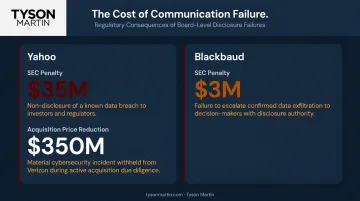
Yahoo's situation illustrates the cost clearly. After failing to disclose a material breach, Yahoo agreed to a $35M SEC penalty, and Verizon ultimately reduced its acquisition price by $350M. More recently, Blackbaud paid $3M after personnel failed to communicate data exfiltration to senior management responsible for public disclosures. These aren't edge cases — they're the predictable outcome of communication frameworks that weren't built to work under pressure.
The five strategies below are designed to close that gap — by building the structure, language, and cadence that board communication requires to hold up when it matters most.
5 Strategies for Building Strong Board Communications
These strategies apply whether you're a CISO, CIO, or general counsel. The goal is the same: clear oversight, credible reporting, and defensible decisions.
Strategy 1: Translate Technology and Cyber Risk Into Business Language
Boards are not technology operators. They need to understand what a risk means for the business — for revenue, reputation, regulatory exposure, operational continuity — not how a vulnerability was discovered or how a control technically functions.
NACD is direct on this point: board-level metrics should focus on strategic indicators of enterprise cyber risk, not operational metrics. Management is responsible for doing the translation. If the translation doesn't happen before the meeting, directors are forced to do it themselves — and most won't.
A practical three-question framework:
Every board update should answer:
- What is the current risk posture?
- What changed since the last briefing?
- What decision or resource does management need from the board?
That structure keeps communication strategic. It avoids drowning directors in operational detail while still giving them what they need to govern.
The most common mistake: Leading with technology outputs. Vulnerability scan counts, SOC alert volumes, patch percentages — these metrics describe system activity, not business exposure. A blocked-attack count doesn't tell the board whether those attempts would have caused a disruption, a compliance violation, or a reputational loss.
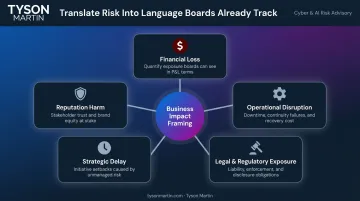
Instead, frame findings using business impact lenses boards already track:
- Financial loss
- Operational disruption
- Legal and regulatory exposure
- Strategic delay
- Reputation harm
For example: instead of "identity controls are weak in the cloud admin layer," say "a compromised admin account could disrupt core systems, delay customer orders, and increase legal exposure if sensitive data is touched." Same finding — completely different decision-making utility.
Building this translation capability is a core part of what Tyson Martin develops with technology executives in advisory engagements. The output is a plain-English risk narrative that tells the board what it needs to know, without the noise that causes directors to disengage over time.
Strategy 2: Build a Stable, Trend-Focused Reporting Dashboard
When the reporting format changes every meeting, directors spend cognitive energy orienting to a new structure rather than analyzing the content. Format stability is itself a governance asset: it's what allows boards to spot drift, track direction, and ask sharper questions over time.
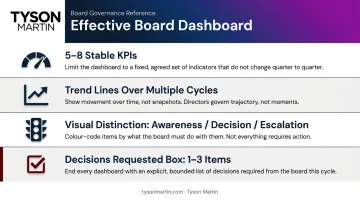
What a board-ready dashboard should include:
- 5–8 stable KPIs tied to risk appetite thresholds the board has approved — not operational metrics
- Trend lines showing direction over multiple cycles, not point-in-time snapshots
- Clear visual distinction between items for awareness, items for decision, and items requiring escalation
- A "decisions requested" box with 1–3 items, each presenting options, cost ranges, and a recommended path
NIST CSF 2.0's Organizational Profiles offer a useful structural model here — comparing current posture to target posture, with gaps and decisions required. That's the same logic a well-designed board dashboard should follow.
Avoiding the trivia trap:
Cramming dashboards with low-signal metrics to demonstrate activity is one of the most common board reporting failures. Blocked attack counts, patch totals, and alert volume usually tell you more about system activity than business exposure. If a metric can't drive a decision, allocate budget, or trigger action, it belongs in management reporting — not the board package.
The goal is a format that can be scanned in three minutes: one page, trend lines, three short sections — top risks, what changed, and decisions needed. A single month can mislead; a three-month trend tells you whether risk is improving, stable, or deteriorating.
When metrics are tied to board-approved thresholds and presented with trend context every cycle, oversight becomes calmer and sharper. Directors stop asking "what does this mean?" and start asking "what do we do about it?"
Strategy 3: Clarify Decision Rights and Escalation Thresholds Before You Need Them
In a crisis, boards and management frequently stall — not because no one is working the problem, but because no one agreed in advance who decides what. Defining decision rights and escalation thresholds before they're needed is the structural condition for a board that governs rather than reacts.
What automatic board notification triggers look like in practice:
- Customer-facing service down for more than 4 hours, or any critical system down for more than 8 hours
- Confirmed or suspected breach of regulated data (PII, payment data, health records)
- Potential financial loss exceeding a defined threshold (for example, $500K or 1% of quarterly revenue)
- Any incident requiring disclosure under SEC rules, GDPR, or other material obligations
- Ransom or extortion demands
- Third occurrence of the same root cause within 90 days
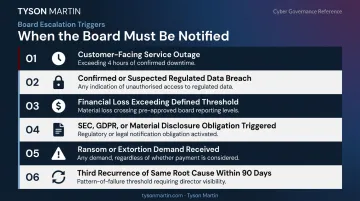
These thresholds should be measurable and unambiguous. The goal is to eliminate debate about when the board must be engaged. That debate should happen in a workshop, not at 2 a.m. during an active incident.
The SEC has made this a compliance requirement, not just a governance preference. The SEC's 2023 cybersecurity disclosure rules require registrants to report material incidents within four business days of determining materiality. Harvard Law School Forum's analysis of the rule notes that intentionally deferring a committee meeting to avoid a timely determination may itself constitute unreasonable delay.
First American paid $487,616 after the SEC found its disclosure controls failed to route relevant cybersecurity information to decision-makers. The control failure wasn't technical — it was structural.
Making the framework inspectable:
The escalation framework shouldn't just exist on paper. Boards should be able to ask: Show me the last three times a threshold was triggered — what happened, who was notified, and how long did escalation take? That question makes governance visible and verifiable. When boards know management has a working escalation framework, they can exercise oversight without drifting into operational territory.
Strategy 4: Know Your Board's Composition and Calibrate Communication Accordingly
Directors bring backgrounds in finance, operations, law, technology, and industry. The same presentation lands very differently depending on who's in the room, and failure to account for that erodes credibility over time.
According to Spencer Stuart's 2024 U.S. Board Index, 19% of new S&P 500 directors came from technology or telecommunications — the largest single industry background category. Among directors aged 50 or under, that figure was 29%. Boards are becoming more technically fluent, but the variation within any given board remains significant.
Practical preparation steps before any board presentation:
- Review director backgrounds using proxy filings and committee assignments — identify who has technology or security fluency, who will focus on financial or liability exposure, and who will track regulatory risk
- Frame the same core message to surface what matters to each lens — the underlying content doesn't change, but the emphasis should
- Note who isn't in the room — full board sessions and committee sessions require different calibration
Using committee structure as a communication strategy:
Audit and risk committees typically have deeper appetite for technical depth than the full board. Reserve committee sessions for detailed control reviews, vulnerability management specifics, patch exception registers, and quarterly deep dives on specific themes (identity, recovery, vendor exposure). Bring to the full board only what requires material decisions: risk appetite thresholds, major technology investments, material incidents, or vendor concentration risk that could stop the business.
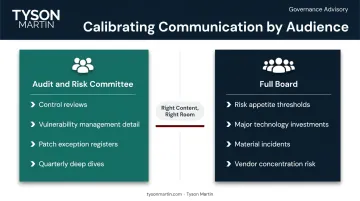
This split prevents the full board from becoming an operating review while ensuring committees have the depth they need to do their job. When the division is unclear, committees either duplicate full board work or leave oversight gaps.
Strategy 5: Continue the Conversation Between Meetings
Board trust is built over time — and most of that time happens between meetings. Executives who surface relevant developments (regulatory changes, industry incidents, emerging risks) outside formal meeting cycles demonstrate reliability and reduce the chance the board is blindsided when something matters.
Low-friction touchpoints that work:
- Monthly written update to the committee chair — two to three paragraphs covering what changed, any emerging risks, and open decisions. Short enough to actually be read.
- Pre-meeting alignment call — understand what's top of mind before walking into the room. This changes the dynamic from presenting to advising.
- 24-hour written recap after every meeting — decisions made, top risks with owners, and actions with due dates and measurable outcomes.
As Tyson Martin puts it: the meeting isn't where trust is won. Trust is won in what happens after. When follow-up is consistent, directors stop fearing surprises and start trusting your direction.
The cycle-only trap:
Executives who only communicate at scheduled board meetings train directors to see them as a quarterly event rather than a strategic resource. That positioning costs real currency when it matters most. Boards that trust their technology and risk executives give them more time, more budget, and more latitude during incidents and major transitions — because they've seen evidence of reliability between the meetings, not just during them.
NACD recommends sustained, structured engagement because boards cannot oversee technology and cyber risk effectively if the only interactions happen during annual presentations or after a crisis.
Conclusion
Strong board communications are not about presenting more. They're about communicating the right things in the right structure, with the right context, so boards can govern rather than guess.
The five strategies in this post build that scaffolding: translating risk into business language, stabilizing the reporting format, defining escalation before you need it, calibrating to the room, and maintaining the relationship between meetings. None require a complete overhaul. All require deliberate design.
Board communication quality should be assessed regularly. If directors are asking operational questions that belong to management, escalation pathways are unclear, or reporting formats change every cycle, those are signals the framework needs a reset.
For boards and executive teams that want to build this capacity, Tyson Martin works with organizations as a board advisor and interim or fractional CISO — establishing the governance structure, reporting cadence, and decision-rights clarity that make board communications work. Under normal conditions and under pressure. Connect on LinkedIn or reach out directly to start the conversation.
Frequently Asked Questions
What are the 7 C's of communication?
The 7 C's are clarity, conciseness, concreteness, correctness, coherence, completeness, and courtesy. In board reporting, clarity and conciseness carry the most weight — directors need to extract the key decision from a brief update, not parse through dense technical content to find it.
How often should a CISO or CIO present to the board?
Quarterly updates to the full board represent standard practice, with more frequent engagement at the audit or risk committee level. During incidents, significant technology transitions, or elevated risk periods, that cadence should compress to monthly — or more often.
What should be included in a board update on cybersecurity or technology risk?
Cover four things: current risk posture, what changed since the last briefing, any threshold-level incidents or emerging risks, and the specific decisions or resources management needs from the board. Keep the focus on what the board needs to decide — not what management needs to track.
How do you explain technical risk to a non-technical board?
Translate the technical finding into business terms — what could it cost, disrupt, or delay? Avoid jargon, use ranges instead of false precision, and map findings to the board's existing risk appetite framework so directors can rank risks in terms they already use.
What is the right length for a board presentation?
Aim to speak for no more than one-third of the allotted time and leave the remainder for Q&A and discussion. Pre-read materials should be a crisp executive summary with supporting detail in an appendix — not an exhaustive slide deck that crowds out the conversation.
How does a new CISO or CIO establish credibility with the board quickly?
Reach out to committee chairs one-on-one before the first formal presentation, and demonstrate command of the organization's current risk posture from day one. Follow up after early sessions to ask for feedback. Show up with a 90-day plan that has named owners and measurable outcomes — not broad aspirational goals.