This post covers what these eight additions reveal about the current threat environment, why the update matters beyond your IT team, and how executives and boards can respond without drowning in CVE numbers.
One piece of context worth holding: CISA is operating under significant resource pressure. The FY 2026 budget justification requests 1,083 fewer positions and $494.67M less in funding than the prior year. A leaner agency making fewer public signals means the signals it does send deserve more attention, not less.
Key Takeaways
- The eight-CVE batch (dated 2026-04-20) targets network management, collaboration, CI/CD, and endpoint systems — all enterprise infrastructure.
- Three of the eight affect Cisco Catalyst SD-WAN Manager, which CISA separately issued an Emergency Directive to address.
- "Active exploitation" means confirmed real-world attacks. Not theoretical risk.
- BOD 22-01 mandates remediation for federal agencies; private-sector organizations should treat its timelines as a reasonable-care benchmark.
- Boards need defined escalation thresholds before an incident forces the question.
What the CISA KEV Catalog Is and Why It Exists
The Known Exploited Vulnerabilities Catalog is CISA's authoritative list of CVEs with confirmed evidence of active exploitation in the wild. Not theoretical risks. Not proof-of-concept research. Flaws that attackers are actively using.
The catalog currently contains 1,601 entries (as of version 2026.05.21).
Binding Operational Directive 22-01 makes remediation mandatory for Federal Civilian Executive Branch agencies, with deadlines typically set at two weeks for newly added vulnerabilities.
For private-sector organizations, the KEV catalog functions as the clearest public baseline for vulnerability prioritization — three things make it worth building into your process:
- Confirmed exploitation: Every entry reflects a flaw attackers are actively using, not theoretical exposure
- Federal remediation deadlines: BOD 22-01 sets a two-week clock for federal agencies, signaling how urgently CISA views each addition
- Private-sector relevance: CISA explicitly recommends the catalog as a prioritization baseline for all organizations, not just government
The catalog is the U.S. government's most direct public signal about where adversaries are operating right now. For any organization, it is the logical starting point for prioritization — not a compliance checkbox reserved for federal agencies.
What the Eight Vulnerabilities Reveal About Today's Threat Landscape
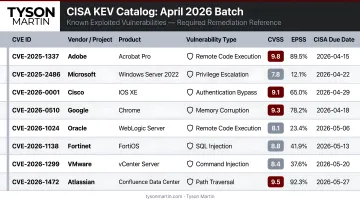
The most recent verified eight-CVE batch was added on 2026-04-20. Here is what was included:
| CVE | Vendor / Product | Vulnerability Type | Federal Due Date |
|---|---|---|---|
| CVE-2026-20122 | Cisco Catalyst SD-WAN Manager | Incorrect use of privileged APIs | 2026-04-23 |
| CVE-2026-20133 | Cisco Catalyst SD-WAN Manager | Exposure of sensitive information | 2026-04-23 |
| CVE-2026-20128 | Cisco Catalyst SD-WAN Manager | Passwords stored in recoverable format | 2026-04-23 |
| CVE-2025-2749 | Kentico Xperience | Path traversal | 2026-05-04 |
| CVE-2023-27351 | PaperCut NG/MF | Improper authentication | 2026-05-04 |
| CVE-2025-48700 | Synacor Zimbra Collaboration Suite | Cross-site scripting | 2026-04-23 |
| CVE-2025-32975 | Quest KACE Systems Management Appliance | Improper authentication | 2026-05-04 |
| CVE-2024-27199 | JetBrains TeamCity | Relative path traversal | 2026-05-04 |
What the Pattern Tells You
Three of the eight CVEs hit Cisco Catalyst SD-WAN Manager — the system that manages how traffic flows across your wide-area network. CISA considered this serious enough to issue a separate Emergency Directive (ED 26-03) specifically for Cisco SD-WAN exploitation. CISA issues Emergency Directives sparingly, typically only when exploitation poses immediate, systemic risk.
The remaining five touch systems that most mid-to-large enterprises run: print management (PaperCut), email and collaboration (Zimbra), endpoint management (Quest KACE), CI/CD pipelines (JetBrains TeamCity), and web content platforms (Kentico). This is not a consumer-software problem. These are the operational systems that keep businesses running.
Two of the eight — PaperCut and JetBrains TeamCity — are flagged as known ransomware vectors. Ransomware exposure is a business continuity conversation, not just a security team problem.
What "Active Exploitation" Actually Means
CISA's inclusion criteria require confirmed evidence that threat actors are using a vulnerability in real attacks. By the time a CVE appears on the KEV list, attacks are already underway. The only open question is whether your organization is in the target set.
The broader threat context reinforces the urgency. CISA and FBI advisories name PRC state-sponsored group Volt Typhoon as actively compromising U.S. critical infrastructure across energy, communications, transportation, and water sectors. A separate CISA advisory identifies Iran-based actors enabling ransomware attacks against U.S. organizations.
Both groups follow the same playbook: exploit known vulnerabilities in enterprise infrastructure. Every CVE in this batch fits that description.
Why Boards and Executives Should Pay Attention
A KEV catalog addition shifts the risk conversation from "potential" to "confirmed." Once a vulnerability appears on the list, any organization running the affected system cannot treat remediation as low-priority without accepting a documented rationale for the delay.
The Governance Gap Most Organizations Have
Most organizations have no defined decision rights around KEV escalation. When a new entry appears, it stays inside IT operations — and the board remains uninformed until something breaks.
The governance breakdowns Tyson Martin encounters most often when beginning work with a new board or executive team include:
- No named owner for who accepts vulnerability risk versus who executes the fix
- No escalation thresholds that distinguish IT-level response from executive notification
- Fragmented security ownership — IT, legal, product, and risk all touch the decision, but nobody can break ties
- Exception management by email — temporary workarounds with no expiry dates become permanent operating models
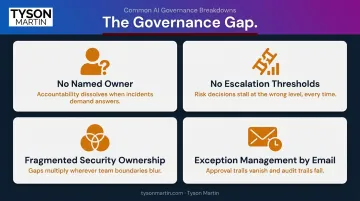
These are not technical problems. They are leadership and governance problems.
The Regulatory and Liability Dimension
The FTC's warning on Log4j and similar known vulnerabilities is explicit: the agency intends to use its legal authority against companies that fail to take reasonable steps to protect consumer data from known vulnerabilities. The Equifax case sits behind that warning as the reference point: a failure to patch a known vulnerability exposed the personal information of 147 million people.
For organizations in financial services, healthcare, and retail, the stakes are higher still. The OCC's 2025 cybersecurity resilience report notes that threat actors continue to exploit publicly known software vulnerabilities and weak authentication at banks. CIRCIA will require covered critical infrastructure entities to report cyber incidents within 72 hours after implementing regulations take effect.
The exploitation window is the concept executives need to internalize. The period between a CVE's appearance on the KEV catalog and an organization completing remediation is the highest-risk interval. Speed of response determines whether an incident occurs — that's not a technical detail to delegate indefinitely.
That's where governance structure matters. Tyson Martin's board advisory and fractional CISO work focuses on building escalation thresholds that define when the board gets briefed, by whom, and with what information — so the right people are making decisions before the window closes, not after.
How to Build a Board-Ready Response to KEV Updates
A functional response operates across three layers:
- Operational — IT and security teams validate whether the organization runs the affected system and execute remediation or compensating controls
- Governance — defined escalation thresholds determine who gets notified, when, and through what channel
- Executive — the board or audit committee receives a plain-English briefing on business impact, not CVE taxonomy
What Clean Escalation Thresholds Look Like
Not every KEV addition warrants a board conversation. But the following questions should trigger a structured notification chain with defined owners and timelines:
- Does your organization run the affected system?
- Is the affected system customer-facing or mission-critical?
- Is the vulnerability flagged as a known ransomware vector?
- Has the vendor released a patch, and is it deployable within the federal deadline?
If the answer to the first two is yes and a patch is not immediately available, that is an executive-level conversation — not something to wait on.
What a Board-Ready Briefing Contains
Effective board reporting on KEV-related risk starts with what the board needs to decide, then works backward. That means covering:
- What is at risk — in plain English, naming the system and the business function it supports
- What the exposure means — revenue, operations, customer data, regulatory obligation, or some combination
- What action is underway — patch, compensating control, or accepted risk with a documented rationale
- Who owns it — a named person, not a team
- By when — a specific date, not "soon"
Technical severity scores belong in the appendix. The board briefing covers decisions, exposure, and dates.
KEV Monitoring as a Standing Practice
KEV catalog updates should be built into regular vulnerability management cycles — not triggered by news coverage or an incident. A practical cadence:
- Weekly security execution check-in: catches newly added CVEs and validates exposure
- Monthly risk review: surfaces KEV-related items that need exception documentation or escalation
- Quarterly board report: includes trend data on open KEV items, remediation timelines met or missed, and any accepted risks with owner names and expiry dates
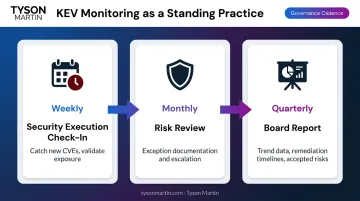
Organizations that embed this cadence into their governance rhythm can respond before the exploitation window closes. Those operating without it face a harder question when the board asks: how long were we exposed, and why didn't we know sooner?
Frequently Asked Questions
What are CISA alerts and advisories?
CISA alerts and advisories are official communications warning organizations about active cyber threats, vulnerabilities, and recommended mitigations. The KEV catalog is among CISA's most actionable tools: it flags vulnerabilities with confirmed exploitation (not theoretical risk) and sets specific remediation deadlines for federal agencies.
What is the current cyber alert level?
Check CISA's cybersecurity advisories page for current alert status. The addition of eight vulnerabilities to the KEV catalog, including three Cisco SD-WAN entries that triggered a separate Emergency Directive, signals an elevated threat environment with active exploitation of enterprise infrastructure.
What are the biggest cybersecurity issues heading into 2026?
Four issues dominate the near-term landscape:
- Nation-state campaigns from China and Iran targeting critical infrastructure
- Ransomware against enterprise and regulated-sector organizations
- Unpatched known exploited vulnerabilities in widely deployed systems
- Governance gaps as CISA navigates serious staffing and resource constraints
What is the current status of CISA?
CISA is under real resource pressure — the FY 2026 budget request cuts over 1,000 positions and nearly $495M compared to the prior year. The agency continues publishing actionable guidance, including KEV updates, but organizations should act on those signals without assuming federal support capacity is growing.
What are the main types of cybersecurity threats?
The primary categories are:
- Exploitation of known software vulnerabilities (the KEV catalog's core focus)
- Ransomware and extortion
- Phishing and social engineering
- Nation-state espionage and pre-positioning
- Supply chain compromise
KEV-listed vulnerabilities are a frequent initial entry point for both ransomware and nation-state intrusions.
What are the new cybersecurity threats entering 2026?
Several trends are gaining traction: AI-assisted attack techniques, Iranian and Chinese campaigns targeting operational technology, and exploitation of network edge devices and cloud-connected management platforms. The growing abuse of legitimate remote management tools as attack vectors is also accelerating — and several of these patterns appear directly in this KEV batch.