
Introduction
Security teams speak in CVEs, control gaps, and technical scores. Boards make funding decisions, set risk appetite, and answer to regulators. Those two conversations rarely meet cleanly — and the gap costs organizations in governance failures, surprise incidents, and missed escalations.
According to NACD's 2026 cyber-risk handbook, 37% of public company directors identify improving the board-CISO relationship as very or extremely important. That gap is structural, not personal. Information security maturity models are one of the most effective tools for closing it — by giving boards and executives structured benchmarks that show where the security program stands today, what's missing, and what a credible improvement path looks like in plain English, not raw technical data.
This post covers what maturity models are, the five common levels, the leading frameworks, how cybersecurity and information security models differ, and how boards should actually use maturity assessments to govern with real accountability, not just satisfy a compliance requirement.
Key Takeaways
- Information security maturity models measure how reliably an organization manages information risk, from ad-hoc processes to continuously improving ones.
- Five levels: Initial, Repeatable, Defined, Managed, Optimizing — each describes a progressively more reliable and measurable security program.
- Four frameworks dominate: NIST CSF 2.0 (flexible), CMMC 2.0 (DoD contractors), C2M2 (critical infrastructure), ISO 27001 (international/regulated).
- Cybersecurity maturity models cover broad digital risk, while information security models focus specifically on protecting data confidentiality, integrity, and availability.
- Boards should use maturity assessments to track trend, set escalation thresholds, and make defensible funding decisions, not to audit technical scores.
What Is an Information Security Maturity Model?
A security maturity model is a structured set of practices, processes, and benchmarks that describe how well an organization manages information risk. At the low end: ad-hoc, reactive, dependent on individual effort. At the high end, the program is proactive, continuously improving, and fully inspectable by leadership.
The concept traces to Carnegie Mellon's Capability Maturity Model, which defines maturity as a progression from undocumented processes to quantitatively managed and continuously improving ones. Security frameworks applied that logic directly to information risk.
What a Maturity Model Actually Does
The practical value is removing guesswork from security planning. A maturity model provides:
- A consistent baseline for measuring where you stand today
- A gap map showing what controls exist versus what's missing or inconsistent
- A prioritization tool for deciding where to invest next
- A governance language that lets leadership discuss risk posture without parsing technical data
What a Maturity Model Is Not
That list of capabilities is easy to conflate with compliance work — but the two are different. A maturity model is not:
- A one-time audit or annual compliance exercise
- A certification in itself
- Proof that an organization is secure
- A substitute for incident response planning
The model is an ongoing management tool — one that tells an organization whether controls operate reliably and consistently, not just whether they exist on paper. The goal, as Tyson Martin frames it for board audiences, is to answer three questions without forcing directors to translate jargon: Are you reducing real risk? Can you prove it? Are you getting better over time?
The Five Levels of Security Maturity Explained
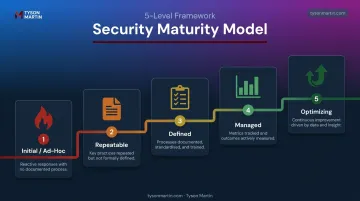
The SEI Capability Maturity Model established the five-level scale that most security frameworks reference. Individual frameworks adapt the labels and criteria — NIST CSF uses four tiers, CMMC uses three levels — but the underlying progression is consistent.
| Level | Name | What It Looks Like |
|---|---|---|
| 1 | Initial / Ad-Hoc | Undocumented, inconsistent, dependent on individual heroics |
| 2 | Repeatable | Key processes documented and reproducible, but uneven across teams |
| 3 | Defined | Policies formalized, standardized, and actively communicated from leadership |
| 4 | Managed | Controls measured with quantitative data; KPIs and KRIs drive decisions |
| 5 | Optimizing | Continuous improvement based on performance data and emerging threats |
Level 1 and 2: Where Most Organizations Start
At Level 1, security depends on whoever happens to notice a problem. Incident response, patch management, and access control all vary by who's on shift. Organizations here are highly exposed and cannot reliably respond to incidents.
Level 2 organizations have documentation and can reproduce processes — but coverage is inconsistent across business units. Compliance requirements are beginning to be addressed; gaps remain.
Levels 3–5: Where Governance Becomes Possible
Level 3 is where security shifts from reactive to proactive. Policies are standardized and leadership actively enforces them. This is also where board reporting becomes credible: there's finally something consistent to measure and report against.
At Level 4, metrics drive decisions rather than intuition. KPIs and KRIs are tracked consistently, and executive reporting becomes routine rather than reactive.
Level 5 adds automated monitoring and genuine board integration into the governance cycle — regular oversight, not an annual status briefing.
Key Information Security Maturity Frameworks
No single framework fits every organization. The right choice depends on industry, regulatory obligations, and how broad the scope needs to be.
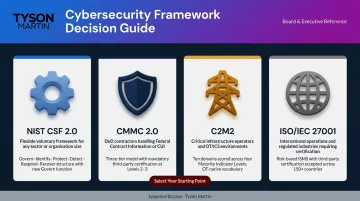
NIST CSF 2.0
Released February 26, 2024, NIST CSF 2.0 is the most widely adopted starting point for U.S. organizations. It organizes security around six functions — Govern, Identify, Protect, Detect, Respond, Recover — and uses four Implementation Tiers (Partial, Risk Informed, Repeatable, Adaptive) that map to the common maturity progression.
Its Organizational Profiles let management document current and target posture in a format boards can actually use for governance decisions. It applies to organizations of any size or sector, which makes it the default choice when flexibility is the priority.
CMMC 2.0
Mandatory for defense contractors and subcontractors handling Federal Contract Information (FCI) or Controlled Unclassified Information (CUI). Three levels:
- Level 1: 15 FAR 52.204-21 requirements, annual self-assessment
- Level 2: 110 NIST SP 800-171 Rev. 2 requirements, C3PAO assessment every three years
- Level 3: Adds 24 NIST SP 800-172 requirements, DCMA DIBCAC assessment every three years
Phase 1 of the rollout began November 10, 2025. Boards with DoD contractor exposure should treat CMMC as a contracting and third-party risk issue, not just a security program matter.
C2M2
Developed by the U.S. Department of Energy, C2M2 v2.1 contains 356 practices across 10 domains, using Maturity Indicator Levels from MIL0 to MIL3. It's built for environments with both IT and operational technology — energy, utilities, critical infrastructure. The ten domains cover everything from asset management and identity access to third-party risk and workforce management, giving boards a domain-by-domain view of where resilience is weakest.
ISO/IEC 27001:2022
ISO/IEC 27001:2022 is the formal certification standard for information security management systems, with accredited auditors operating in over 150 countries. Edition 3 focuses on confidentiality, integrity, and availability, with a structured path to third-party certification.
Certification is useful as external assurance for regulators, customers, and business partners. It confirms the ISMS meets documented requirements — not that risk is absent.
Framework Decision Guide
Use this guide to match your situation to the right starting point:
| Situation | Best Fit |
|---|---|
| Starting a maturity program, flexible scope | NIST CSF 2.0 |
| DoD supply chain, FCI/CUI in scope | CMMC 2.0 |
| Critical infrastructure, OT environments | C2M2 |
| International operations, regulated industries, customer assurance | ISO/IEC 27001 |
Cybersecurity vs. Information Security Maturity Models
The two terms get conflated constantly — and the confusion costs boards the wrong governance tool at the wrong moment.
NIST defines information security as protecting information and information systems from unauthorized access, use, disclosure, disruption, modification, or destruction — anchored in confidentiality, integrity, and availability. ISACA is more direct: "cybersecurity is a part of information security," with cybersecurity extending to networks, systems, and connected digital ecosystems.
In practice, this distinction matters for governance:
- Information security maturity models focus on protecting data assets, aligning with regulatory standards (HIPAA, PCI DSS, GDPR), and managing an ISMS. They're the right lens when compliance requirements — not threat landscapes — are driving the security program.
- Cybersecurity maturity models take a broader view — technology, processes, people, and third-party ecosystems — and address the full range of cyber threats including supply chain exposure, ransomware, and operational resilience.
Most organizations need both lenses. The key is knowing which one answers the governance question on the table. Regulatory examination? Information security model. Third-party and supply chain risk review? Cybersecurity model. NIST CSF 2.0 is built to serve both purposes — but picking up the framework without knowing which question you're answering first is how boards end up with assessments that look complete and govern nothing.
How Boards and Executive Teams Should Use Maturity Models
A maturity score by itself doesn't govern anything. Its value is what it unlocks: clear decision rights, defensible funding rationale, and a risk posture that can be communicated without technical translation at every board meeting.
What Boards Should Receive
The right board deliverable is not a raw score or a list of open vulnerabilities. It's a one-page scorecard showing:
- Three to four security outcomes (reduce exposure, improve response, strengthen recovery) with trend arrows
- Top risks with named owners and due dates
- Exceptions and risk acceptances with aging and expiration dates
- Two short paragraphs: what changed since last briefing, and what decision the board needs to make
Trend matters more than point-in-time scores. A snapshot can look fine while risk quietly grows. Showing three to four quarters of trend data lets directors challenge assumptions and track whether the program is improving, holding, or regressing.
Escalation Thresholds: The Governance Mechanism
Maturity models help boards set pre-agreed escalation thresholds — defining whether a gap requires board-level action or management-level remediation. These thresholds should be tied to business impact, not technical severity:
- Management handles: Operational gaps, control deficiencies below materiality thresholds
- Risk committee escalation: Material risk choices involving financial exposure, regulatory risk, or significant data sensitivity
- Board escalation: Issues crossing agreed thresholds in dollars, customer harm, downtime duration, or disclosure obligation
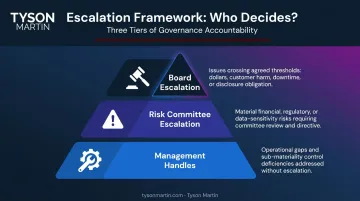
The rules must be approved before incidents occur, not debated in real time during a crisis.
The Regulatory and Financial Stakes
For organizations in financial services, healthcare, and retail, maturity levels connect directly to regulatory examinations, audit committee reporting, and SEC disclosure readiness. Public companies must disclose board oversight of cybersecurity risk and material incidents within four business days of determining materiality under SEC rules adopted in 2023.
A documented maturity assessment and trend dashboard is precisely the kind of evidence boards need to demonstrate that oversight is genuine.
On the insurance side, Marsh reported US cyber insurance rates decreased an average of 5% in Q4 2024, attributing the improvement partly to companies strengthening their cybersecurity controls. Insurers evaluate control posture and cyber hygiene when setting premiums. That makes maturity a direct input to premium negotiations, not an abstract compliance exercise.
Organizations without a CISO, or navigating a security leadership gap, benefit from engaging an independent board advisor to conduct or interpret maturity assessments and build the board reporting structure. The goal is ensuring the audit committee receives a credible, unbiased risk picture.
That independence is the differentiator. An advisor not embedded in day-to-day operations can challenge the findings and translate them into business-level decisions — without the internal pressures that shape in-house reporting. Tyson Martin works with boards and audit committees in exactly this capacity, providing the outside perspective that makes maturity assessments actionable rather than just documented.
How to Conduct a Security Maturity Assessment
Step 1: Baseline the Current State
Choose the appropriate framework — or combination of frameworks — for your industry and compliance obligations. Then conduct a current-state review covering:
- Policy and procedure documentation
- Control evidence (not just attestation — logs, tickets, artifacts)
- Incident response and recovery capabilities
- Governance and ownership structures across key domains
Internal self-assessments work when teams have objectivity and bandwidth. External independent assessments add credibility and cross-industry benchmarking — particularly when internal teams are too close to the work, or when trust between management and the board is strained.
ISACA's Three Lines Model assigns independent assurance to internal audit, with external advisors providing outside perspective and validation. Organizations in transition — new leadership, M&A activity, post-incident recovery — benefit most from an externally led assessment, which establishes a clean, defensible baseline before internal ownership solidifies.
Step 2: Build the Roadmap
Translate findings into a phased action plan with:
- Quick wins: Privileged access cleanup, MFA gaps, backup integrity — fast exposure reduction
- Risk reducers: Email security, patching on internet-facing systems — closing known attack paths
- Foundational capabilities: Asset inventory, vulnerability management — repeatable processes
- Longer-term work: Architectural shifts and program maturation — sustained capability building
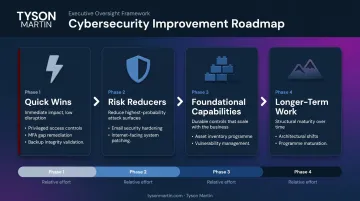
Every initiative needs a named owner, a target date, and a clear risk outcome. A 6-to-12-month horizon with 90-day execution cycles keeps priorities visible without becoming abstract planning documents.
With the roadmap in place, the final step is making sure progress stays visible — and that the board can track it without relearning the format every quarter.
Step 3: Monitor and Report Over Time
NIST SP 800-53 Rev. 5 requires risk assessments at an organization-defined frequency, with updates after significant changes. In practice:
- Annual full assessment at minimum
- Quarterly lighter reviews for fast-changing businesses
- Triggered reassessments after major organizational or technology changes — acquisitions, cloud migrations, new regulators, serious incidents
The goal is a stable dashboard that shows trend over time — one directors can read quickly, ask sharp questions from, and compare directly to last quarter without reorienting to a new format.
Frequently Asked Questions
What is an information security maturity model?
A structured framework of security practices and benchmarks used to measure how effectively an organization manages information risk. It shows where the program stands today across key domains and guides prioritized improvement — treated as an ongoing governance tool, not a one-time audit.
What are the five levels of security maturity?
Most frameworks use five levels:
- Initial — ad-hoc, reactive, undocumented
- Repeatable — documented but inconsistently applied
- Defined — standardized, proactive across the organization
- Managed — quantitatively measured with KPIs
- Optimizing — continuously improved based on data and emerging threats
The progression is a shift from firefighting to inspectable, reliable governance.
What is the difference between a cybersecurity maturity model and an information security maturity model?
Cybersecurity maturity models cover the full digital threat landscape — technology, people, processes, and third parties. Information security maturity models focus specifically on protecting data confidentiality, integrity, and availability in alignment with regulatory standards. Most organizations use both perspectives depending on the governance question.
Which security maturity model is right for my organization?
NIST CSF 2.0 for flexible, risk-based programs across any sector; CMMC 2.0 for DoD contractors handling FCI or CUI; C2M2 for critical infrastructure or OT environments; ISO 27001 for international operations or regulated industries requiring formal certification.
How should boards use security maturity assessments?
As a trend tool, not a point-in-time score. Boards should receive a stable scorecard showing improvement or regression over time, then use those findings to:
- Set pre-agreed escalation thresholds
- Tie results to funding and resource decisions
- Inform regulatory readiness and cyber insurance reviews
How often should an organization assess its security maturity level?
At minimum annually. Reassess sooner after major changes: acquisitions, cloud migrations, new regulatory obligations, leadership transitions, or significant security incidents. Fast-changing businesses often add a quarterly lighter review between full assessments.