According to KPMG's 2026 Global TPRM Survey, only 15% of leaders express high confidence in the data underpinning their third-party risk programs. That's not a tool problem. It's a prioritization problem.
This guide gives you a practical, board-defensible method for determining vendor criticality — what criteria to apply, how to score and tier vendors, and how to act on the results without drowning in administrative complexity.
Key Takeaways
- Vendor criticality and vendor risk rating are different things; conflating them creates blind spots and wastes oversight resources.
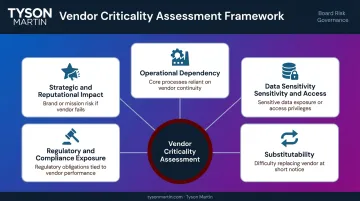
- Five criteria drive criticality: operational dependency, data sensitivity, substitutability, regulatory exposure, and strategic/reputational impact.
- Assessment follows a five-step process: inventory vendors, apply criteria, score and tier, document decisions, and schedule reassessments.
- Critical vendors require enhanced due diligence, board-level visibility, and BC/DR integration beyond annual questionnaires.
- The most common failure is miscategorization — over-labeling vendors as critical or missing real ones due to undefined criteria.
Vendor Criticality vs. Risk Rating: Why the Distinction Matters
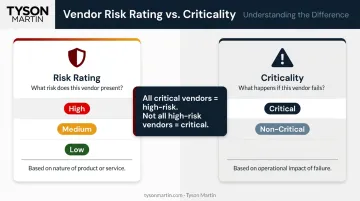
These two designations answer different questions, and conflating them is one of the most common governance errors in third-party risk programs.
- Risk rating measures the inherent risk a vendor presents based on the nature of their product or service — typically high, medium, or low.
- Criticality is a separate designation that identifies vendors whose failure would materially harm operations, customers, or compliance — regardless of their risk level.
A payment processor can be both critical and high-risk. A commodity office supply vendor might be high-spend but neither critical nor high-risk. The 2023 OCC/FDIC/Federal Reserve interagency guidance recognizes this, noting that banking organizations may assign a "criticality or risk level" to each third-party relationship — treating them as distinct assessments.
The governance principle: all critical vendors should be treated as high-risk, but not all high-risk vendors are critical. A vendor can present significant cybersecurity risk without being operationally essential.
What Happens When You Get This Wrong
Tyson Martin frames the problem directly in board advisory work: "If your 'critical' list is 120 vendors, it isn't a tier, it's a catalog." When boards receive a vendor catalog instead of a decision tool, they stop engaging. Genuine exposures go unmonitored.
Regulators expect board-level reporting on critical vendor performance. Both miscalibration errors have consequences:
- Too many labeled critical — board reporting becomes noise; directors disengage from the list entirely
- Too few labeled critical — the board loses visibility on genuine exposures before they escalate
- Mislabeled vendors — oversight resources concentrate on the wrong relationships
The OCC's 2024 community bank guide is direct on board responsibility: management must periodically report to the board on third parties supporting higher-risk and critical activities.
That reporting only works if the underlying classification is defensible — which means keeping both designations separate from the start.
The Five Criteria for Assessing Vendor Criticality
No single factor automatically qualifies or disqualifies a vendor as critical. These five criteria, taken together, determine whether a vendor rises to that level. Weight them based on your organization's risk tolerance and operating model.
Operational Dependency
The core question: if this vendor stopped performing today, how quickly and severely would operations degrade?
Factors to evaluate:
- Does the vendor perform a core function — payments, data processing, infrastructure?
- Is there a manual fallback, and how long would it hold?
- Would an outage stop revenue, service delivery, or patient safety?
DORA Article 3 defines a critical or important function as one whose disruption would materially impair financial performance, service continuity, or compliance with legal obligations. The FFIEC similarly requires that outsourced technology resilience align with recovery time objectives when third parties support critical operations. If your recovery timeline cannot tolerate a vendor outage, that vendor is a criticality candidate.
Data Sensitivity and Access
A vendor's access to sensitive data elevates criticality independent of how operationally central they are. Track both data type and access level:
- Data types: customer data, employee data, payment data, health data, intellectual property
- Access levels: none, user-level, admin, production, or support access
Regulatory obligations follow data access directly:
- GLBA requires financial institutions to assess service providers based on risk and adequacy of safeguards
- HIPAA requires written business associate agreements before any vendor can create, receive, or transmit protected health information
- PCI DSS v4.0.1 Requirement 12.8 requires a maintained list of all third-party service providers, written agreements, and at least annual compliance monitoring
Vendors with production access or admin rights to systems holding regulated data should be treated as criticality candidates by default.
Substitutability
How easily and quickly can this vendor be replaced? A vendor with a unique capability, proprietary integration, or a 12-month implementation timeline is far more critical than a commodity service provider with five direct alternatives.
DORA Article 31 includes substitutability as an explicit criterion for designating critical ICT third-party providers, citing "lack of real alternatives and difficulty of migrating services." NIST SP 800-161 Rev. 1 reinforces this through concentration risk analysis and alternative supplier assessment.
Score this criterion on:
- Replacement timeline
- Data portability requirements
- Integration complexity
- Availability of viable market alternatives at comparable capability
Regulatory and Compliance Exposure
Some vendor relationships carry direct regulatory risk — if the vendor fails or acts improperly, the organization bears the consequence. Third-party servicers, customer-facing agents, and vendors handling regulated data all fall into this category.
Regulatory frameworks converge on the same requirement: identify relationships whose failure would materially impair operations or compliance, then apply enhanced oversight. This applies across OCC/FFIEC banking guidance, SEC cybersecurity disclosure rules (2023), DORA (effective January 17, 2025), HIPAA, and PCI DSS.
The enforcement record makes the stakes concrete. OCC assessed an $80 million civil money penalty against Capital One in 2020 for cloud-risk governance failures. HHS OCR settled a HIPAA business associate agreement failure for $31,000 in 2017.
Strategic and Reputational Impact
Does this vendor enable a product line, market expansion, or capability central to your strategic plan? Would failure damage your brand or trigger negative media attention?
Reputational risk is harder to quantify, but it belongs in the assessment. Tyson Martin's advisory approach translates these factors into enterprise risk language: a marketing SaaS breach isn't just a security issue — it's "brand damage plus disclosure risk." A cloud provider failure threatens "uptime, customer experience, and revenue recognition." When you express reputational risk in operational terms — revenue at risk, disclosure triggers, customer churn — it becomes scoreable and earns a place on the board's agenda alongside financial and compliance exposures.
How to Assess Vendor Criticality: A Step-by-Step Process
This process works whether you have 50 vendors or 5,000. It's designed to be documented, audited, and explained to a regulator or board without improvising.
Step 1: Build Your Vendor Inventory
You cannot assess what you haven't identified. This step requires a complete inventory of all third-party relationships — including sub-processors and fourth-party dependencies that bypass standard procurement controls.
Shadow vendors are a real governance risk. Pull vendor names from multiple sources simultaneously:
- Accounts payable and corporate card spend
- SSO app catalogs (Okta, Entra ID, Google)
- Active contracts from procurement and legal
- IT support tickets
- Department-specific tools across finance, HR, sales, and marketing
For fourth-party visibility, focus on critical vendors' key subprocessors rather than attempting to map every dependency exhaustively.
PCI DSS v4.0.1 Requirement 12.8.1 independently requires maintaining a list of all third-party service providers with access to cardholder data — but the governance principle extends beyond payments to any sensitive data environment.
Step 2: Apply the Criticality Criteria
Create a structured scoring template using the five criteria above. Use a simple rating scale — 1 to 3, or low/medium/high — for each criterion, then assign weights that reflect your organization's priorities.
Three diagnostic questions from regulatory guidance that can anchor this step:
- Would sudden loss of this vendor cause significant disruption to operations?
- Would failure harm customers directly?
- Would this vendor's absence trigger compliance consequences?
Vendors that answer "yes" to any of these warrant deeper evaluation across all five criteria.
Step 3: Score and Tier Each Vendor
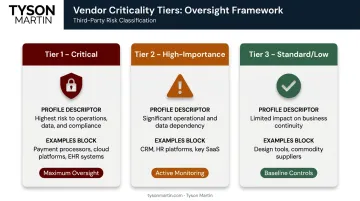
Weighted scores produce a criticality tier. A practical three-tier structure:
| Tier | Profile | Examples |
|---|---|---|
| Tier 1 (Critical) | Production/admin access, regulated data, single point of failure, outage stops revenue or safety | Payment processors, cloud platforms, EHR systems, payroll providers |
| Tier 2 (High-Importance) | Moderate business impact, significant data access, replaceable but not quickly | CRM systems, HR platforms, key SaaS tools |
| Tier 3 (Standard/Low) | Minimal data access, easily replaced, limited operational exposure | Design tools, non-integrated SaaS, commodity suppliers |
For borderline cases — vendors that score near a tier boundary — document the rationale explicitly. The decision matters less than the defensibility. A vendor near the Tier 1/Tier 2 boundary should be evaluated on its specific access patterns and data flows, not a rigid score cutoff.
Step 4: Document the Decision and Communicate Upward
An undocumented criticality decision is not defensible in a regulatory exam or board discussion. Documentation should capture:
- Criteria applied and scores assigned
- Rationale for edge cases
- Name of the decision owner
- Date of the assessment
Critical vendors must be reported to senior leadership and, per most regulatory frameworks, to the board. The board view should show the number of critical vendors, current risk status, any tier changes since the last review, and performance flags — not a full vendor list.
The goal is a stable dashboard that shows trend, not trivia — quarterly views covering top vendor risks, movement over three to four quarters, and specific decisions requested from the board.
Step 5: Schedule Reassessment Triggers
Criticality changes as vendors evolve, contracts renew, and your environment shifts. Event-driven reassessment triggers should include:
- New integration or data type change
- Privilege increase
- Breach news or major outage
- Acquisition (yours or the vendor's)
- Subcontractor change
- Contract renewal
- New regulation touching the service
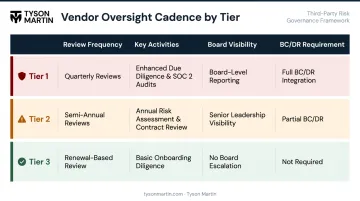
Tier 1 vendors warrant at minimum an annual formal review and continuous monitoring between cycles. Tier 3 vendors can be reviewed at renewal or on major change. The key is making triggers automatic — not dependent on someone remembering to initiate a review.
How to Interpret and Apply Criticality Ratings
Generating a criticality tier is only useful if it changes oversight behavior. A rating that sits in a spreadsheet without driving action is risk theater.
Critical Tier: Maximum Oversight
Critical vendors require:
- Enhanced due diligence: financial health, independent audit reports (SOC 2 Type II, ISO 27001), subcontractor arrangements
- Contract provisions: SLAs for uptime and recovery, audit rights, breach notification windows in hours (not "reasonable time"), right to terminate for cause
- Quarterly performance reviews and board-level reporting
- Inclusion in BC/DR testing — not just BC/DR planning
FFIEC Appendix J requires that outsourced technology resilience align with recovery time objectives and that BCP testing occur when third parties provide critical services. The test should prove the organization can actually operate through a vendor outage, not just that a plan exists on paper.
High-Importance Tier: Active Monitoring
This tier often catches vendors that don't quite meet the critical threshold but would cause significant disruption if they failed without warning. Obligations include:
- Annual risk assessments with semi-annual performance reviews
- Monitoring for negative news and financial deterioration
- Documented contract review at renewal
Standard and Low Tiers: Baseline Controls
Standard and low-criticality vendors still require basic onboarding diligence and periodic review. The goal is freeing up oversight capacity for Tier 1 and Tier 2 — not eliminating controls entirely. That discipline across all tiers is also what makes board reporting coherent rather than reactive.
Using Criticality to Drive Board Reporting
The board view of vendor risk should not be a vendor list. It should be a decision-ready dashboard showing:
- Total critical vendors in scope, and how many are currently out of tolerance
- Concentration risk (top vendors by business impact)
- Tier changes since the last review, with rationale
- Open actions with owners and due dates
- Decisions requested — limited to one to three items per cycle, each with options and a recommended path
Organizations navigating leadership transitions or regulatory scrutiny often discover their vendor criticality framework was never documented in a defensible form. Closing that gap before a regulatory exam or board inquiry requires both technical depth and board-level framing.
An experienced fractional CISO or board advisor can shorten that timeline — typically delivering vendor tiering, documentation, and a board-ready reporting baseline within the first 30 to 60 days.
Common Mistakes and Best Practices for Ongoing Oversight
The Most Consequential Miscategorization Errors
- Over-labeling: Too many vendors designated critical dilutes attention on the relationships that genuinely matter and draws examiner scrutiny. A critical list with 120 vendors signals the program doesn't have real criteria.
- Under-labeling: Using spend or vendor reputation as proxies for criticality, while ignoring operational dependency and data access. High-spend vendors are not automatically critical; low-profile vendors can be.
- Ignoring fourth-party relationships: A Tier 1 vendor's subprocessors can introduce hidden concentration risk that never surfaces in the primary assessment.
A useful check for any vendor designation — answer these three questions:
- Does failure create measurable business impact?
- Is the vendor difficult to replace quickly?
- Does the vendor access sensitive data or systems?
Three "yes" answers should push the designation toward critical.
Data Quality and Program Maturity
KPMG's 2026 global TPRM survey found that only 15% of leaders express high confidence in the data underpinning their TPRM programs. Board reporting should disclose data confidence limits — not just tier counts. When evidence is thin, outdated, or self-reported, say so explicitly rather than presenting false precision.
Common maturity failures:
- Relying on outdated vendor profiles from initial onboarding
- Using one-size-fits-all questionnaires regardless of tier
- Treating criticality assessment as a one-time exercise
Best Practices That Separate Strong Programs from Weak Ones
- Define criteria before scoring begins — not during or after
- Assign explicit ownership for each vendor relationship; shared ownership means no ownership
- Integrate criticality tiers into BC/DR planning and contract negotiation, not just the risk register
- Automate reassessment triggers so tier changes surface when circumstances change, not only at scheduled review cycles
- Keep the critical tier small — 10 to 30 vendors for board visibility is the right range
- Establish a cadenced oversight rhythm: monthly reviews for Tier 1 and Tier 2, plus a quarterly board-ready view showing trends and exposure
Frequently Asked Questions
What are the key steps in vendor risk management?
The core steps are: inventory and tier all vendors, conduct risk assessments scaled to criticality, negotiate contracts with appropriate protections, monitor ongoing performance, and reassess regularly. Criticality determination comes first — it sets the depth of oversight every other step applies.
What are the risk rating levels for vendor risk assessment?
Most organizations use a three- or four-level scale: critical, high, medium, and low. Risk ratings reflect the inherent risk of a vendor's product or service; criticality reflects the operational impact of vendor failure. Both designations are required for a complete governance picture.
Is a critical vendor always a high-risk vendor?
All critical vendors should be treated as high-risk for oversight purposes. The reverse is not true: a vendor can present significant cybersecurity risk without being operationally essential. Both designations must be applied separately, because they drive different management responses.
How often should vendor criticality be reassessed?
Annual reviews for all vendors, with event-driven reassessments triggered by contract renewal, material changes in vendor business or financial health, organizational M&A, or incidents. Critical vendors warrant continuous monitoring between formal annual reviews.
What happens when a critical vendor fails to perform?
The organization should have documented contingency plans: alternate vendor options, in-house fallbacks, and contractual SLAs with defined consequences. Critical vendors must be integrated into business continuity and disaster recovery (BC/DR) testing so failure scenarios are rehearsed before a real incident occurs.
Who should own vendor criticality decisions?
Criticality decisions require cross-functional input from IT, legal, compliance, and business line owners, with final accountability resting with a designated risk function. Results must be communicated to senior leadership and the board, not siloed within procurement or IT.