Introduction
AI now sits inside consequential business decisions — hiring algorithms, credit scoring, fraud detection, customer service routing — yet most boards are overseeing these systems with governance structures designed for a different era.
The result is a widening gap between how fast organizations adopt AI and how accountable anyone actually is when something goes wrong.
According to McKinsey's 2024 State of AI report, 65% of organizations now regularly use generative AI — but only 18% have an enterprise-wide council or board with actual authority over responsible AI governance.
A separate Deloitte survey of 695 board members and C-suite executives found that 66% said their boards had limited to no AI knowledge or experience, and 31% said AI wasn't on the board agenda at all.
This post breaks down exactly what an AI governance board is, who belongs on it, what it is responsible for, and the practices that separate meaningful oversight from governance theater.
Key Takeaways
- The AI governance board is a focused oversight body — distinct from the full board — accountable for AI strategy, risk, ethics, and regulatory compliance.
- Composition should span technology, security, legal, risk, and business operations, with independent AI expertise included, not treated as optional.
- Core responsibilities cover AI inventory, policy approval, risk classification, regulatory compliance tracking, and pre-defined escalation thresholds.
- Best-practice boards establish decision rights and reporting rhythms before an incident forces the issue.
- Whether to form a dedicated AI committee or expand an existing one depends on the scale and risk level of your AI deployments.
What Is an AI Governance Board?
An AI governance board — whether a dedicated board-level committee or a cross-functional governance body — is the formal structure responsible for strategic direction, accountability, and risk oversight across an organization's AI systems.
The concept and the institution are distinct: AI governance is the set of principles and policies; the AI governance board is the body that makes those principles binding.
How It Fits Within the Full Board
The full board retains ultimate fiduciary accountability for AI risk. The governance board provides the depth of focus the full board cannot sustain on its own. The analogy holds well: audit committees exist because full boards cannot audit in session. AI governance works the same way — the full board sets the mandate, and the committee does the work.
The NIST Framework as Governing Context
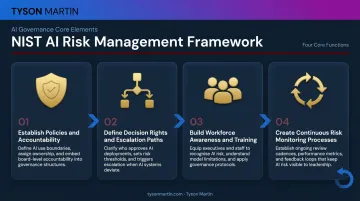
The NIST AI Risk Management Framework defines its "Govern" function as the foundation of AI risk management. It covers four core elements:
- Establishing organization-wide AI policies and accountability structures
- Defining decision rights and escalation paths for AI-related risk
- Building workforce awareness and training programs
- Creating processes for continuous — not periodic — AI risk monitoring
NIST treats governance as an ongoing discipline, not a compliance exercise. That distinction matters. Organizations that treat AI governance as a deliverable (produce the policy, check the box) consistently fail to catch the risks that governance is supposed to surface.
Core Roles on an AI Governance Board
No single role can carry AI governance. The board needs cross-functional coverage — and each role fills a gap the others cannot.
Executive Chair or Board Sponsor
Typically the CEO, board chair, or designated independent director. Sets the governance tone from the top and ensures AI oversight stays connected to business strategy. Without visible executive sponsorship, AI governance defaults to a compliance exercise that management works around rather than with.
CTO or CIO
Provides technical grounding: what AI systems exist, how they work, where data flows, and what architectural constraints affect risk. This role prevents the board from approving AI policies that are disconnected from how the systems actually operate.
Chief Information Security Officer
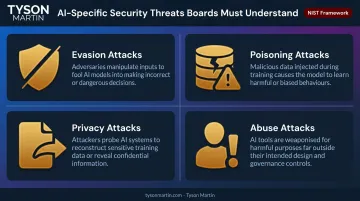
Addresses AI-specific security risks that are distinct from traditional cyber threats. NIST's adversarial machine learning research identifies four attack categories boards should understand:
- Evasion attacks — manipulating inputs to cause incorrect model outputs
- Poisoning attacks — corrupting training data to degrade model behavior
- Privacy attacks — extracting sensitive data from models
- Abuse attacks — exploiting AI systems for unintended purposes
These are not theoretical. The CISO's role on the governance board is to ensure these vectors are part of the organization's AI risk picture, not siloed in the security team's queue.
General Counsel or Chief Risk Officer
Maps AI use cases to applicable laws — employment discrimination, consumer protection, sector-specific rules — and flags liability questions when AI systems make decisions affecting individuals. As regulations multiply across jurisdictions, this role keeps the board from being caught off guard by enforcement.
Business Unit Representatives
Ground the governance board's work in how AI is actually being used. Shadow AI adoption — employees using AI tools outside IT's visibility — is widespread. Governance that only reflects what the technology team knows is incomplete.
External AI Advisor or Independent Director
Provides third-party perspective, reduces groupthink, and signals to investors and regulators that oversight is credible rather than self-referential. Deloitte's 2025 research notes that 40% of executives said AI had prompted reconsideration of board composition — a direct acknowledgment that existing directors often lack the expertise to ask the right questions.
That gap has driven demand for fractional board advisors who specialize in translating AI and cyber risk into strategic terms. Tyson Martin's board advisory practice serves this function: plain-English AI risk posture, decision-rights mapping, and structured oversight frameworks — delivered independently of the internal team reporting the results.
Key Responsibilities of an AI Governance Board
Maintain an AI Inventory and Risk Classification System
The board cannot govern what it cannot see. Management must identify all AI systems in use — including third-party tools and shadow AI — and classify each by risk level, use case, and regulatory jurisdiction.
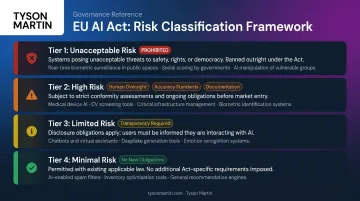
The EU AI Act's four-tier classification is a practical model:
| Risk Tier | Examples | Obligations |
|---|---|---|
| Unacceptable | Social scoring, manipulative AI | Prohibited |
| High | Hiring, credit, healthcare, critical infrastructure | Strict requirements: human oversight, accuracy, documentation |
| Limited | Chatbots, AI-generated content | Transparency disclosures required |
| Minimal | Spam filters | No new AI Act obligations |
Approve AI Policies Before Deployment
The board sets the guardrails before deployment, not after a problem surfaces. At minimum, that means written policy covering:
- Permitted and prohibited AI applications
- Generative AI use standards and data handling requirements
- Human oversight requirements by risk tier
Boards that wait for a crisis to set policy have already abdicated this responsibility.
Oversee AI Risk Management Against a Recognized Framework
The NIST AI RMF's four functions — Govern, Map, Measure, Manage — give boards a practical structure for verifying that management's risk program is systematic rather than reactive. The board's role is oversight, not execution: verify that a program exists, that it maps to a recognized framework, and that findings are acted on.
Track Regulatory Compliance Across Jurisdictions
Regulations are moving quickly:
- EU AI Act — Prohibitions active February 2025; general-purpose AI rules August 2025; full applicability August 2026
- Colorado SB24-205 — High-risk AI deployers must conduct impact assessments, notify consumers, and provide appeal mechanisms (effective February 2026)
- Texas HB149 — Takes effect January 2026
- EEOC guidance — Federal anti-discrimination laws apply to AI used in recruiting and wage-setting
- FINRA Notice 24-09 — Generative AI use is subject to existing supervisory and communications rules
The board must designate responsibility for monitoring this calendar and require compliance updates as a standing agenda item — not an occasional one.
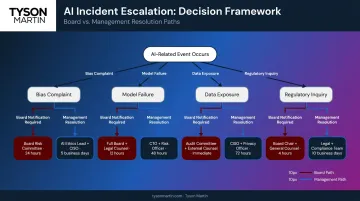
Pre-Define Escalation Thresholds and Decision Rights
Define what AI-related events require immediate board notification versus management-level resolution — before an incident forces the question. The list is longer than most boards anticipate:
- A bias complaint against an automated decision system
- A model failure in a high-stakes process (hiring, credit, clinical)
- A data exposure involving AI-processed information
- Regulatory inquiry tied to an AI application
Each of these needs a pre-written answer: who gets called, within what timeframe, and what authority they have to act. Without that, the board learns about the incident the same way management does — after the fact, with no clear owner.
Dedicated AI Committee vs. Integrating Into Existing Committees
The right structure depends on where the organization sits on the AI risk spectrum.
Dedicated AI committee makes sense when:
- AI is embedded in high-stakes, regulated processes (financial services, healthcare, consumer platforms)
- The organization has numerous AI deployments requiring ongoing oversight
- AI risk is material enough to compete for agenda time against other committee priorities
Integration into an existing risk or audit committee can work when:
- AI adoption is limited or early-stage
- The organization supplements integration with explicit AI literacy investment
- Committee charters are updated to include AI oversight scope explicitly
As NACD notes, integration can be effective — but only when it comes with targeted education and independent expertise, not just expanded scope.
Neither option has to be permanent. A practical hybrid: assign AI oversight to the audit or risk committee now, with a documented trigger — scale of deployment, risk severity, regulatory change — that automatically initiates a dedicated committee. This prevents the question from being revisited reactively every time the landscape shifts.
AI Governance Board Best Practices
Clarify Decision Rights First
Before anything else, define:
- What the board approves (AI policy, high-risk system classification, major AI investments)
- What management decides independently
- What triggers escalation to the board
Boards that skip this step create ambiguity that becomes expensive the moment an AI incident surfaces.
Establish a Predictable Reporting Cadence in Plain Language
Board reporting should answer four questions every briefing cycle:
- What are the top AI risks right now?
- What changed since the last briefing?
- What decisions does the board need to make?
- What proof supports the current risk assessment?
Trend indicators matter more than point-in-time snapshots. A single quarter of clean data can mask a deteriorating pattern. Three-quarter trends tell you whether AI risk is improving, holding, or sliding.
Build AI Literacy Deliberately
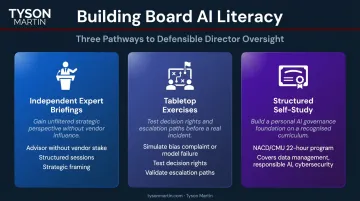
Board members don't need to understand model architecture. They need to ask sharp questions. Three mechanisms that work:
- Independent expert briefings — Structured sessions from an advisor without a vendor stake in the outcome
- Scenario-based tabletop exercises — Simulating an AI incident (a bias complaint, a model failure in production) forces boards to test whether their decision rights and escalation paths actually function
- Structured self-study — NACD and Carnegie Mellon University offer the Effective AI Oversight for Directors Certificate Program, a 22-hour program covering data management, responsible AI, cybersecurity, and strategic alignment
Tyson Martin, as an NACD member, speaker, and contributor and a participant in the World Economic Forum's Centre for Cybersecurity, structures board briefings around this same principle: translating AI and cyber risk into the language of oversight rather than operations.
Connect AI Governance to the Enterprise Risk Register
AI risk doesn't live in isolation. It intersects with cybersecurity, regulatory compliance, operational resilience, and reputational risk. AI-related risks should appear in the enterprise risk register with named owners, severity ratings, and mitigation timelines. A separate AI report that never connects to the organization's broader risk conversations is oversight in name only.
Common Mistakes That Undermine AI Governance Boards
Governance Theater
Forming an AI committee that meets quarterly, reviews a slide deck, and produces no binding decisions, no audit trail, and no escalation actions. McKinsey's 2024 data points to the gap: 65% of organizations regularly use generative AI, but only 18% have a governance body with actual authority. Meanwhile, 44% reported at least one negative consequence from generative AI use.
The test is simple. If a board cannot describe its AI decision rights — or the last time it changed an AI-related policy — the governance is performative. Ask three diagnostic questions:
- Can any member name a specific AI decision the board made or blocked in the past 12 months?
- Is there a documented escalation path for AI incidents, with named owners?
- Does the board receive AI risk reporting on a defined cadence?
MIT Sloan Management Review describes this pattern directly: responsible AI becomes "reputational window dressing" when organizations publish principles without the accountability, strategy, and resources to act on them.
Waiting for an Incident to Build the Structure
Most organizations only engage seriously with AI governance after a bias scandal, a regulatory penalty, or a data breach involving an AI system. Frameworks, reporting lines, escalation paths, and decision rights assembled under pressure are always calibrated to the last incident — not the next one.
Governance built before a crisis can reflect deliberate risk judgment. Governance built after one reflects damage control.
Frequently Asked Questions
What is an AI governance board and how is it different from the full board of directors?
An AI governance board (or committee) is a focused oversight body that provides the depth of scrutiny the full board cannot sustain across all AI systems and decisions. The full board retains ultimate fiduciary responsibility for AI risk but delegates ongoing oversight to the committee.
Who should sit on an AI governance board?
Composition typically includes the CTO/CIO, CISO, General Counsel or Chief Risk Officer, and business unit representatives. Boards with significant AI exposure should also include an independent director or external advisor with operational AI and risk expertise.
Should companies create a dedicated AI committee or expand an existing committee?
Organizations with high-risk or heavily regulated AI deployments benefit most from a dedicated committee. Integrated oversight within an existing audit or risk committee works for lower-complexity programs, provided charters are updated and the committee invests in AI literacy.
How often should an AI governance board meet?
A minimum quarterly cadence for formal meetings, supplemented by standing AI agenda items in full board meetings. Material AI-related events — model failures, bias complaints, regulatory developments — should trigger ad hoc escalations between scheduled meetings.
What metrics should an AI governance board track?
Key categories to track:
- AI inventory completeness
- High-risk systems without documented owners
- Regulatory compliance status by jurisdiction
- Fairness and bias audit outcomes
- Time to remediate AI-related incidents
What is the difference between AI governance and AI compliance?
Compliance means meeting specific regulatory requirements — it is a subset of governance. Governance is the broader framework: policies, decision rights, accountability structures, and ethical standards that guide how the organization develops and deploys AI responsibly, including standards that go beyond any single regulation.