
Introduction
Organizations collectively spend over $200 billion annually on cybersecurity, yet the average cost of a data breach reached $4.88 million in 2024 — a record high. More telling: many breaches exploit gaps in controls organizations already owned and believed were working.
A security process and technology effectiveness assessment exists to close that gap. A compliance audit asks, "Do we have controls?" An effectiveness assessment asks something harder: "Are those controls actually working?"
The distinction matters enormously at the board level. Documented controls and operating controls are two very different things. This guide covers:
- What effectiveness assessments are and how they differ from audits
- Why boards and executive teams need direct visibility into them
- How they work across the People, Process, and Technology dimensions
- How to translate findings into decisions, not shelf reports
Key Takeaways
- Effectiveness assessments verify whether your security controls are working as intended — not just whether they exist on paper
- Coverage spans three dimensions: People (behavior and awareness), Process (governance and incident readiness), and Technology (configuration, integration, and coverage)
- Without periodic reviews, organizations carry false confidence — controls that pass documentation reviews but fail under real conditions
- Findings must become prioritized actions with named owners and measurable outcomes — not compliance artifacts
- Boards and audit committees must be able to challenge assessment findings and track remediation progress — oversight requires engagement, not passive receipt
What Is a Security Process and Technology Effectiveness Assessment?
A security process and technology effectiveness assessment is a systematic evaluation of whether an organization's security controls — spanning people, processes, and technology — are correctly implemented, operating as intended, and producing measurable risk reduction.
That distinction separates it from a compliance check, which only confirms that controls exist and meet a documented standard. Compliance confirms presence; effectiveness confirms performance.
These assessments apply across a broad range of control domains:
- Security program management and maturity
- Incident response readiness and tested escalation paths
- Access control governance and identity management
- Third-party and vendor risk program effectiveness
- Technology stack performance and coverage gaps
Common triggers include scheduled reviews, organizational transitions (new CISO, M&A, major cloud migration), regulatory changes, and post-incident analysis.
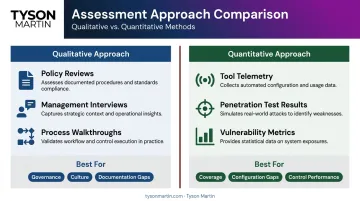
Qualitative vs. Quantitative Approaches
The two main methodological approaches serve different purposes and most mature programs combine them:
| Approach | Methods | Best For |
|---|---|---|
| Qualitative | Policy reviews, management interviews, process walkthroughs | Evaluating governance, culture, and documentation gaps |
| Quantitative | Tool telemetry, penetration test results, vulnerability metrics | Measuring coverage, configuration gaps, and control performance |
Organizations typically structure assessments as point-in-time reviews (suited for specific triggers like M&A or regulatory exams) or as continuous monitoring programs that track effectiveness over time. The right choice depends on organizational maturity and what's driving the review — a post-incident debrief calls for a different cadence than an ongoing board governance program.
Why Boards and Executive Teams Need These Assessments
The Regulatory Stakes Are Now Explicit
Regulatory bodies no longer accept having controls on paper as sufficient evidence — they require demonstrated effectiveness.
- SEC Cybersecurity Disclosure Rules (effective 2023) require public companies to disclose material cybersecurity incidents and describe their cybersecurity risk management processes annually
- NIST CSF 2.0 introduced a dedicated Govern function, elevating board-level oversight to a first-class framework component
- NIS2 Directive in the EU requires management bodies to approve and oversee cybersecurity risk management measures — and hold personal liability for non-compliance
The SEC's enforcement action against SolarWinds and its CISO illustrated precisely what board-level accountability for security program effectiveness looks like in practice. The allegation wasn't simply that a breach occurred — it was that the organization misrepresented the state of its security controls.
The False Security Problem
Organizations routinely invest in tools and policies that are misconfigured, underutilized, or disconnected from each other. This creates the appearance of protection without actual risk reduction. Common patterns include:
- EDR platforms deployed across only a subset of endpoints
- Incident response plans that exist as documents but have never been tested
- Security tools running in alert mode with no one reviewing the output
- Access controls documented as active but not enforced in practice
An effectiveness assessment surfaces these gaps before an adversary does — and gives boards verifiable evidence that controls are working, not just installed.
When the Need Becomes Urgent
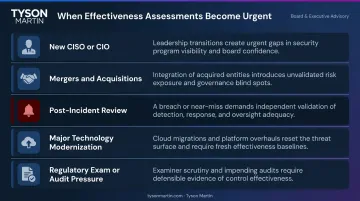
That governance imperative becomes especially acute during periods of change. Certain organizational moments make these assessments particularly high-priority:
- New CISO or CIO — incoming leadership needs an honest baseline, not inherited assumptions
- Mergers and acquisitions — buyers and integration teams need verified security posture, not documentation
- Post-incident review — understanding what failed and why requires more than an incident report
- Major technology modernization — cloud migrations and platform changes shift control coverage in ways that aren't always visible
- Regulatory exam or audit pressure — examiners increasingly ask for evidence of effectiveness, not just policy binders
The Three Dimensions to Assess: People, Process, and Technology
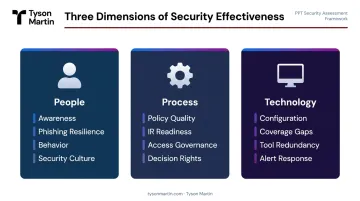
The People, Process, and Technology (PPT) framework provides the standard lens for scoring security program effectiveness. Assessing all three dimensions — rather than defaulting to a technology-only review — produces a materially more accurate picture of actual risk posture.
People
The People dimension covers whether security behavior matches security policy across the organization:
- Employee security awareness and phishing resilience
- Behavior during simulated incidents and tabletop exercises
- Compliance with acceptable use policies
- Whether security culture exists organization-wide or is confined to the IT team
Common measurement tools include phishing simulations, security awareness training completion rates, and skills-based testing. According to Proofpoint's 2024 State of the Phish report, 71% of organizations experienced at least one successful phishing attack in the prior year — a reminder that awareness programs don't automatically translate to resilient behavior.
Strong awareness programs can still fail when the processes behind them aren't tested. That's where the second dimension comes in.
Process
The Process dimension evaluates whether governance structures hold up outside of documentation:
- Quality and operationalization of security policies
- Incident response plan readiness and tested escalation paths
- Access control governance and change management procedures
- Whether decision rights are clear when pressure is real
A process gap is often harder to detect than a technology gap. Documentation looks complete right up until the moment a real incident reveals that escalation contacts have left, approval workflows haven't been followed, and the IR plan hasn't been exercised in 18 months.
Process gaps create the conditions where technology investments underperform — which brings us to the third dimension.
Technology
The Technology dimension assesses deployed tools against their intended purpose:
- Whether tools are properly configured and integrated
- Coverage gaps in detection or response capabilities
- Redundant or underperforming tools consuming budget without reducing risk
- Whether alerts and telemetry outputs actually drive a response
Assessment at this layer focuses on what tools are actually doing — not what the vendor said they would do at procurement.
The most common finding across all three dimensions is a significant gap between what organizations believe their controls are doing and what those controls are actually doing. That misalignment is precisely what the assessment is designed to surface.
How a Security Effectiveness Assessment Works: Step by Step
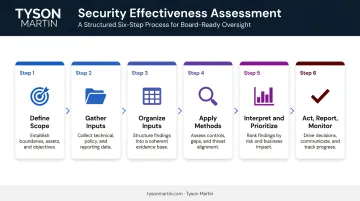
Step 1 — Define Scope and Objectives
Clarify which systems, teams, processes, and timeframes are in scope. Identify which risk areas or control domains to prioritize. Critically, establish what "effective" means for this specific organization — given its industry, regulatory environment, and threat profile.
Scoping too broadly produces unfocused findings. Scoping too narrowly misses material gaps. Getting this right shapes every downstream result.
Step 2 — Gather Inputs
Collect documentation (policies, incident logs, audit reports, vendor assessments), tool telemetry and metrics, prior assessment results, and interview data from stakeholders across IT, operations, legal, and executive leadership.
The most common gap at this stage is relying solely on documented controls rather than verifying how they actually operate in practice. Documentation and operational reality diverge more often than most organizations expect.
Step 3 — Organize and Structure Inputs
Map collected inputs to the PPT framework and the relevant security framework — NIST CSF, ISO 27001, or CIS Controls — based on the organization's regulatory environment and proof needs. Then identify coverage gaps, inconsistencies between documented controls and actual behavior, and areas where no measurement data exists.
This stage surfaces the controls that are assumed to be working but have no evidence to prove it.
Step 4 — Apply Assessment Methods
Execute evaluation techniques matched to each dimension:
- People and Process: Policy and process walkthroughs, management interviews, tabletop exercise observations
- Technology: Reviewing third-party penetration test results, analyzing tool telemetry, and validating control configurations against documented policies
The mix of methods should be tailored to the organization's risk profile, not defaulted to a single approach. A heavily regulated financial institution needs different depth than a mid-market manufacturer.
Step 5 — Interpret Results and Prioritize Findings
Translate raw findings into risk-prioritized insights:
- Which gaps represent highest likelihood and impact?
- Which are compliance-only issues vs. genuine risk exposure?
- Which require immediate executive attention vs. longer-term remediation?
Effective interpretation connects technical findings to business consequences — revenue exposure, regulatory liability, operational downtime. That translation is what boards and executives need to act on.
Step 6 — Act, Report, and Monitor
Develop a prioritized action plan with named owners, timelines, and measurable outcomes. The deliverable set should include:
- Top risks with owners, next milestone, and due date
- A decision-rights map clarifying what requires board approval vs. management delegation
- A 90-day execution plan with owners and proof of closure defined upfront
- A draft metrics pack with 10–12 stable metrics showing trend over time
Communicate findings to boards and senior leadership in plain English — what changed, what's at risk, and what decisions are required at the executive level. Then establish a monitoring cadence so the assessment doesn't become a point-in-time snapshot that's stale within six months.
Turning Results Into Board-Level Action: A Practical Walkthrough
Consider a mid-size enterprise in a regulated industry that believed its endpoint detection and response (EDR) platform and incident response plan provided comprehensive coverage. Both existed on paper. Both appeared in compliance documentation. The board had received no reason to question either.
What the Assessment Uncovered
Three findings emerged that were invisible in the compliance record:
- The EDR had been deployed across only 60% of endpoints (an incomplete rollout from 14 months prior that never reached full coverage)
- The incident response plan had never been tested, and several escalation contacts listed in it had left the organization
- No executive had reviewed security metrics in over 12 months, meaning no one with decision authority had a current view of risk posture
None of these gaps were visible in the documentation. All three were material.
How Findings Were Framed for the Board
The board received a governance-ready briefing, not a technical report:
- Three critical action items with named owners and 90-day timelines
- A revised security dashboard showing current state vs. last quarter on five stable metrics with trend arrows
- Clear decision rights — specifically, which items required board approval (budget for EDR completion) vs. management delegation (IR plan re-testing and contact updates)
A governance-ready briefing gives directors what they actually need: clear owners, defined timelines, and decisions they can act on in the room.
The Core Insight
The organization's tools existed. The policies existed. None of it was working as intended, and that gap stayed invisible until someone measured it deliberately. Organizations that skip effectiveness assessments don't know what they're missing — they just discover it later, under worse conditions.
How Tyson Martin Can Help
Tyson Martin works with boards of directors, audit and risk committees, and C-suite executives who need an experienced, independent view of whether their security program is actually working — not just documented.
His background spans enterprise security and technology leadership at AWS, Home Depot, and Best Buy. He also contributes actively to governance bodies including the National Association of Corporate Directors (NACD), the National Retail Federation CISO Executive Committee, and the World Economic Forum's Centre for Cybersecurity.
That combination of operational depth and board-level governance experience shapes how assessment findings get structured for executive audiences.
What the Engagement Produces
Security process and technology effectiveness assessments are structured as time-boxed sprints, typically completed within 10 to 15 business days. The process requires roughly 60 to 90 minutes from a short list of leaders — no lengthy workshops. At conclusion, clients receive:
- Top risks with named owners and next milestone dates
- A decision-rights map clarifying accountability at the board and management levels
- A 90-day execution plan with owners, cost ranges, dependencies, and defined proof of closure
- A draft metrics pack — 10 to 12 stable metrics with targets and trend arrows that boards can track quarter over quarter
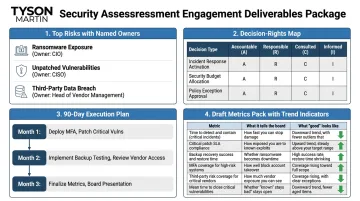
The board-facing dashboard is designed to show trend, not trivia. It tracks thresholds (what's acceptable), trends (whether posture is improving), and time-to-fix (how long risk stays open) — the three questions boards actually need answered.
When Interim CISO Support Makes Sense
For organizations that need both an honest assessment and immediate executive stability, Tyson can step in as an interim or fractional CISO alongside the assessment engagement. The assessment findings directly inform the interim scope: day-one priorities, decision rights to establish, and the 90-day roadmap. The two workstreams aren't separate — the assessment is what makes interim leadership ready to execute from day one.
When to Engage
The organizations that benefit most are those facing one or more of these situations:
- Leadership transitions — new CISO or CIO who needs an honest baseline, not inherited assumptions
- M&A activity — buyers or integration teams requiring verified security posture
- Post-incident recovery — understanding what failed and building defensible evidence of remediation
- Regulatory scrutiny — exam preparation or disclosure readiness requiring demonstrated control effectiveness
- Board-level questions about whether existing security investments are actually performing
The engagement is deliberately independent of the in-house CISO, security vendors, and MSSPs. That independence is what gives boards a credible, unfiltered view of actual security posture — not a vendor's summary or a team's self-assessment.
Frequently Asked Questions
What are the 7 steps of pen testing?
The standard phases are reconnaissance, scanning, gaining access, maintaining persistence, lateral movement, analysis, and reporting — sometimes followed by remediation verification. Penetration testing is one component of a broader security effectiveness assessment; it evaluates whether technical controls can be circumvented, but doesn't assess process or people dimensions on its own.
Which is better, VAPT or SOC?
They serve different purposes. VAPT (Vulnerability Assessment and Penetration Testing) identifies and validates technical vulnerabilities at a point in time, while a SOC provides continuous detection and response. Most mature programs use both — and a security effectiveness assessment evaluates how well each is actually performing relative to its intended function.
How often should a security process and technology effectiveness assessment be conducted?
At minimum annually, and additionally when triggered by significant organizational changes — new CISO or CIO, M&A, a security incident, major technology deployments, or an upcoming regulatory exam. High-change environments often warrant semi-annual reviews.
What is the difference between a security audit and a security effectiveness assessment?
A security audit evaluates whether controls exist and comply with a specific standard. An effectiveness assessment evaluates whether those controls are working as intended and delivering actual risk reduction. The two are complementary — audits confirm existence, assessments confirm function.
How do boards measure whether their cybersecurity spending is actually working?
Through stable, trend-based security metrics tracked consistently over time — not one-time snapshots. Boards should expect to see a small dashboard (10–12 metrics) with trend arrows, mapped to business risk outcomes, plus independent periodic assessment of whether the security program's outputs match its stated objectives.
What triggers the need for a security process and technology effectiveness assessment?
Any of the triggers covered in the frequency question above can prompt one. But the clearest signal is a board-level question about whether existing investments are actually performing — when the organization needs an honest, outside view of security program effectiveness before an auditor or an incident answers that question instead.