
Introduction
Most organizations have cybersecurity policies. The problem is that no one has checked whether they actually work.
The SEC, investors, and regulators now hold boards directly accountable for cyber risk — yet many have never formally tested whether their governance policies hold up under real conditions. The policies exist. The question is whether they're operating or just sitting in a document repository.
According to IBM's 2024 Cost of a Data Breach report, the global average cost of a data breach reached $4.88 million — a 10% jump from 2023 — with 70% of breached organizations reporting significant business disruption.
That's not a technology failure. In many cases, it's a governance failure: the wrong people were making decisions, escalation paths were untested, and policies existed on paper but not in practice.
What follows is a practical breakdown of what a cybersecurity governance assessment actually involves, why it's become a fiduciary priority — and how to conduct one whose findings hold up under scrutiny.
Key Takeaways
- A cybersecurity governance assessment evaluates whether your policies and processes are actually working — not just documented
- Governance failures are usually a clarity problem: undefined decision rights, untested escalation paths, and policies no one follows
- SEC rules now require boards to disclose cybersecurity oversight annually, with material incidents reported within four business days
- The assessment moves through six stages: scoping, policy inventory, practice alignment testing, decision rights review, board reporting evaluation, and action planning
- The output is a 90-day plan with named owners, measurable outcomes, and board-ready communications that show trend over time
What Is a Cybersecurity Governance Assessment?
A cybersecurity governance assessment is a structured review of an organization's cybersecurity policies, processes, decision rights, and oversight structures — designed to determine whether they're fit for purpose, not merely compliant on paper.
Unlike a penetration test, it doesn't look for software vulnerabilities. It asks a different question: do the right people have the right authority, information, and accountability to manage cyber risk at the speed the business actually moves?
The Three Layers It Covers
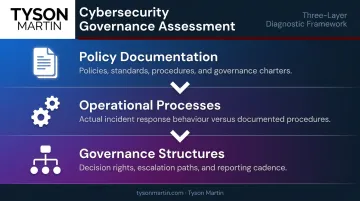
Every governance assessment works across three distinct layers:
- Policy documentation — What's written: policies, standards, procedures, governance charters, and when they were last reviewed
- Operational processes — How work actually gets done: what people do when an incident happens, not what the procedure says they should do
- Governance structures — Who decides, who escalates, who reports to whom, and on what cadence
NIST CSF 2.0, released in February 2024, formally added a Govern function as a new core element — covering organizational context, risk management strategy, roles and responsibilities, and oversight. The framework explicitly recognizes that governance outcomes can't be evaluated the same way technical controls are.
An assessment at this layer is structural and organizational, not technical.
What surfaces from this kind of review is often more consequential than any vulnerability scan. Undated policies. Unsigned charters. Security practices that have informally replaced formal procedures. Escalation thresholds that no one has ever actually tested. These gaps don't show up in a port scan.
Why Cybersecurity Governance Assessment Is Critical for Boards and Executive Teams
Boards are no longer passive recipients of security briefings — they are accountable parties with real legal exposure attached.
The SEC's Cybersecurity Risk Management, Strategy, Governance, and Incident Disclosure rule (Release Nos. 33-11216 and 34-97989), effective September 2023, created two hard requirements for public companies:
- Annual disclosure (Regulation S-K Item 106(c)) describing the board's oversight of cybersecurity risk and management's role in assessment and management
- Four business-day incident disclosure (Form 8-K Item 1.05) after determining a cybersecurity incident is material
Those aren't aspirational guidelines. They're enforceable obligations, and the SEC's enforcement record confirms it.
What Enforcement Actually Looks Like
The SEC's enforcement record makes the stakes concrete:
- First American Financial (2021): Security personnel identified a vulnerability months earlier but failed to remediate it per company policy; senior executives weren't informed before public statements were made
- Blackbaud (2023): Stated attackers didn't access donor bank account or Social Security data — even after company personnel learned otherwise. $3 million civil penalty
- R.R. Donnelley & Sons (2024): Failed to design effective disclosure controls to route cybersecurity information to decision-makers. $2.125 million civil penalty
- Unisys, Avaya, Check Point, Mimecast (2024): All charged with misleading disclosures related to the SolarWinds intrusions. Penalties ranging from $990,000 to $4 million
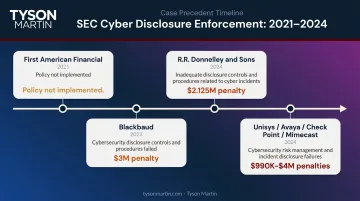
The pattern across every one of these cases is the same: written policies that weren't implemented in practice, and disclosure decision-makers who weren't informed in time.
The Business Case Beyond Compliance
Governance maturity isn't just a regulatory checkbox. The World Economic Forum's Global Cybersecurity Outlook 2024 found that 93% of leaders at organizations excelling in cyber resilience trust their CEO to speak externally about cyber risk — a direct reflection of how well governance structures translate security complexity into clear, executive-level communication.
That clarity doesn't happen by accident. It comes from defined escalation paths, tested disclosure processes, and boards that receive consistent, actionable reporting — exactly what a governance assessment is designed to verify. When those structures are absent, the reputational and legal exposure after a breach compounds fast, often exceeding the operational damage of the incident itself.
How to Conduct a Cybersecurity Governance Assessment: Step by Step
The most common mistake is treating this as a documentation exercise. It isn't. It's a functional audit of whether governance holds under pressure.
Step 1 – Define Scope and Objectives
Start by answering two questions: what's in scope, and what does success look like?
Common in-scope areas include:
- Incident response authority and escalation thresholds
- Board reporting cadence and content
- CISO escalation rights and direct access
- Vendor oversight and third-party risk protocols
- Regulatory disclosure procedures
The objective shapes the depth. An assessment preparing a board for investor review looks different from one responding to a regulatory inquiry or establishing a baseline after an acquisition. Skipping this step creates scope disputes mid-assessment — exactly when momentum matters most.
Step 2 – Inventory Existing Policies and Processes
Gather all documented cybersecurity policies, standards, procedures, and governance charters. Flag anything that is:
- Undated or unsigned by leadership
- Not reviewed in the past 12 months
- Missing an identified owner
For each policy, map three things: who enforces it, who monitors compliance, and who can grant exceptions. Gaps in ownership are common and consequential. If no one is accountable, the policy isn't operational — it's decorative.
Step 3 – Test Policy-to-Practice Alignment
Interview stakeholders across the first three lines — IT and security teams, risk and compliance functions, and internal audit. The key question at each conversation: "What do you actually do when X happens?" Then compare the answer to the written procedure.
Deviations fall into two categories. Some reflect organizational learning — informal processes that work better than the documented version. Others are uncontrolled workarounds that create real exposure. Both need to be documented. Neither should remain invisible.
The interviews also surface where exceptions pile up, where decisions stall because no one has clear authority, and which controls exist on paper but fail under real operating conditions.
Step 4 – Evaluate Decision Rights and Escalation Thresholds
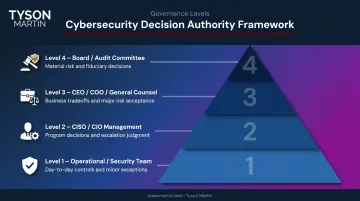
Map who has authority to make cybersecurity decisions at each level:
| Level | Role | Decision Authority |
|---|---|---|
| Operational | Security team | Day-to-day controls, minor exceptions |
| Management | CISO/CIO | Program decisions, escalation judgment |
| Executive | CEO/COO/General Counsel | Business tradeoffs, major risk acceptance |
| Board | Directors/Audit Committee | Material risk, fiduciary decisions |
Then test the thresholds. Walk through a simulated scenario — ransomware, a third-party breach, a regulatory inquiry. Note exactly where decision-making becomes ambiguous, delayed, or concentrated in one person.
This is where most organizations find the real problem: two or three senior leaders with conflicting understandings of who can authorize a ransom payment or invoke business continuity protocols. Before an incident, that ambiguity is a governance gap. During one, it determines the outcome.
When internal dynamics make honest gap-finding difficult, an outside facilitator can run this testing without the politics.
Step 5 – Assess Board Reporting and Visibility
Evaluate reporting quality against three criteria:
- Does it show trend over time, or just point-in-time status?
- Does it translate technical risk into business and financial impact?
- Does it give board members what they need to challenge management constructively — not just receive updates?
Gartner's 2025 survey on board cybersecurity confidence found that 90% of non-executive directors lack confidence in the value of cybersecurity investments, with only 10% expressing strong confidence that their organizations had achieved the right balance between protection and cost. That's not a technology communication problem. It's a reporting design problem.
The NACD's 2026 Director's Handbook found that improving cybersecurity reporting quality was "very or extremely important" for 43% of public company directors and 57% of private company directors. The gap between what boards receive and what they need to govern effectively is real — and an assessment surfaces it explicitly.
Step 6 – Prioritize Gaps and Build a 90-Day Action Plan
Rank gaps by business impact and exploitability — not by ease of fix. A missing escalation threshold in incident response outranks an outdated vendor questionnaire template, even if the questionnaire takes an afternoon to update.
Each priority item needs:
- Assign a named owner — one person, not a committee
- Set a due date with no ambiguity about accountability
- Define a measurable outcome that specifies what "closed" looks like
- Identify the proof required to confirm closure (test results, logs, access review evidence)
The board should be able to ask "where are we on this?" at the next meeting and receive a direct answer. A plan that can't answer that question at the next board meeting isn't a plan — it's a list.
From Written Policy to Real-World Practice: An Assessment Walkthrough
Consider a mid-market financial services firm with documented cybersecurity policies, a designated CISO, and a quarterly audit committee briefing. On paper, governance looks functional. The board has asked for greater confidence ahead of an investor review.
What the Assessment Surfaces
- Incident response policies exist, but no escalation threshold defines when the board is notified versus when the CISO handles it internally
- Vendor risk policies require annual reviews, but the last review for three critical vendors was 18 months ago
- The CISO's quarterly dashboard shows compliance metrics — patch rates, training completion, MFA deployment — with no trend analysis and no connection to business risk
The Governance Gap No One Documented
The organization assumed documentation equaled governance. The assessment surfaces something more specific: three senior leaders give different answers to the same question — who has authority to authorize a ransom payment?
No one is wrong. There's no documented answer. That's a decision rights vacuum.
The Corrective Actions
- Decision rights are captured in a one-page authority matrix, approved by the board, that answers five questions without debate: who accepts risk at what threshold, who approves exceptions and for how long, who decides when security competes with delivery, who declares incident severity, and who owns critical vendor decisions
- Vendor reviews are assigned owners with 30-day remediation deadlines
- Board reporting is restructured around three sections: top risks, what changed since last quarter, and what the board needs to decide or acknowledge
The Measurable Outcome
The result is a board that can answer investor and regulatory questions with specificity, a CISO with documented escalation authority, and a 90-day plan with named owners and measurable success criteria. Governance stops being a claim and becomes something you can inspect.
How Tyson Martin Can Help
Tyson Martin works with boards, audit committees, and C-suite executives as a board advisor, interim CISO, or independent fractional executive. That outside perspective matters because internal teams often can't surface honest gaps when organizational dynamics are in the way.
The deliverables from a governance assessment engagement are designed for immediate use:
- Decision-rights map answering the five authority questions without ambiguity
- Top risks with owners — each security concern tied to a named business owner and a defined response
- 90-day action plan with named owners, due dates, cost ranges, and proof requirements
- Draft metrics pack built around trends and thresholds, with a clear decision mapped to each metric
- Board-ready reporting pack showing what changed since the last meeting and what requires a decision now
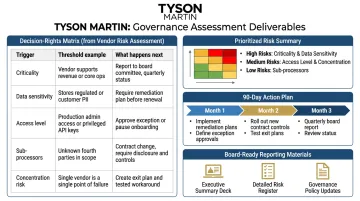
These aren't documents that sit on a shelf. They're governance structures designed to hold under real incident pressure — and to give boards the clarity they need before a crisis, not during one.
Tyson's background includes leading security and technology transformation at enterprise scale — AWS, Home Depot, and Best Buy. He is an active contributor to the NACD, the National Retail Federation CISO Executive Committee, and the World Economic Forum Centre for Cybersecurity. That experience informs how assessments are scoped, what gaps typically surface, and how findings are communicated to boards in plain language.
Organizations best suited for this engagement are those in transition: new executive leadership, post-incident review, M&A activity, pending regulatory scrutiny, or a board that needs stronger oversight and lacks independent capacity to build it.
If your board is being asked to answer questions about cybersecurity oversight and you're not confident the governance structures behind those answers will hold up — that's the conversation to have. Connect directly to discuss a governance assessment engagement.
Frequently Asked Questions
What is the difference between a cybersecurity governance assessment and a security audit?
A security audit evaluates technical controls and compliance with specific standards. A governance assessment evaluates whether the right people have the right authority, information, and processes to manage cyber risk — it's a structural and organizational review, not a technical one. Both matter, but they answer fundamentally different questions.
How often should an organization conduct a cybersecurity governance assessment?
Most organizations should conduct a formal assessment annually. Any major change event warrants a reassessment as well: new executive leadership, a merger or acquisition, a significant incident, or a material regulatory change. The SEC's annual disclosure requirement creates a natural cadence for public companies.
What are the most common signs that cybersecurity governance policies are failing?
Four warning signs stand out:
- Policies that are undated or unsigned
- Board reports showing compliance checklists instead of risk trends
- Conflicting answers among senior leaders about escalation authority
- Security practices that deviate from documented procedures with no formal exception process
Who should own the cybersecurity governance assessment process?
The CISO or CIO typically leads execution, but the board or audit committee should commission and receive the output. When internal capacity is limited or organizational dynamics would suppress honest findings, an independent board advisor provides the objectivity the process requires.
What is the policy-to-practice gap, and why does it matter?
The policy-to-practice gap is the difference between what documented policies say should happen and what actually happens under real conditions. The SEC has specifically cited this gap in enforcement actions against First American, Blackbaud, and others — making it a governance failure with direct legal and reputational consequences.
What should board members be able to answer about cybersecurity governance after an assessment?
Board members should be able to answer four questions:
- Who is accountable for cybersecurity at each organizational level
- What the escalation process is during a material incident
- What the current risk trend shows and what changed since the last briefing
- What decisions belong to the board versus what is delegated to management