Introduction
Generative AI is moving fast inside enterprise project environments—and most organizations haven't built the governance infrastructure to match. McKinsey found that 65% of surveyed organizations regularly use GenAI, yet nearly half reported at least one negative consequence from it in 2024. That gap between deployment speed and governance maturity is where project risk lives.
The promise is real. GenAI can scan contracts, flag schedule slippage, and simulate supplier failures faster than any manual review cycle. Results vary sharply depending on data quality, whether decision rights are clearly assigned, and whether human oversight is genuinely embedded in the workflow rather than referenced in a policy document no one enforces.
This guide covers the full picture: what GenAI actually does in a project risk context, how to implement it step by step, which variables drive success or failure, and the governance mistakes that tend to surface as audit findings.
Key Takeaways
- GenAI shifts project risk management from periodic reviews to continuous, data-driven monitoring — governance must precede deployment for this to work
- More than 80% of AI projects fail, with data quality cited as the leading cause—make data readiness a risk control, not an IT task
- Decision rights must be defined before any GenAI tool goes live; without them, AI outputs create noise, not oversight
- Regulated industries face additional constraints: GDPR, HIPAA, and sector-specific rules apply to how GenAI processes and stores project data
- Boards should ask whether they can inspect what GenAI is doing and whether governance exists to act on what it finds
How Generative AI Changes Project Risk Management
Traditional project risk management runs on periodic reviews—weekly for critical projects, monthly or quarterly for others, per PMI guidance. That cadence made sense when risk identification was manual. GenAI breaks that assumption entirely.
What GenAI Actually Does Differently
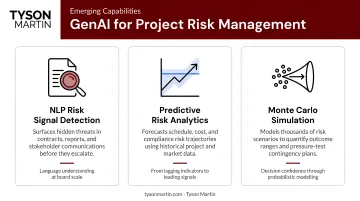
Three capabilities make GenAI meaningfully different from previous risk tools:
- Natural language processing (NLP): Scans unstructured sources—emails, vendor contracts, meeting notes, status reports—to surface risks buried in text that never makes it into a risk register
- Predictive analytics: Flags early signals of schedule slippage, budget creep, or resource constraint by analyzing patterns across historical project data and current inputs
- Scenario simulation: Models what-if situations (supplier failure, regulatory change, key resource loss) and evaluates mitigation options before risks materialize
A 2025 infrastructure project study published in ScienceDirect reported 85.3% accuracy and an 86.6% F1 score for an AI-driven risk identification model—outperforming the subjective, labor-intensive nature of traditional expert-led assessments. That result matters, but it reflects one project context. AI improves pattern detection and risk coverage where training data is strong and project conditions are well-defined—not across every environment by default.
The Governance Layer Most Implementations Miss
GenAI doesn't replace the risk decision—it changes what information reaches decision-makers and how fast. For boards and executives, the quality of AI-surfaced risk data directly shapes the quality of their oversight. Poor signals produce poor decisions, delivered at higher speed.
That speed advantage disappears if the AI itself is ungoverned. GenAI introduces its own risks into the project environment:
- Hallucination: AI can generate plausible-sounding risk assessments that are factually wrong. In Mata v. Avianca, a federal court sanctioned lawyers $5,000 after attorneys submitted fabricated ChatGPT-generated cases—a direct analogy for unvalidated AI outputs reaching board reporting
- Data privacy exposure: Cisco found that 48% of GenAI users entered non-public company information into GenAI tools
- Algorithmic bias: Skewed historical project data produces skewed risk predictions—confidently delivered
Governing the AI's own risk profile belongs in the same framework as the risks it monitors. Without that layer, boards receive faster reporting with no way to assess whether what they're reading is reliable.
How to Use Generative AI for Project Risk Management
Effective deployment follows a structured sequence. Skipping steps doesn't save time—it creates blind spots that surface later as incidents or audit failures.
Step 1: Define the Risk Governance Framework Before Selecting Tools
This is where most organizations fail. They select a tool, then try to retrofit governance around it.
Before any GenAI tool is introduced, establish:
- Who owns each risk category, who approves escalation, and at what threshold a GenAI-flagged risk requires human review or board-level visibility
- Who can sign off on risk acceptance, for how long, and under what conditions (silence is not approval)
- Evaluate GDPR, HIPAA, OCC model risk guidance, and sector-specific requirements against any GenAI tool before deployment, not after
Without this structure, AI outputs accumulate without accountability. Every risk flag becomes a debate rather than a decision.
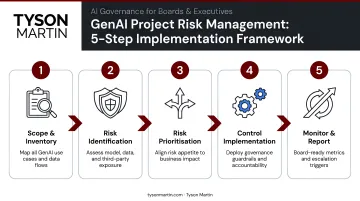
Step 2: Integrate Quality Data Sources
Connect the GenAI system to both structured and unstructured data:
- Schedules, budgets, resource logs, and incident history (structured sources)
- Stakeholder communications, meeting notes, and vendor contracts (unstructured sources)
Then audit data quality before integration. Gartner projects that 60% of AI projects not supported by AI-ready data will be abandoned through 2026, and 63% of organizations already lack — or are unsure they have — the right AI data-management practices. Biased, incomplete, or siloed historical data produces inaccurate risk flags, eroding trust quickly — teams either dismiss legitimate alerts or overreact to noise.
Step 3: Configure Risk Identification and Prioritization Parameters
Define the risk categories the system should monitor:
| Risk Category | Key Data Inputs | Escalation Trigger |
|---|---|---|
| Schedule risk | Milestone tracking, dependency logs | Slippage beyond defined threshold |
| Budget risk | Spend actuals vs. forecast | Variance exceeding approved tolerance |
| Resource risk | Capacity logs, attrition signals | Critical role coverage drops |
| Vendor/third-party risk | Contract terms, SLA performance | Breach or non-response flag |
| Compliance risk | Regulatory deadlines, audit findings | Obligation missed or approaching |
| Cybersecurity risk | Vulnerability feeds, access logs | Severity threshold breach |
Set probability and impact thresholds that determine when a flagged risk moves from automated monitoring to active human review. This is where decision rights stop being theoretical and become operational.
Step 4: Run Scenario Simulations and Validate Outputs
Use GenAI's simulation capabilities to stress-test mitigation options before risks materialize. Ask the system: what happens if the primary vendor fails in month four? What if a regulatory change arrives mid-project? This converts AI from a detection tool into a planning tool.
Require human validation of AI-generated risk assessments before they influence project decisions or board reporting. This "human-in-the-loop" checkpoint is the primary control against hallucinated or biased outputs.
For organizations building governance-ready risk structures quickly, engaging an experienced interim CISO or board advisor at this stage ensures the validation process is both credible and auditable , not a formality.
Step 5: Establish Continuous Monitoring and Reporting Cadence
Move from periodic risk reviews to continuous monitoring. GenAI should feed a live risk dashboard that shows trend over time, not just point-in-time snapshots. Boards need to see what changed since the last briefing , not a static inventory.
Define reporting standards that translate AI-generated risk data into plain-language summaries for non-technical executives:
- Current risk posture, stated plainly
- What changed since the last review and whether it moved in a better or worse direction
- The specific decision required from leadership
Raw model outputs belong in appendices, not board presentations.
Key Variables That Determine Whether GenAI Risk Management Succeeds
Getting the tool right matters far less than getting these underlying conditions right.
Data Quality and Representativeness
GenAI models learn from training data and current inputs. If historical project data is incomplete, siloed, or skewed by a handful of outlier projects, the model's risk predictions will reflect those distortions, delivered with false confidence. Poor data produces alert noise that erodes trust in the system over time.
Decision Rights Clarity
GenAI surfaces risk faster and at greater volume than manual methods. Without clear escalation thresholds, teams are flooded with signals they cannot act on. A 2024 systematic review in clinical decision support found that alerts were overridden 90% of the time when they lacked clear ownership and actionability. The parallel for AI risk tools without defined decision rights is direct.
Organizations with defined escalation paths see faster, more targeted responses. Without them, alert fatigue sets in and governance breakdowns follow at the executive level.
Human Oversight Design
Generative AI is probabilistic, not definitive. It can hallucinate plausible risk scenarios that didn't occur, and it can miss novel risks that fall outside its training data. Human checkpoints aren't optional: they are the primary control.
Projects with structured review cycles catch AI errors before they influence resource allocation or stakeholder reporting. Those without them risk compounding bad decisions at speed.
Regulatory and Compliance Alignment
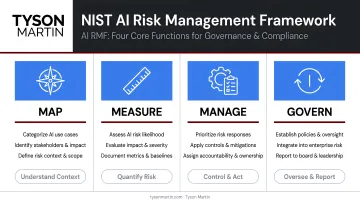
The NIST AI RMF organizes AI lifecycle risk management around four functions: GOVERN, MAP, MEASURE, and MANAGE. The EU AI Act requires high-risk AI systems to treat risk management as a continuous iterative process across the entire lifecycle, not a one-time configuration decision.
In regulated industries, how GenAI processes project data—who sees outputs, how risk data is stored, what crosses jurisdictional lines—may itself create compliance exposure. A GenAI deployment that surfaces valuable risk insights but inadvertently violates data residency requirements creates a net negative.
Sector-specific alignment matters here:
- Financial services: Evaluate GenAI risk tools against OCC model risk management guidance
- Healthcare: Align deployments with HHS Trustworthy AI principles
- Retail and consumer data: Honor FTC privacy commitments throughout the data lifecycle
Common Mistakes and Governance Gaps to Avoid
Skipping Governance Design
The most common and costly mistake: selecting a GenAI risk tool before establishing who owns the risk decisions it will surface. Deploying AI without decision rights is like installing a fire alarm with no one assigned to call the fire department — when the alert fires, no one moves.
Treating AI Outputs as Authoritative
GenAI can produce hallucinated risk assessments that sound credible and specific. Organizations that route AI-generated risk flags directly into project decisions or board reporting without a human validation step are building their oversight on untested ground. The Mata v. Avianca example isn't an edge case—it's a preview of what happens at scale when AI outputs skip verification.
Neglecting the AI's Own Risk Profile
Most organizations focus on using GenAI to monitor project risk but fail to govern the AI's own risk profile. Cisco found 62% of GenAI users entered internal process information into AI tools—and Samsung reportedly banned employee use of ChatGPT entirely after sensitive code leaked into the model.
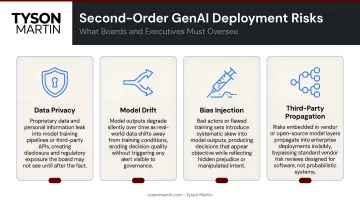
Second-order risks that commonly go unmanaged:
- Data privacy exposure from feeding sensitive project data into third-party models
- Model drift that degrades accuracy over time without detection
- Prompt injection vulnerabilities that can corrupt AI outputs
- Algorithmic bias from skewed training data
Engaging a fractional CISO or technology governance advisor early in the deployment helps organizations map these risks before they become incidents.
Reporting Trivia Instead of Trend
Feeding AI-generated risk data into board reports without translating it into plain-language trend summaries and clear decision points wastes the technology's value. Executives need to know what changed and what decision is required. The right report answers two questions: what shifted since last time, and what action does it require? If it can't answer both in under two minutes, it isn't a governance tool—it's a filing system.
Conclusion
Generative AI can make project risk management faster, more accurate, and more proactive—but only under specific conditions. Governance must be designed before deployment, not retrofitted after the first incident. Data quality and human oversight aren't supporting features; they determine whether AI output is usable at all.
The organizations that extract the most value from AI-driven project risk management treat governance as a precondition, not an afterthought. Decision rights need to be defined before the first tool goes live. Escalation thresholds must hold under real pressure—not just in documentation. And board reporting has one job: translate AI signals into choices executives can act on, not add to the noise they're already managing.
The AI doesn't close the governance gap. It exposes it. Organizations that do this well aren't distinguished by the tools they deploy—they're distinguished by the decision-making infrastructure those tools plug into.
Frequently Asked Questions
How can generative AI help manage risk?
GenAI helps manage risk by rapidly analyzing large volumes of structured and unstructured data to identify emerging threats, simulate what-if scenarios, and generate real-time alerts. This replaces slow, manual risk registers with continuous, adaptive monitoring that surfaces risks earlier and across a broader range of inputs than traditional methods.
How does AI help in risk management in project management?
AI helps project risk management by predicting schedule delays, budget overruns, and resource shortfalls before they occur—using historical project data and current inputs to flag risks earlier than traditional review cycles. It also recommends mitigation strategies and enables scenario planning before risks escalate.
How can generative AI be used in project management?
Key GenAI applications in project management include:
- Automated risk identification via NLP across contracts and communications
- Scenario simulation for mitigation planning
- Real-time dashboard reporting
- Plain-language risk summaries for stakeholder and board communication
What are the 5 P's of risk management?
The 5 P's of risk management are Plan, People, Process, Performance, and Politics. GenAI most directly strengthens Plan and Process—through continuous data analysis and proactive scenario modeling that surfaces risks before they require reactive decisions.
What are the biggest risks of using generative AI in project risk management?
The top risks are AI hallucination producing inaccurate risk assessments, data privacy exposure from feeding sensitive project information into GenAI tools, algorithmic bias from skewed training data, and lack of human oversight allowing unvalidated AI outputs to drive project decisions.
How should boards oversee AI-driven project risk management?
Boards should require that AI outputs are human-validated before influencing material decisions, mandate plain-language risk trend reporting rather than raw AI outputs, and confirm the AI deployment is governed under the organization's technology risk framework—with defined escalation thresholds for board visibility.