Introduction
Boards are being asked to govern AI they don't fully understand — and the pressure is real. According to NACD's 2025 survey, 62% of directors now set aside agenda time for full-board AI discussions. Yet only 16% have developed a formal AI strategy or policy, and just 15% have conducted an AI risk assessment.
That attention-to-action gap is where framework selection becomes consequential. Two frameworks dominate the conversation: ISO 42001 and the NIST AI Risk Management Framework.
Choosing between them isn't a compliance exercise. The choice shapes how AI risk gets reported to the board, how accountability is assigned across the organization, and how defensible your decisions become when regulators or incidents arrive.
This article covers both frameworks in practical terms: what each requires, where each fits, and how to decide between them.
Key Takeaways
- ISO 42001 is a certifiable international standard built around a formal AI Management System (AIMS), using the Plan-Do-Check-Act model
- NIST AI RMF is a voluntary U.S. framework organized around four functions: Govern, Map, Measure, and Manage — no certification required
- Both published in 2023; neither is legally required in the U.S., but ISO 42001 assumes a more mature compliance program
- ISO 42001 suits organizations needing audit-ready documentation and global credibility
- NIST AI RMF suits organizations wanting adaptable risk guidance without certification overhead
- Many regulated organizations run both — NIST for internal risk management, ISO 42001 for external validation
ISO 42001 vs. NIST AI RMF: At a Glance
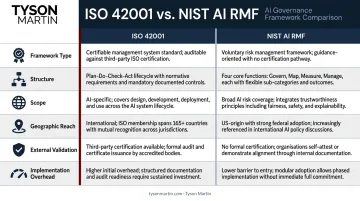
The table below captures the core structural differences between ISO 42001 and the NIST AI RMF — useful for boards and risk committees deciding which framework fits their governance posture.
| Dimension | ISO 42001 | NIST AI RMF |
|---|---|---|
| Framework Type | Certifiable management system standard | Voluntary guidance framework (no certification) |
| Structure | Plan-Do-Check-Act (PDCA) | Four functions: Govern, Map, Measure, Manage |
| Scope | Full AI lifecycle with documented governance requirements | Flexible, sector-agnostic, adaptable to context |
| Geographic Reach | International recognition, cross-border compliance | U.S.-developed, most referenced in U.S. regulatory contexts |
| External Validation | Yes — through accredited certification bodies | No — internally owned risk posture |
| Implementation Overhead | Higher — requires formal audits and documentation | Lower — self-directed using NIST playbook |
What Is ISO 42001?
ISO/IEC 42001:2023 is the first international standard for an Artificial Intelligence Management System (AIMS), published by ISO in December 2023.
What makes it distinct from guidance documents is certifiability. Organizations can engage an accredited third-party certification body to independently verify their AIMS — giving auditors, enterprise customers, and regulators something concrete to examine.
How the PDCA Model Works in Practice
ISO 42001 uses the same Plan-Do-Check-Act structure familiar from ISO 27001 and ISO 9001. For boards and risk committees, this translates to:
- Plan — Define AI policy, conduct risk assessments across the AI lifecycle, establish roles and responsibilities
- Do — Implement controls, document processes, deploy AI within the governance structure
- Check — Monitor performance, run internal audits, measure against objectives
- Act — Address nonconformities, drive continuous improvement cycles
This structure maps directly to what a board audit committee expects to oversee: documented policy, assigned accountability, evidence of monitoring, and a clear process for correcting failures.
Integration with Existing ISO Standards
ISO 42001 uses the same harmonized clause structure as ISO 27001 and ISO 9001. For organizations already certified in either standard, this reduces implementation friction: existing management system documentation, internal audit processes, and governance structures can be extended rather than rebuilt from scratch.
Use Cases for ISO 42001
ISO 42001 fits best where AI decisions carry significant consequences and external scrutiny is likely:
- Clinical decision support and patient triage systems in healthcare
- Credit scoring, benefits eligibility, and automated lending decisions in financial services
- Workforce management and hiring tools where regulatory exposure exists
- Enterprise AI vendor relationships where customer due diligence requirements apply
The certification ecosystem is still maturing. ANAB launched its ISO/IEC 42001 accreditation program in January 2024, with 15 applicant or accredited certification bodies participating. In the UK, UKAS granted BSI the first accreditation for ISO/IEC 42001 certification of AI management systems. Certification requires auditors qualified under the separate BS ISO/IEC 42006:2025 standard.
Early adopters span multiple sectors. Viz.ai achieved ISO/IEC 42001 certification for agentic AI in healthcare in May 2026. Nitrogen, a financial advisor technology platform, announced certification in March 2026, claiming to be the first known company in wealth management technology to receive it. Microsoft lists ISO/IEC 42001:2023 among its compliance offerings.
What Is the NIST AI Risk Management Framework?
The NIST AI RMF 1.0 was released on January 26, 2023, by the U.S. National Institute of Standards and Technology. It is explicitly voluntary, non-sector-specific, and applicable across use cases — designed to help organizations manage AI risks across the full system lifecycle without prescribing a particular management structure.
The Four Core Functions
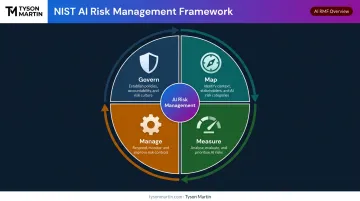
For executive decision-makers, the four functions work as a risk management operating model:
- Govern — Establish the cultural, policy, and organizational foundation for AI risk management, including accountability structures, risk tolerance, and governance policies
- Map — Understand the context, purpose, and potential harms of each AI system. Categorize AI use cases by risk level
- Measure — Assess, monitor, and benchmark risk and performance attributes against defined criteria
- Manage — Prioritize, respond to, and communicate identified risks, then maintain and improve those responses as conditions change
NIST's Trustworthiness Attributes
NIST defines seven characteristics of trustworthy AI that give boards a useful vocabulary for risk discussions:
- Valid and reliable
- Safe
- Secure and resilient
- Accountable and transparent
- Explainable and interpretable
- Privacy-enhanced
- Fair with harmful bias managed
The Generative AI Profile
NIST AI 600-1, published July 2024, introduces a Generative AI Profile identifying 12 specific risk categories — including Confabulation, Data Privacy, Harmful Bias or Homogenization, Information Integrity, and Value Chain and Component Integration. Boards overseeing GenAI deployments can use these categories directly to structure risk reporting and define what requires escalation.
Use Cases for NIST AI RMF
The framework's flexibility makes it the practical starting point for a wide range of organizations — particularly those that need structure before any compliance obligation exists:
- Organizations building internal AI governance programs from scratch
- U.S. federal agencies and government contractors (OMB M-24-10 encouraged agencies to incorporate NIST AI RMF best practices)
- Financial services firms — Treasury released a Financial Services AI Risk Management Framework that adapts NIST AI RMF to sector-specific needs
- Critical infrastructure operators (DHS issued AI safety guidelines in April 2024 organized around NIST AI RMF functions)
The NIST AI RMF Playbook maps suggested actions to each function and is updated continuously, so organizations can treat it as an evolving reference rather than a one-time implementation guide.
Key Differences That Matter for Boards and Risk Leaders
Certification vs. Internal Ownership
The most consequential difference for board oversight: ISO 42001 produces an externally validated, certifiable result. NIST AI RMF produces an internally-owned risk posture. Both have value, but they serve different audiences.
ISO 42001 certification gives regulators, enterprise clients, and insurers something they can independently verify. NIST AI RMF risk assessments, without additional reporting structure, are harder to communicate upward — they describe what you know about AI risk, but don't automatically produce the evidence trail an auditor expects.
Implementation Burden
- ISO 42001 requires documented policies, formal governance structures, ongoing audits, and third-party certification body involvement. This demands meaningful resource investment and may affect AI deployment timelines
- NIST AI RMF can be implemented using the self-directed Playbook. The flexibility that makes it accessible can also produce inconsistent application across business units without deliberate governance design
Regulatory Alignment
| Context | Better Fit |
|---|---|
| EU AI Act alignment | ISO 42001 (SGS and similar certification bodies offer EU AI Act assurance services built around it) |
| U.S. federal agency alignment | NIST AI RMF (OMB and Treasury directly reference it) |
| Cross-border operations | Both frameworks in a crosswalk approach |
| Domestic U.S. only | NIST AI RMF as primary |
Risk Reporting to the Board
ISO 42001's documentation requirements map naturally to board audit and compliance reporting. The standard's PDCA structure produces evidence of governance that can be presented directly to an audit committee.
NIST AI RMF's four-function model can feed executive dashboards, but that translation requires deliberate effort. The framework defines what to think about, not how to report it upward. Organizations relying on NIST AI RMF for internal governance need a separate reporting layer to surface trend, accountability, and escalation triggers for board consumption.
That gap is where the real work happens: converting framework outputs into stable metrics, clear delegation thresholds, and board-ready reporting that shows what changed, what decisions are pending, and who owns them.
Which Framework Is Right for Your Organization?
The honest answer depends on four factors: where you're regulated, how mature your AI program is, what your board expects to see, and whether you need external validation or internal risk language.
Decision Guide
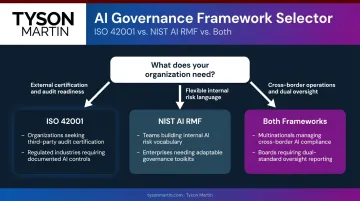
Choose ISO 42001 if:
- You operate in a heavily regulated sector (healthcare, financial services, critical infrastructure)
- Enterprise customer due diligence requirements demand third-party assurance
- You're already ISO-certified in adjacent areas (ISO 27001, ISO 9001) and want to extend that investment
- EU AI Act alignment is relevant to your operations
Choose NIST AI RMF if:
- You're building your first AI governance program and need a flexible starting point
- Your operations are primarily U.S.-focused
- You need a GenAI-specific risk taxonomy (NIST AI 600-1's 12 risk categories)
- Certification overhead would slow AI governance adoption across the organization
Choose both if:
- You operate across U.S. and international jurisdictions
- You want NIST AI RMF as internal risk management language and ISO 42001 as external validation
- You serve regulated markets where both domestic and international governance scrutiny applies
Three Scenarios in Practice
Scenario 1 — Regional Healthcare System: A health system deploying AI for clinical decision support needs audit-ready governance. Regulators, accreditors, and enterprise partners expect documented evidence of how AI decisions are governed, reviewed, and corrected. ISO 42001 leads, with NIST AI RMF informing the internal risk assessment layer.
Scenario 2 — Financial Services Firm: A financial services firm building its first AI risk program needs flexibility. NIST AI RMF's four-function model — and Treasury's financial services adaptation of it — provides the right starting framework. ISO 42001 becomes a future-state objective as the program matures and external validation needs increase.
Scenario 3 — Retail Enterprise with U.S. and EU Operations: A retail enterprise managing third-party AI vendors across jurisdictions needs both frameworks in a crosswalk approach. NIST AI RMF governs the internal AI risk portfolio; ISO 42001 provides the external assurance structure for cross-border regulatory alignment. NIST publishes a crosswalk document mapping NIST AI RMF to ISO/IEC 42001, which makes this integration tractable.
The practical question is which governance structure your board can inspect, your management team can execute, and your regulators will recognize. That answer looks different for a regional health system than it does for a global retailer. Advisory work across enterprise environments, including large-scale AI programs at AWS, Home Depot, and Best Buy, shapes how these framework decisions translate into executable governance priorities — and that's where fractional CISO and board advisory engagement delivers its most direct value.
Conclusion
Neither framework wins outright. ISO 42001 and NIST AI RMF were designed for different organizational postures, and both belong in a mature AI governance program — just in different roles.
The right choice depends on three factors:
- Where you're regulated — international exposure favors ISO 42001's certification path
- How developed your AI program is — early-stage programs benefit from NIST AI RMF's flexibility
- What your board needs now — external validation or internal risk management language
For many organizations in financial services, healthcare, and retail, the answer is a sequenced approach: NIST AI RMF to build internal governance language, ISO 42001 to validate it externally.
What matters to a board isn't which framework you chose — it's whether you have a stable view of AI risk posture, clear accountability for AI decisions, and the ability to escalate and respond when something goes wrong. Both frameworks are instruments for getting there. The work is translating their requirements into governance decisions with named owners — not filling out a compliance checklist and filing it away.
Frequently Asked Questions
How does ISO 42001 compare to the NIST AI Risk Management Framework?
ISO 42001 is a certifiable international management system standard (PDCA model) that produces independent third-party validation. NIST AI RMF is a voluntary U.S. framework structured around Govern, Map, Measure, and Manage that produces an internally-owned risk posture. Both address AI risk management; the core difference is external certification versus internal governance.
What is the NIST AI Risk Management Framework?
A voluntary guidance framework published by NIST in January 2023, structured around four core functions: Govern, Map, Measure, and Manage. It is widely referenced by U.S. federal agencies as a de facto AI governance baseline, with no mandatory certification requirement.
What are the main types of AI risk?
Both frameworks cover technical risks (bias, model drift, hallucination), operational risks (insufficient oversight, misuse), and societal risks (privacy violations, discriminatory outcomes). NIST's Generative AI Profile (AI 600-1) further identifies 12 GenAI-specific categories, including Confabulation, Data Privacy, and Harmful Bias or Homogenization.
Can an organization implement both ISO 42001 and NIST AI RMF simultaneously?
Yes — they are complementary, not competing. Many organizations use NIST AI RMF for internal AI risk management and portfolio oversight while pursuing ISO 42001 certification for external credibility and audit readiness. NIST publishes a crosswalk document mapping its framework to ISO 42001 to support this dual approach.
Which AI governance framework is better for regulated industries like healthcare or finance?
Regulated industries typically benefit from ISO 42001's certifiable approach, which produces the audit-ready documentation regulators and enterprise clients expect. NIST AI RMF complements this as the primary reference in U.S. federal and sector-specific regulatory guidance.
Is ISO 42001 certification mandatory?
ISO 42001 certification is voluntary in the U.S. and most jurisdictions — no U.S. regulator currently mandates it. For organizations in regulated sectors or international markets, it carries real weight with auditors and enterprise clients as AI governance scrutiny increases.