Introduction
Most executives treat contracts as a legal department problem—until they aren't. A vendor breach surfaces during an incident. An auto-renewal locks in a relationship that stopped performing months ago. A missing data handling clause triggers a regulatory inquiry. By then, an administrative gap has become a financial, legal, or reputational problem.
This pattern is especially acute in financial services, healthcare, and retail. Contract obligations in these sectors intersect with regulatory requirements, third-party cybersecurity risk, and fiduciary accountability. A missing HIPAA business associate agreement isn't a paperwork problem — it's a settlement waiting to happen.
According to World Commerce & Contracting, effective contract management could save organizations an average of 9% of annual revenue. At scale, that's a board-level exposure, not a back-office inefficiency.
This guide covers contract risk and compliance at the executive level — governance structure, decision rights, and the practices that protect organizations without slowing operations.
Key Takeaways
- Organizations lose an average 11% of contract value—and most of that leakage occurs post-signature, not during negotiation
- Contract compliance is a continuous post-signature discipline, not a one-time pre-signature check
- Accountability is typically fragmented across 7+ functions—and only 11% of organizations rate their end-to-end process as effective
- Third-party involvement now accounts for 30% of breaches, making vendor contract governance a security priority
- Boards need risk posture summaries covering exposure, trends, and decisions—not contract status lists
What Is Contract Risk? The Hidden Exposures Executives Must Know
Contract risk is any unforeseen issue—unclear language, unmonitored obligations, or regulatory gaps—that negatively affects the financial, legal, or operational outcome of an agreement. The critical nuance: risk doesn't only emerge from bad contracts. It also emerges from good contracts that no one is actively monitoring.
The Four Categories Executives Should Know
Financial risk: Unclear pricing escalations, missing liability caps, and unmonitored auto-renewals that drain budget without review. WorldCC's Most Negotiated Terms research found 76% of respondents negotiate limitation of liability clauses frequently, yet many organizations still execute agreements without defined caps.
Legal and compliance risk: Contracts lacking required regulatory clauses create direct exposure. HHS/OCR reached a $750,000 settlement with Raleigh Orthopaedic Clinic after the clinic disclosed PHI for roughly 17,300 individuals without a business associate agreement in place. A missing clause. A six-figure consequence.
Operational risk: Ambiguous SLAs, undefined milestones, and vendor underperformance that only become visible when something breaks. Uptime Institute's 2024 analysis found 54% of significant outages cost more than $100,000, with third-party provider issues contributing to nearly 1 in 10 outages.
Cyber and third-party risk: Vendor contracts that grant system access without adequate security controls, defined breach notification timelines, or audit rights. Verizon's 2025 Data Breach Investigations Report found third-party involvement in 30% of breaches, up from roughly 15% the prior year.
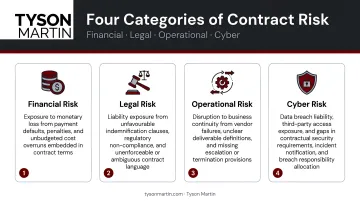
These categories don't fail independently. When operational performance goes unmonitored, financial exposure grows silently. When vendor cyber risk isn't contractually defined, a single breach can trigger compliance consequences that dwarf the original contract value. The board question isn't which risk category applies—it's how many are active at once.
What Is Compliance in a Contract?
Contract compliance is the ongoing process of ensuring all parties fulfill the obligations, regulatory requirements, and performance standards embedded in an agreement. The word "ongoing" carries the full weight here.
Compliance is not a pre-signature review. It doesn't end at execution. A contract can be perfectly drafted and still generate real financial and regulatory exposure if no one is monitoring whether its terms are being met twelve months later.
The Four Pillars That Shape Compliance Responsibility
Every agreement rests on four foundational elements. Weakness in any one of them creates compounding risk across the contract's lifecycle:
- Offer and acceptance — Clear scope and obligations. Vague scope is where "fix everything" creep begins, and where accountability collapses.
- Consideration — Financial terms and payment conditions. Imprecise payment terms distort forecasting and create disputes.
- Legal validity — Regulatory alignment and enforceability. Contracts that lack jurisdiction definitions or required regulatory clauses aren't just incomplete—they're liabilities.
- Performance — SLAs, deliverables, and audit rights. Without measurable performance standards and the right to verify them, vendors operate without accountability.
Performance is where most compliance failures actually surface. Audit rights go unexercised, SLAs go untracked, and renewal windows close without a single performance review — not because organizations lack the contract language, but because no one owns the monitoring function.
A Contract Risk Management Framework for Boards and Executive Teams
Mature organizations treat contract risk the way they treat any other enterprise risk: with defined standards, ownership, thresholds, and reporting. A contract risk management framework is a governed, repeatable process that operates across the full contract lifecycle—not a one-time legal review.
KPMG and WorldCC found the average contracting lifecycle involves at least 7 functional owners, yet only 11% of organizations rate their end-to-end process as very effective. The framework below addresses why.
Step 1: Establish Risk Standards and Tolerance
Every framework starts with the board and executive team defining what acceptable contract risk looks like. This means:
- Approved clause standards and fallback language
- Liability thresholds by deal value
- Escalation triggers for non-standard terms
- Which contract types require security or legal review before execution
Without defined tolerance, every team makes independent risk calls. Those calls accumulate into portfolio-level exposure that no single function can see.
Step 2: Identify and Score Risk Early
Risk identification should begin at intake—before negotiation starts. Standardized templates, clause libraries, and structured intake processes surface financial, legal, operational, and cyber risk categories early, when they're still cheap to resolve.
WorldCC's 2023 Benchmark Study found 74% of organizations use standard templates, but only 34% have a comprehensive clause library. The gap between those two numbers is where risk enters undetected.
Step 3: Mitigate Through Governance Controls
Mitigation happens at two levels:
- Contract level: Pre-approved fallback language, indemnification clauses, liability caps, insurance requirements, audit rights, and security addenda for any vendor with data or system access
- Governance level: Approval workflows, cross-functional sign-off requirements, and documented risk acceptance decisions with a named authority
Documenting accepted risk is non-negotiable. When an auditor asks why a non-standard clause was approved, "we discussed it" is not an answer.
Step 4: Monitor Continuously Post-Signature
Most contract value leakage and compliance failures happen after execution—not during negotiation. Effective post-signature monitoring requires:
- Extracting all obligations and assigning cross-functional owners
- Setting reminders for renewal windows and compliance deadlines
- Tracking SLA and KPI performance against contract terms
- Providing boards with portfolio-level risk reporting—not individual contract status
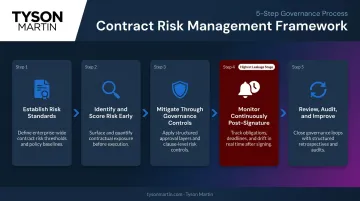
This is where the 11% contract value leakage WorldCC identified actually occurs. The contracts exist and the obligations are written—but without active monitoring, no one catches the drift until it becomes a loss.
Step 5: Review, Audit, and Improve
The governance loop closes through periodic audits of the contract portfolio, focusing on high-value, long-duration, and high-risk agreements. A functional audit cycle includes:
- Reviewing clause performance and flagging terms that created disputes or exceptions
- Feeding audit findings back into clause libraries and risk thresholds
- Tracking which non-standard terms were accepted and whether the underlying rationale still holds
- In regulated industries: the audit committee and general counsel should jointly set the cadence and scope
This step is where the framework earns its name. Without it, standards drift, thresholds become outdated, and the process reverts to ad hoc reviews.
Who Owns Contract Compliance? Clarifying Decision Rights Across the Enterprise
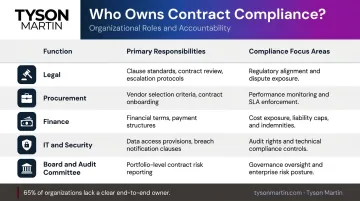
Contract compliance fails most often not because organizations lack policies, but because accountability is fragmented. Legal thinks procurement owns it. Procurement thinks legal owns it. IT doesn't know it's involved. This is the governance problem that boards need to resolve through explicit decision rights—not org charts.
WorldCC's 2023 study found 65% of organizations lack a clear owner for the end-to-end contracting process.
Functional Accountability Breakdown
| Function | Core Responsibility |
|---|---|
| Legal | Clause standards, regulatory alignment, escalation paths for non-standard terms |
| Procurement | Vendor selection, due diligence, performance obligation monitoring |
| Finance | Financial term monitoring, payment schedules, cost exposure from deviations |
| IT & Security | Contracts involving system access, data handling, breach notification, audit rights |
| Board/Audit Committee | Portfolio-level risk posture reporting, regulatory change oversight |
Legal cannot be the sole post-signature monitor. Finance can't catch cyber risk. IT won't flag missing indemnification clauses. Each function has a lane—and the accountability needs to be written down, not assumed.
The Security Governance Layer
Boards in regulated industries are increasingly expected to demonstrate oversight of third-party cyber risk. Contracts are the primary mechanism for enforcing it. When a vendor has access to systems, data, or cloud infrastructure, IT and security must be involved in contract review—not notified after signature.
This accountability gap widens during M&A, leadership transitions, or post-incident recovery, when contract governance gets deprioritized. During these windows, organizations engaging fractional or interim CISOs gain a governance layer that can establish enforceable contract standards, define vendor risk tiers, and build the escalation structures board oversight actually requires. Tyson Martin's work with boards focuses specifically on this: building inspectable execution frameworks for vendor contracts so that accountability holds before an incident surfaces the gap.
What Board Reporting Should Look Like
Boards don't need a contract status list. They need a risk posture summary:
- Exposure concentration by category (financial, compliance, cyber)
- Outstanding obligations at risk, with owners
- Renewal pipeline with performance context
- Regulatory changes affecting existing contract terms
- Decisions requested—with options, not just updates
The distinction matters. A list of vendor names tells a board nothing actionable. A dashboard showing three critical vendors with open control gaps, two renewals arriving in 60 days, and one exception aging past its deadline gives the board something to govern.
Best Practices to Reduce Contract Risk Without Slowing the Business
Standardize Before You Scale
A clause library and pre-approved template system is the highest-leverage investment in contract risk reduction. It embeds controls into every agreement without requiring legal review on every deal. Templates should be reviewed whenever regulations change or when audit findings reveal recurring vulnerabilities—not just at annual policy review cycles.
Build Cross-Functional Accountability Into the Process
Assigning post-signature owners for each obligation type is the easy part. Making it stick requires more:
- Reminders and dashboards tied to deadlines
- Escalation thresholds that trigger automatically
- Named authority for exception decisions
Ownership without a monitoring process is organizational theater. The governance has to be operationalized, not just documented.
Integrate Cyber and Third-Party Risk into Contract Governance
Operationalizing that governance matters most where the exposure is highest: vendor relationships that touch your data or infrastructure. Contracts involving data access, cloud infrastructure, or system integration should go through a security review before execution. The priority clauses to verify:
- Breach notification timelines (in hours, not "reasonable time")
- Audit rights and evidence cooperation language
- Subcontractor flow-down and approval requirements
- Data ownership and deletion on termination
- Security requirements: MFA, encryption, least privilege, logging
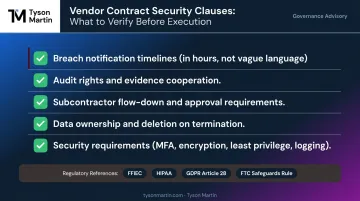
FFIEC, HIPAA, GDPR Article 28, and the FTC Safeguards Rule all require or expect specific third-party contract controls. These aren't optional—they're the contractual evidence regulators look for during examinations.
Monitor Renewals as a Strategic Risk
Unmanaged auto-renewals carry two distinct risks: financial exposure from paying for underperforming vendor relationships, and compliance exposure from renewing into terms that no longer meet current regulatory requirements. Reviewing renewal-bound contracts in advance, with current performance data and regulatory context in hand, is a deliberate policy choice. That review should happen before the auto-renewal window closes—not after.
Frequently Asked Questions
What are examples of contract risk?
Common examples include missed payment terms, ambiguous liability clauses, unenforced vendor system access, missing HIPAA business associate agreements, and auto-renewals with no performance review. These exposures are financial, legal, operational, or cyber in nature — and each category tends to amplify the others when contracts go unmonitored.
What is compliance in a contract?
Contract compliance is the ongoing process of ensuring all parties fulfill the obligations, regulatory requirements, and performance standards stated in an agreement. This is a continuous post-signature responsibility — not a one-time review — and it requires named owners with active oversight authority.
What are the 4 pillars of a contract?
The four pillars are offer and acceptance (clear scope and obligations), consideration (financial terms and payment conditions), legal validity (enforceability and regulatory alignment), and performance (deliverables, SLAs, and audit rights). Weakness in any pillar creates compounding risk across the contract's lifecycle.
Who is responsible for contract compliance in an organization?
Responsibility is cross-functional: legal owns clause standards and regulatory alignment; procurement and finance own vendor performance and financial terms; IT and security own technology-related obligations. The board's audit or risk committee should receive portfolio-level reporting — but ownership is frequently assumed rather than formally assigned.
How does contract risk connect to cybersecurity and vendor risk?
Vendor contracts are the primary vehicle through which third-party cyber risk enters the enterprise — governing system access, data handling, breach notification timelines, and subcontractor controls. When those clauses are absent or unenforced, organizations typically discover the gap during an incident, not before it.
What is the difference between contract management and contract risk management?
Contract management covers the administrative lifecycle — drafting, execution, and renewal. Contract risk management proactively identifies and mitigates the financial, legal, operational, and cyber exposures embedded in those contracts. Both are necessary; the distinction is that risk management requires a governance layer, not just a process owner.