Introduction
Boards in 2026 are being asked to approve AI strategies, oversee AI risk, and hold management accountable — sometimes within a single agenda item. The problem isn't the workload. It's that "AI risk assessment" and "AI governance policy" are being treated as two names for the same conversation.
They aren't. And the gap between them is where governance actually breaks down.
According to a 2025 EY survey, 80% of organizations still need to develop risk management controls for AI — even as deployment accelerates. Separately, only 18% have an enterprise-wide council with actual authority over responsible AI governance. This article explains what that separation requires in practice — and why regulators in 2026 are no longer treating it as optional.
Key Takeaways
- AI risk assessment identifies which systems carry risk, what those risks are, and how severe — producing a prioritized risk register, not rules.
- AI governance policy defines how AI is approved, deployed, monitored, and retired, based on risk tolerance, regulatory obligations, and business goals.
- Conflating the two produces either policy written on assumptions, or risk findings that never change anything.
- Separation requires explicit decision rights — a clear owner responsible for turning risk findings into policy action.
- The EU AI Act requires proof that risk findings shaped policy controls, not just that both documents exist.
The Cost of Conflating the Two Functions
Most AI governance frameworks present risk assessment as a component of policy rather than a separate function. The NIST AI RMF's Govern/Map/Measure/Manage structure covers both, but it doesn't prescribe who performs each at the board versus management level. That ambiguity encourages organizations to treat them as one continuous activity.
Early AI adoption reinforced this. When a single team was small enough to write the policy and identify the risks, separation wasn't necessary. As AI becomes embedded across the enterprise, those two functions require different owners, different access, and different outputs.
Two failure modes result:
Policy drafted ahead of findings. The document reflects assumed risk tolerance rather than actual exposure. It sounds rigorous. It doesn't reflect what the AI systems are doing.
Risk findings with no accountable policy owner. Findings accumulate in reports without triggering changed behavior. The organization has documentation of risk, but no accountability loop for acting on it.
The board-level symptom is specific. Directors receive a mix of technical findings, compliance checkboxes, and policy language in a single package. That mix makes it impossible to answer the two questions boards need answered: What is our AI risk posture? What changed since last quarter?
Defining the Two Functions
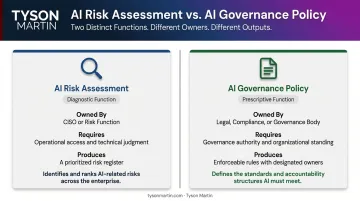
AI Risk Assessment: The Diagnostic Function
Risk assessment identifies which AI systems present risk and characterizes those risks across relevant dimensions:
- Data quality and lineage
- Model accuracy and drift
- Algorithmic bias
- Security vulnerabilities, including adversarial inputs
- Regulatory exposure under applicable frameworks
- Third-party AI dependencies
The output is a prioritized risk register — a factual account of current exposure. It answers: what is our current exposure and what could go wrong? It is grounded in observed system behavior and current conditions.
Critically, it does not tell the organization what rules to follow or what the risk tolerance should be. Those are policy questions. That boundary matters, because the moment risk assessment starts prescribing rules, it loses its diagnostic integrity.
AI Governance Policy: The Prescriptive Function
Policy defines the institutional rules governing how AI is approved, deployed, monitored, escalated, and retired. It answers: how will we govern AI going forward? It is prospective and enforceable.
The output is a set of commitments with designated owners — not a description of risk.
The Competency Distinction That Matters
These functions require different capabilities:
| Function | Requires | Produces |
|---|---|---|
| Risk Assessment | Operational access, technical judgment | Prioritized risk register |
| Governance Policy | Governance authority, organizational standing | Enforceable rules with owners |
In financial services, healthcare, and retail, this split maps to existing roles. Risk assessment typically belongs to the CISO or risk function. Policy ownership typically belongs to legal, compliance, or a governance body with board reporting responsibility. When one function is asked to carry both, the result is usually policy that lacks enforcement standing or risk registers that drift into prescription — neither does its job well.
What a Standalone AI Risk Assessment Produces
The Risk Register
A well-constructed AI risk register maps each AI system in use against specific risk dimensions. Only 30% of organizations maintain a comprehensive centralized inventory of all AI systems — meaning most organizations can't produce a complete register without first closing that inventory gap.
A completed register captures:
- Which systems carry elevated likelihood of risk materializing given current controls
- Which systems carry manageable versus urgent impact — recoverable within normal operations versus material financial, reputational, or regulatory consequence
- Where control gaps exist relative to identified risks
- Which third-party AI dependencies introduce risk the organization doesn't directly control (in financial services, 80% of institutions incorporate vendor models into their model inventories)
What the Assessment Explicitly Does Not Produce
A risk register is not a policy document. It doesn't set risk tolerance, define acceptable use, or establish the rules the organization will follow.
Those answers require governance authority — the assessment provides the factual basis, and the policy function decides what to do with it.
What an AI Governance Policy Actually Contains
A governance policy isn't a risk description — it's an institutional commitment. Three elements distinguish a functional policy from a compliance document:
1. Use Case Approval Criteria
Policy must define what categories of AI decision-making require board or executive sign-off versus what falls within management's delegated authority. Autonomous decisions affecting individual rights, AI deployment in credit underwriting or clinical decision support, and AI use cases involving sensitive personal data are examples of categories that typically warrant elevated approval thresholds.
2. Ethical Guardrails
These represent the organization's stated limits regardless of business case — what the organization will not do with AI even if it's technically feasible and commercially attractive. This is a policy function. It can't be derived from a risk assessment alone, because it requires governance authority to bind the organization to a position.
3. Escalation Thresholds
Policy must define when a risk finding triggers a policy review, when it triggers a policy update, and when it triggers board notification. Without these thresholds pre-defined, escalation becomes ad hoc — exactly the noise-instead-of-signal problem that makes board oversight reactive instead of structured.
A policy document without escalation thresholds documents aspiration. It doesn't govern.
How to Connect Them: Decision Rights and the Hand-Off
The Structural Gap Most Organizations Leave Undefined
Risk assessment findings must have a designated policy owner accountable for the institutional response. Without this assignment, the two functions operate in parallel without ever actually informing each other.
The hand-off mechanism isn't complicated to design. It rarely exists, though, without deliberate effort to build it.
The Decision Rights Matrix
A functional matrix routes findings by consequence level:
| Finding Type | Routed To | Example |
|---|---|---|
| Risk posture trend, threshold breaches | Board | Material change in high-risk AI exposure since last briefing |
| System-level findings requiring remediation | Executive team | Specific model drift exceeding defined tolerance |
| Findings within established control parameters | Risk function | Resolved without escalation per pre-approved thresholds |
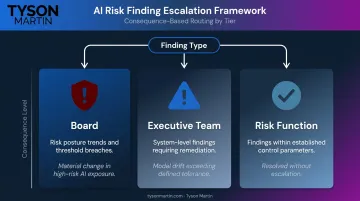
This matrix is itself a policy artifact — not a risk assessment output. It must be defined in advance, not negotiated after a finding surfaces.
The 2026 Regulatory Consequence of an Undefined Hand-Off
The EU AI Act entered into force in August 2024, with obligations for high-risk AI systems under Annex III applying from August 2, 2026. Article 9 requires providers and deployers of high-risk AI systems to establish a continuous, documented risk management system — and to demonstrate that identified risks informed specific control measures.
This applies directly to organizations in:
- Financial services: AI systems for credit scoring and insurance risk pricing are explicitly listed as high-risk under Annex III
- Healthcare: Emergency triage and patient dispatch systems; clinical decision support tools that qualify as medical devices under Annex I
- Retail: AI use cases intersecting with creditworthiness, biometric data, or essential service decisions
The enforcement standard isn't whether a risk assessment was conducted and a policy exists. It's whether the two are demonstrably connected: assessment findings must be traceable to specific policy controls.
What a Well-Functioning Hand-Off Looks Like at the Board Level
A board receiving a well-structured AI governance briefing should be able to answer four questions in plain language:
- What is our current AI risk posture?
- What changed since the last briefing?
- Which findings triggered policy action?
- What decisions require board approval versus management authority?
Most organizations can't answer all four. The gap is rarely analytical — it's structural. Tyson Martin's AI governance engagements with boards start by defining the decision rights matrix and hand-off protocols before a single finding needs to be escalated, so the structure holds when it matters.
Frequently Asked Questions
What is the role of risk assessments in AI governance?
Risk assessment is the diagnostic input that governance policy acts on — identifying what risks exist and how severe they are, so the governance structure has factual grounding for policy controls, escalation thresholds, and board reporting priorities. Without it, policy reflects assumptions rather than actual exposure.
What should be included in an AI governance policy?
At minimum, four elements: use case approval criteria (what requires board vs. management sign-off), ethical guardrails on what the organization will not do with AI, escalation thresholds connecting risk findings to policy action, and a review cadence tied to formal assessment cycles.
Who should own AI risk assessment versus AI governance policy?
Risk assessment ownership typically sits with the CISO, risk function, or a designated AI risk owner with operational access. Policy ownership sits with legal, compliance, or a governance body with board reporting authority. The decision rights framework determines how findings move between these owners.
How often should AI risk assessments be conducted?
High-risk AI systems warrant formal assessment at least annually and before any material change to the system or its use case. Continuous monitoring for model drift and performance degradation runs continuously between formal assessments. Policy review should run on the same cadence as formal assessments.
What happens when AI risk assessment and policy are treated as the same function?
Two failure modes emerge. Policy written before risk findings are available reflects assumed rather than actual exposure. Risk findings without a policy owner accumulate as documentation without changing behavior. In both cases, the board receives noise instead of a clear picture of posture and required decisions.
How does the EU AI Act affect how organizations structure AI governance and risk assessment?
For high-risk AI systems under Annex III, the EU AI Act requires organizations to document a continuous risk management system and demonstrate that identified risks informed specific policy controls. Regulators will look for evidence the two functions are connected — not just that both documents exist separately.