Introduction: Why AI Governance Has Become a Board-Level Imperative
AI governance has moved from a compliance footnote to a question boards are expected to answer directly: How are AI decisions made, audited, and controlled at the executive level?
According to McKinsey's 2024 State of AI research, 72% of organizations had adopted AI, yet only 18% had an enterprise-wide council or board with authority for responsible AI governance. By 2025, that gap widened: 88% of organizations used AI in at least one function, and 51% reported at least one negative consequence.
Most boards have inherited AI risk they cannot yet quantify, report on, or escalate clearly. The signs are familiar:
- No documented AI oversight process
- No escalation threshold when a model produces a harmful output
- No clear owner when a decision goes wrong
That internal exposure is now meeting external pressure. Regulators, investors, and auditors are no longer accepting policy documents as proof of governance. This article maps the leading AI governance consulting models and firms operating in 2026, the strategies they deploy, and what boards should demand from any governance partner.
Key Takeaways
- 72% of organizations deploy AI; only 18% have formal enterprise-wide governance authority — most boards are exposed
- Boards need formal governance structures, not values statements — AI ethics and AI governance solve different problems
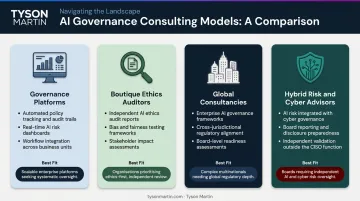
- In 2026, four consulting models cover this space: governance platforms, boutique auditors, global consultancies, and hybrid risk-and-cyber advisors
- Regulated industries increasingly need the hybrid model — governance connected to live operational controls, not just policy
- NIST AI RMF, ISO/IEC 42001, and the EU AI Act provide the framework — operational implementation is what actually closes risk
What Ethical AI Governance Actually Means in 2026
Governance vs. Ethics: A Critical Distinction
AI ethics describes what an AI system should do. AI governance is the organizational structure that ensures it actually does that — and determines who is accountable when it doesn't.
That distinction matters for boards. An ethics statement tells you a company values fairness. Governance tells you:
- Who owns the decision when a model produces a discriminatory output
- What controls prevent that output from reaching customers
- How quickly the board is notified when it does
Governance turns ethics from a statement of intent into something you can audit, defend, and act on — which is what the next section covers.
What Operational Governance Looks Like in Practice
In 2026, the leading programs connect policy to production. That means governance isn't a PDF sitting in a shared drive — it's embedded in how AI systems are built, monitored, and reported on.
Concrete indicators that governance is real, not just documented:
- AI systems require a documented risk classification before deployment
- Model behavior is monitored continuously, not just at launch
- Escalation thresholds exist and are tested — everyone knows when an AI incident becomes a board-level event
- Board reporting includes AI risk trends, not just status updates
PwC's 2025 Responsible AI survey found that 56% of organizations now place primary Responsible AI responsibility with first-line IT and engineering teams. That's a clear shift from policy functions toward operational ownership — but it also raises the stakes for board-level reporting. Governance that lives only in engineering, and never surfaces to the audit committee, isn't governance yet.
Types of AI Governance Consulting Models
Four models define the 2026 market. Each has a distinct fit profile — and choosing the wrong one creates its own governance risk.
| Model | What It Delivers | Best Fit |
|---|---|---|
| Governance Platforms (Credo AI, Holistic AI) | Software-driven model tracking, compliance documentation, audit trails | Organizations with internal teams to operationalize the tooling |
| Boutique Ethics & Audit Specialists (ForHumanity) | Independent model audits, bias evaluation, certification criteria | Organizations needing third-party review without a full program buildout |
| Global Consultancies (Deloitte, BCG, IBM) | Enterprise-scale frameworks tied to broader transformation mandates | Large organizations with substantial budgets and long program timelines |
| Hybrid Risk & Cyber Advisors | Governance integrated with cybersecurity, GRC, and incident response | Regulated industries needing defensible, operationally connected controls |
The model choice has direct consequences for defensibility. For regulated industries — financial services, healthcare, retail — the hybrid model is the necessary choice. Governance that exists only as policy does not hold under regulatory scrutiny. The FTC's enforcement action banning Rite Aid from facial recognition surveillance for five years demonstrated exactly what happens when AI is deployed without operationally integrated safeguards.
Top AI Consulting Firms for Ethical Governance in 2026
The firms below represent the primary models in the market.
Deloitte — Trustworthy AI Practice
Deloitte's Trustworthy AI framework covers fairness, transparency, accountability, safety, and privacy. Their service scope includes AI strategy, risk management and governance, model risk management, regulatory support, and audit and assurance. The framework is built for enterprise-wide governance programs with regulatory alignment across financial services, healthcare, and government.
Who it's for: Large organizations undergoing AI transformation that need governance embedded in a broader change management program.
Honest limitation: The engagement model skews large enterprise. Mid-market organizations may find scope, timelines, and cost structure misaligned with operational reality.
IBM Consulting — Integrated Platform and Governance Advisory
IBM's watsonx.governance platform combines multi-model governance, fairness and explainability monitoring, compliance content, and organizational framework design. The Governance Graph maps AI estates and integrates AI risk with IT and third-party risks across hybrid and multi-vendor environments.
Ideal when: Your organization wants strategy and tooling delivered within a single vendor ecosystem.
The catch: IBM's governance programs are built around their platform. Organizations not running IBM AI infrastructure should evaluate whether recommendations remain vendor-neutral.
BCG — Strategy-Led AI Governance at Enterprise Scale
BCG structures Responsible AI implementation across five pillars: Strategy, Governance, Key Processes, Technology and Tools, and Culture. Their approach is particularly strong for incumbent organizations where AI governance must accompany business model transformation, not just technology deployment.
Works best for: Enterprises pursuing organization-wide AI reinvention where governance is one workstream among several.
Worth knowing: Not optimized for organizations that need governance connected to live security controls or regulatory incident response capabilities.
Boutique Ethics and Audit Specialists
This category includes Credo AI, Holistic AI, and ForHumanity — each with a distinct role:
- Credo AI automates policy documentation, compliance tracking, and audit-ready evidence generation — aligned to EU AI Act, NIST AI RMF, and ISO 42001
- Holistic AI delivers enterprise governance infrastructure with bias, toxicity, and hallucination testing, plus compliance workflows for EU AI Act and NYC Local Law 144
- ForHumanity builds Independent Audit of AI Systems criteria and certification programs — it's audit infrastructure, not a consulting firm
Ideal when: You need independent model evaluation or bias auditing as a standalone workstream.
Honest limitation: Boutique specialists are not designed to deliver end-to-end governance programs or connect governance to cybersecurity and risk management functions.
Hybrid Risk and Cyber Advisors — The Regulated-Industry Model
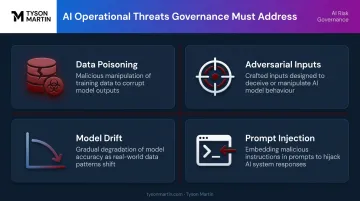
The hybrid model is distinct from every category above: it delivers governance as part of a connected cybersecurity and GRC program, not as a standalone advisory track. That means addressing AI-specific threats alongside policy frameworks, within a structure that connects directly to incident response and compliance:
- Data poisoning — corrupting training data to manipulate model outputs
- Adversarial inputs — crafted inputs designed to force model errors
- Model drift — gradual degradation of model accuracy over time
- Prompt injection — manipulating AI inputs to override intended behavior
This model aligns governance to NIST AI RMF 1.0 (Govern, Map, Measure, Manage) and ISO/IEC 42001 while integrating with the operational controls regulators actually inspect.
For regulated industries, this isn't optional. A governance framework that can't survive a regulatory review or M&A due diligence process hasn't actually been built — it's been documented.
Ethical Governance Strategies the Leading Firms Deploy
Framework Alignment as the Foundation
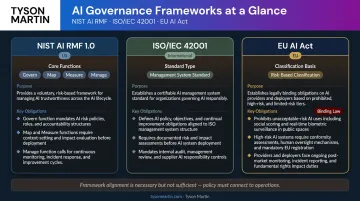
Leading firms build governance programs on three primary frameworks:
- NIST AI RMF 1.0 — organizes risk management around Govern, Map, Measure, and Manage functions
- ISO/IEC 42001 — the first AI management system standard, specifying requirements for establishing, implementing, and continually improving an AI management system
- EU AI Act — a risk-based framework that bans unacceptable-risk AI practices and imposes specific obligations on high-risk AI applications
Framework alignment is necessary but not sufficient. The policy must connect to how AI is actually built, deployed, and monitored — otherwise it remains a compliance artifact that provides no real protection.
Model Transparency and Explainability
Top governance programs require AI systems to produce audit-ready explanations of how decisions are made. This is especially critical in high-stakes applications.
The CFPB has made this explicit: Circular 2023-03 states that creditors using AI or complex credit models must provide specific and accurate adverse-action reasons — they cannot rely on generic checklist responses that don't reflect what the model actually considered. The same principle extends to hiring, clinical decisions, and fraud detection.
For boards, explainability is not a technical nicety. It's the foundation of defensible reporting.
Bias Auditing and Decision Rights
Bias testing at deployment is a snapshot, not a governance program. Leading firms embed ongoing fairness testing throughout the AI lifecycle — triggered by model updates, data changes, and periodic review schedules.
The FTC's Rite Aid enforcement action is the clearest regulatory signal to date. Deploying facial recognition without reasonable safeguards and without monitoring for false-positive risks resulted in a five-year ban. Continuous monitoring exists precisely to catch drift before it reaches that threshold.
Decision rights are the other gap most programs leave unresolved. Without clear documentation of:
- What the board oversees versus what management controls
- What constitutes a material AI incident requiring board notification
- Who has authority to halt or roll back a model in production
...governance frameworks dissolve in actual incidents. The structure exists on paper but not in the room when something goes wrong.
AI Model Registries and Continuous Monitoring
Enterprise governance programs use model registries to track every AI system in production — its purpose, training data lineage, risk classification, deployment status, and compliance posture. Continuous monitoring then detects model drift before it creates regulatory or operational exposure.
For boards, the right question is not "do we have a registry?" It's "what does the registry show, who reviewed it last, and what changed?" That shift — from checking a box to interrogating the data — is where governance oversight becomes substantive.
Regulatory Drivers Shaping the 2026 AI Governance Landscape
The Three Primary Frameworks
EU AI Act — Entered into force on 1 August 2024. Prohibitions and AI literacy obligations applied from 2 February 2025; GPAI obligations from 2 August 2025; most rules apply from 2 August 2026. A simplification proposal (EUR-Lex 52025PC0836) is advancing through the EU legislative process. Organizations in scope need active compliance mapping now, not at the deadline.
NIST AI RMF 1.0 — Remains the core US AI risk framework. The Generative AI Profile adds updated guidance for genAI-specific risks. No federal mandate exists, but it is increasingly referenced in regulatory guidance and M&A due diligence.
US AI Policy — The Trump administration revoked EO 14110 in January 2025. EO 14179, Removing Barriers to American Leadership in Artificial Intelligence, is now the active federal AI policy direction. In practice, sector-specific regulators — OCC, Federal Reserve, CFPB, FDA, ONC — drive governance requirements across financial services, healthcare, and consumer protection.
Regulatory Velocity as a Governance Risk
Each of the frameworks above has changed materially in the past 18 months — and the pace isn't slowing. A governance program written 18 months ago and not reviewed since is likely operating with stale controls.
For regulated industries, quarterly governance reviews are the minimum standard. A governance program should be built to be updated — with clear owners, review triggers, and version-controlled controls — not delivered once and shelved.
How Boards and Executives Should Evaluate AI Governance Partners
Boards are being asked to provide meaningful oversight of AI systems they didn't build and don't fully understand technically. The right governance partner doesn't add complexity to that problem — they reduce it by producing clear decisions, defensible reporting, and inspectable controls.
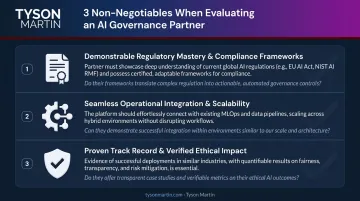
Three Non-Negotiables
1. Demonstrated knowledge of your specific regulatory environment. Generic AI framework expertise is not the same as understanding how CFPB adverse-action requirements, FDA AI device guidance, or Federal Reserve model risk expectations apply to your AI systems. Ask prospective partners to walk through a specific regulatory scenario relevant to your industry.
2. The ability to connect policy to operational controls. A governance partner who only writes frameworks is a document author, not a governance advisor. Ask how their programs handle model updates, incident response, and regulatory changes after delivery.
3. A track record that has survived scrutiny. Internal approval is not validation. Ask whether their governance programs have been reviewed in regulatory examinations, M&A due diligence, or board-level incident response. The answer reveals whether the program was built to be inspected or just to be presented.
The Board Advisor Model
For organizations that need AI governance integrated with existing technology and cyber risk oversight, a board advisor or fractional executive with both AI governance and cybersecurity fluency can bridge the gap between technical teams and board-level accountability.
Tyson Martin works with boards and executive teams to clarify decision rights, tighten governance structures, and build reporting frameworks that give boards real oversight without requiring them to become AI experts. His AI Governance Starter Pack is a fixed-fee 30-day sprint that delivers:
- AI risk assessment scoped to your operating environment
- Decision-rights map with clear escalation thresholds
- Board-level AI policy ready for director review
- Facilitated director briefing
Organizations move from zero formal governance to a defensible posture in weeks, not quarters.
The critical question to ask any prospective governance partner: How do you handle a regulatory change that makes our current controls insufficient? If the answer is "we'd start a new engagement," that's not a governance program — it's a deliverable.
Frequently Asked Questions
What is ethical AI governance, and why does it matter for boards in 2026?
Ethical AI governance is the set of structures, policies, and controls that determine who is accountable for AI decisions and how those decisions can be audited or explained. Boards are now expected to demonstrate meaningful oversight under evolving regulations, and regulators are moving from guidance to enforcement.
What is the difference between an AI governance platform and an AI governance consulting firm?
Platforms like Credo AI or IBM watsonx.governance are software tools for tracking, monitoring, and documenting AI models at scale. Consulting firms design the organizational frameworks, policies, and accountability structures around those tools. Organizations typically need both — the platform provides the infrastructure; the advisor builds the program that makes it defensible.
How should a board oversee AI governance without getting lost in technical complexity?
Boards should focus on three areas:
- Are AI decisions explainable and auditable?
- Do clear decision rights and escalation thresholds exist?
- Does governance reporting show trends tied to real operational controls — not just technical metrics no one on the board can act on?
What frameworks do top AI governance consulting firms use in 2026?
The leading firms align to NIST AI RMF, ISO/IEC 42001, and the EU AI Act as the primary governance frameworks. Sector-specific overlays apply for financial services (SR 11-7, Federal Reserve model risk guidance), healthcare (ONC HTI-1, FDA AI device guidance), and consumer protection contexts (CFPB circulars on algorithmic decisions).
How do regulated industries approach AI governance differently?
Regulated industries require governance to be operationally integrated — not just documented — because regulators expect AI controls to connect to actual compliance programs and incident response capabilities. Policy binders don't survive regulatory examinations; working controls do.
When should an organization hire an external AI governance consultant versus building an internal function?
External consultants are most valuable when deploying high-risk AI systems, facing regulatory scrutiny, or needing an independent review of existing frameworks. Fractional and advisory models deliver ongoing oversight without the cost of a full internal function — especially practical for mid-market organizations where a dedicated AI governance role isn't yet warranted.